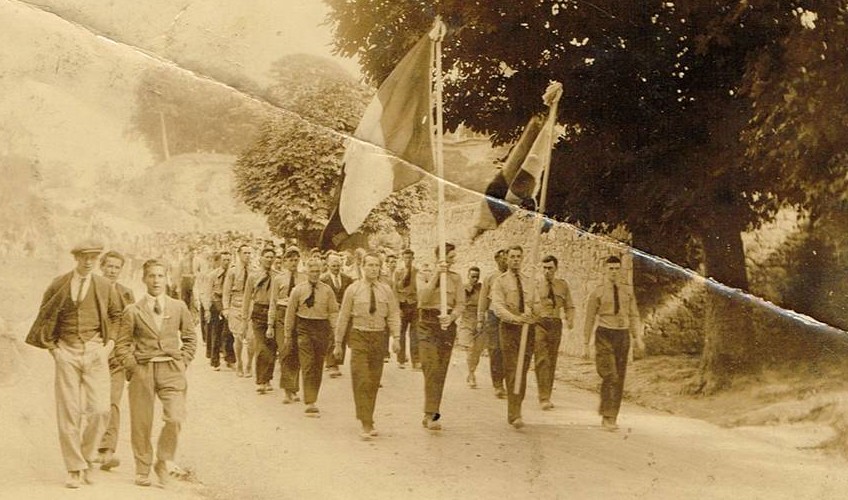
MacManus on the 1933 formation of today’s Fine Gael party, one of Ireland’s primary capitalist parties through the merger of the Pro-treaty Cumann na nGaedheal, the right-wing agrarian National Centre Party and the fascist Blueshirts, serving as a reactionary, pro-imperialist force since.
‘Capital Closes its Ranks in Ireland’ by Aodh MacManus from International Press Correspondence. Vol. 13 No. 41. September 15, 1933.
After the ban–a rearrangement of forces. Following the revival of the Cosgrave Coercion Act by the De Valera government, which declared O’Duffy’s fascist National Guard (Blueshirts) illegal, the imperialist interests in the Irish Free State are closing their ranks.
Immediately following the ban, the organs of finance-capital commenced to call frenziedly for a united front of the classes they represent. The “Irish Times” editorial of August 23 is typical. It stated:
“The proclamation of the National Guard may prove to have been a happy turning point in the Free State’s fortunes if it brings Cumann na nGaedheal, the Centre Party and General O’Duffy’s civic supporters together in a whole-hearted effort to win the next general election and to end the economic war.”
These calls were followed by several secret conferences, and it is now announced that Cumann na nGaedheal (Cosgrave Party), the Centre Party and O’Duffy’s National Guard are all to be merged in a new United Ireland Party. General O’Duffy is to be president, with McDermott (Centre Party) and Cosgrave as vice-presidents. Cosgrave will be chairman in the Dail. The Cosgrave Party, in announcing the development, points out the growth of the economic crisis in Ireland, stating that “the nation’s present calamitous condition of political ambiguity and rapid economic decline is bound, if allowed to continue, to lead to a crisis of extreme gravity.”
What is the economic background to this fusing of parties of imperialist capital?
Last week the Free State trade figures for July were announced. The total trade for the month was £3,986,191, as compared with £5,936,439 in July last year. Both imports and exports fell comparing the month in each year–imports falling by £1,038,136 to £1,377,365, and exports dropping from £839,135 to £1,377,365. The chief falls were in cattle and live stock, which are suffering the full effects of Britain’s punitive tariffs. The figures for the two years were:
Cattle–Other live animals.
July, 1932 £427,219–303,651
July, 1933 £195,948–99,147
The decline is seen better in comparing the figures for the twelve months ending July. The total trade for the year ended July, 1933, was £55,255,418, against a total of £83,030,930 for the year ended July, 1932, and a total of £91,935,164 for the year ended July, 1931.
The unemployment figures are also going up. On August 14 last there were 54,590 registered as unemployed, a week later there were 55,197, and on August 28 there were 55,590. And of these, only about 16,000 are receiving any benefit. In addition to those registered at the labour exchanges there are 124,000 persons in receipt of relief. A number of these are old or infirm persons, but the majority are unemployed workers denied any other form of livelihood. At the Dublin Board of Assistance meeting on August 30, it was reported that in the area there were 9,156 persons receiving a total of £5,537 in relief, an increase of 1,306 persons since last year and of £2,227 since 1931. “If that is the increase in the middle of the summer what will be the number in the winter,” said a member of the Board–a question the unemployed are also asking. This is the position that has forced the groupings of the Right into each others’ arms.
The de Valera government, believing itself secure in its mass support, professes little concern and refers scornfully to the “Cripple Alliance.” As far as Fianna Fail is concerned, all talk of the fascist danger has vanished. Its organ, the “Irish Press,” is now mute where before it was clamant. O’Duffy makes no more pronouncements, the Blueshirts dare not appear in public, and their organ, the “Blueflag,” came out last week-end only as a duplicated sheet, and so far not a single person has been arrested under the revived Coercion Act. On the surface it looks like a great tactical victory for de Valera. Actually two things have happened, which only the Communist Party of Ireland has noted:
(1) The open imperialist fascism of O’Duffy has been compelled to execute a flanking movement that lines it on the right side of the law alongside the parties that sent it out to do battle. The blueshirt is doffed and the parties of the Right together don the “greenery-yallery” shirt of the “United Ireland Party,” which unquestionably will pursue a vigorous imperialist-fascist policy along more “constitutional lines” for the moment.
(2) De Valera has both lulled the masses (who were demonstrating against the fascists in the most formidable and disconcerting way) and has taken a big step in the fascisation of the State apparatus. A police cordon was placed between the masses and the Blueshirts, while the Cosgrave Coercion Act was unsheathed, and now hangs, like a Damocles’ sword, not alone over the revolutionary working class, but over petty-bourgeois heads who hailed a feast at which they think the Blueshirts are to be the only guests. By the stroke of a pen de Valera can now outlaw the Communist Party or the Irish Republican Army, without troubling to notify the “legislators” of the Dail. And it is quite clear from his speech at Thurles recently, and other pronouncements, that he is prepared to strike at the appropriate moment: the quantity of C.I.D. spying and pogrom-inciting will change to the quality of total illegality–and a repression that will in nowise resemble the almost genteel visits of the police to O’Duffy’s headquarters. De Valera’s “fighting” of fascism consists of driving along a fascist road himself.
The Republicans are blind to this. At a time when the most powerful united front of the masses is necessary, they are appealing for unity with the government. Witness Madame Maude Gonne MacBride (who can always be trusted to expose the yearnings of the Right Wing of Republicanism) at a meeting in Dublin on September 3rd:
“Support de Valera against the enemy. I believe him when he says that he has the same goal as he always had—an Irish Republic–but the government may be up against difficulties many of us know nothing about. It is the duty of all of us to maintain unity on the Republican side.”
True, Madame MacBride “regretted” that de Valera had jailed a number of I.R.A. men, but unity with him was “our duty above all.” Nor was she speaking without the book. “An Phoblacht” on September 2nd published a statement from the Council of the Irish Republican Army. After a number of paragraphs of criticism of the government’s failure to establish the Republic, the Army Council calls for unity with the government on the basis of the repudiation of the traitorous Treaty of 1921 and the declaration of the Irish Republic. A nonsensical request, but by turning the eyes of militant republicans to this fake and impossible unity with the Government, their attention is diverted from the real unity that the situation demands–unity with the toiling masses struggling spontaneously against the imperialist menace.
The attitude of the Irish Labour Party towards fascism is instructive. Mr. W. Norton, T.D., its leader, said a few mild words at the Irish T.U.C. in August about the Blueshirts being “unnecessary” Mr. W. Davin, T.D., another leading light, pleaded in the Dail for O’Duffy to be given his pension as ex-chief of the Free State police with “good grace”; while Senator Johnson was the most interesting of all. In the Free State Senate on August 22 he spoke on the ban on O’Duffy’s organisation. Disapproving of the Blueshirts’ “militarism” which, he said, “is undoubtedly going to lead to revolt not merely by the I.R.A., but by every democratic movement that feels its principles are being destroyed,” he came out practically in open support of fascist economics:
“General O’Duffy advocates vocational representation. I think there is a good deal to be said in favour of vocational representation…There is so much good in the economic proposals of the National Guard that the government should have encouraged a discussion of the ideas that were broached by the organisation.”
At no time have the Labour reformists made any pronouncement against fascism; during the days when the workers were battling on the streets the Labour Party did not exist. But the Labour reformists will be forced to face up to the question at the party’s annual conference in October, when several branches will put forward motions reflecting the feeling of the workers in the Labour Party. One Dublin branch has tabled motions referring to the deportation of Jim Gralton, and calling for a revision of the Party’s programme and policy. The Bray branch is putting forward the following motion:
“That this conference of the Irish Labour Party considers the National Guard movement as an anti-working-class force, with aims and intentions similar to Hitler’s Nazis and Mussolini’s fascists, under whose rules in Germany and Italy the Trade Unions, all Labour organisations and other working-class organs of struggle against capitalist tyranny have been brutally broken up and outlawed, their leaders imprisoned, tortured and murdered, their funds stolen, property confiscated and press suppressed; that this conference warns the Irish workers and Labour Party supporters of the danger of the introduction of similar forms of fascism into Ireland; that this conference calls for a resolute struggle against all attempts at establishing a fascist dictatorship in any guise in Ireland; and instructs the Administrative Council to take every possible step in conjunction with all forces opposing attempts at reactionary dictatorship to combat this great danger to the Labour Movement.”
Thus this Labour Party branch, like the 1916 Club (composed of Easter Week veterans), endorses the policy of the Communist Party of Ireland as the only way to meet the present situation and calls for a united front. Whether the bureaucrats will be able to smother the demand remains to be seen; certain it is that they will attempt some manoeuvre that will avoid any fighting front and at the same time save their face with the rank and file. But, whatever this conference may decide, the C.P.I. will push ahead with its drive to build the anti-fascist fighting front from the Labour and Republican masses.
International Press Correspondence, widely known as”Inprecorr” was published by the Executive Committee of the Communist International (ECCI) regularly in German and English, occasionally in many other languages, beginning in 1921 and lasting in English until 1938. Inprecorr’s role was to supply translated articles to the English-speaking press of the International from the Comintern’s different sections, as well as news and statements from the ECCI. Many ‘Daily Worker’ and ‘Communist’ articles originated in Inprecorr, and it also published articles by American comrades for use in other countries. It was published at least weekly, and often thrice weekly. Inprecorr is an invaluable English-language source on the history of the Communist International and its sections.
PDF of full issue: https://www.marxists.org/history/international/comintern/inprecor/1933/v13n41-sep-15-1933-Inprecor-op.pdf

