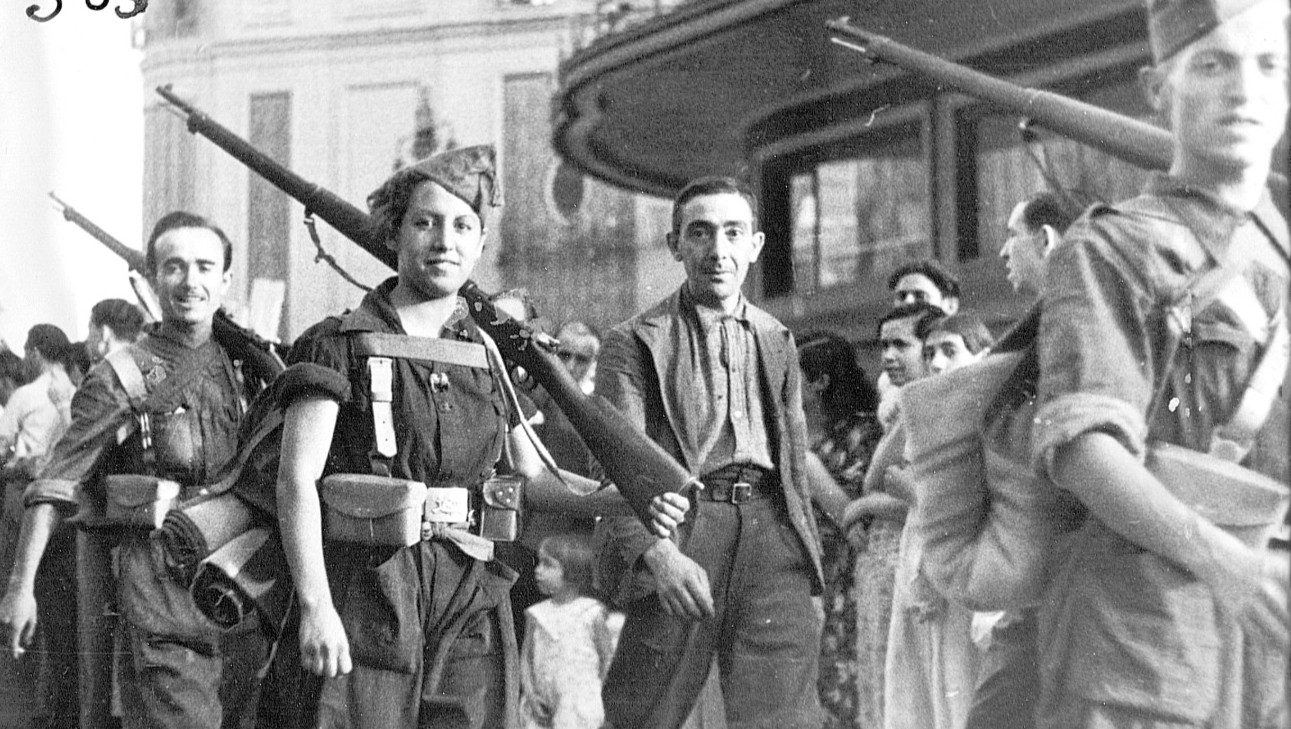
A key point of contention among Republicans in the Spanish Civil War was what kind of army was to replace the Antifascist Militia Committees, a popular army or a class army. The P.O.U,M.’s position below.
‘A Revolutionary Army’ from The Spanish Revolution (POUM, New York). Vol. 2 No. 5. March 17, 1937.
We have continually held that the question of the army was of fundamental importance of the future of the revolution. In recent weeks we have had to stand against the current to maintain our slogan of “A Revolutionary Army.” Only this kind of an army can assure us the victory. We have stood against the People’s Army because it does not correspond to the needs of the hour–the hour of the workers and the revolution. We are against the non-political, anti-fascist army, neutral towards the class struggle, because such an army always ends in the service of the counter-revolution. We want an army of the working-class, a political army at the service of the revolution. This is the real difference between our position and that of the reformists.
After a certain number of military reverses of the governmental Etat-Major, the loss of the town of Málaga has brought the question of the anti-fascist army to the attention of all the Spanish anti-fascist organisations. We know that Málaga was given up to the Italian Fascists almost without resistance. The responsibility for the loss of Málaga falls entirely on the Etat-Major of the government forces stationed at Valencia. The cause for this check was not the absence of a regular army and a united command, since the forces which should have defended the town were under the orders of a commander who had been named by the War Minister of the central government of the Spanish Republic and who received his orders from this Minister. The danger of leaving the conduct of the war in incapable hands or to those who are ready to betray even the simple anti-fascist republican cause is clearly seen.
The impression produced by the fall of Málaga has been used by the reformists to attempt purely and simply the reconstruction of the old bourgeois army. In Catalonia, among many other more or less absurd projects, an effort has been made to get the Generality to embrace the conception of a regular People’s Army. In Valencia, where the Spanish Government is now in residence, manifestations, stimulated by some of the leaders of the U.G.T., have been organised in order to cover up the responsibility of the Government in the conduct of the war and to confine the anti-fascist organisations within the sphere and influence of the Republican Government. It is perfectly clear that, as on other occasions, the revolutionary organisations (those who take their stand on the principles of the Social Revolution) have been the object of bitter attacks and violent threats under cover of the campaign for the People’s Army. These revolutionary organisations, that is to say, the P.O.U.M., the F.A.I. and the C.N.T., while they accept the principle of the creation of a powerful army to vanquish the fascists, are not prepared to agree that this army be given the character of a so-called neutral army, which will eventually be in reality the strongest possible weapon in the hands of the capitalists and the reactionary forces against the workers.
To assume that in the actual conditions of Civil War, through which Spain is passing, the army should be neutral is to be either as ignorant, as certain Catalan Socialists or as hypocritical as the Spanish Stalinists. The history of the revolutionary struggles of the past proves beyond a shadow of doubt that the armies which were brought into being during these epochs were definitely political. Without going back to Cromwell and the English Civil War, one can cite the example of the work of Carnot during the French Revolution. Carnot considered that an army was an armed political organisation, that is to say an army with definite political principles serving the revolutionary cause. Trotsky, when he founded the Soviet Red Army, based himself on the same principle and used the army as an instrument in the service of the workers and of the proletarian Revolution. In all these armies there were political commissaries, in whom the soldiers placed their confidence, and, being themselves under the control of the workers’ organisations and responsible for the political evolution of the Revolution, these commissaries had as their mission the task of giving to the army its character as an instrument of victory for the transformation of the existing social regime. The Spanish Stalinists are not unaware of these historical facts. It must not be forgotten that on the central front, where the so-called People’s Army is entirely under the control of the Communists through the intermediary of the central Government and its General Staff, this army actually possesses political commissaries. Seeing, however, that the Stalinists are the best defenders of the bourgeois democratic Republic and consequently, the enemies of the revolutionaries and that the political commissaries are under their control, this army has clearly and definitely taken on the character of a bourgeois army in the service of the Republic. The political commissaries have been the agents of the transformation of an army, basically proletarian and revolutionary in character, into an army placed at the service of the awakening bourgeoisie. The watchwords of the Socialist campaign in Catalonia, “Win the war!,” “People’s Army!,” “United Command,” “Only one flag, that of the Spanish Republic” in reality hide the fundamentals of the question in order to deceive the masses and to draw them along the pathway of reformism against the revolutionary tendencies of the workers. If these watchwords do not hide this anti-revolutionary policy, they are simply empty formulas, in so far as all the organisations, including the revolutionaries, are in favour of a strong, disciplined army and a united command.
The P.O.U.M. states that the present army cannot be a politically neutral army but must be based on the revolutionary class struggle and in the service of the working and exploited population, an army which must be the guarantee of victory now and the defender tomorrow of the revolutionary conquests of the new revolutionary society.
The P.O.U.M. is in favour of compulsory military service, but only for the workers and peasants. We are not prepared to allow the bourgeoisie to have the honour of bearing arms in defence of the interests of the workers.
Mobilization is an excellent measure, but it can only be realised practically if it is possible to give to the sections which are called up the arms which are necessary to make them into fighting units. Owing to the resistance of the Valencia Government, these arms have not been supplied to Catalonia. We of the P.O.U.M. draw attention to the fact that to mobilise four or six further age groups in addition to those which have been already called up will cause a serious economic problem, as it will be necessary to keep them in the barracks until it is possible to send them to the front. The P.O.U.M. therefore, desiring to bring constructive proposals, is of the opinion that, instead of simply mobilising age groups which will be ineffective, it would be much better to institute compulsory military instruction to be carried out after work hours in such a manner that when it is necessary to call up the future age groups they may be able to go immediately to the front. By these means the men will be ready and the economic problem will be avoided.
The P.O.U.M. is not opposed to the United Command. It insists, however, upon its being controlled by the workers’ organizations, not only in a revolutionary spirit but also because the United Command exists on the Aragón front as well as on the other fronts of the peninsula, and on this front defended by the Catalan troops, the control of the Valencia Government has given contrary results to those expected. Every offensive by the Catalonian troops has been held back for months and he slogan “Why do we not attack on the Aragón front?” has been turned today against the best defenders of the bourgeois Republic and the authority of the Governments of Valencia and Barcelona. Everyone knows that the reasons for the lack of offensive on the Aragón front are due as much to the lack of orders to attack as to the insufficiency of arms, two things which are beyond the control of the Catalans.
The P.O.U.M. demands also the control of mobilization and the recruitment of the officer class by the workers’ organizations. It is impossible to put the recruitment and the formation of the new army in the hands of an officialism of which the political aspect and the general interests are in almost all cases doubtful. Further, the popular Officer’s Training College must no more have the right to commission new officers only on the basis of their level of education and of their belonging to middle class or lower middle class circles. The working classes have given sufficient proof during the last seven months of their spirit of initiative, and it is from their ranks that the officer class of the new revolutionary army should and can be formed.

The political commissaries and the Soldier’s Committees, having a definitely revolutionary political line, are the guarantors of the revolutionary spirit in the new army. Everything which is against this principle is against the social revolution.
The P.O.U.M. cannot admit for a moment the pretensions of a new project that the “War Commissaries” should be named by the command, that is by the officers.
Such is the position of the Spanish Worker’s Party of Marxist Unity on the formation of the new army. A regular army, but at the same time a revolutionary army. The war in Spain is not a war or national independence but a class war. The P.O.U.M. conscious of their role as the vanguard of the Revolution, are not prepared to follow those reformists who have ceased to be revolutionary even during the epoch of the revolution. The P.O.U.M. are confident that in this fight to impose a Regular Revolutionary Army they will not be alone. At their side will be the other clearly revolutionary organizations, that is to say the C.N.T., the F.A.I. and the Anarchist Youth.
The Spanish Revolution (not to be confused with the CNT supporters’ paper of the same name, time, and look)) was the English language journal of the Partido Obrero de Unificación Marxista (POUM). Edited by American couple Charles and Lois Orr, she a member of the POUM women’s militia, the journal was aimed at British and US audiences through the International Revolutionary Marxist Centre, sometimes called the “Three and a Half International,” from October, 1936 until the arrest of the Orrs and the banning of the POUM after Barcelona’s “May Days” 1937 uprising.
PDF of full issue: https://www.marxists.org/history/spain/poum/spanishrevolution/v2n5-mar-17-1937-Spanish%20Revolution.pdf

