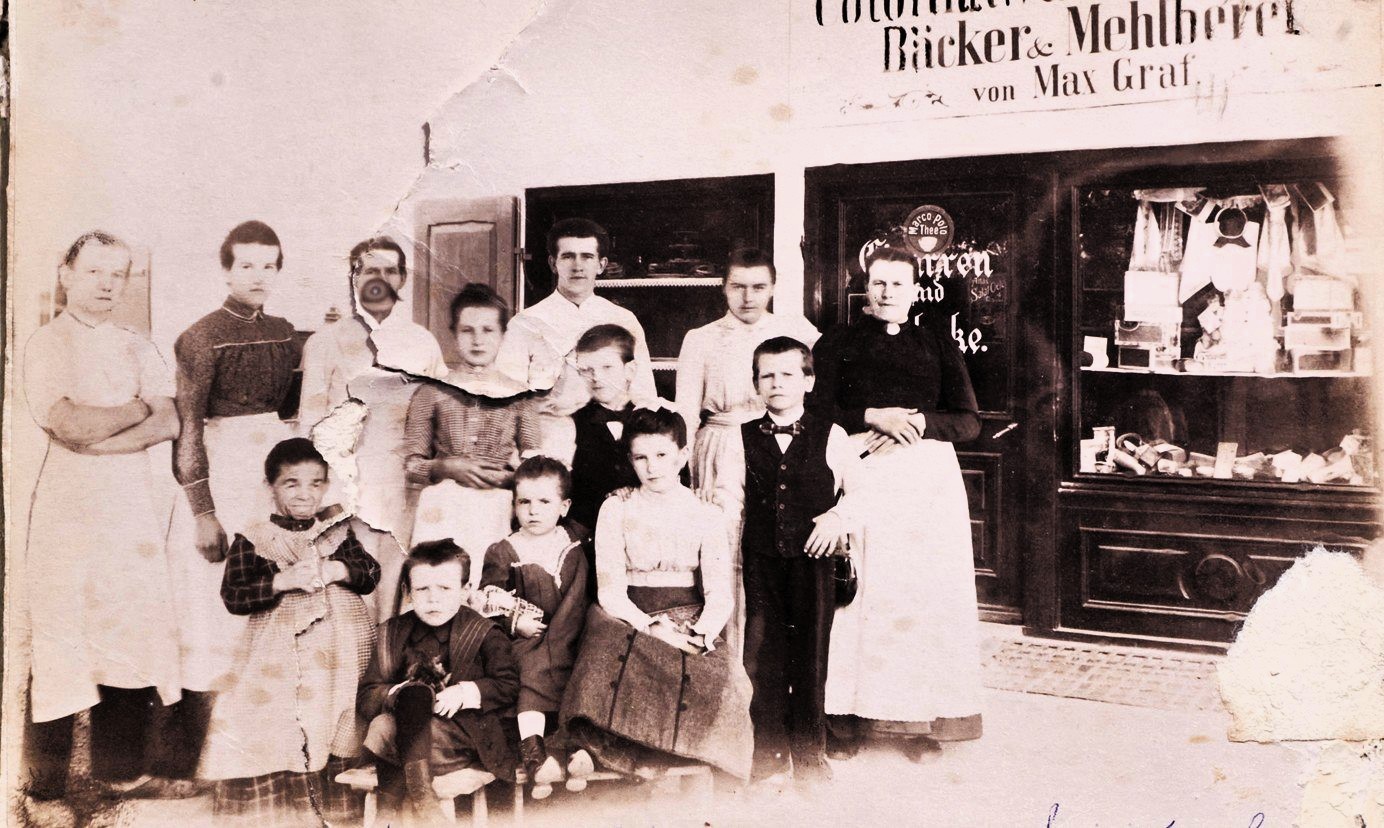
A superlative piece of writing; this social-psychological history through the person of Bavarian leftist anti-fascist writer Oscar Maria Graf as he began his exile from the Nazis looking back at how his parents, a village baker and farmer’s daughter in rural Germany with eleven children, saw the world.
‘Heritage: A Fragment of Autobiography’ by Oscar Maria Graf from International Literature. No. 12. 1935.
I was born on July 22, 1894, in the little village of Berg near the Stornbergersee in Upper Bavaria. Formerly inhabited by a few fishermen and peasants, the village suddenly became an historical landmark and owes its prosperity to this fact. The mad Bavarian King Ludwig II was drowned there on Trinity Sunday, 1886. Since then his castle and its park became a point of attraction for tourists. Romantic legends sprang up in the course of time. Numerous tourists come every summer, buy admittance, and wander through the half empty castle sniffing up the atmosphere of all the “historical landmarks.” The businesskeen villagers quickly took advantage of the favorable situation, organized a “Tourist and Beautifying Society” and did some profitable advertising. Rooms and houses for rent were very much in demand every summer. The village stores profitably handled “Souvenirs of King Ludwig and Berg Castle.” The fishermen built family baths and boat renting piers. The inn keepers renamed their inns to “Restaurant” or “Hotel zum Kénig Ludwig,” there are also several cafes of this name. The peasants made profitable speculations with their parcels of land on the lake and became well-to-do. Now there are quite a few rich villas in the village and on the beach.
It can easily be seen that the inhabitants of my home village have good reasons for being monarchists. A king and his unusual death proved very advantageous to them. Piety and devotion went hand in hand with their own interests in the most natural fashion. But nothing is immutable and everything depends upon circumstances. The opinion of the villagers took an opposite swing when, during the Weimar Republic days, ex-Crown Prince Rupprecht decided to settle at the castle and close the park to tourists. The flow of tourists threatened to stop. Every citizen felt himself wounded to the quick. The “immutable devotion to the lord’s castle” only returned after the ex-crown prince completely abandoned the idea.
My father was the village baker, my mother the daughter of one of the neighboring peasants.
My ancestors on father’s side came to Bavaria from Sulzburg about the middle of the sixteenth century. They were mostly itinerant waggoners and also made wooden hay-forks, vegetable spades and cooking utensils for the peasants. My grandfather, a man about six feet in his stocking feet, was the first to settle down in Berg, plying the same trade. He had many children and was very poor, but all his life he was sure of a sudden turn of luck, of a miracle, that would make him rich overnight. Poor folk were not held in great esteem by the peasants. Consequently this otherwise good and sober man became a passionate lottery addict. As his sparse earnings barely met the needs of his large family they must have felt the pangs of hunger every time he bought a lottery ticket, spending his last cent on it. He was a taciturn man, strict with himself and with his family. Much later my father told me how when a child he was occasionally forced to make a trip on foot to the town of Stornberg with an empty stomach and in rags in the depths of winter to buy a lottery ticket. As he had no adequate shoes, his feet froze.
In the end my grandfather died in as great misery and poverty as he had lived. My father went out into the world, learned the baker’s trade and covered half of Germany in his wanderings. Some of the family got married and moved to Munich, a sister married a Czech miner and emigrated to America with him. Ever since then it became a tradition in our family that at least one from each generation must go to the United States to look for his fortune. Some of them did get fairly well-to-do.
On mother’s side my ancestors have been Bavarian peasants since ever and a day. The traits of the peasant and the openhearted craftsman are therefore well blended in us children. This heritage became of great use to me later, when I began to draw characters from these class groups in my books. The peasant in my part of the country looks down upon the artisan and trader and never quite considers them his equals. This experience and direct knowledge of relations made it possible for me to grasp what was essential in these contradictions. My first novel Chronicle of Flechtling (1925) shows the struggle of my ancestors against the native peasantry from this point of view.
My mother gave birth to eleven children and twice came near dying. One recollection of those days is indelibly engraved in my memory. I was five years old then. One evening the villagers gathered in front of our house. They knelt on the street and prayed many rosaries for a “someone” very ill. This “someone” was my mother. She lay in the big bed in a high fever after giving birth to a child and hovered between life and death. The people’s faces were earnest in prayer and they accompanied their prayers with sighs. All of a sudden a light showed in the room where my mother lay, then the window opened and my mother appeared in it.
“I am not dying, it hasn’t come to that yet! You can all go home,” she said quietly and simply. The amazed villagers were stunned, but finally rose and wandered silently away.
Eight of the children grew up, three died. The five boys learned the baker’s trade at home. My oldest sister became a milliner, another a dressmaker, and the youngest learned the barber’s trade. Then the oldest boy, Max, fell early in the war in Flanders, and Emma, the dressmaker, died when she was barely twenty-six.
As there was a small farm along with the bakery, each one of us children had to do our chores in the stable, cattle barn, work in field and woods. Thus we learned all the peasant lore. We were not treated gingerly. Everyone had to work as he could and if one weakened the ridicule of the others was merciless. This gave one both an inner and outer robustness. A sort of mad pride in outstripping and outdoing the others took fast hold. At the same time there was a sort of dry lack of love among us. This later turned into a constant opposition that was almost akin to a silent enmity. There was no tenderness lost among us.
My Mother
My mother considered ceaseless, patient toil generally the greatest virtue. She was by no means given to pride, but without ostentation she was proud of the amount of work she could do. And only one that could toil as tirelessly and to the same effect could command, any sincere respect as far as she was concerned. She secretly despised all “fine folks” even though she was amiable to them as a business woman. Such idlers, in her opinion, did not know “of what use man is on Earth.” Until her very death she would get up at four in the morning and seemed to tire only when she sat down in the evening. Then her eyes would usually close while she was still at supper. She would brace up, eat a little faster and smile almost shamefacedly. Praise embarrassed her. Vanity was foreign to her.
Ever since her fifth child she suffered from an ailment which caused her much pain and frequent blood poisoning. The disease was called “redstream” and the villagers held the belief that the wound must be kept open otherwise the “bad blood” would get into the body and surely cause one’s death. Mother would therefore only wash her bleeding feet nightly and do her day’s chores as usual. She was puzzlingly merciless to herself and never spared herself in the least. I remember once she had to take to bed because her feet now refused to function. The district doctor came and drew a long face. He was a very gruff man and this won him the confidence of all. “Yes, Mrs. Graf,” he said, “looks like we’ll have a corpse on our hands soon! You must not get up for some time at any rate, understand?” My mother nodded slightly (with a smile). When the doctor came again three days later she was standing at the oven. The doctor raged and stormed, told her she must be mad and ordered her back to bed. She was entirely undisturbed and said serenely: “Yes, yes, doctor! And who’ll do the washing? Who will do my work for me?” Her work—that was her one and all. She did not take to bed then and her feet got better after a while anyhow. She had an iron constitution, as they used to say. She endured much pain and only very seldom complained. With all that she was mild and cheerful and eagerly clung to life. Only when she had to lie down sick did she feel useless, uncertain and truly unhappy. Once only did I see her really angry,—that was when, out of fear that she would again get up too soon from a sickness, we tied her down to her bed.
She thought very simply and acted likewise. She never understood intricate ideas or complicated feelings. We once asked her: “Tell us, mother, did you love father when you married him?” She smiled as if this were the oddest sort of a question to ask, and answered: “Hm, hm, I guess I had to.” She said this calmly and frankly. It was just part of life to marry a man, have children, to become somewhat exhausted with work in time and to finally die. Anything beyond that “was not right.” She was a mother and that’s all. That was her attitude to all the villagers and relatives. A child was born, grew, went to school, matured, grew a beard and married. To her he always remained her boy.
We children often importuned her with our demands to the extent that she became melancholy. We lied to her and used all wiles to gain our end. Her broad face would get sadder and sadder. It hurt her not to be able to give us what we wanted, because she was unusually kind and totally without any demands herself. She could not contradict or argue. She was perfectly helpless before any demand, believed everyone and anything and listened naively to any argument without finding anything to be said against it. A dispute among those near to her caused her great anguish. She suffered intensely if relatives or we, children, were angry among ourselves and always. tried to effect a reconciliation. Such yielding unassertiveness is usually called lack of character. But patience and tolerance were her most profound characteristics. “It is not always the other one’s fault,” was her saying when bitter feelings came out or some injustice came to light. She herself never lost her temper. What she loved most was peace. That is why she hated the war. It took people away from their accustomed work, tore sons away from their mothers, brought misery and pain and was of no use. Harmony among people, however, made life tolerable. “Mother,” asked one of my brothers once, “what would you do if, for instance, Bavaria became French?” She looked at him uncomprehendingly and said: “Well, I guess we should have to keep on working as we do now.” I never heard her say “my country.” She clung only to the soil from which she came and to the people she knew. One of my brothers who had grown rich in America once came to visit us. He brought his own automobile and took mother on a trip to Rome. She was unhappy all the way, everything was strange and uncomfortable. When they came back and she dismounted from the automobile she exclaimed, really relieved and happy, “This is the best moment of the entire trip.”
She liked amiable people who never quarreled, were gay and did not put on airs. They were like her and she enjoyed spending Sunday or a holiday afternoon with them. On such occasions she would tell stories of the past in her broad cheerful way and peculiarly enough it was always some object, some thing, that brought the story to her mind. An uncle, for instance, kept puffing at his pipe unceasingly. This reminded her how as a child she ounce: pissed into the pipe of a hired man who had the habit of leaving it in a field ditch. She mimicked how the man vainly tried to light the moist tobacco after the haymowing was over. She would laugh till the tears came to her eyes. Rough jokes she considered the right thing in this social circle and the broad, robust peasant humor suited her perfectly. More finely attuned souls would surely have found this simple hearted entertainment rather indecent. She thought it nothing out of the way. If one looked at her then, unobserved, the impression she made was of one who had never been really young and had never grown old. She seemed to be the same throughout all the years: full of vitality to her last breath.
Her sore feet notwithstanding, she danced the customary dances at marriage feasts even when she was seventy and performed all the customary functions.
She had no intellectual interests. The only thing she read beside her prayer book was the “church news.” She was a devout Catholic but not bigoted and tolerant to people of other creeds. Her religion was just as much a habit as her work and she followed her precepts with great sobriety. Since childhood she belonged to a religious order that imposed upon every member the duty of saying twelve “paternosters” daily. It was hard to enceive when she got the time for it, and when I asked her about it once, she said quite soberly: “Well, where can I say my prayers? In the outhouse—that’s where I have most time for it.” She did not see that this could be laughed about. She prayed, she confessed, went to communion, because it was the custom to do so. She never thought about it. Generations before her had believed likewise, it must therefore be the right thing. Nevertheless she did not consider the “sacred things” particularly marvellous. There was something human about it for her. On the occasion when my brother took her for a ride to Rome she joined the many pilgrims that came to kiss the Pope’s hand. She was really disappointed about it. “My God, our Pope, hm…he doesn’t look like much…He seems to be a very ordinary man,” she said and showed with her hand about how tall he is. Well, he is about this big—no more.” And she reminisced what a stately man King Ludwig was, what large hands he had in comparison to the unsightly (ordinary) Pope.
“Yes, but the Pope is holy,” I mocked a bit. She did not notice the irony. “Yes, he is holy, but they could have found a bigger man just the same,” was her serene reply.
We children lost our faith in early youth and despised all religious customs. That pained her, but when the priest reproached her about it once, she only said: “My God, father, what can I do about it. I guess I shall have to do the praying for them.” She could not argue and convince anyone. She was always a silent example, that’s all. There was no fanaticism or stubbornness about her. She avoided people who possessed those traits, they instilled a sort of secret fear in her.

Her heart felt the injustice of things in the world, but who could change that? We can only be good to one another. There were poor and rich—she was on the side of the poor and oppressed all her life long. Riches, grandeur and “posing” did not go with her. There was something unreal about it to her. She probably believed implicitly that such things must blow up sooner or later, must have a terrible end.
There was only one just leveller for her—Death. No one could evade Death. And like all good Catholics she held the unshakable fundamental view that comes from the helpless melancholy of every living creature: “All that is must go! Man is nothing but a lump of clay after all. So why all this vanity, why make such a fuss about ourselves?” This was the source of her great good nature and of, perhaps, an almost nihilistic lack of comprehension for all seeming human greatness.
Death hovered over all of life. Death was mightier than all human handiwork. Fear of Death filled all her simple thoughts and feelings just because she was so healthy and clung to life with every fiber. That was the source of her humility. I inherited perhaps most of her traits…
My Father the Baker
My father was different entirely. Rebel and freethinker, he was subject to a sort of liberal patriotism. He mistrusted priests and was constantly at war with all officialdom including the mayor and school teacher, but particularly the police and judge. He would get into a raging dispute with them on the least provocation and often had to pay considerable fines for derogatory remarks. He was convinced that everyone in public or state service “lived on money stolen from honest citizens.” At times he would be passionately engrossed in some such feud and spare no money, wile or imagination. He outdid himself in schemes and tricks with thievish delight. The only thing he prized was the justly deserved popularity obtained by dint of personal ability. He liked men who were always ready for a fight and witty inn entertainers. With such he gladly got drunk and was then merry with a broad, loud and incontinent gaiety.
He had wandered about a great deal and finally rose from poverty to become a well-to-do bakery owner. The war of 1870-71 tore him away from this again. He was wounded at Orleans and remained with a stiff hand all his life. He laid plans for the new campaign to re-establish himself again while still at the hospital. He did not let himself be simply discharged from the army and “gotten rid of” with a mere pittance. He stayed until he had managed to get a war pension. When he came back home he began again from the start in the dilapidated house mortgaged to the limit. The obstacles seemed insurmountable. The stubborn unyielding brothers and sisters fought every inch. For days, months, years this war at home kept up. The villagers despised him for his poverty. Peasant-like, everyone baked their own bread. A baker seemed superfluous to them. No one gave him anything on credit and quite a few would have liked to see that “fellow” broken. There was some field and woods attached to the house which could then be gotten cheap under the hammer.
“And just because it came so hard, I struggled for it,” my father said much later, quite proudly at times, and he would conscientiously enumerate all his old enemies. He distrusted even the best neighbor since then. He remained: a peppery fighting cock and a hard boiled egg. “It’s just the same in little matters as in big ones,” was his favorite saying as he compared his struggle, his home, his slow rise, with a state. He was more far sighted and tenacious than was supposed. He discounted all possibilities quite soberly, although there was no pedantry about him. His marriage with my mother roused the indignation of all the natives round about. “Such a beggar to marry the daughter of a peasant!” But she brought him a dot of a thousand gulden, a cow, two beds and a woman in the house that could be useful. One finally got a little bit out of the jam. The enterprising man established a general store beside the bakery. Everything that was purchased had to be paid for spot cash. Fearfully my mother saw the money she had brought melt away. According to old peasant tradition this money was to be kept for only very bad times. My father was furious when she failed to understand what he was about. His enterprising spirit and her peasant steadfastness clashed. She cried bitterly and was sure they would be beggared within a few months. He attempted again and again to explain things to her, show her his calculations. She could not understand it and only looked on helplessly. That made him even more angry and he would sputter and curse. The neighbors who heard him roar, gloated over it. He could curse in masterly fashion and keep it up for a long time.
The business did not seem to prosper. It meant hard work and wasn’t without its mishaps. Mother prayed secretly. Then an unexpected piece of luck came. The king and his court occupied the castle. That drew a great many gentry who settled in the neighborhood. The business at once began to flourish. There was a swing upward. Amazed and vexed the villagers saw the cantankerous baker undertake his first house alteration. Building remained his greatest passion all his life and shortly before his death almost an Idee-Fixe. Perhaps the once oppressed and despised man only wanted to make his triumph visible by having built the biggest and best looking house in the village in the course of years. At any rate after he had built it he went further and built a modern concreted sewerage settling pit into which the fluids of the dung heaps flowed and, partly filtered, seeped into the ground. A neighbour liked the idea and built a similar one. My father then let the builder draw up a new set of plans and one fine day there was—digging going on again. Thus new settling pits grew up all around the village and everyone shook his head over it. The old man would inspect some new settling pit built and satisfactorily murmur: “Ours is still the best. No one far and wide has one like it.” About the time of the first upswing the king’s secretary came to the little bakery. The envious neighbors, all full of curiosity, gathered about the windows. The high dignitary offered father the title of caterer to the court. Father sent a swift look at the window and said, shaking his head: “Thanks, very much, your excellency! Too great an honor for me! Thanks very much, but I don’t want any more than any other honest business man that does his duty and pays his taxes. I am glad his majesty likes my bread. That is a great satisfaction! Thanks very much, your excellency, but the tithe won’t do! I am the ‘Berg baker’ and I want to be nothing else as long as I live.” The great lord was astounded and continued to expostulate but father stubbornly insisted on his refusal. Titles and official advancement were obnoxious to him. Luckily the refusal of the title did not have any untoward effect upon trade, but his boldness gained for him the envious respect of the villagers.
My Father the Philosopher
My father was a newspaper reader and he occasionally read books om history which he got by subscription. What he read made him thoughtful. He would talk about it and ordinarily ended with an oddly resigned remark. One could see he often wished to discuss these matters but there was no one to discuss with. That was why he was glad we children began to read books at an early age. I never could fathom the reason why we became such passionate readers of books. As soon as we got through with a book father would ask what it was about. He listened attentively and was quite obviously happy when we retold well what we had read. Then he would begin to explain it all in moralising fashion. Singularly enough, he would always refer everything back to himself, whether it was/about a conquered tribe of Indians or about a hero who finally came out victorious. It was always he and about him. Some one had told his story! He would go into pathos and if we listened attentively he would call us “bright children” and pass his hand lightly over our heads.
“You just mark this,” he would end, “it is October 28 today. In exactly a year from now remind me of what I said.”
Once I did remind him of such a talk. He had forgotten about it long ago and was finally vexed with me when I repeated what he had said and I got a good box on the ear for it. He was probably ashamed to have let such phrases and extravagant statements slip off his tongue in a sentimental mood, as he was usually very reserved. Fundamentally he was very shy and would not let anyone see into him. If he thought he had betrayed himself in this respect he would quickly switch to some rough joke or make some sarcastic remark. In this he showed a very lively imagination.
My father was rather slim and not very tall. His longish face was marked by prominent cheekbones and deep-set dark brown eyes. His long mustache was very pointed at the ends. My mother was somewhat bigger and much more solid-boned. Her face was broader. He did not give a rap for his own external appearance. He was always dressed rather shabbily. But he was not averse to have the womenfolk dress up and my mother’s almost stubborn simplicity vexed him occasionally. It gave him so much more pleasure therefore that his daughters were “flashy” when going to church or to a ball. He felt flattered when people spoke about it but hid this under a mask of loud gaiety.
We children sang as we went about delivering bread and to judge by the praise of the villagers we must have had fair voices. Now and again someone would say to father: “Baker, today your kids sang again like larks.” He would answer jokingly: “They were only shouting because they were hungry!” But we never knew want and hunger at home.
My father never did have any clear idea of historical connections. He was only interested in great historical figures and judged many of them by their pictures. If the face was a sympathetic one to him—the man was without faults. But unorientated and unconnected as his views were, with all their oddness and ludicrousness, he brought those personalities humanly closer to us than any book or teacher. No one ever made the causes and essential significance of the various wars so clear to me as my father, although his assertions were mostly of his own invention and had nothing to do with facts.
“Mark this, my lad,” he told me once about the Thirty Years War, “one must look behind the facts.” And he tried to explain: “Commander Tilly and Wallenstein fought with each other because they couldn’t come to terms about the forests. The Tillys owned the woods all the way into Bohemia. But Wallenstein said: Hold on there brother, everything on Bohemian soil belongs to me—you can do as you please in Bavaria…They quarreled and made war only on account of some lousy wood.”
“Only on account of some wood?” I asked disenchantedly—because a child looks for the heroic in the stories of the past and for romantic heroes in war.
“Yes, only because of some rotten wood,” my father confirmed and thus shattered my first illusion. I realized then that behind all those famous wars there was nothing but avaricious interests of some exploiters.
When I was about eight years old a new parish priest came who was very intolerant to all who entertained other beliefs. He told many derogatory stories about the devilish doctor, Martin Luther, and represented the latter as a paragon of all mortal vice. By chance we told about this at home and my father flared up in rage.
“What? Is that what he told you?” he raged. “Luther was a courageous man. The Catholics don’t like him only because he saw through their swindles. The pope at that time played havoc with our beliefs generally. He lived in wealth and plenty and devoured the Peter’s pence. It was a real swindle: whoever gave enough money for the pope got ‘absolution’—was forgiven all his sins…That Doctor Luther saw through the swindle and said you can’t buy forgiveness for your sins with money, the Lord God needs no money and neither should the Pope…That’s why they persecuted him, those fellows from Rome and now Luther is painted as a devil! Bah! Don’t let them tell you such stuff and nonsense!…Don’t you believe this new parish priest! And if he doesn’t like it tell him your father told you so…”
We didn’t contradict the parish priest, but neither did we believe what he told us, no matter how well he did the telling. We gradually began to doubt.
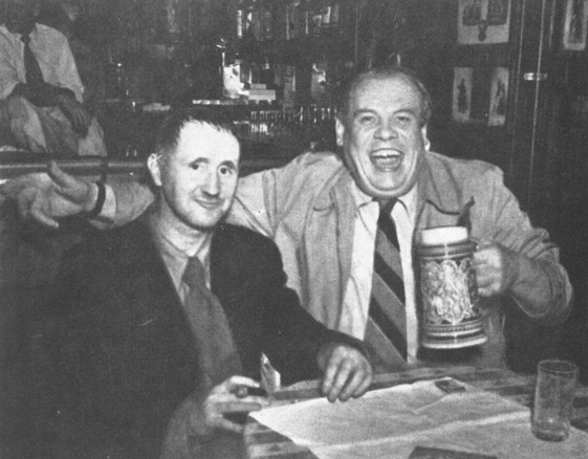
My father liked Wallenstein too because he wanted to command his army himself and eliminate the king. He liked King Ludwig I because this king made. Munich into a capital city by his artistic joy in building and because he was really quite a civilian all his life. He had a special place in his heart for Bismarck whom he had seen twice during the war. He knew no more about him than that he had opposed, unafraid, the megalomaniac young Kaiser Wilhelm II, drank a lot and spent little money on clothes. “But look at him—a man, every inch of him!” my father would say, pointing to Bismarck’s picture. Men who could handle a bottle well won his heart generally. “Only when a man has had a drink does he really show himself,” was his dictum. I must admit he was quite right in this.
He hated sanctimonious hypocrites, picayune crawlers and conceited fools, and, though he wore his iron war cross proudly, he had no use for “soldiers or military heads.” His opinion was that only those who didn’t get on in life, stuck to the army. He possessed considerable discernment, as far as people were concerned, and his hard life made him skeptical. No one could tell him black was white. Though in time he was generally well liked, he never had a real friend. This may have been due to the fact that he loved people as a phenomenon and found them entertaining but never liked anyone in particular. He transmitted this trait to his children. The chance of the moment dictated his bottle companion. After they had gone their ways they had nothing in common. He found the dry unequivocal vulgarian to his liking. If the chap had some wit he would even win his heart for a while. He had no respect for rank, birth or wealth. He only appreciated what he found directly in a person to surprise and entertain him.
One could thus come to believe my father was incapable of loving anyone. No one can, of course, really see what’s going on within others. But people are nevertheless supposed to have souls.
In spite of all their quarrels, my father and mother lived together very well. They supplemented each other. She worked untiringly and seemingly without any aim. He thought everything out, regulated and distinguished between the useful and the fruitless. She was timid, he venturesome. Thus they matched. He wanted her to stop working so hard and be more sparing of herself after they had become well-to-do. He was touched by her immutable matter-of-courseness and unpretentiousness, her untiring diligence and altogether too anxious frugality. As with the years he became more and more sickly and could not work very hard any longer, he felt indebted to her. She had never had anything really beautiful, any really great joy. He proposed she take a trip to the bathing places or a longer cure at one of them. To him nothing was too expensive for her sake. But she could never understand such reasoning and found the proposals a frivolous wanton. That depressed him very much. In the end he stayed home mostly and drank Affenthal red wine because the doctors forbade beer. He became morose and grumbled a lot to himself. He had a particular liking for the peasant saying:
Time goes—
The candle flickers,
The wife dies,
The man sinks,
And nothing matters.
“Nothing matters”—as much as to say it has all been useless. Hope and love and trouble and endeavor had all been in vain.
As we all stood around his deathbed, our faces full of concern and tearful, he pulled himself together once more, vented a few anguished curse words, trembled and fell back dead. He was not quite sixty when he died. A rainy fall darkened the windows.
It was 1905. I was in the sixth grade at public school and the youngest of five brothers, eleven years old then.
My mother died almost thirty years later. Also on such a day in autumn, on September 27, 1934. I was at a banquet of Soviet writers in Tiflis at the time and had no word from home for a long time. I had no idea she was on her death bed at the time and in my toast spoke about her and her simple life. I had seen her last in 1932. We were standing in the cemetery of our village church near the family plot. Less than four months later I had to leave my home country. While an emigrant I only seldom got a few lines from my mother. They were always the same. “Dear Oskar, how is everything with you? When shall I see you again?” Nothing mere. The awkward letters were the only things that betrayed the silent ache of a great longing such as only the much enduring could feel…
In between my father’s death and hers there had been a world war, a German half-revolution, inflation, the Kapp and Hitler putches, the beginning of the Third Empire and all my inner development. I have tried to show this: truthfully in my two books We Are Prisoners and Wonderful People. The heritage from my parents, however, seems to me to have been only indicated. That’s why I have written this amplification.
Translated from the German by S.D. Kogan
Literature of the World Revolution/International Literature was the journal of the International Union of Revolutionary Writers, founded in 1927, that began publishing in the aftermath of 1931’s international conference of revolutionary writers held in Kharkov, Ukraine. Produced in Moscow in Russian, German, English, and French, the name changed to International Literature in 1932. In 1935 and the Popular Front, the Writers for the Defense of Culture became the sponsoring organization. It published until 1945 and hosted the most important Communist writers and critics of the time.
PDF of full issue: https://www.marxists.org/subject/art/literature/international-literature/1935-n12-IL.pdf
 Revolution's Newsstand