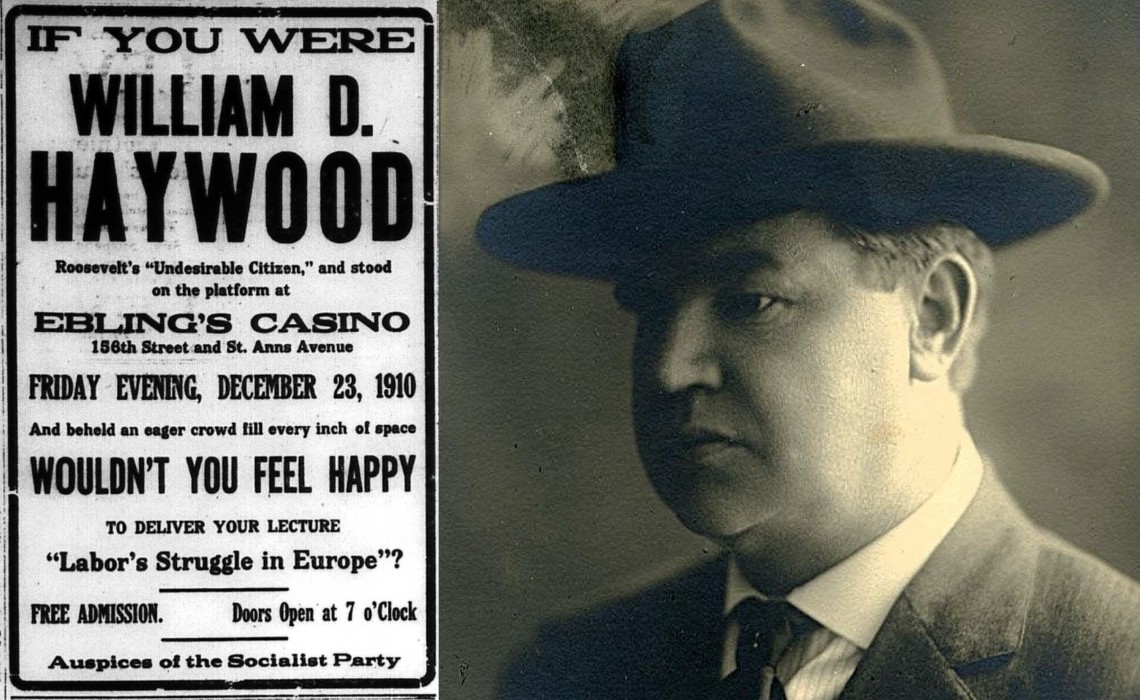
Haywood just back from an extensive tour of Europe during which he attended the Socialist International’s Copenhagen Congress, reports to a packed New York audience on his impressions.
‘Haywood Tells of Old World Battles’ from the New York Call. Vol. 3 No. 358. December 24, 1910.
Describes Labor and Socialist Movement of Several Nations.
In his lecture on “Labor’s Struggle in Europe” last night in Ebling’s Casino, the Bronx, under the auspices of the Socialist party of the Bronx, William D. Haywood reviews the struggles of the working class of the Old World in a way that has seldom been attempted by an un-American Socialist or labor unionist. Striking stories were told of the workers of Norway and Denmark and Sweden and England, Scotland and Wales and France and Italy and Spain.
The present conditions of both the Socialist and labor movements were pictured. Where the big miner of the West thought praise was due he gave praise, and where he believed the Socialist or labor movement did not line up with revolutionary working class principles he did not spare his criticism. It was the general opinion that Haywood’s account of the working class movements of Europe was the best that has been given in America. Not only as a delegate to the International Socialist congress was he received everywhere with open arms, but his brave stand and aggressive action in a remarkable period of American labor history was a standing introduction to all the workers of Europe.
Haywood began his speech by a brief account of the international Socialist congress, of which he did not have a very high opinion. According to him, the congress was not a good place to take the revolutionary pulse of the workers of Europe. The introduction of resolutions, their amendments and final adoption is about all Haywood could see in the congress from a distinctly working class point of view, he said. He assured his hearers, however, that there was a large number of real revolutionary Comrades at the national congress, and that while these Comrades were not prominent as speakers, they did represent the spirit and intelligence of the working class of Europe.
Denmark No Paradise.
Haywood criticized the reports by several American Socialists, that there is a Socialist movement of any importance in Denmark. He also criticized the statement that Denmark is a sort of paradise of labor, and the claims that the co-operative movement among the farmers is of revolutionary value.
According to Haywood, the workers under the system of so-called co-operative farming are about in the same condition as if the entire land was owned by one concern and leased out to the workers.
Nine Year Contract.
Nor did he see, said he, after a little investigation, much to the labor movement of Denmark. As an instance, he said, he was told that all the printers in the country were members of a union, but that on close investigation he discovered that the president of this so-called labor union is a boss printer himself, employing about 100 men, and that it has signed a contract with the employers for nine years. He said he asked the leaders why they did not make it ninety years.
“If the International Socialist congress,” said he, “could have taken the advice of the mayor of Copenhagen, a Socialist, who said that the Socialist party could only bring about reforms within the existing state and within national boundary lines, and that the emancipation of the workers must he brought about by one big industrial organization, it would have learned something.”
The farms in Norway, he said, are being deserted–and the boys and girls are pouring into the cities and its industries.
English Sights.
From the labor struggles of Norway and Denmark, Haywood carried the reader to England, where he spoke under the auspices of the Social Democratic party. He reached England, he said, about the time of the Welsh coal miners’ strike, and made it his business to get in close touch with the men involved. He told the story of that strike which, to him, he said, is the greatest event that ever has taken place in the British labor movement.
Hope of England.
Haywood believes that the Welsh miners are the hope of England. When he told the audience the story of the tactics employed by the Western Federation of Miners there was enthusiastic applause. Haywood said the best way to compel the mine owners to give in was to let the mines All up with water. As the water in the shafts arise, he said, the spirits of the bosses lower. He said the Welsh miners, previous to the present strike, which started in November, had been accustomed to keeping the bosses’ machinery in order during the strike, and when they were about starved out after several months’ strike, they straggled back to work.
The capitalists, he said, blamed his speeches for change of tactics on the part of the Welsh miners, and said that had it not been for him the coal miners of Wales would have faithfully obeyed the orders of their officials, who have been betraying them for so many years According to Haywood, his speeches did have some effect, but he said for two or more years there has been an enormous amount of industrial union writings read among the miners Most of the Industrial union writings of Deba, De Leon, and other Americans have been extensively read among the miners, he said.
Learning Solidarity.
“In the past,” Haywood said, “the Weish miners held large parades and demonstrations, they sang hymns, struck peaceably and starved contentedly and in sections, but they are learning the message of industrial solidarity,
He told about the struggles of the boiler makers, cotton workers, etc., also, and said that in all these strikes there is the new industrial union spirit.
Trip to France.
From England he went to France, where he got a glimpse of the railroad strike, He only got as far as Boulogne on the first trip, however, where he saw the Reservists, who were mobilised by the renegade Briand. Haywood said he did not care to ride on a train manned by scab, and if he had cared to, he would have taken chances of being shot by a union striker. On his second trip to France he met the Socialist and labor union leaders, including the militant Herve, now in jail.
“A little more development in the French labor movement,” said Haywood, “and the labor unions of country will take the productive forces and run things for the benefit of the workers themselves.”
From France he went to Italy where the workers have developed a remarkable revolutionary labor movement. The glass-blowing industry, he said, has been taken over by the unions, and the workers have efficiently shown their ability to run things. The farmers, too, he said, are swinging into line as the farmers of no other countries are. Already there are 70,000 of them organized into aggressive unions, and they have under collective cultivation more than 200,000 acres of land.
“It will not be long,” he said, “before the landlords in Italy will be as scarce as hair on Rockefeller’s head.”
Labor Party Scored.
From Italy the big miner went back to England and here he entered on a discussion of the Labor party. And it was with bitterness that he spoke about it. According to him, the Labor party makes no effort to represent Socialist principles. It is, he said, the political expression of the pure and simple trade unions.
The only reason he mentioned it, he said, is that he did not want to see it repeated in this country. You can imagine, he urged upon his hearers, what sort of a thing a coalition of the Socialist party and the American Federation of Labor would be. And here he quoted Debs in the latest Issue of the International Socialist Review, who sees danger ahead of the Socialist party.
Roosevelt and Mitchell.
Haywood startled his hearers when he said that a ticket with Roosevelt and Mitchell for candidates, boosted by the insurgent movement and backed by the A. F. of L, was not so remote as some would think. In fact, he said, such a movement is on foot.
Before his lecture on the labor movement in Europe. Haywood spoke on the Warren sentence and its identification with the Western Federation of Miners. A resolution was passed in behalf of the fighting editor, who gets six months for his faithfulness to labor.
Previous to Haywood’s address Frank Bohn and Sol Fieldman spoke. Louis A. Baum, organizer of the Bronx acted as chairman.
The New York Call was the first English-language Socialist daily paper in New York City and the second in the US after the Chicago Daily Socialist. The paper was the center of the Socialist Party and under the influence of Morris Hillquit, Charles Ervin, Julius Gerber, and William Butscher. The paper was opposed to World War One, and, unsurprising given the era’s fluidity, ambivalent on the Russian Revolution even after the expulsion of the SP’s Left Wing. The paper is an invaluable resource for information on the city’s workers movement and history and one of the most important papers in the history of US socialism. The paper ran from 1908 until 1923.
PDF of full issue: https://www.marxists.org/history/usa/pubs/the-new-york-call/1910/101224-newyorkcall-v03n358.pdf

