Stimulating analysis from a leading Marxist thinker of his generation. A central figure in the Polish and German workers’ movement for decades, Marchlewski (Karski), formed a partnership, one of our movement’s great political collaborations, with Rosa Luxemburg and Leo Jogiches during their 1892 exile in Zurich, where together they founded the Social Democratic Party of the Kingdom of Poland. Exiled from Czarist Poland for his revolutionary activity to Germany, when this was written Karski was editor of Leipziger Volkszeitung. He soon resigned in protest after the Party leadership refused an article by Luxemburg. Withdrawing from Party leadership, in December 1913 he began Sozialdemokratische Korrespondenz with Luxemburg and Franz Mehring as regular contributors.A member of the Gruppe Internationale and an original Spartacist, Karski spent from January, 1918 until June, 1918 in prison, being traded for German prisoners held by the Bolsheviks. Back in German in early 1919, Karsk was in the Ruhr when the Uprising broke out and Liebknecht and Luxemburg were murdered. Escaping to Poland, Karski was head of the Provisional Revolutionary Committee during the Soviet-Polish War in 1920. After the defeat of the Red Army he returned to Soviet Russia where he was dispatched to the Far East, writing these articles on his return. Settling in Moscow he was first head of the Communist University of the National Minorities of the West, and worked on issues of peasant economy for the Comintern. Writing and researching until his death in Italy while on vacation in 1925 at the age of 57.
‘Japanese Imperialism in the Far East’ Julian Marchlevsky from International Press Correspondence. Vol. 2 No. 88 & 92. October 13 & 27, 1922.
The imperialist appetite of Japan–Intervention in Siberia–The occupation of Vladivostok and Sakhalin–The failure of negotiations at Dairen–The situation at present
Like the Conference of Dairen six months ago, the Russo-Japanese Conference of Tchang-Tchung, which comrade Joffe attended as plenipotentiary of Soviet Russia, came to an end on September 26th without having produced the least result.
Japan proved herself intractable. She refused to evacuate the region of Vladivostok and the northern section of the island of Sakhalin, territories belonging to the Republic of the Far East. As to the Russian Revolution, victorious on all the fields of battle, it could neither deliver the Russian working population to Japanese exploitation nor tolerate indefinitely foreign intervention in the Far East. At Tchang-Tchung, therefore, the Russian and Japanese points of view were altogether irreconcilable.
As at The Hague and at Genoa, Red Russia found herself face to face with imperialism.
At the time when the Russo-Japanese Conference was disbanding, a telegram from Russia informed us of the arrival at Kharkov of Japanese industrialists and financiers who had decided of their own accord to renew relations for business purposes–with the Republic of the Far East and the Soviets. In Asia as in Europe economic necessity does not allow intelligent capitalists to sanction the policies of their own governments.
On all these events, taken as a whole, the following article of comrade Marchievsky, written on his return from a journey to the Far East, will give us a clear view.
Since the World War the relation of forces in the Far East has completely changed. An imperialist Russia no longer exists to menace the yellow races. Germany has been equally eliminated. And the victorious powers of Europe and America have too many other cares at this time to pursue an active policy in the Far East.
The sole country to benefit from the disorganized condition of the European states, both conquerors and conquered, is Japan, mighty power of the Far East, who in 30 years, has won 3 wars. Three wars hardly glorious, it is true, for China had been incapable of offering serious resistance, the Russia of the Czars had proven herself to be unequal to the needs of the hour, and Germany had devoted insignificant forces to the defense of her possessions in the Far East. On the contrary, three victories dangerous in their consequences, for they created in Japan, in the army, among the petty bourgeoisie, and even among the workers and peasants, an imperialist psychology of which the nobility in power cleverly took advantage.
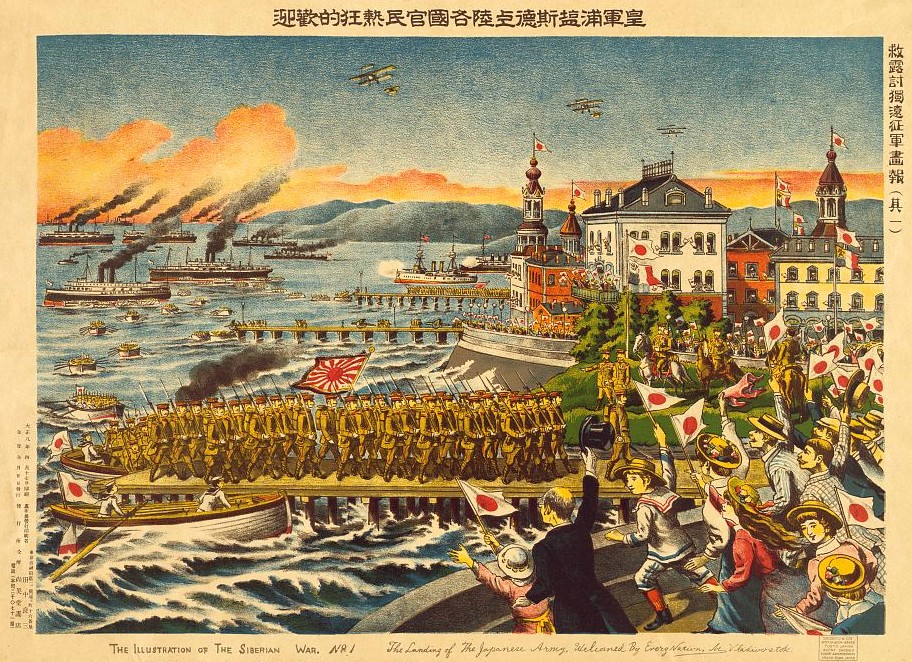
Japan covets Siberia above everything. Intervention in Siberia, against the Russian Revolution, came as a godsend to the Military Party. The songs of the Japanese soldiers express the hope of “watering our horses in the Volga”. The Russian counter-revolution in the Far East, however, was as unsuccessful as everywhere else, and could not hold its ground before the Red armies. Japan was content when, after the debacle of Koltchak and Semenov, the Japanese divisions were able to retreat to the east without being pursued. She wanted, however, to draw the most advantage from this trick. When the Allied troops evacuated Siberia, Japan declared that she had particular interests to defend, citizens to protect. And under these pretexts she sent troops to Vladivostok and the Amur River.
At Nicolayevsk, on the Amur (1920), an unforeseen drama was enacted. As everywhere, the Japanese had conducted themselves in the country like arrogant conquerors. Russian sympathizers–irregulars not belonging to the Red Army, as enquiry proved took the city by surprise, massacred the garrison and several Japanese families. Thereupon the Japanese, as an act of reprisal, occupied the mouth of the Amur and the northern part of the island of Sakhalin.
But to occupy Vladivostok, other reasons were necessary–and better ones. The inhabitants of the great Russian port had adhered to the democratic republic of the Far East established, in agreement with Soviet Russia, in the east of Baikal, with Tchita as its capital. Vladivostok being the rallying point for the officers and former soldiers of Koitchak and Semenov, the Japanese had no trouble in brewing up a conspiracy, and then a reactionary coup d’etat. Outwardly neutral, they armed and financed the counter-revolution, and it was thus that in May, 1921, the white “national” government of Vladivostok was born. That marked the beginning of an orgy impossible to describe. During the imperialist war all merchandise sent to Russia from America passed through Vladivostok. The warehouses of this city contained enormous quantities of food provisions, of war material, of railway stock, etc., worth several hundred million gold roubles. The national government lived upon the pillage and the sale of these public goods. Little by little, almost all was sold to the Japanese, who resold a good part of the stock to China. The occupation of Vladivostok and its “emancipation from Bolshevik bondage” was a splendid affair for Japanese speculators. And as the military coteries and trouble brewers of Tokio kept themselves quite near, the proud Samourais received their share of the booty.
During the summer of 1921 the government of Tchita attempted to enter into negotiations with Japan. The latter did not refuse. For a long time the Empire had been a prey to an economic crisis, suffering from overproduction, from unemployment, etc. Hundreds of thousands of bourgeois were hostile to the occupation of Siberia. They were hoping for much from fie opening of the Siberian markets. But on the other hand, the Military Party expected to continue its conquests. During the war Japanese scholars had explored the eastern part of Siberia; they knew what fabulous riches that country contained. Although it had been hoped to obtain them at the point of the sword, would it not be wise, Japanese capitalists asked, to plan a pacific penetration of Siberia, rather than to engage in a long and expensive war? Besides, the masses were demanding the recall of the troops of occupation because their maintenance involved enormous expenses, because the harsh Siberian climate gravely affected the health of the Japanese soldier, because the Bolshevik sympathizers did not give them one moment’s rest.
For all these reasons the government of Tokio could not refuse to negotiate, and conferences began in September, 1921, at Dairen, that is, in the ancient Chinese village of Tabin-Vou, which later became the Russian port of Dalny later leased to the Japanese. With astounding insolence the Japanese negotiators at first presented demands signifying nothing less than the colonization of the whole of Transbaikal. The Russian negotiators, however, did not allow themselves to be the least bit influenced. It was then that, to complete its pressure, Japan launched the great offensive of the Whites of Vladivostok. About 8,000 men comprising the national Russian army passed beyond the Japanese zone of occupation without hindrances and marched towards Khaborovsk, on the Amur.
At first, the Red Army of the Far Eastern Republic was surprised, for no one in Tchita expected to engage in battle during the negotiations. But if the Whites and the Japanese had counted on the acquiescence of the inhabitants of that region and the cossacks of the Amur, they were sadly mistaken. The action of the Communist partisans rendered their situation more and more critical. It was not until last February, however, that the Republic of the Far East was able to furnish the force necessary to defeat its enemies. And considering the enormous difficulties of communication and the rigorous Siberian winter this ought not to astonish us.
The victory of the revolutionary troops was decisive. The Whites escaped complete annihilation only by taking refuge in the Japanese zone of occupation. After the victory of the Reds, the Japanese representatives decided to negotiate in earnest, and to abandon their exaggerated pretensions. A provisional treaty was drawn up at Dairen which accorded Japan great advantages. The Russian negotiators, however, refused to sign it before the date of the evacuation of Siberian territory by Japanese troops had been formally and precisely fixed. The Japanese negotiators appeared to yield for a moment, but then formulated anew counter-proposals altogether inacceptable. Finally, they offered to fix the time of evacuation in the following terms:
“A mixed commission shall regulate the mode of evacuation. Japan agrees to evacuate Siberian territory three months after the completion of the work of this commission”.
This was to assure herself the possibility of dragging on the matter indefinitely into the future. The Far Eastern Republic could not consent. On April 16th, the negotiations were discontinued.
We know now why the Japanese imperialists could not accept a bona fide solution. The governor-general of Manchuria was at that time preparing for war against the Government of Peking. Japan, a power of the first rank, well-informed of these plans, could not give up holding her troops of 40,000 men in Vladivostok which was but a short distance away from the center of operations of the civil war in the celestial empire.
Several times since the recent events in China the press has announced the coming evacuation of Siberia by Japan. That is still spoken of. Dates are fixed, negotiations are opened and broken. At Vladivostok, however, the orgy of the reactionaries continues. This experience makes it impossible to accord the least credence to the selfish promises of Japanese imperialism.
***
Problems of the Far East
Capitalist development has taken place in Japan during the past fifty years with a surprising rapidity. The World War only accelerated this in two ways. First, the participation of Japan in the conflict increased enormously her own needs of war materials; secondly, Japan became the source of supply to Russia and, after the entrance of the United States into the war, Japan became the chief source of supply of manufactured articles to the Chinese market, neglected by Europe and America.

To the Nipponese capitalists, the years of the war were the fat years of fabulous profits. The Japanese working class also benefited to a certain extent. The demand for manual labor by far surpassed the supply. This situation caused a slackening in the discontent of the country districts, still under a semi-feudal regime.
The bourgeois revolution of 1868 did not in fact abolish the property rights of the feudal nobility, which still owns the greater part of the land. The large landed proprietors let out their land in small parcels, generally under conditions very often resembling serfdom. It is quite the usual thing that the peasant owes to the lord half of his harvest. When we take into consideration the intensity of the peasants’ work–rice cultivation for instance, requires a sustained effort–we see that the tribute paid by the farmer to the proprietor represents more than a ground rent; it. represents the product of a slave’s work, and an inhuman exploitation. The development of industry has thus led to a strong emigration movement from the country districts to the cities, especially among the women. The farmer cannot live unless some member or members of his family work in industry.
After the war, the industrial crisis became inevitable. The needs of the army diminished, the Russian market was lost, American and British competition could be seen pressing upon the Chinese market, and Germany also became a very successful competing factor. To which may be added that the Japanese exchange is very high, which places Japan among the countries with a high cost of living. The rapid decrease of exports naturally brought about a strong restriction on production, followed by unemployment and increase in the cost of living. The numerous strikes and industrial conflicts, of which the Japanese newspapers do not cease to speak, are thus explained.
Emigration of the rural population towards industry ceased, thus increasing the tension of the situation in the Country districts. Peasant revolts became very frequent. To combat them, the government used the Prussian method (or Czarist).
As for the workers’ movement, lively and interesting, it is in its beginnings and leans generally to a non-political syndicalism. The Japanese Constitution is largely the cause of this: a system of two legislative chambers, very restricted suffrage for the Lower Chamber, and supremacy of the Upper House.
Nominally, the Japanese nobility, very numerous, has lost its privileges. But it has found a haven in the army, the navy, and bureaucracy. It no longer disdains participation in industry and commerce. The political revolution having done no harm to the old clans of the nobility, there results curious combinations of the clan system with capitalism. The generals and admirals belonging to a clan or fraternity may always be assured of the cooperation of the members of their group mixed in with the bourgeoisie. Thus from top to bottom of the political and economic structures, several cliques, comprising officers of the army and the administration, are orgying in the most corrupt practices that can be imagined. Let us not be astonished that the majority of the workers are sickened by the political practices of present day Japan and that non-political syndicalism finds a fertile field among them.
The new revolutionary ideas still plow their way with difficulty. Up to the present time, the achievements of Communist propaganda in Japan have been slight, and the number of organized Communists is very small. The fear which they inspire in their government is all the more remarkable. For fear of Bolshevism, Japan wants no contact with Russia. No sanitary cordon would appear too strong to Japan to insure it against the penetration of the Bolshevik bacillus.
Yet Communist influence makes itself felt in the most unforeseen ways. Lately, for instance, the Japanese press sounded the alarm: Our soldiers are returning from Siberia, contaminated by Bolshevism! And it appears to be truth, although a surprising truth, taking into consideration the vigilance employed by the Japanese police to prevent contact of the soldiers with the inhabitants, and taking likewise into consideration the difficulty of exchanging ideas among people of different languages. Bolshevism must have an extraordinary power of penetration to have reached even the Japanese soldiers in Siberia, and prisoners of both their officers and the police. The fear of the red peril has led the Japanese bourgeoisie to introduce a bill in Parliament which is an exact reproduction of Bismarck’s anti-Socialist laws of 1868. The bill has been temporarily defeated, because it attacked not only Socialist propaganda, but also the tame liberalism which has numerous adherents in the press, and in political circles. But the possibility remains that it will be adopted with some modifications at the next parliamentary session. Confronted by more and more accentuated economic conflicts, the bourgeoisie will not flinch before the most extreme measures.
To procure a diversion to the dissatisfaction of the masses and the penetration of subversive ideas, the Japanese bourgeoisie has found no better remedy than to affirm the necessity for the military expansion of the Empire.
Their arguments are of childish simplicity: Japan is a poor country, incapable of nourishing an ever-growing population. Therefore it must conquer new lands and new sources of raw materials, if it is not to succumb.
The first affirmation is true. Japan is in fact a country which Nature has favored very little. It possesses neither coal nor iron and lacks therefore the primary necessities for industrial development. Its textile industry depends largely upon importation of foreign raw material. Even its agriculture is capable of a limited development.
But it is not true that Japan is overpopulated. Great sections of the Archipelago are but very sparsely populated. If one objects that these sections, especially the Isle of Yeso, are but slightly favored by Nature, we will remark that the countries coveted by Japanese imperialism, Manchuria and Eastern Siberia are no better off. Moreover, experience shows that the Japanese peasant is a poor colonial. At least, all his attempts at colonization in Korea and Southern Manchuria have failed lamentably. Only the small number of three hundred thousand Japanese colonists could find root in Korea. In Manchuria, in spite of the advantages which have been handed to them, the Japanese merchants could not supplant their Chinese competitors. The reasons for this inferiority are many: little capacity for acclimatization, augmented by the conservation of national customs; incapacity to cultivate the earth otherwise than in their native country; the practice of parceling out the land.
The power of suggestion of imperialist ideas in Japan is very great. One meets even Japanese Socialists who cannot throw them off. The anti-militarist propaganda will have great difficulty to combat this psychosis, but several factors are already working for us. As Germany before, Japanese imperialism is now burning the candle at both ends. It wants both an army and a navy of the first order. The excessive charges on the budget call forth an ever-greater opposition. The military party, far from taking this opposition into consideration, attempts to dispose of it by acting on its own initiative. Last March, it discussed the possibility of a war with America, and prepared the most elaborate plans: In case of a war in the Pacific, the oceanic communications of Japan might be interrupted; therefore, Japan must assure its food and raw material on the Asiatic continent. As it is very doubtful that either Russians or Chinese will be too willing to supply Japan, an army of three million men would have to be sent to the continent to occupy the shores of Shanghai. Then, the Japanese militarists could represent such a war of conquest as a war of national defense. Such projects have scared certain bourgeois circles. The liberal opposition to militarism is gaining in force.
Having seen in Europe the powerlessness of such resistance in case of any real danger, we must come to the following conclusion: Either the Japanese workers and peasants will be forced by circumstances into the class war and will oppose the development of imperialism, or sooner or later, Japan will be drawn into a series of military ventures which will set the Far East aflame, and finally debase the Japanese people to the present condition of the German people.
International Press Correspondence, widely known as”Inprecorr” was published by the Executive Committee of the Communist International (ECCI) regularly in German and English, occasionally in many other languages, beginning in 1921 and lasting in English until 1938. Inprecorr’s role was to supply translated articles to the English-speaking press of the International from the Comintern’s different sections, as well as news and statements from the ECCI. Many ‘Daily Worker’ and ‘Communist’ articles originated in Inprecorr, and it also published articles by American comrades for use in other countries. It was published at least weekly, and often thrice weekly.
PDF of full issue: https://www.marxists.org/history/international/comintern/inprecor/1922/v02n088-oct-13-1922-Inprecor.pdf
PDF of issue 2: https://www.marxists.org/history/international/comintern/inprecor/1922/v02n088-oct-13-1922-Inprecor.pdf

