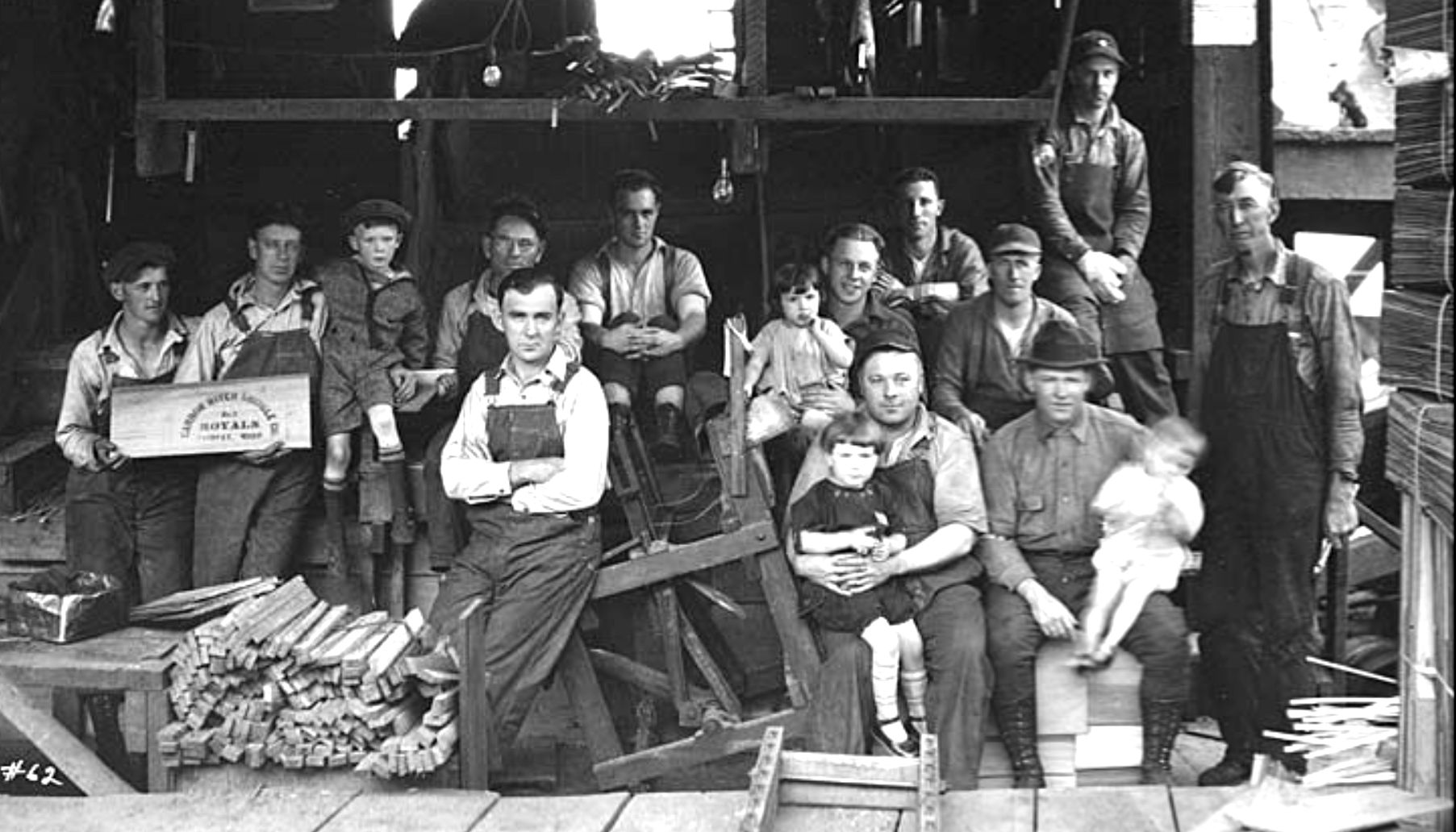
A strike by shingleweavers in the Pacific Northwest sees craft division in the process further devolved into geographical division, with one industrial union for all the employees–across region and company–from clerks to lumberjacks being the demand of the militant workers.
‘Shingleweavers Must Organize Industrially’ from Industrial Worker. Vol. 1 No. 47. February 12, 1910.
The strike of the shingle weavers at Anacortes is still on. The strike was called on December 8th, and although the mill owners have made attempts to operate all the plants on the non-union basis, they have met with little success. Three mills are being operated with non-union men (such as they are). Half of the timber goes out into the burners, and the other half into a new grade of shingles called “pointed and round” shingles. The owners of the mills, as is usual with the master class, are willing to operate the plants at a loss rather than give in to the demands of the striking shingle weavers.
The bosses have employed the usual tactics used in the breaking of strikes. Boarding houses have been established close to the plants, where the scabs are fed. The bosses also employ what are termed as scab herders. These scab herders escort the men to and fro, from the mills and boarding houses, morning, noon and evening. They stop all night with the rest of the scabs at the boarding houses, and should any of them desire to go up-town he is always accompanied by one of these scab herders. There are three of the boarding houses, one for each of the mills, and one scab herder to each boarding house. Whenever a boat is due with non-union men aboard for the mills, these scab herders, along with the bosses, go down to the docks and accompany the scabs up to the boarding house.
The shingle weavers’ union of the Grays Harbor country have also been on strike for the past three months. Some of the mills in that district are being run with scab labor, while others are being operated by union men.
I would like to ask how long would the strike of Grays Harbor and Anacortes have lasted had all the men employed in the shingle mills belonged to one union, such as the Industrial Workers of the World, and used Industrial Union methods in combating their employers? 1ue way we are organized at present, the shingle weavers belonging to one union, the engineers to another, the firemen to another, and the laborers or unskilled help not organized at all, we are kept fighting among ourselves; one craft goes on strike, while the other remains at work, so that it generally ends up in defeat.
We are told by such men as Gompers and Mitchell, who knock knees, wine and dine at the banquets of the Civic Federation with the multi-millionaires, that our interests are identical with those of our masters. Then they tell us to organize into crafts, each trade into a separate union, make contracts with our employer, etc. The result is that our contracts are made so that each craft’s expires at a different time. For instance, the shingle weavers’ contract expires on the 1st of January, the firemen’s on the 1st of May, and the engineers’ on the 1st of October. When we go on strike we give the employers notice a certain length of time before we do so, the result is that the employer prepares for the struggle, and when we walk out of one door he rushes in the scabs whom he has held in preparation at the other. Also, when one trade goes out on strike, the other trades employed in the same industry or plant, who have contracts expiring at different dates, remain at work, working alongside of scabs. Good union engineers run the engines fired by scab firemen. Good union shingle weavers work on machines run by steam furnished from an engine room where only scabs are employed. Or good union firemen and engineers furnish steam to run machines that are operated by scab shingle weavers. Such is the result of craft division.
Such methods will never bring us victories. The way to organize to insure success is to take in every man employed in the shingle industry, from the man working on the boom, the drag sawyer, knee bolter, block piler, sawyer, knot sawyer, packer, tallyman and other men and helpers employed around the mill, to the men employed in the engine rooms, engineers, firemen, oilers and watchmen, into one solid Industrial Union. Then when it comes to the point where a strike is to be called, not to give the employer thirty or sixty days’ no tice as is often done, thereby giving him the warning and sufficient time in which to prepare for the struggle, but make the demands, and if they are refused, every man employed in the shingle mill, from the laborer to the shingle weaver, walk out of the plant as a body, thereby completely paralyzing the plant. Such methods will secure for the men their demands, if any methods will, and such methods will have to be pursued if we are to success fully combat our employers.
If the calling out of men employed in the mill does not win the strike, the men employed in the woods, who belong to the loggers’ union of the same general organization, carrying the same card and wearing the same button, refuse to furnish logs to mills operated by scabs. The men employed on the tow boats, who are also members of the same general organization, but of another Industrial Union, refuse to haul the bolts or logs to the scab mills. Finally, if that is not sufficient to win the strike, the longshoremen refuse to load scab shingles, and finally the sailors and seamen who are also members of the same organization, also recognizing that “an injury to one is an injury to all,” refuse to man ships loaded with scab shingles.
Such are the methods employed by the Industrial Unionists. It is such methods that have won for the French workers who are organized on Industrial Union lines the name of being the most progressive of labor organizations. The workers, if they wish to be successful in their struggles for higher wages, better conditions of employment and shorter hours, must present to their exploiters, the employing class, a solid front in times of industrial warfare, and it is only by being organized into a solid Industrial Union, such as the I.W.W., that this is possible.
Agitate industrial unionism throughout the shop or plant at which you are employed Spread the literature and propaganda of the organization. Get subscribers for the organization papers. When a sufficient number of men in your locality are willing to become members of the Industrial Workers of the World, organize yourselves and send for a charter. For information about organizers to come to your locality address the nearest local, a directory of which can be found in this paper.
PRESS COMMITTEE LOCAL 316.
The Industrial Union Bulletin, and the Industrial Worker were newspapers published by the Industrial Workers of the World (IWW) from 1907 until 1913. First printed in Joliet, Illinois, IUB incorporated The Voice of Labor, the newspaper of the American Labor Union which had joined the IWW, and another IWW affiliate, International Metal Worker.The Trautmann-DeLeon faction issued its weekly from March 1907. Soon after, De Leon would be expelled and Trautmann would continue IUB until March 1909. It was edited by A. S. Edwards. 1909, production moved to Spokane, Washington and became The Industrial Worker, “the voice of revolutionary industrial unionism.” A victim of finances and internal disputes, the IW ceased publication in 1913, only to be revived in 1916 and surviving as a weekly, sometimes more, until 1931. Easily among the most important working class newspapers in U.S. history and an essential resource on the wobbly, and larger radical labor experience.
PDF of full issue: https://www.marxists.org/history/usa/pubs/industrialworker/iw/v1n47-feb-12-1910-IW.pdf

