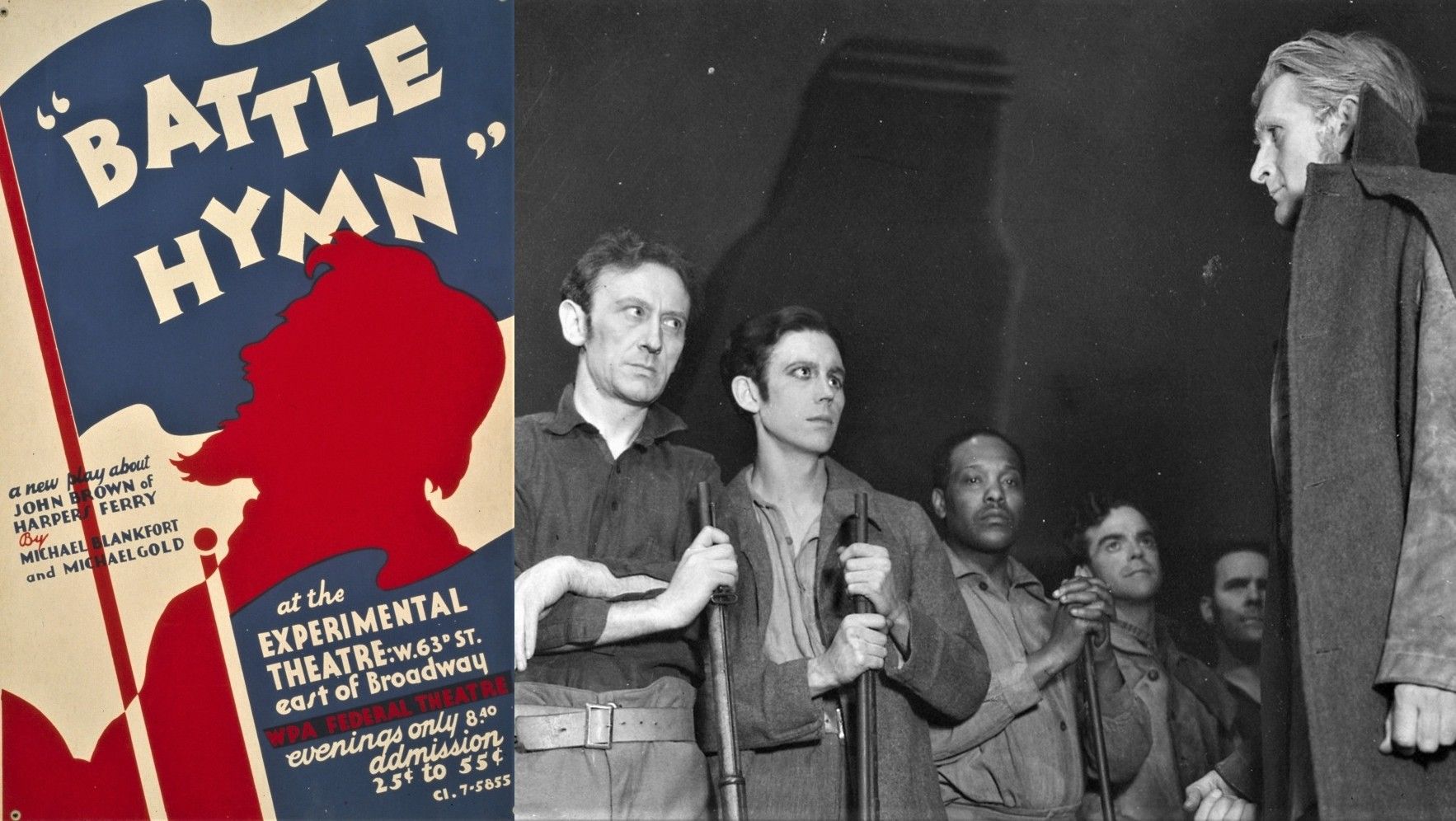
Michael Blankfort, in the first of a series, discusses the relationship of form and content in the context of a revolutionary theater attempting to break down the barriers between performance and audience. Blankfort began his career in the radical theater, most notably writing the Federal Theater Project’s Battle Hymn about John Brown, and somehow escaping the Blacklist (and helping others to escape it) found regular work in Hollywood writing such films as the Caine Mutiny and The Plainsman.
‘Facing the New Audience: Sketches Toward An Aesthetic for the Revolutionary Theatre’ by Michael Blankfort from New Theatre. Vol. 1 No. 7. June, 1934.
INTRODUCTION
IN line with the growth of the class-conscious revolutionary workers in this country have come, as would be expected, radical literary and dramatic movements. Revolutionary ideology carries with it the plasm of a new culture, and the theatre plays no small part in it. In the last five years there have been more plays written and produced which have concerned themselves with the conflicts of the working class in this country than in the whole of the last three decades. Today there are enough plays to give body to the phrase “revolutionary theatre” and now is the time to question some of our old aesthetic standbys and see how they fit in. With the new theatre, new problems arise.
All that we have read, seen, studied, has to be turned over in the soil of our times. Accepted theories have to be tested by the fire of the new culture which is growing up inside the old. The so-called classic essences of the theatre have to be examined before the worker’s audience, for it is out of them that the new culture, in all its forms, must grow. Our task is no new one. In England, the Independent Labor Party, many years ago had to meet the problem when they started a worker’s theatre. Piscator in Germany and Meierhold in Russia met them and recorded their achievements. Today, in America, we must do the same. The plays of the Theatre Union and the Workers’ Laboratory Theatre have shown us what we can do and what mistakes we have made.
Of the several elements in the theatre, we have selected the audience as meriting our first consideration for a great deal of what we have to say to the playwright depends on what we find in the audience. It is an essential, if not the most essential, ingredient of the revolutionary theatre.
THE AUDIENCE
What is this awesome body of human beings without which no play can survive? What are its prejudices and appetites?
First let us differentiate it from mob, for it is due to a lack of this differentiation that many writers can uphold the naive advice given to them by smug and reactionary critics. While it is true that mob and audience have similarities, their differences are more important. The mob demands unanimity of opinion; audience has no such power. Mob can act; audience is relatively passive. Mob rationalizes its acts psychopathically; mob is headstrong, impulsive and dogmatic. Audience is capable of none of these things. Mob is anti-social, while audience is exactly the reverse. Mob is anarchy; audience is communism. And the one final and most important difference: in a mob the lowest common denominator is the criterion for its thought and action, and in the audience, the less gifted minds are always ready, nay eager, to accede to superior intelligence, taste and action. Unless these differences between mob and audience are kept in mind we are apt to follow the naive and individualistic advice which one of the reactionary critics, Mr. J.E. Spingarn, gave to playwrights. “Don’t think of your audience,” he wrote, “for that is the best way of serving it in the drama.” Thus a particularly vicious form of art for art’s sake can grow out of the confusion of audience with mob. That is why it is necessary for us to be clear about them.
But even after we have distinguished the two groups we are met with the question whether or not there is an audience mind. There are many conflicting opinions and there are many pros and cons, but it would be pointless to stop and list them, for despite the differences they may have on the “audience mind” all psychologists agree that the only approach to the subject is via the individual. Individuals reflect their class and culture. They are a smaller image of the world’s larger picture.
In any modern textbook of psychology you will find a description of how the individual, in a group, responds to a social stimulus. This response involves more than the physiology of complex sensori-motor arcs; it involves the psycho-physiological as well as the class history of the individual; in short, a social response, especially a response to an art form, includes the machinery of the whole human person. “Every individual has within him the possibility of definite modes of response which constitute his personality,” wrote Dr. Herbert S. Langfeld in his book, The Aesthetic Attitude.
A theatre audience consists of many personalities. These personalities, walking on two legs, leave the relative security of their chrysalis, meet up with others, their wives, mistresses, friends, husbands, lovers, even their relatives; they go out of their way, suffer the subway (or the taxi); and finally, after a great deal of travail, settle into little pools here and there. You will find them in the magnitombs of New York, or in a windworn crossroad Roxy’s. They are in barns, in old mills made over, in a cheap store in a mining town, in Chicago’s upholstered seats. They are everywhere, daily.
What is the magic in the theatre which brings millions of patrons to its shrine?
Once in a while Mr. George Jean Nathan gets tired of the sound of his voice, and out of the jelly of his half-truths emerges a bit of sound observation. An example of this is in his brief essay, The Audience Emotion from The Art of the Night. He writes:
“A theatre audience enters a theatre with the deliberate intention either of forgetting itself for a couple of hours or of being reminded of half-remembered phases of itself, of its life and of its dreams and despairs…It comes into the theatre ready and willing an eager to be made, or the nonce, other than it is.” Mr. Nathan, as is his custom, misuses his sagacity to prove that human nature never changes. However, it is not his bad psychologizing that interests but rather the gist of his observation.
When John Jones goes into the theatre to forget, or to remember, or to be made other than he is, he is expressing some sort of a wish. About the specific nature of his wish, and of its fulfillment, we will have more to say later, but one thing is clear; he and the myriad personalities which compose the audience have this in common; they have a wish to see themselves as they were, or as they would like to be; never, if we follow Mr. Nathan, are they interested in seeing themselves as they are. Although this might seem strange and unseemly, let us accept Mr. Nathan’s description for the time being, for in this section of our essay, at least, we are referring to the same audience as Mr. Nathan–the bourgeois audience.
The press may be said to be more informative and the radio more entertaining, but whatever the wish is, the theatre is the only art which can satisfy it with any effectiveness and for any large number of people. There is reason to believe that Lunacharsky was referring to only one side of the class struggle when he said, “Whenever the class struggle grows tense drama steps up to the front, because if all literature serves the class struggle, the drama, by means of the theatre, is the most active force… it affects directly large masses of people.”
But Lunacharsky realized, of course, that the drama could be utilized by both sides. We, too, intend to show this. We will show how the wish is utilized by the bourgeois playwrights and how it must and can be utilized by the revolutionary playwrights, but before we do so, it is essential for us to know more about the wish proper.
THE WISH
We can forgive all things in the theatre, the proscenium, the obvious mechanisms, the distortion of the fourth wall removed. We can adjust ourselves to its improbabilities, its perversions of a life we may know better than the playwright, its platitudinous use of accidents, its frauds, its miserable nostrums, but the one thing we can never permit is the failure to show us our own faces as we would like to have seen them on looking into our respective mirrors. The wish is the thing, and not merely the play.
Professor E.B. Holt, whose work in the field of psychological response has been overlooked by psychologists as well as critics, defines the wish by saying that it includes: “impulse, tendency, desire, purpose, attitude and the like.” In Animal Drive and the Learning Process he writes, “An exact definition of the wish is that it is a course of action which some mechanisms of the body is set to carry out, whether it actually does so or not.
We should do well if we consider this wish to be, as in fact it is, dependent on a motor attitude of the physical body, which goes over into overt action and conduct when the wish is carried into execution.” (The italicized words are ours and are of importance when we come to consider the construction of the revolutionary play.)
Holt gives us the physiological background of the wish. Let us examine it from another aspect, because the wish described by him is only half the story.
When John Jones becomes aware of those familiar peristaltic movements in his mid-region he seeks out food. Hunger drives him, as it would a white rat or a marmoset, to his food box, a cafeteria. Psychologists use the word drive to describe his behavior. But when loosely viewed Jones may be said to be fulfilling a wish, “the wish to eat.” This kind of wish, however, is not the one which is of immediate interest to us merely because it is essentially undramatic, and will remain so until something else happens to it. If John Jones, for example, is unemployed and has no money to buy food, or if someone tries to get what he has away from him, then drama begins, antagonist and protagonist appear, the wish takes on new character. Thus we see that the crude “wish to eat” does not become a wish in the dramatic sense of the word until it is thwarted or is in conflict with something. Out of frustration and conflict therefore emerges the wish which is the basis of our inquiry.
This formulation covers the one of Mr. Nathan’s although it may not seem so on the surface of it, but “the wish to see ourselves as we were” and the “wish to see ourselves as we would like to be” can come only out of a disgust or weariness with what we are. This disgust or weariness, in turn, must arise from some frustration or conflict in ourselves, or else it would be the most natural thing “to wish to see ourselves as we are.”
If all wishes, therefore, arise out of life conflicts, then it is by means of these same conflicts as projected in the theatre that wishes are satisfied. Brunetiere resolved this in his law which states that the drama is the representation of the will of man fighting against something, “in conflict with the mysterious powers or natural forces which limit and belittle us.” His observation although perhaps a little too simple is, nevertheless, the blood source and the very heart of all drama despite the carpings of the William Archers and the Henry Arthur Joneses. In the Greek plays it was the inflexible will of the gods, against which the human was pitted. In Hamlet, two wills, both in the same person, struggled against each other. In Hedda Gabler, Hedda’s will entered the jousts with Lovborg’s. In Ghosts, there is the representation of a will fighting against the unmoving and immalleable past. In The Weavers, the will of one class strives mightily against the will of another.
But in these plays as well as in the psychological laboratory a man’s wishes have usually been conceived of as though the man himself was no more than a complicated around in a material world without the slightest reference to some of the most important aspects of that world; wage-slavery, exploitation, war, etc. And when plays deal with these things like What Price Glory and Journey’s End the result is apt to be a sort of half-baked and romanticized realism plus a liberal allotment of sex or mock heroics. Even Gorki’s The Lower Depths failed to show in the misery of the pre-war hobo or lumpenproletariat any more than a soul sickness.
“It is not consciousness that determines social existence,” as Marx said, “but, on the contrary, it is social existence which determines consciousness.” Today only a fool, or a philosopher like Mr. Will Durant, or a critic like Mr. Spingarn (and we are cursed with many of them) would be willing to deny that. If the psychological conflicts determine the wish, then, in most cases, the psychological conflicts are determined by man’s struggle against economic forces, and the culture which these economic forces create.
It should be clear, however, that if most wishes arise out of an economic or cultural conflict, some do not. For example, the “wish to live” which grows out of a conflict which John D. Rockefeller may have with a cancer is quite different from the “wish to live” growing out of a steel worker’s struggle to get enough to eat (although he too may have a cancer). The “wish for health” may be for one type of audience strongly psychological, and for another type of audience decidedly economic.
This can be illustrated in another way. One of the most universal wishes in a capitalist world is the “wish for economic security,” and yet it is neither as strong nor does it occur as frequently in J.P. Morgan as in a C.W.A. worker. Still another illustration may be found in a dramatic portrayal of the “wish to marry” which is thwarted by a lack of money. Such a play might emphatically arouse a working class audience and leave an upper class audience cold and a little incredulous.
Thus, we see that what may seem to be, superficially, a psychological wish is really an economic wish with its roots in the conflicts and contradictions of our present day culture and economy. And, furthermore, we have observed that specific audiences have a specific character and quality of wish. So decided is that that it takes no great prophet to foretell whether a group of people is an audience for (i.e., will have its wishes satisfied by) the Theatre Guild, A.H. Woods, musical comedy, burlesque, or the Theatre Union.
These general observations concerning the wish give us a new approach to the problems of the revolutionary theatre; its audiences and its plays, as well as giving us another way of tackling and evaluating the plays of the bourgeois theatre. By using this tool new light may be thrown on the class content of plays and related problems. These questions will be discussed in another series of articles.
Our next step, however, will be to show how the wish is satisfied and the relation of the wish-fulfillment to the struggle between classes and their respective cultures.
* As you have undoubtedly noticed I have not made a distinction between theatre and moving picture audiences. The theatre and the cinema differ at many points (technique of production, variety of representation, distribution, admission scale, etc.) but the audience appeal of both depend essentially on the same thing; the ability to satisfy the wish.
The New Theater continued Workers Theater. Workers Theater began in New York City in 1931 as the publication of The Workers Laboratory Theater collective, an agitprop group associated with Workers International Relief, becoming the League of Workers Theaters, section of the International Union of Revolutionary Theater of the Comintern. The rough production values of the first years were replaced by a color magazine as it became primarily associated with the New Theater. It contains a wealth of left cultural history and ideas. Published roughly monthly were Workers Theater from April 1931-July/Aug 1933, New Theater from Sept/Oct 1933-November 1937, New Theater and Film from April and March of 1937, (only two issues).
PDF of full issue: https://www.marxists.org/history/usa/pubs/workers-theatre/v1n07-jun-1934-New-Theatre-NYPL-mfilm.pdf

