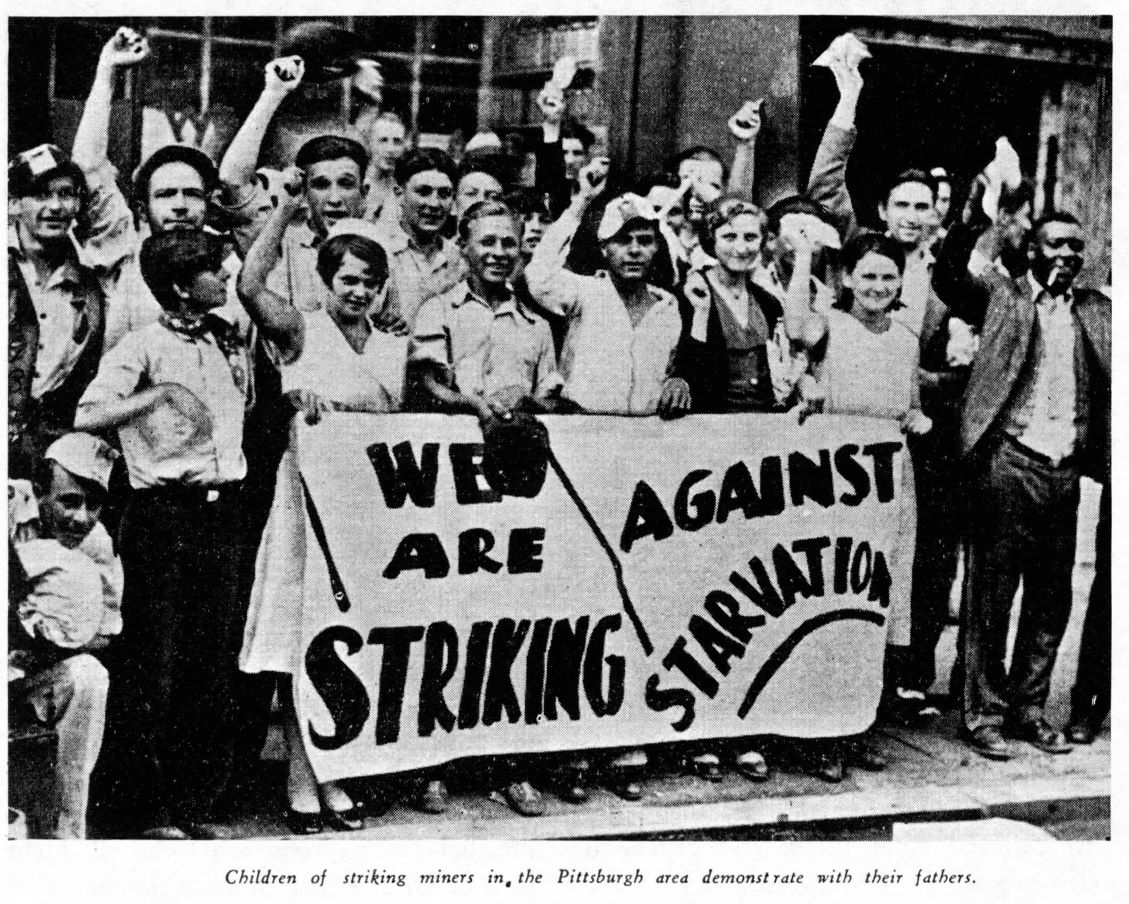
The Great Depression hit some people and places harder than others. One place that descended into real hunger was soft coal region along the Ohio River Valley. A report on conditions there and the work of the Unemployed Councils for relief.
‘Starvation in Eastern Ohio, W. Va. and Western Pa.’ by Leon Thompson from The Daily Worker. Vol. 8 N0. 75. March 27, 1931.
WITH the possible exception of the South, there is probably no major industrial section of the United States with such an appallingly widespread condition of abject poverty, mass starvation and disease-pestilence as in Eastern Ohio, West Virginia and Western Pennsylvania. The situation is so disastrous that even the most conservative bosses’ newspapers can no longer hide it. In the Feb. 1 issue of the “Columbus Dispatch,” a special correspondent, Hugh Fullerton, who is touring this section, is forced to speak of “Pestilence Is Stalking Ohio ‘Hunger Belt,” “Full Extent of Famine Unrealized,” “Sufferers Hopeless,” “Red Cross Failing to Reach Even Most Desperate Cases in Many Sections,” etc.
This section is not only an important industrial district, but also a big agricultural territory. As a result, the farmers, just as well as the coal miners, steel workers and clay workers, are feeling the pinch of starvation and disease. Along the Ohio Valley, from East Liverpool to Cincinnati, from Steubenville, southwest to Cincinnati–there exists the worst situation of privation, hopelessness and suffering.
“Thousands of children are huddled in poor homes without clothing or shoes to attend school. Thousands of others go hungry and undernourished, easy prey to disease. Fathers, unable to find employment, go gaunt and hollow-eyed and mothers stare at a stranger vacantly. There are few tears–merely despair.
“Men are cutting coal for 40 cents a ton loaded in the mine and in one district for 25 cents a ton. Men are supporting large families on an average of less than $1.50 a day when they work–and begging for two or three days’ work a week.
“The drought left the small farmers and the farm hands without winter supplies. Gardens and small farms failed. The entire district, whether one strikes coal or clay products sections, has been, since 1921, poverty stricken, the buying power exhausted, wages low, employment part time, families large.
“The situation is actually desperate in many districts. Every county infirmary and every children’s home we visited is overcrowded, and finding it difficult to care for the cases forced ‘on the county.”
“Every county agent we called upon reported extraordinary demands for county help, over and above the usual mid-winter pressure.”
This is how a correspondent for a conservative bourgeois newspaper writes. Imagine the actual suffering that is going on!
This same correspondent goes on to describe the situation in the mining camps. What little relief may be given is handed out to scabs only, while those miners who belong to the National Miners’ Union, and who struck two years ago, are permitted to die slowly of starvation.
Mr. Fullerton makes a very significant remark in summarizing the situation: “It is strange when one thinks that the fathers of these men supposedly fought to do away with slavery, and are now living under conditions far worse than those of slaves. And as we passed those small, bleak cemeteries, I thought to myself, “Those are the lucky ones, up there on the hillside!”
Housing conditions are terrible as a result of unemployment. Many families, unable to pay rent, are forced to double, triple or even quadruple up in rooms for only one family. I know of a case where 18 men, women and children live together in two rooms, filthy, small, stuffy, no ventilation, and a child sick in bed with diphtheria.
In Wheeling, the impoverishment of the masses of working class families is almost unbelievable. In the “Congressional Record” of Feb. 9 a speech of Senator LaFollette is recorded, in which he cites figures on the unemployment situation. The percentage of unemployment in proportion to the whole population in Wheeling is 19.1 per cent, while such leading industrial centers as Detroit and Cleveland have unemployment percentages of 18.5 per cent and 11.6, respectively. It is interesting to see that Chicago, with 22.5 per cent, is the only city in the United States with a higher degree of relative unemployment than exists here in Wheeling. According to a recent report of the Associated Charities of Wheeling, which is a very conservative report, 4.644 persons, including 2,884 children, are forced to eat daily at the soup kitchens. And the Associated Charities are only one of the three or four large charity organizations in Wheeling. According to the same report, there are 1,014 families in extraordinarily desperate need of immediate relief, in addition to thousands who are forced to stagger along on starvation, part time wages. In a survey of 945 families in Wheeling who applied for help, it was pointed out that 168 families were left without support through the death of the head of the family, 88 families were forced to apply for help because of sickness, and 689 because of unemployment and insufficient part-time wages. At the same time, the Wheeling News carries stories about “Wheeling Steel Corporation Continued Growth Through 1930,” annual profits amounting to $2,688,601.97, while the total financial assets of the corporation were $40,702,897.
The conditions of the working youth are even worse. There are about 500 young workers bettween 18 and 25 who eat at the soup kitchen of the Union Mission daily. In a questionnaire-survey that the Y.C.L. is conducting here, we find that in 7 out of 10 average families, the wages of the young workers in the families are the only source of making a living. In one instance, for example, a Y.C.L. member in the Wheeling unit reported that his whole family of six depends on his weekly wage of $10 for the last year and a half. In the whole period, this family only received one charity food basket of $2. Many young workers, especially the migratory youth that look for employment from town to town, have no place to sleep. The jails are full of young workers who were arrested because they break into A. & P. stores for food, milk, bread, etc.
Meanwhile, the terror of the police against the unemployed Negro and white workers is growing. Those unemployed workers who are found to be members of the Unemployed Councils have their charity-orders taken away from them. The Wheeling City Council is going through with the introduction of the chain-gang and vagrancy laws, despite the supposed “repeal.” Negro workers are taken out for a ride and threatened to be shot or thrown into the river if caught distributing leaflets. Meanwhile, the Y.C.L. and the Party, with the cooperation of the Unemployed Council and National Miners’ Union, are preparing protest mass meetings td arouse mass sentiment against tills reign of terror. The Associated Charities and the bosses’ fake Emergency Relief Committee announce that no more relief will be given, not even the slop-soup and garbage-can charity that are dished out, owing to “lack of funds.”
We find that It Is a national policy of the bosses to withdraw even the measly charity that was hitherto given out. The Communist Party and the Young Communist League are preparing to nominate working class and youth candidates for office in the municipal elections here under the slogan of “Don’t Starve! Organize! Demand Relief!” The Unemployed Councils are making house-to-house registrations of families, and we have come across many needy families on the verge of downright starvation and disease. Around each case of a desperate unemployed family we are developing a campaign, demanding immediate relief from the city and charity organizations for each case.
The Daily Worker began in 1924 and was published in New York City by the Communist Party US and its predecessor organizations. Among the most long-lasting and important left publications in US history, it had a circulation of 35,000 at its peak. The Daily Worker came from The Ohio Socialist, published by the Left Wing-dominated Socialist Party of Ohio in Cleveland from 1917 to November 1919, when it became became The Toiler, paper of the Communist Labor Party. In December 1921 the above-ground Workers Party of America merged the Toiler with the paper Workers Council to found The Worker, which became The Daily Worker beginning January 13, 1924.
PDF of full issue: https://www.marxists.org/history/usa/pubs/dailyworker/1931/v08-n075-NY-mar-27-1931-DW-LOC.pdf

