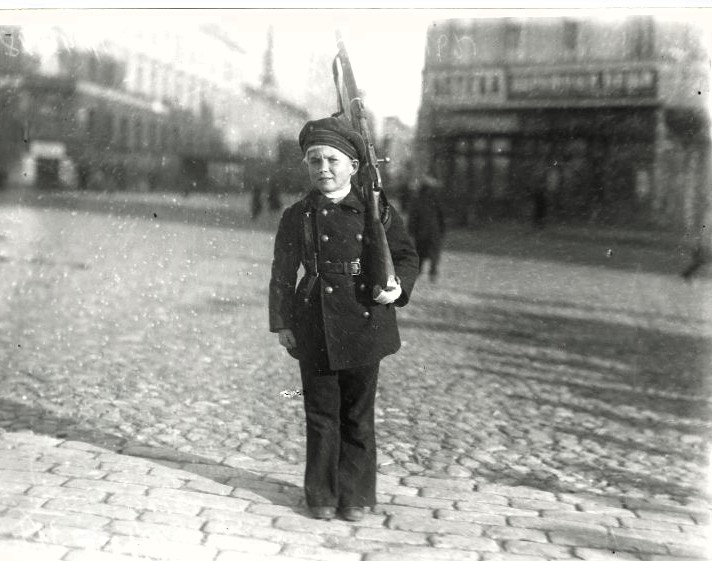
The years after the seizure of power in October, 1917 saw a colossal war, involving millions from dozens of countries and factions, that would redefine the aims of the Revolution and reshape the political geography of whole continents. During war politics are decided by force; the Revolution went with the Red Army, A sense of the scale, stakes, and drama of that history-making conflict, here at it height, is evident in the speech by Trotsky, Commissar of War and just from the front, to the Petrograd Soviet on September 11, 1919. Petrograd is threatened by the White’s Northwestern Army, based in Estonia with Finnish British Imperialist support, while another British forces pushes from Archangel. The offensive began shortly after this speech with White forces reaching the city suburbs by early October. After a popular mobilization stopped their forward motion, the 7th and 15th Red Armies counter-attacked, pushing the Whites to the Estonian frontier by late October and forcing British withdrawal from their Archangel base by the end of the year, ending the northern threats to the Capital of the Revolution.
‘Petrograd Does Not Yield!’ (1919) by Leon Trotsky from Truth (Duluth). Vol. 4 No. 30. July 23, 1920.
Trotzky Sends Out Ultimatum To Allied and Finnish Imperialists. Warns Them That Further Action On Their Part Lends Them Liable To The Consequences.
Mentioning the words of Mr. Churchill somewhere that fourteen nations were attacking Soviet Russia (Finland among the fourteen, Comrade Trotsky spoke as follows:
“Our western front is stationed on territory of such a nature that we cannot retreat even one mile, and we cannot afford to yield one quarter of an inch of ground to our enemies. This is the Petrograd, standing as it does on the coast of the Baltic Sea, is now the only door left to us which opens towards Western Europe. It is as dear to us as our eye–it is our eye. We cannot afford our Petrograd eye to be blinded by anyone; we must preserve our eye-sight. We cannot, and we will not, tolerate any approach too near Petrograd, great nerve centre of our country.
“Comrades, over and over again has it been said to you. and over and over again have you understood from our pronouncements that we have no desire to continue the war against Mannerheim or his present substitute, Ståhlberg. Similarly, we have no desire to fight Bourgeois Esthonia. We have other tasks, other problems, requiring attention. The struggle we have embarked upon, a struggle on a universal scale, will not be decided on the Esthonian or Finnish front–it will be decided on the front of the whole world. The result of that struggle depends on the action of the workers of Great Britain and France, on the action of the suppressed and subject races in Asia China, Persia, Afghanistan, and India. On these factors depends the result of our struggle against the imperialism of Great Britain, the most powerful, dangerous, cruel, and treacherous imperialism the world has ever seen.
“We know that the question of Esthonia and Finland will only be settled in this way. We know very well that the Finnish and Esthonian bourgeoisie stand on their feet only so long as they are supported by the ghoulish and monstrous centipede of British Imperialism. When you settle the struggles that involve London, Paris, India, Persia and China, the question of Finland and Esthonia will automatically settle itself. Once this is clearly grasped, it will be understood that not out of sympathy or desire for peace with the Ståhlberg and all the present rulers of Esthonia, Finland, and Lithuania do we now say emphatically that we have no desire to fight Esthonia. Furthermore, now that we are gaining the upper hand on the Esthonian frontier, we have officially proposed an armistice to the Estonian bourgeoisie, and hope that these preliminary steps will lead towards the conclusion of peace.
“You know that the conclusion of peace, whenever and wherever it was brought about, has never done us any harm. Our enemies, who were the hope and support of the Esthonian and Finnish bourgeoisie, have found their everlasting, peace in the churchyard, but we are alive and sound. The memory of Brest-Litovsk has passed into history but the Soviets are in existence, and therefore we can say calmly and convincingly to the Esthonian bourgeoisie. ‘Which kind of death do you select for yourselves? Death by way of open hostilities against us, or by way of your peaceful extinction?’ We can, therefore, quite calmly wait for their answer during the coming days, or weeks.
“We do not know in what way White Esthonia or White Finland is going to act. We have already learned some facts which lead us to believe that the Finnish White guards are at last about to abandon all adventures against Petrograd. You remember the time when their leader was Mannerheim. At that time the question of arranging the campaign against Petrograd seemed to have been almost decided. Mannerheim chose the neighbourhood of the river Terijokl as the manouvring place for his troops. That was in February. The whole enterprise ended most miserably for Mannerheim and his clique. Rank-and-file meetings were held in which the adventure-seeking policy of Mannerheim was severely criticized and condemned. Only two companies took part in the manoeuvres—only 300 men, according to reliable Finnish information. The expedition prepared against Petrograd was postponed—our counter-monoeuvres at Sielo-Ostrov having something to do with this postponement. We set a going courses of instruction for Red officers in Petrograd. We told them that if the danger came near the city they would get the honour of repelling it. These were our best troops. They enthusiastically accepted the prospects of such a great distinction. Since that time their number have been unchanged, but soon after that Mannerheim’s name was erased from the list of candidates for the Presidency, and in his stead was elected the colourless Professor Stahlberg, whose only activities seem to consist in trembling before the Entente and Mannerheimites, who, under the leadership of General Ignatieff, threaten to revolt If he does not manage things according to their ideas. These latter are the ‘activists’ of by gone times, the bourgeois and petty bourgeois officers who have no more courage than to put forward the claim for the annexation of Petrograd as a guarantee of getting a warm port for Finland on the coast of the Arctic Ocean.
“These are their childish expectations. Some time ago I was reading the epic poetry of the Finnish nation—the Kalevala. It Is a collection of popular legends, myths and fables. It is a dissertation on the poetic spirit of the Finnish people, and shows that the Finns are an able and talented nation, who have in front of them a high culture and mental development. Comrades, in these songs and stories are hidden, to a certain extent, the ideas which the young Finn ‘activists’ now embody. It is related in ‘Kalevala’ how once upon a time there was an enormously big hen which laid an egg from which the earth and the sun were hatched. In another part of the book it is stated that there was an axe of such fabulous dimensions that it took exactly 87 hours for a bird to fly from one end of it to the other. That is only imagination and phantasy on the part of an ancient people; but if the Finnish ‘activists’ could capture Petrograd. It would mean the realisation of their fable—the Finnish hen hatching the earth and the sun.
“But the Finnish ‘activists’ have not the pluck to strike us a blow by themselves, alone and unaided. Behind their backs stands England, which says to Stahlberg—‘You must do what Mannerheim promised to do! Thanks to your professional love of peace and professorial vacillation, we mobilise in Finland every one we can, arm them, and send them against Petrograd’. So England looks upon Finland as a piece of coal or a heap of straw to be thrown into the fire of civil war. England does not care though the consequences prove most precarious for Finland. England’s only concern is to use the Finns as tools to perform blood-letting on the Russian workers and peasants, and that section of the Finnish bourgeoisie which allows itself to be humble lackey of British Imperialism is the most accursed traitor to the Finnish working class.
“And we, comrades, and with us Red Petrograd and its Soviet, give our word of honour that we will not tolerate indefinitely that such a small country which got its independence through the November Revolution, shall remain a hotbed of all sorts of intrigues and conspiracies against us. That country received its independence without a fight, and offers us now in return every kind of plot piratical expeditions into our territory, attacks on our frontier guards, etc. It constantly threatens and provokes us; it is a secure refuge for Yudenitch, Rodsjanko, and others. Just now our enemies are concentrating in Helsingfors great stores of military equipment. Each day sees the arrival of tanks for use against us.
“They tell the most ignominious lies to their people; they cheat them by untrustworthy information and venomous chauvinism. They are trying to organise two or three army corps, officered by Englishmen, to be moved against us. On any other part of our vast battle-front these preparations would be of small significance for us, but on the Petrograd front we cannot tolerate it—on the Petrograd front we must act, and act quickly. We know the plans of our adversaries. We know also quite well the internal conditions in Finland we know for whom the chains are being forged there. Each tank of theirs, each battalion is noted on our list. We know when and where they are going to be sent. We have long since made all the necessary preparations to repel with bloodshed all the treacherous attacks of the Finns.
“Of course, we do not for one moment entertain the idea of violating Finland’s independence, so long as the Finns behave with decency, stop all their piratical enterprises against our frontiers, and give up their mad idea of capturing Petrograd. On our part we shall refrain from every form of reprisal. Not a single Red soldier shall cross the Finnish frontier, but at the same time we have concentrated there all necessary forces, so that we can rest assured that at the first serious attempt of the Finnish buccaneers, Churchill, Lloyd-George, and Stahlberg will be informed that the same road which leads from Helsingfors, and Viborg to Petrograd leads also from Petrograd to Viborg and Helsingfors. An a further—if the Red Terror ever achieved anything—we shall now say to the Finnish bourgeoisie; ‘You treacherously deprived the Finnish working class of their freedom and independence. Looking forward to the logical development of the Universal Revolution, we have not touched you. You sold young Red Finland, first to the Germans, and afterwards to the English. We did not touch you. You sent the aeroplanes—we tolerated it. You dropped bombs on the women and children—we tolerated it. The moral right is with us. Although we knew that the suppressed workers in Finland would hail enthusiastically the advent of our Red troops, we did not send them—we did not wish to be entangled in an act of provocation. But now, when provocation becomes more and more insistent, when it culminates in a military adventure against Petrograd, we say that every bourgeois becomes responsible for every collective counter-revolutionary attempt against our Red Capital. Every bourgeois in Viborg and Helsingfors must settle his account if, thanks to their provocation, our troops invade Finland.’
“’But,’ one may say to us, ‘that is revenge!’ Comrades, the policy of revenge is foreign to us; but there are moments when revenge becomes a necessary revolutionary factor. English capitalists are too impotent to wage war against us; they slip their hounds upon us—the total number of these hounds, according to their over-lord, Churchill, being fourteen. These hounds close their teeth in the bodies of the Russian workers, at the same time sucking the blood and betraying the interests of their own working classes. We must now show that we cannot have these petty bandits, while serving the interests of the universal pirates biting and tearing the bodies of the Russian workers and peasants. And a practical lesson will first be given to Finland; Finland will be the first to come under the fist of the Red Army and will be well rewarded for all the panic, provocation, conspiracies, and treason hatched by her. We shall strangle her mercilessly. Comrades, we have concentrated brave divisions at Petrograd which will be reliable reserves for you when you start your manoeuvres.
“I conceal nothing. The Finnish upper classes have had plenty of time to examine our words; in all probability they are in possession of plenty of facts to corroborate our words. We have concentrated forces, both adequate and reliable, at the proper place. I am not going to name these forces or their numbers.

“Comrades! You know the enthusiasm with which the peoples of Asia greet our advancing troops. Soviets have granted to the Bashkirs the fullest self-determination and independence, with the result that they are now organising with the greatest enthusiasm their contingents of Red cavalry and infantry. The Bashkirs know very well who Koltchak is; they have been in his school and have finished his course as the best and most reliable supporters of the Soviets. In the South, in Ukraine, the first Bashkir regiments showed that they were excellent soldiers. Among them are many heroes, but, unfortunately, they are not yet sufficiently developed politically. Petrograd must be for them the promised academy.
“Comrades, we will give you the Bashkir division. Their commanders—the Communists and revolutionary fighters anxiously inquired as to how they would be accepted—they wondered if their coming would be likely to cause misunderstanding or racial hatred. I replied to the questions of these young comrades by telling them that they do not yet know the Petrograd proletariat. I said to them—‘The workers of Petrograd accept the First Bashkir Division as brothers, and will help them in their cultural and political development.’ We have already said, and will again say to these Bashkirs, who have been drawn for the first time into revolutionary and political activities. ‘Do you know Koltchak, who persecuted, hanged and shot you? The Finnish bourgeoisie is the ally of Koltchak they help him to seize power.’ At the very time when the Finnish bourgeoisie in Helsingfors and Viborg, following the prescriptions and orders of the English generals, send their vanguards against us, we gather the Petrograd workers and Bashkir cavalry and say to them that they are about to have their revenge for the cruelties of Koltchak.
“I repeat, the rulers of Finland have plenty of time to scrutinize every word. I have been empowered to utter here. These gentlemen have themselves commenced a very dangerous game. We will not slip on the orange peels, in the shape of Finland, which Great Britain throws in our way. We must stand firm and unshakable here on the coast of the Baltic Sea, looking steadfastly to the West. The Finnish question, therefore, is not an ordinary one to us; it is not simply one of ‘the fourteen’. No! It is an extraordinary question to which we are entitled to give an extraordinary answer. Its extraordinary importance does not involve any of our other numerous battle-fronts. It does not matter when we finish Denikin whether in one, two, three, or six months. We shall concentrate our best forces against Finland, and Viborg and Helsingfors must meet the expense. Correctly speaking, the most stubborn and decisive battles are in front of us. We must strain ourselves to an even greater degree than we have hitherto done. Our enemy is not yet broken. A few days ago we got a secret message from England. Our friends, the Communists, there write:—‘Your progress in the heroic struggle against counterrevolution fills our hearts with the greatest admiration. Many forces in our land which were inert up to the present are now becoming active. Everything goes to show more and more clearly that England will soon stand on the threshold of Revolution.’
“How will the Revolution break out? Will It take place in London, carried thither from Paris, or will it blaze out in Aasia, among the enslaved natives of the colonies? We cannot tell beforehand. But it is a fact that our advance in Siberia and Turkestan fills the hearts of Asiatic peoples, suppressed by the English, with revolutionary enthusiasm. This revolutionary fervour calmed down when Koltchak drove us towards the Volga. Now, occupying Aktjubinsk, the question of our uniting with Soviet Turkestan will be settled in the next few days—with Soviet Turkestan, whose nearest neighbor Afghanistan, is revolting against English tyranny; India, seething with discontent; and enslaved China, which expects us anxiously and hopefully.
“We walk through the gateways of Asia, we—the shadow of death for the English and French Stock Exchanges. Who knows—probably the way to London and Paris goes through China, and India, and Persia, and Afghanistan. There will we strike, and strike hard, at the Imperialism of Great Britain. There we will transform Great Britain into an evil and isolated island where the bourgeoisie will strip ten hides from the proletariat. Before us stand these enormous and gigantic historical problems. We are wakening up the whole continent of Asia. Each day we get news that the movement there goes deeper and deeper; that it is taking root in never layers of the working masses. We stand as the impregnable fortress of the Workers of the World, on the boundary line between the Urals and Moscow, between Europe and China, between England and China. We are not now what we were two years ago—courageous adventures only. We are not now what we were on the first anniversary of the November Revolution when we were starting the reorganisation of our Red Army. No! Now we are organized, disciplined, and armed. We have evolved from chaos; we are now on firm ground.
“Our munition factories are working so smoothly that I can say with confidence; It does not matter how long the international financiers compel us to fight. I think we can wage war for a longer period than many people suppose we can. Our soldiers will have abundant supplies of rifles, bayonets, cartridges, machine-guns, and boots.
“There is now no slackness in military supplies to strangle us. It follows in such an army, which is used to conquering, which can sweep the counter-revolutionary forces from the surface of the earth, which can advance our frontier so far westward that the people will say. ‘Here is the frontier of the Federated Soviet Republics.’ In the ranks of such an army grow and develop the best organisers for other public activities.
“Comrades, history compels the Russian proletarians to enter the ranks of the Red Army, and there to acquire strength initiative, firmness, resolution, understanding—the knowledge both to give and is execute orders. Such an extraordinary school is bestowed on our working class—on the vanguard of our working class.
“That Commissary whose place is now at the head of the regiment will be indistinguishable when he goes back to peaceful civilian work. Unfortunately not all of them go back. Many of them, like heroes, have fallen in battle. At some future time the great poets of the working class will describe, with words of fire, the immortal deeds of these heroic Workers’ Commissaries who carried on their shoulders the burden of these heroic battles for the benefit and welfare of the Workers of the World. The great writers of the times to come will give us impressive descriptions of the sufferings and self-sacrifice of these heroes—the Commissaries. But the majority have come back at the head of their victorious regiments, and now devote themselves to productive work on the field of economic and cultural activities.
“And if we were capable, when hungry, destitute and exhausted, pressed on every side by our unscrupulous enemies English, French and, formerly, Germans—to organise almost with bare hands our Red Army of workers and peasants, and beat all our adversaries if we were capable at doing that, it means that we are capable of doing anything. We also will be capable, with our constructive army, of overcoming all difficulties on the battlefield of our economic and cultured life—on our bloodless front.
“We will show to the whole world how the working class in one of the most backward countries in the world, subject ail the time to the most pitiless blows of history, can, in a comparatively short time—in two or three years—not only ascend from the bottomless slough of destitution and misery, but by tremendous leaps reach an unheard-of altitude, becoming the organiser, the standard-bearer and emancipator of the Workers of the World. Remember, the eyes of the whole world are watching the struggle, suffering and progress of the Russian working class.
“No! Finland cannot overthrow us—never!
“History has appointed us to solve these titanic problems. We, cannot perish, because the great Working Class cannot perish!”
(Translated from “Viestl” (Finland) by J.R.)
Truth emerged from the The Duluth Labor Leader, a weekly English language publication of the Scandinavian local of the Socialist Party in Duluth, Minnesota and began on May Day, 1917 as a Left Wing alternative to the Duluth Labor World. The paper was aligned to both the SP and the I.W.W. leading to the paper being closed down in the first big anti-I.W.W. raids in September, 1917. The paper was reborn as Truth, with the Duluth Scandinavian Socialists joining the Communist Labor Party of America in 1919. Shortly after the editor, Jack Carney, was arrested and convicted of espionage in 1920. Truth continued to publish with a new editor J.O. Bentall until 1923 as an unofficial paper of the C.P.
Access to full issue: https://www.mnhs.org/newspapers/lccn/sn89081142/1920-07-23/ed-1/seq-1

