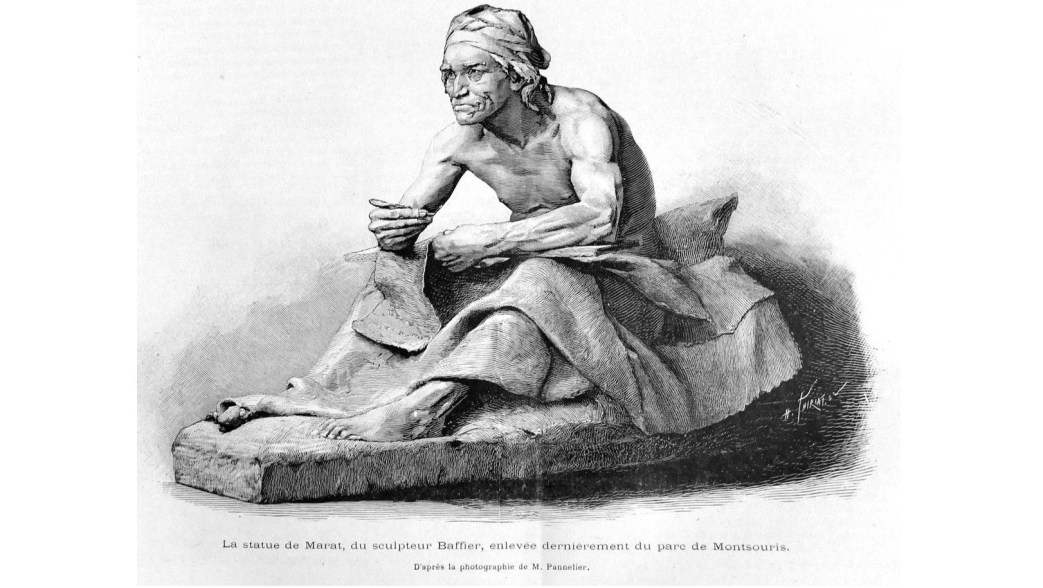
Marat’s early vision for the Revolution is set forth in these letters to his erstwhile friend, Camille Desmoulins.
‘Letters to Desmoulins’ (1790) by Jean Paul Marat from Writings and Speeches. Voices of Revolt No. 2. International Publishers, New York. 1927.
MARAT TO DESMOULINS (June 24, 1790)
Early in the Revolution, Marat, who was somewhat older than Camille Desmoulins, had felt a genuine friendship for this young and ardent revolutionary, who was issuing the weekly paper, Revolutions de la France et de Brabant. In the course of time, however, Marat was brought to recognize the vacillating opportunist character of Desmoulins and did not hesitate to express his criticism of his former friend.
***
A LETTER from the Friend of the People to the Editor of the Revolutions de la France et de Brabant:
In order to establish a truly free constitution, i.e., one that will be truly just and wise, the foremost requirement is to have all laws approved by the people and to install preliminary searching examinations, particularly, to give the people time enough to watch the various machinations, which presupposes a maturity of the national spirit and the formation of a public opinion concerning all fundamental points. The decrees of the National Assembly can, therefore, be nothing but provisional measures until they have been sanctioned by the Nation; for the right to sanction them pertains exclusively to the Nation. Failing the execution of this essential, inalienable, direct and immediate right, it would subject itself to blindly operative laws of caprice and its representatives, who are exploiting their power to command the people, according to their own whims, would find themselves in the possession of the supreme power. They would become the absolute masters of the nation’s fate and would thus remain the final rulers of the State. This culmination, which was not attained even by our kings after fifteen centuries of encroachments on the rights of the people, was the object of their efforts and designs, their hopes and aspirations, but they carefully concealed this goal. And the National Assembly, this embryo of a day, which was not created by the people, this posthumous child of despotism, this disgracefully constructed body, in which there are so many enemies of the Revolution and so few true friends of our country? This illegal body, which the Nation has rather tolerated than created, would it have the audacity to go so far; would it possess the impudence to boast of such a step? Such a claim would be the acme of boldness, if it were not really the pinnacle of insanity.
We might say to them: You petty intriguers, who owe your seats in the Senate only to intrigues, to petty devices, to corruption or to election by a few privileged castes that have now disappeared, cease your attempts to put us under the yoke. The first of your attempted crimes was to recognize the King “Veto of Postponement”; the right of veto–of absolute veto–inheres in the people alone. The people will accept this right with eagerness and will pass over to the order of the day in spite of your faithless actions. You are already at the end of your political existence; soon you will be dissolved in the mass and your works will be your judgment; the Nation will weigh your labors according to its wisdom, and of the great mass of decrees which you have taken pains to transform into irrevocable laws, it will retain only those that are in accord with the common weal; it will reject with scorn all those ill-devised decrees that have sprung from your ignorance; it will reject with abomination all the vicious decrees that have resulted from your corruptibility; and your names, engraved in the annals of the Revolution, will be preserved only as a means of unmasking your shame and your ridiculousness! Believe me, faithful companion in arms (Desmoulins), that nothing is more important for a victory of Liberty, for the happiness of the Nation, than to enlighten the citizens as to their rights, and to create a public opinion. Therefore I summon you to labor without ceasing; publish in our periodical prints a number of selected drafts for the best possible constitution; this is the only means we have of evaluating the labors of our representatives at their true worth.
I shall begin the series:
The serious demands of those that have nothing, on those that have everything.
Assembled Law-givers!
The nation consists of 25,000,000 persons; we alone constitute more than two-thirds of this number and yet are nobodies in the State, or at least, if you speak of us at all in your sublime decrees, it is only to humble us, to oppress us, and enslave us. Under the old regime, such neglect on your part, such treatment at your hands, would hardly have appeared unreasonable; we lived under rulers who considered that the whole nation was merely themselves; we were nothing in their eyes, and only when it was a question of robbing us of the fruits of our labor or of harnessing us to their own chariots, would they deign to consider us at all.
Those times are past. But what have we gained? In the first days of this Revolution, which turned so many heads, which was the occasion for so many shouts of joy and intoning of Te Deum, of this Revolution that has elevated so ·many writers to the skies, celebrating them in so many festivals, and which admires so many blockheads to this day, our hearts were opened to joy for at least a moment. We cradled ourselves in hopes that our sufferings would end and our lot improve.
Desirable though the changes may be that have been introduced in the State, they are all for the rich alone; Heaven was always hard on the poor, and this will always be the case.
Assembled Law-givers! You term yourselves representatives of the people, you allege that you have formulated its demands and safeguarded its rights. Yet, what have you done for us? No doubt you will say: we have worked in order to liberate the Nation. Very well! But of what use is political liberty to us, to us who have never known such liberty and never will know it? It is of value only in the eyes of the thinker who would teach men, of the publicist who would make a name for himself, of those citizens who would have no ruler at all; but we poor unfortunates have no time to ponder these matters. (What would become of the nations if the poor should be as conscious of their rights as the philosophers, and if their minds should permit them to appreciate their terrible situation!) We rarely intervene in the affairs of the State and even if this should occasionally be the case, we play the part of onlookers only!
We were never much impressed with the liberty of citizens, and we shall never take it seriously again. Why should we have any illusions on this matter? Under the so-called rule of liberty we are worse off than under despotism. We are exposed a hundred times more to the affronts of the petty accomplices of our tyrants than we ever were under the terror of Kings’ bailiffs. We have no one to whom to present our complaints, no one from whom we may demand justice. Our Section Commissaires, our Justices of the Peace, our state officials, all have retained their old posts. In our new administration, you can find more of the old people that were in the former administration, and, in addition, new intriguers, new ambitious rascals, new scoundrels of still less dignity. All of these are the accomplices of the old regime who apply extortion to us, plunder us, incite us and oppress us, at their pleasure; in broad daylight they enter our houses, and drag us from our homes in the dark of night, for no other reason than their own caprice. Our police courts and our district courts are as badly organized as were our old chief courts of the provinces.
What more can we say to you? Formerly we had half a million tyrants; to-day we have a million oppressors! Assembled Law-givers! You hand us over to their mercies defenseless; and by the lack of interest you show in our security and our peace, we can fully understand, in spite of your principles of liberty, in spite of your big words about equality of rank and equality of the conditions of life, that we remain nothing but a low rabble in your eyes.
Furthermore, in the matter of true inner liberty, which cannot exist at all for them that have nothing, the lot that is in store for us is an eternal serfdom. Since we are fettered all day long at our labor, whether we be day laborers or servants, we can achieve no higher lot than to be constantly at the beck and call of a hard and exacting master.
You know well that this inestimable possession of liberty that will be yours does not exist for us; in this respect, we are therefore as alien to the accomplishments of the Revolution as if we were not citizens of the State at all.
You have solidified possession in the law and placed it under the protection of the Constitution. But how slight is the value of these regulations for a man who has no possessions to administer, no interests to defend I What can property itself mean for the poor?
You have destroyed traditional privileges, you have introduced a greater degree of equality among the upper classes of citizens, a better distribution of taxes. These forms, all of which are to your advantage, are still indifferent to us. Even though you have distributed taxes more justly among the great fortunes, you still permit them to weigh as a heavy burden on the poor; the bread the poor man eats, the wine he drinks, the cloth his clothes are made of–these are burdened with heavy taxes. How is it possible for you not to feel that it is a demand of justice that the disinherited be freed from these taxes? How were you able to escape the feeling that taxes should not exist for him who is held down by his poverty below the level of the fulfillment of the most necessary bodily needs, that for him taxes must be an unbearable burden?
Far from affording us your aid, you have cruelly and barbarously taken from us everything we once had. The possessions of the Church were the patrimony of the poor; you have taken from them this patrimony in order to defray the expenses of the follies of the government, the extravagances of the ministers, the extortions of the administrators, the shameful splendor of the court, the impostures and piracies of the vampires of the State. You have alleged your intention of eliminating the abuses of the clergy; and yet you have permitted the crozier and the miter to retain an immense portion of the possessions that actually belong to us; you have not made any effort to assure us even a small fraction of these possessions, and the clerical officials now hold them as their property, as a claim to indemnities with which they can continue to secure all the good things of life to which they are accustomed.
In the reading of our decrees concerning holders of benefices, bishops and archbishops, who, depending on the case, draw either their full salaries, or one-half, or one-third, or one-fourth of their salaries, one might take these saintly personages for chief rabbis who are cashing in on their usurious claims.
We are at last being given, for all the underfed persons in the kingdom, fifteen millions taken from the estates of the Church, which had been taken away from the poor under the pretext that they were to be used in payment of the obligations of the State; this means, once they are paid, about thirty-five sous per head of the population; and yet, through one of your leaders, you appropriated nineteen millions for the purpose of paying the debts of a scamp who happened to be born close to the throne, a shameful wastrel, whose obscene dissipations are the least of his crimes, an enemy of our country, who has finally become a disgusting conspirator (d’ Artois). What shall be inferred from all this? All these advantages enjoyed by the rich with the aid of our ordinances, and as a result of their possessions, are of no value to us. And in this respect we have been sacrificed by the Revolution just as if we were not members of the State at all.
Up to the present time, the new order of things exists entirely for the advantage of the rich and the intriguers: but this is only a portion of their privileges. Assembled Law-givers! You have pretended to be trying to assure all citizens, as a result of the most careful study, equal rights, for the great good of the entire country; and you made it a condition that offices, positions, honorary appointments, should be bestowed only by reason of talent and virtue. All this would have been wonderful, if you had not made every effort to destroy your own work. After the manner of stage magicians, you have caused one concession after the other to disappear. Hardly had you declared that free and equal citizens should be appointed to positions without discrimination by virtue of their fitness alone, for discharging the duties of such positions, than you added: but they may not represent the nation unless they pay a direct tax of one silver mark; unless they pay a direct tax of ten livres they cannot become electors; unless they pay a direct tax of three livres, they cannot enter into the possession of civic rights. In this manner, by means of these petty provisions, you have succeeded in shutting us off from admission to the Senate, to the courts, to the leading posts, to the magistracy. You declare us incapable, in the name of the law, of filling any of the positions to which you have summoned us by virtue of our natural rights; and now–the culmination of your injustice–you go so far as to declare us incapable of appointing those who are to represent us, so far as to deny us even the quality of citizens. Your famous Declaration of the Rights of Man was merely a shameful deception for the delectation of the simple-minded, since you feared their wrath; for, when more carefully examined, this Declaration of the Rights of Man amounts merely to a promise that the rich shall enjoy all the advantages and honors of the new regime. It appears, therefore, that the glorious Revolution was made only to benefit those who were the sole enjoyers of the blessings of the century. But if this famous decree, which makes talent and virtue the sole condition for attaining public office, were not meant merely as a parody, it would, nevertheless, have no value for us. Thrown back again upon our poverty, we can serve our country in no other way than with the strength of our arms, as we have always served it. In this way, you alone enjoy the privilege of commanding others, we are asked only to obey, to devote to the State our labors, our fatigue, our sufferings. The advantages of the Constitution for us amount to nothing more nor less than the privilege of remaining in filth and misery.
***
MARAT TO DESMOULINS (August, 1790)
IN spite of all your cleverness, my dear Camille, you are still quite a novice in politics. Perhaps the amiable frivolity which is the basis of your character and which permits your pen to disport itself in the most serious fields, serves as an obstacle to reflection and to serious and sound discussion. It is with reluctance that I tell you that your pen, which belongs to our country, would serve it to greater advantage, if your path were firm and straight; but you are irresolute in your judgment; you censure to-day what you will approve to-morrow; you glorify unknown persons for insignificant performances; you appear to have neither plan nor goal, and you cap the climax of your silliness by obstructing the labors of your friend and holding back his blows in his struggle–during these moments of crisis–when he deals passionate and inspired blows for the common cause, and when the people appear to hope for nothing except from their despair.
The inappropriate and yet bitter reproofs addressed to me by you in your paper, might deprive the cause of freedom of its most zealous defender. For they rob me of the confidence of a great number of citizens who are not in a good position to pass sound judgment on me. It is this solitude that moves me to-day to take the sad step of expounding to you the motive for my conduct during the period of the Revolution. If you had taken the pains to follow my course, you would have judged it more soundly and you would have spared me the humiliation of being obliged to explain things to you that should not have escaped your attention.
Marat now makes reference to the appeal printed above, “Are We Undone?” in which he declares the use of terror against counter-revolutionists to be the only means of safeguarding the Revolution. Desmoulins had opposed this measure. Marat continues:
Is there any one that does not know that this patriotic document, which was denounced by a miserable scoundrel, was considered a crime against the Nation only by men who had joined in a conspiracy against liberty, who were the slaves of vice and the purchasable creatures of injustice, who make it their sport to conspire against their country and their duty to murder its most zealous defenders? But, l am by no means inclined to be displeased with their disapproval, since I regard it rather as a certificate of honor.
Indignant at the conspiracies again and again cropping up by reason of ancient prejudices, disquieted by the reports of the enemy’s approach, and convinced that it will be impossible for us to escape the horrors of civil war if we do not finally make up our minds to cut off the heads of those most responsible for the present situation, the author of this document summons the people to take possession of the ring-leaders of the conspirators. Horrified at the thought of the boundless misfortune that would be the inevitable consequence of their triumph, he reminded the people that five or six hundred heads cut off would assure the people liberty and happiness forever, and that–if these heads should be spared for any considerations of mistaken humanity–millions of innocent persons would be condemned to die a frightful death.
Present this alternative even to those wise men who consider themselves men of leniency, and I doubt whether one of them will hesitate. But let the enemy once cross the boundaries, and the most peaceful citizens will go far beyond the author’s present demands, and you yourself, dear Camille, will bitterly regret the failure to punish all of the traitors to the Nation!
Writings and Speeches of Jean Paul Marat. Voices of Revolt No. 2. International Publishers, New York. 1927.
PDF of original book: https://www.marxists.org/history/usa/parties/cpusa/voices-of-revolt/02-Jean-Paul-Marat-VOR-ocr.pdf

