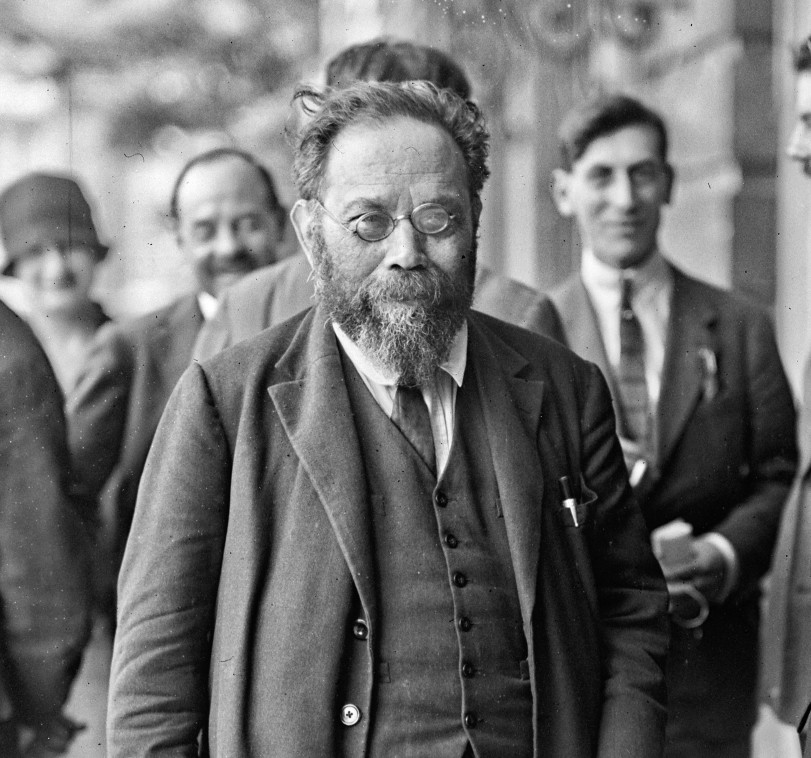
In damning the reformists and opportunists of his day, Rappoport also damns them in ours.
‘The Failure of Reformism in Italy’ by Charles Rappoport from The New York Call. Vol. 3 No. 364. December 30, 1910.
You are quite in error if you think that reformism is a doctrine or a method striving to obtain positive results.
Reformism is rather a romantic tale for peace-dreamers. It is the beautiful dream of noble democrats who, having acquired a taste for economy, desire also to economize a revolution.
The reformistic Machiavellis are also miracle performers. They transform bourgeois flattery into ministerial portfolios. They undertake to keep watch over the capitalist booty in exchange for a few capitalist tips, which are always promised but never paid. If the reformists had made a serious effort for the realization of reforms, they would by this time be aware of the fact that their work is fruitless. We have plenty of reformers, but we lack reforms. Reformists climbing, reforms declining–this is the net result of international reformism.
The uncompromising doctrinaire reformists resemble in many respects the uncompromising anarchists. The ones as well as the others believe in dogma, refusing to be convinced by everyday experience. For the reformists, the catastrophic dogma is displaced by the reformistic dogma, short-cut Socialism by piecemeal Socialism, the miracle of direct action by the miracle of peaceful, democratic and governmental reform. The former believe in violence only, the latter are fascinated by the charms of the fusion policy. It is in vain that recent history in all countries, including! Russia, bas accomplished numberless instances of bad faith and treason on the part of bourgeois democracy. Our happy opportunists close their eyes, stuff their ears) and continue to dream democratic alliances and fusion. There, and only there, according to them, lies salvation for Socialism, otherwise to be realized in geological periods to come.
The Milan congress brought into evidence a new failure of reformism. The reformistic experiment was being carried out under almost ideal conditions. Since the Florence congress of 1908 the opportunists were the masters of the party and of its central organ. Avanti, edited by a man of great ability, Bissolati, an incurable ministerialist. The syndicalists, devoted disciples of Georges Sorel, left the field clear, being absorbed in the exercise of “revolutionary gymnastics.” The kind and generous Morgari, who dreams of the integral unity of doctrines and methods, watched the reformistic flood, a sad spectator, unable to act. And what were the results of the reformistic supremacy in the Socialist party? A decline of the party recognized and conceded by everybody. The party, already weakened by the withdrawal of the syndicalists, lost other members by the thousands. The press languished. No enthusiasm, no action.
And to crown all this, a reformist leader, Bissolati himself, declares that the party is a “dead branch.”
Bissolati wants to “liquidate” by turning over control of the party to the ultra reformistic trade unions,
This is quite logical. To the opportunist, Socialism is nothing: the reforms always promised but never realized–are everything. It is the function of the trade unions to demand reforms. What need, then, for the party? Let it die! Bissolati would gladly change the party for reform democracy, but as the latter shines through its absence, the working class is called upon to carry out this democratic program, and nothing else. The reforms become proletarian, a class reformism, with its nature unchanged, windy meat for hungry proletarian stomachs. Illusions and mirages do not become realities because a part of the working class in charmed by them. So much the worse for those who fail to see the capitalistic reality!
Italian reformism is like French reformism. In fact, we may say that one proceeds from the other. Just as the Italian anarchistic-syndicalism is a French importation.
The theoretical leader of Italian reformism is Turati, a great and noble poet, who gives to the service of reformism an imagination of Oriental richness and a style really prodigious.
When you ask him why he, a convinced ministerialist, “obstinately refuses power” while the ex-revolutionist Ferri shamefully begs for it, he answers, “The party is not rich enough to buy an automobile. The party is not ripe for such a supreme honor.” When you ask him why he never speaks of Socialism, substituting for it reformistic dreams, he answers, “While one climbs a mountain one does not see the top.”
The prosaic truth is entirely different. The party is not ripe for power because it is not corrupted, and Turati is too honest to play the role of an Italian Briand.
When one ceases to make Socialist propaganda and to push to the front the fundamental vice of the existing regime–monopolized property, and the only remedy for it–class organization having in view the transformation of property, one ceases to be a Socialist and becomes a bad democrat. Under a false Socialist label they peddle around the immediate demands.
The opportunists obstinately refuse to understand that the reformatory capacity of the capitalist regime, preoccupied with the problem of self-preservation and overburdened by military expenditures, is extremely insignificant. They are not realists, but empirics.
There is an abyss between empiricism and realism. The realists have in view the whole, the great historical reality of the powers that are born, grow and develop. They do not see only what exists, but also and especially what will come. The empirics, on the contrary, see only the small reality of the moment, which passes and disappears. They are the prisoners of the temporary, the slaves of the actual, the worshipers of fact, which often is only an accident, a passing moment. They see only that which shines, the surface and not the bottom of things, the ephemeral powers which occupy the political stage, the official scenery, and not the real powers which undermine the regime. The opportunist impressed by the official powers, which are foreign or hostile to us, and is prone to neglect our own power, which is in formation, the power of the working class. He deserts his legitimate class to flirt with the enemy’s class. Thus he condemns himself to sterility, if not to the shame and disaster we witness in France.
The reformistic empiricism does not concede that the best way to obtain some reforms from the regime is to have a great Socialist party attacking the regime at its heart—property–and a working class strongly organized and self-conscious.
The rest is bad literature, poetry–in reformistic prose.
The New York Call was the first English-language Socialist daily paper in New York City and the second in the US after the Chicago Daily Socialist. The paper was the center of the Socialist Party and under the influence of Morris Hillquit, Charles Ervin, Julius Gerber, and William Butscher. The paper was opposed to World War One, and, unsurprising given the era’s fluidity, ambivalent on the Russian Revolution even after the expulsion of the SP’s Left Wing. The paper is an invaluable resource for information on the city’s workers movement and history and one of the most important papers in the history of US socialism. The paper ran from 1908 until 1923.
PDF of full issue: https://www.marxists.org/history/usa/pubs/the-new-york-call/1910/101230-newyorkcall-v03n364.pdf

