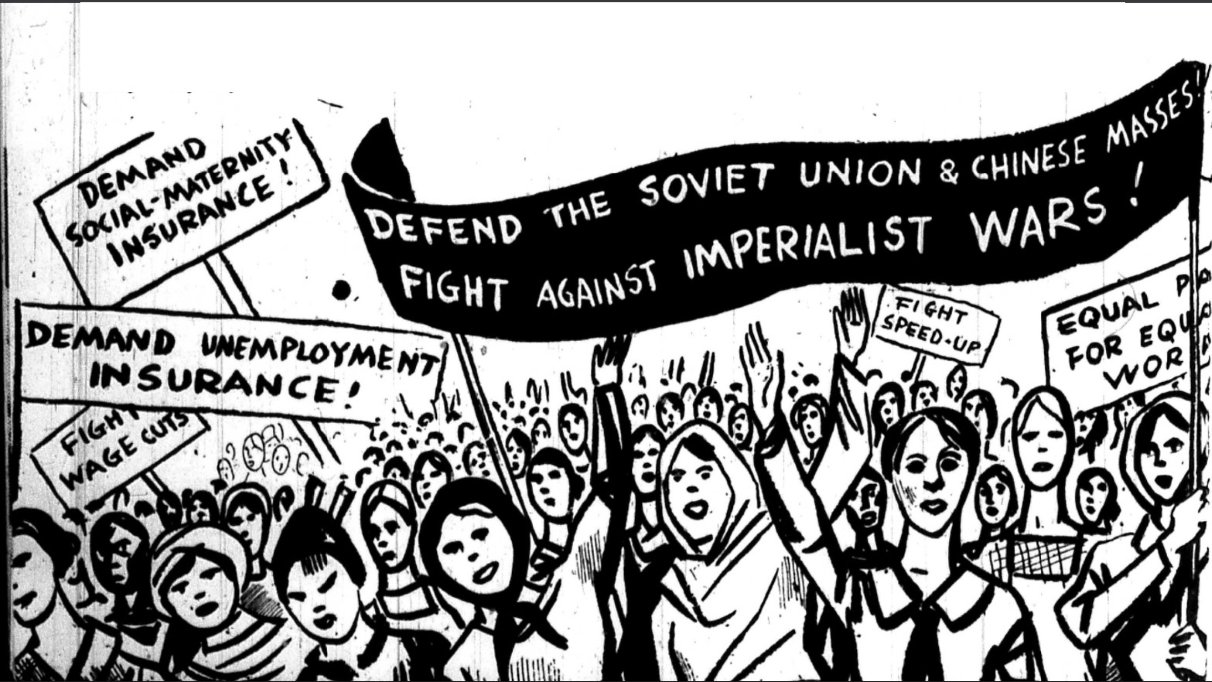
Anna Damon reports on women’s issues and participation as the Party’s 8th national c0nference held in Cleveland in April, 1934.
‘Women and the Communist Party Convention’ by Anna Damon from Working Woman. Vol. 5 No. 4. April, 1934.
Five hundred regular and fraternal states delegates from forty-two gathered in Cleveland, April 2-9, for the Eighth National Convention of the Communist Party of the U.S.A. This great gathering’s plan of struggle against capitalism adopted by the miners, steel, auto, textile, railroad and other workers and farmers, is of outstanding significance to the entire American working class, for it represents the interest of all the oppressed and exploited masses.
The keynote of the deliberations and decisions of the Convention was given in the masterful report of the general secretary of the Communist Party, Comrade Earl Browder.
“The world stands on the brink of revolutions and wars…Even the United States, still the strongest fortress of world capitalism, has been stripped of its last shred of ‘exceptionalism’, stands fully exposed to the fury of the storms of crisis, and, relatively speaking, is registering its deepest effects. The economic losses due to the crisis, in the United States alone begin to approach the figure of total losses of the World War.
“A great upsurge of class struggles is sweeping the capitalist world. In the United States the upsurge of mass resistance to the capitalist policy of driving the masses into starvation, a policy intensified behind the demagogic cloak of Roosevelt’s New Deal, has already been answered by the capitalists with machine guns…Fascism is rearing its ugly head more and more boldly every day in the U.S.A.”
The report of the Central Committee reviewed in simple words the struggles led by the Communist Party since the Seventh Convention in the interest of the toiling masses. It showed the Communist Party was the only political party which sounded the alarm against the treachery of the N.R.A. at its very inception and led the workers in strikes and struggles against the miseries of the N.R.A., fighting for higher wages and shorter hours, against killing speed-up.
The activities of the Scottsboro case signalized the Party as the champion of the oppressed Negro masses leading the struggle for Negro liberation and the right for self-determination in the Black Belt. It showed the Party as the leader and organizer of demonstrations and hunger marches.
As a result of these activities the Party grew from 7,500 members in 1930 to 24,536 in 1934. Thunderous applause greeted the report amid great enthusiasm delegates remained standing, cheering and singing revolutionary songs.
The co-report of Comrade Stachel dealt mainly with economic struggles–the united front activities based around the immediate demands of the workers. It showed the great headway made in leading the strikes of the workers against the N.R.A., the growth of the industrial unions of the T.U.U.L. and our opposition work in the American Federation of Labor.
Other reports of various fields of work were given by Comrades Hathaway, Haywood, Puro and Brown. While all the reports showed definite headway made by the Party there was no self-satisfaction with the progress made. On the contrary, there was a most self-critical examination of the mistakes and short-comings in the work and a determination for overcoming them. Great stress was laid on increasing the among the youth, the women, paying tempo of the Party’s mass work, particular attention to work in the shops, mines and mills in basic industries.
Problems confronting the Party’s work among women, the need of fighting for their daily needs, was sounded in the main report of comrade Browder.
“Special attention is also necessary to the tasks of winning and organizing women industrial workers and housewives in the revolutionary movement. The capitalist class has drawn women into industry on a much larger scale than we have drawn into revolutionary activities and organizations. We will continue to lag behind the capitalists in this respect only at the price of continued weakness in the revolutionary movement. This question becomes all the more pressing because we are faced with a perspective of imperialist war in the near future. Under war conditions, everybody knows vast additional masses of women will be drawn into industry and especially into munitions manufacturing. Furthermore, large scale mobilization of women workers into the armies will create gaps in our ranks which can only be filled by the bold promotion of women workers. That means we should long ago have been seriously and systematically preparing the women forces and boldly promoting them to leading responsible posts. The mobilization of masses of women workers requires special attention to their particular needs, formulation of special demands, the creation of special opportunities to consider their problems in connection with the problems of the whole working class, through conferences, etc. Especially, it requires more systematic recruitment of women into the trade ‘unions and above all, into the Communist Party.”
Speakers from the field, textile, packing house, mine, auto workers, and farmers all spoke of the problems confronting women in the shops and the need for greater attention towards, this phase of work. Mother Bloor, ever young 71 year old veteran, in speaking at the Convention, brought out the need of mobilizing women against war. She said: “A Communist is a Communist wherever he or she is. We don’t only show the face of the Party here. We show it at all times by our leadership, by our activities, by exposing the enemies of the working class; and so when we go out of here, we must go out together mobilizing our forces, not only for improved conditions, but we must go out together against war. The women are going to lead you against war. We must take up consciously and definitely how we are going to mobilize the women against fascism and war. The women will lead in this struggle, but the men too must be made responsible to organize broad masses of women to send delegates to the Women’s International Congress Against War which will be held in Paris July 28, 29 and 30th. We must see that there will be delegates from farm women, delegates from mine women of America, even from religious organizations–a real united front against war.”
Anna Schultz, leader of the Communist Party, wife of John Scheer, murdered by the Nazis, in greeting the Convention in the name of the German Communist Party, brought to the attention the problems of work among women. She stated: “In Germany, already today, women have replaced the murdered and arrested masses of workers. The most important link in one chain of work our Party among working women must be the organization of delegate meeting of working women from the shops on the basis of the united front from below. The meetings of women delegates from the shops are the most important lever for the mobilization and organization of the women workers. It is this lever which will enable us to mobilize white and Negro women for the mass struggles against imperialist war, against fascism, and for the solution of the immediate problems of the workers.”
Ann Burlak, spirited young textile worker, National Secretary of the Textile Workers Union, related the recent strikes against the N.R.A. in the textile industry and pointed to the militant part that women play in these strikes, the need of promoting these women into leading positions in the unions as well as in the Party. Speaking of the treachery played by the United Textile Workers leaders in the great Salem, Mass., textile strike, where they tried to break the unity of the workers, she said: “Some of the workers developed into the most militant fighters; especially was this true of the women. In fact, at one meeting where Mr. Thomas McMahon of the U.T.W. tried to speak to these strikers, the women jumped up and said: ‘Mr. McMahon, you talk about god, but you don’t care whether our children starve’, and pulled him off the platform and tore his clothes.
Eula Gray, whose uncle has been murdered by the Southern landlords in the Massacre against the share- croppers at Camp Hill, Ala., told of the militant work done by the young workers of the Sharecroppers Union. She related the work of the girls:
“We, the youth, through leaflet squads, organized groups to distribute leaflets, suggested one way to begin: all went out together and put leaflets everywhere. The landlords could not understand how the leaflets were in such peculiar places; one of the youth girls was asked by the landlord whether she was out distributing them leaflets. She told him, what the hell difference did it make. One of them asked the girl–when he found leaflets in his kitchen–he had bad dogs and did not see how the leaflets were put there, I told him bad dogs do not hinder the Communist Party at all.”
A Negro woman delegate from Detroit spoke of her personal experiences on the National Hunger Marches, 1931, 1932: “Who were the most militant fighters in the Hunger March? Were they the women? Comrades, the answer is yes. When we arrived in Washington we marched solidly for eleven hours and in this march not a woman gave out. Not only on the Hunger March–I was one who participated in 1932 in the strikes in the automobile industry in the city of Detroit and there we could see an example of who was the militant fighter, who went to the front to support the men with stones in order to combat the police.”
A Comrade from the Southern Illinois coal fields, told of the great struggles put ap by the women through the women’s auxiliaries of the P.M.A., how they led picket lines, and how in many instances when the miners were ready to give up the fight, they were urged on by the women. They were shamed into continuing the fight because of the militancy of the women who were determined to fight to a bitter end the coal barons to win bread for their children. Although a young member in the Party, she has done splendid work in winning away from the corrupt leadership of the P.M.A. rank and file members of the auxiliaries, many of whom joined the Communist Party. She urged greater attention be given by the delegates on their return for work in their respective fields to recruit more women into the Party.
The Convention, which lasted five days, carefully studied the political and economic situation of the country, adopted resolutions to guide the work in the future, as well as a new central executive committee, the leadership of the Communist Party. The Convention closed amid great enthusiasm, the delegates went back to their districts, shops, mines and mills with a clearer understanding of how to carry on the fight against Roosevelt’s program of starvation and war, for the fight against fascism and imperialist war, and in defense of the Soviet Union, for the organization of the workers and farmers preparing for a Soviet America.
The Working Woman, ‘A Paper for Working Women, Farm Women, and Working-Class Housewives,’ was first published monthly by the Communist Party USA Central Committee Women’s Department from 1929 to 1935, continuing until 1937. It was the first official English-language paper of a Socialist or Communist Party specifically for women (there had been many independent such papers). At first a newspaper and very much an exponent of ‘Third Period’ politics, it played particular attention to Black women, long invisible in the left press. In addition, the magazine covered home-life, women’s health and women’s history, trade union and unemployment struggles, Party activities, as well poems and short stories. The newspaper became a magazine in 1933, and in late 1935 it was folded into The Woman Today which sought to compete with bourgeois women’s magazines in the Popular Front era. The Woman today published until 1937. During its run editors included Isobel Walker Soule, Elinor Curtis, and Margaret Cowl among others.
PDF of full issue:

