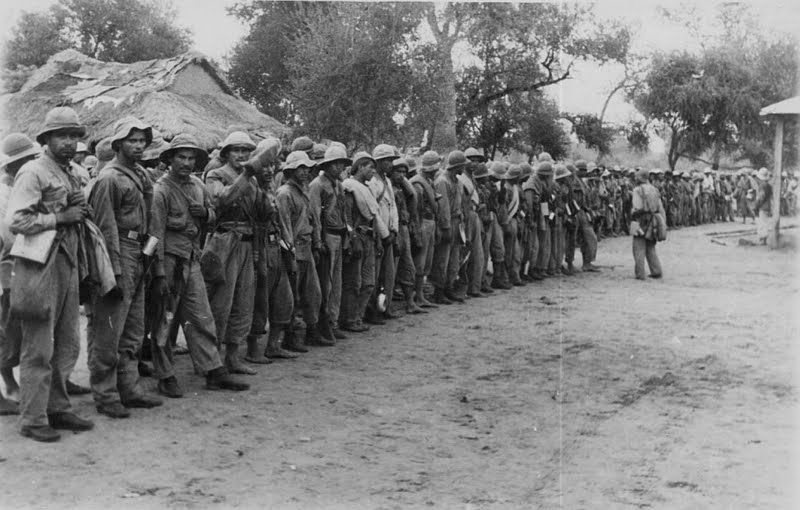
The Chaco War fought between Paraguay and Bolivia was among a number of 20th century conflicts in South America in part instigated by the violent rivalry between British and U.S. imperialism. A look at the beginnings of what would become among the continent’s costliest wars.
‘Against the Imperialist War in Latin America’ by Luis Ortiz from The Daily Worker. Vol. 9 No. 245. October 9, 1932.
WORKERS AND PEASANTS SLAIN IN PARAGUAYAN-BOLIVIA CHACO WAR
Anglo-American Rivalries Behind Struggles; Oil Interests Prime Mover
American Workers! Stop Munitions Shipments From Ports of the U.S.A.
The old dispute between Bolivia and Paraguay, about the Chaco Boreal that had been almost forgotten for more than 50 years before 1929 and that in that year 1929 almost brought these countries into a war, has again brought a violent eruption. Cannons and machine guns of both countries are sowing death among hundreds and thousands of workers and peasants who, blinded by the provoking and misleading cry of the agents of imperialism and the national bourgeoisie: “An Outlet to the Sea”: “An Outlet to the Rio Paraguay”: “Bolivia Violates the Territorial Sovereignty of Paraguay”, etc. throw themselves into a criminal war for the exclusive gain of the imperialists and their national lackeys.
The agents provocateurs in the pay of the Standard Oil Co., the Royal Dutch Shell, together with the agents of the gamonales (big Bolivian landowners), of the Paraguayan landowners and the other agents of the national bourgeoisie, actively carry on a national-chauvinist campaign which tends to hide the inter-imperialist character of the war, which will bring to the workers and peasants of both countries nothing but death and misery unless the imperialist war conspiracy is exposed and defeated.
The Fight for Oil.
The Chaco Boreal territorial dispute came to the forefront again as soon as the agents of the oil companies made the discovery that this territory has oil deposits. It then became a coveted jewel to the imperialists and their national lackeys, who under all kinds of pretexts now incite both countries to wage a bloody war.
The socialists and reformists of both countries add their voices to the general chorus of war inciters, although in a different key. True to the treacherous role of the Second International and the Amsterdam Reformists they come to the help of their respective bourgeoisie and imperialist masters claiming that the Bolivia-Paraguay war will end the crisis and unemployment; that an outlet to the sea will develop new industrial and commercial life for Bolivia, create more jobs, etc.
But these worthy disciples of McDonald, Vandervelde, Bauer, etc. “forget” to remember that there is unemployment and misery in Chile, Peru, etc., although those countries have ports, have “outlets to the sea.” War As the Way Out of the Crisis. When speaking about the Bolivia-Paraguay war we can not forget the historical moment in which this war is taking place. We can not separate this event from the general international situation, from the sharp struggle now going on in the whole world, from the deep antagonisms between the imperialist countries and their struggle for redivision of the colonial and semi-colonial world. The Bolivia-Paraguay war gives us a clear example of the sharpness of the imperialist conflict and a sample of the program of the imperialists and their national lackeys, and their way out of the crisis.
Dangerous Tendencies.
The Bolivia-Paraguay conflict has been taken rather lightly by very many of our comrades, as some event isolated from the general international situation, es some little war between two small South American countries, forgetting entirely that the smallest conflicts in this acute situation of international crisis, of sharp imperialist rivalries may be the beginning of a world-wide conflict. Whoever takes such view takes the same view point of the socialists at the outbreak of the world war! This is to forget history, forget Marxism and take the point of view of the liberal and pacifists, actually in practies to give aid to the imperialist. In this struggle the imperialists mobilize the governments under their control as well as the oppositional political groups.
War Conspiracy in Chile.
Some time ago the Minister of Foreign Affairs of Bolivia made a sudden trip to Chile, where he held a number of secret conferences with the Chilean government. What was discussed in these conferences was not disclosed but if we consider that Chile produces nitrate (a war product) in great quantities and that the only inlet to Bolivia from the sea is through Chilean ports we can readily see what was taken up in these conferences. That Chile takes sides with Bolivia in the present war is essential or at least the Bolivian government must get a promise of “neutrality” from Chile, that will limit them the transport of war materials through Chile, Argentina plays a very important part in the war and openly has taken the side of Paraguay. In this conflict Argentina not only plays the game of British imperialism but also comes forward to the defense of its own special capitalist interests. Argentinian investments in Paraguay are next to the British and American and are very closely linked up with British capital. Argentina has mobilized some of its troops on its frontiers under the pretext that they have to see that “there be no incursions into Argentinian territory.”
War Mongering in Uruguay.
In Uruguay, the “Batallista Party” which sides with the British war mongers asks through its press, etc., that the Uruguayan government declare war on Paraguay and denounces the government stand in favor of Bolivia, The Uruguayan Minister in Bolivia in a public speech declares that his government will side with Bolivia. Such a tense situation has been created that the governments of Uruguay and Argentina have broken off relations.
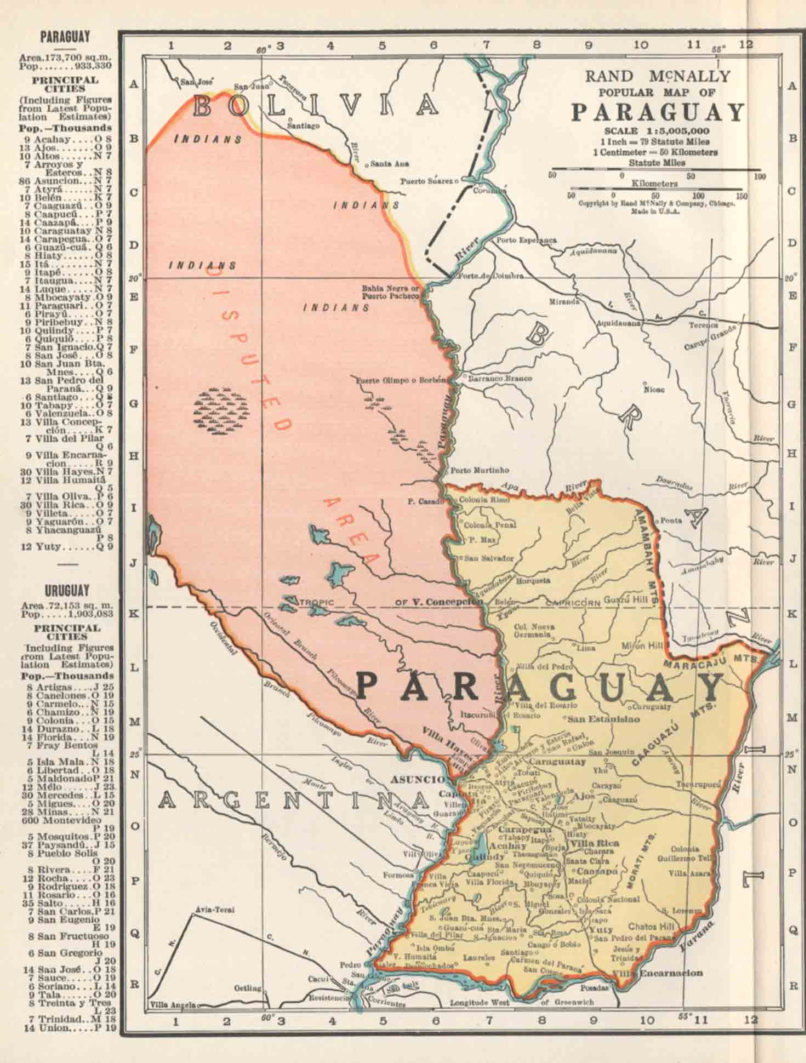
The Brazilian government took sides with Bolivia at the beginning of the conflict, undoubtedly due to obtaining advantageous positions in the railway that unites Brazil with Bolivia. In contrast with the position taken by the Federal Government the Southern rebels representing the feudal-agrarian coffee interests which are closely connected with British interests, took sides with Paraguay and declared their opposition to the pro-American policy of the Vargas Government.
The “Neutral” Committees.
Of course in all these moves and counter-moves we see a lot of vacillations in the positions taken by the political groups and governments, vacillations which are dictated by the force of the tremendous interests involved and by the active maneuvers of Wall Street and London bankers. A “Neutral” Committee has been formed. The committee is composed of the United States, Mexico, Cuba, Colombia and Uruguay. Obviously a “neutral” committee dominated by American imperialism. British imperialism has answered this move by the formation of another “neutral” committee, called the ABC-Peru, composed of Argentina, Brazil, Chile and Peru, which, because of its closeness to the warring countries has “more authority” to settle the dispute.
At the same time that this committee is formed, the League of Nations continues its “neutral” activities to “settle the conflict.”
The Resistance of the Workers.
A clear picture of the situation would not be given of course, if we were to ignore the serious resistance and struggles against war carried on by the revolutionary working class and its organizations. Reports in the capitalist press inform us that some time ago 8 Bolivian workers and intellectuals were court-martialed and shot because they led demonstrations against the war in La Paz, Bolivia. Also reports in South American newspapers inform that 500 Paraguayan soldiers were disarmed and punished because they refused to go to the front.
A number of conferences against the war have been held in different countries. In Argentina an anti-war conference was held and was attended by 120 representatives of workers’ organizations of Argentina, fraternal delegates from the General Confederation of Labor of Uruguay and political exiles from Paraguay and Peru. In this conference a committee was selected to prepare a South American anti-war conference to be held in Uruguay in November. September an anti-war conference was held in Montevideo, Uruguay. Also an anti-war manifesto was published and widely distributed, on occasion of the rupture of relation between these two countries, signed by the Uruguayan Confederation of Labor and the Trade Union Classist Committee of Argentina.
A similar manifesto was published, signed jointly by the Trade Union Classist Committee of Argentina, the General Confederation of Labor of Brazil, the Workers’ Federation of Chile and the General Confederation of Labor of Uruguay and the Peruvian Confederation of Labor.
Strengthening the Anti-War Front.
The struggles and activities against the Bolivia-Paraguay war is being carried on mainly in the border countries and as yet has not taken the wide character it should. This struggle is all the more important if we realize that in Bolivia there is no Communist Party but only small disconnected Communist groups, and that the Paraguayan Communist Party is a very small one and was founded not long ago.
The war between Bolivia and Paraguay places serious tasks before the Communist Party of the United States and the revolutionary working class. Munitions have been shipped and are being shipped to Bolivia from American ports. The New York Times carried an article in its Sunday edition (Oct. 2) in which it is stated that the Remington Arms factory in Bridgeport, Conn., has received a very large order of arms from Bolivia.
Give Life to the Anti-War Pact.
In the year 1929 a Continental Congress was held where the Latin American Confederation of Labor was formed. In this congress were present two fraternal delegates of the Trade Union Educational League (now the T.U.U.L.) in which a pact of solidarity was signed between the TUEL and Latin American Confederation of Labor. Mutual support was promised in the common struggles against imperialism, oppression, against war, etc.
The actual war situation and the danger of this war spreading to many other Latin-American countries must arouse the most determined struggle against it in the ranks of the American working class and specially in the Party and Trade Union ranks. We must make the Solidarity Pact of Montevideo something more than a document, it must become a living reality of struggle against imperialist war.
The Daily Worker began in 1924 and was published in New York City by the Communist Party US and its predecessor organizations. Among the most long-lasting and important left publications in US history, it had a circulation of 35,000 at its peak. The Daily Worker came from The Ohio Socialist, published by the Left Wing-dominated Socialist Party of Ohio in Cleveland from 1917 to November 1919, when it became became The Toiler, paper of the Communist Labor Party. In December 1921 the above-ground Workers Party of America merged the Toiler with the paper Workers Council to found The Worker, which became The Daily Worker beginning January 13, 1924.
PDF of full issue: https://www.marxists.org/history/usa/pubs/dailyworker/1932/v09-n245-NY-oct-13-1932-DW-LOC.pdf

