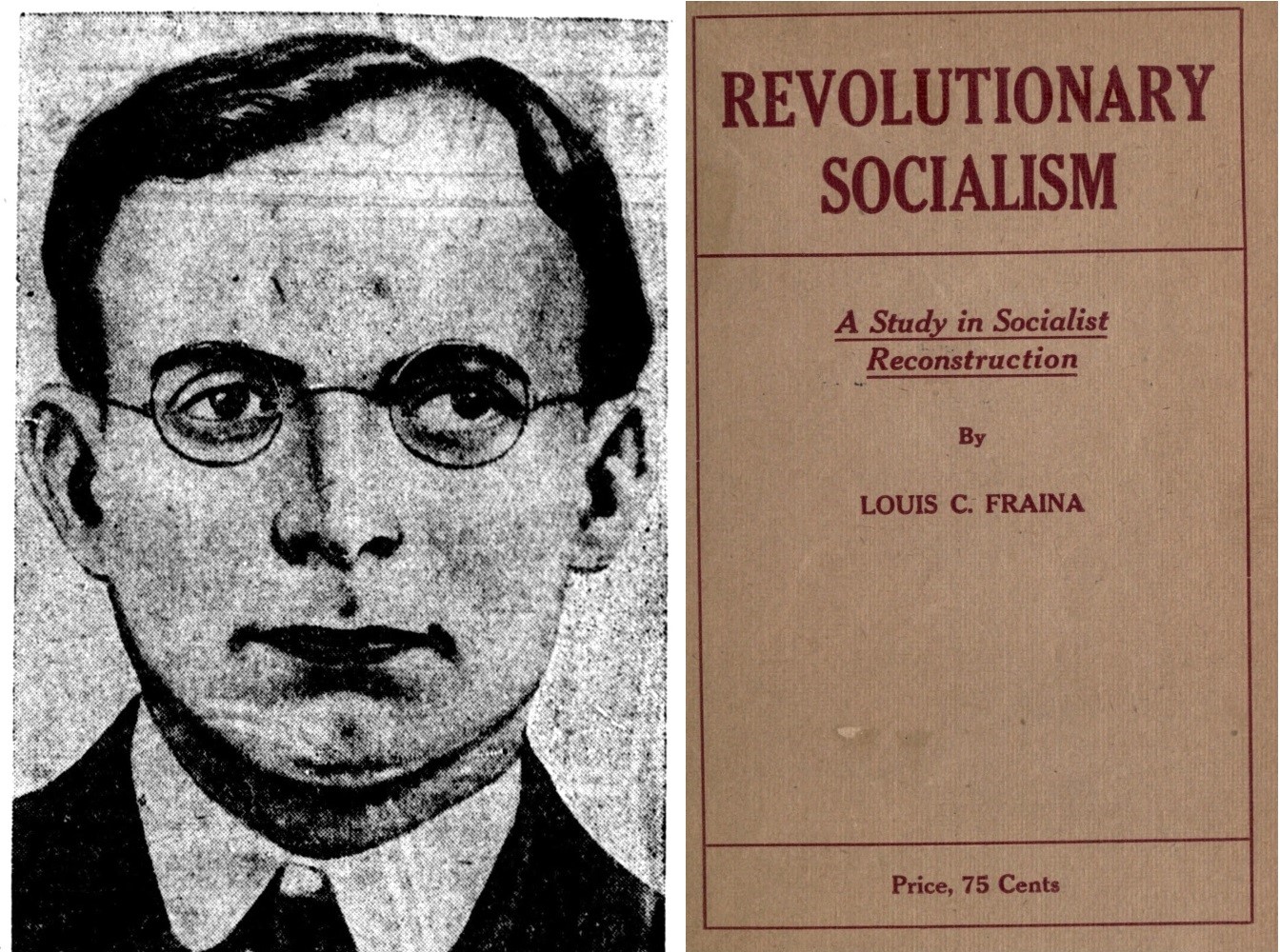
In response to the Socialist Party’s halfhearted and somewhat performative application to join the Comintern in 1920, Louis Fraina, the C.P.A.’s international representative then in Germany, filed this protest to the Executive Committee of the Communist International.
‘The American S.P. and the International’ by Louis C. Fraina from The Communist (C.E.C. Minority). Vol. 1 No. 5. May 8, 1920.
To the Executive Committee of the sub-Bureau of the Communist International.
Comrades:
The Socialist Party of the United States has decided to affiliate with the Communist International, and has made application accordingly to G. Zinoviev. In considering this application, the following points should be borne in mind:
1. The mere decision to affiliate with the Communist International is in itself of small value: the decisive factor is acceptance, in theory and practice, of Communist fundamentals.
2. The resolution of the American Socialist Party in favor of affiliating with the Communist International is silent concerning acceptance of the principles and tactics of the International. At the last National Convention of the Party, August 30, 1919 (at which, incidentally, the expulsion of 40,000 Communists from the Party was overwhelmingly approved) mass action, Soviets and proletarian dictatorship as means of Revolution were rejected, the Socialist Party evading every actual problem of revolutionary theory and practice.
3. The policy of the Socialist Party is completely dominated by the conception of parliamentary conquest of Capitalism. The Party is not revolutionary; on the contrary, it is shamelessly opportunist; its tactics are comprised in dependence upon petty bourgeois democracy, parliamentarism, reformism, and co-operation with the liberals and the reactionary trades unions.
4. The revolutionary elements in the Socialist Party have either been expelled or have seceded of the former Party membership, approximately 50,000 are now in the Communist Party and 15,000 in the Communist Labor Party, and less than 30,000 are still in the Socialist Party. The Socialist Party now sists wholly of the Right and the Centre: opportunists and reformists, all. The dominant personages in the Socialist Party are: Morris Hillquit, an unprincipled, refined opportunist of the Longuet type; Victor L. Berger, a social-patriot who, in 1913, urged that the United States should conquer and annex Mexico; Seymour Stedman, a typical petty bourgeois radical, who, upon the expulsion of 40,000 Communists from the Party, declared in a capitalist newspaper: “The Socialist Party has been purged of the Bolsheviks;” Meyer London, who, as a member of Congress, supported the war and was not expelled from the Party; Algernon Lee, who, while a member of the New York City Board of Aldermen, voted to promote the sale of Liberty (war) Bonds and urged war against Germany “in order to save the Russian Revolution”! All the leaders who represented the Socialist Party as a typical party of the old International are still dominant: there has been a purge of the Communists, but not of the opportunists, of the Right and Centre.
5. The Socialist Party prides itself upon having declared against the war;
a) The revolutionists largely responsible for the anti-war declaration are now out of the Party;
b) The Party’s official policy, as expressed by the leaders who are now still dominant in the Socialist Party, was one of petty bourgeois pacifism and miserable opportunism.
6. The Socialist Party wages a strong campaign against intervention in Russia and for recognition of the Russian Soviet Government; but this campaign is scarcely distinguishable from the campaign of the petty bourgeois radicals.
7. Five Socialist Party representatives elected to the Legislature of the State of New York have been denied their seats by the Legislature. The Socialists’ defense at their trial had three aspects:
a) that constitutional government and democracy are menaced by the act of the Legislature;
b) that the Socialist Party has no connection with the Communists;
c) that it is not true the Socialist Party aims to establish a Soviet Republic in the United States, since favoring the Russian Soviet Republic “does not mean proposing, or even dreaming, that a system which develops naturally from Russia’s material conditions is adaptable to a highly complex economic system such as that of the United States.”
8. The Government’s savage campaign of repression against the Communists does not involve the Socialist Party. In a declaration issued January 23, 1920, justifying the repressive campaign of the Department of Justice, Attorney General Palmer said: “Certainly such an organization as the Communist Party of America and the Communist Labor Party cannot be construed to fall within the same category as the Socialist Party of America, which latter organization is pledged to the accomplishment of changes in the Government by lawful and rightful means.”
9. The National Executive Committee of the Socialist Party, in session March 8, 1920 (two months after the decision to affiliate with the Communist International) revealed three significant facts:
a) That a number of trades unions had been invited to send delegates to the Party Convention of May 8
indicating that the Socialist Party is merging more completely in reactionary craft unionism.
b) That a demonstration for political prisoners was being arranged together with the Freedom Foundation and the National Civil Liberties Bureau indicating the Socialist Party’s co-operation and affiliation with petty bourgeois radicals.
c) That Jean Longuet was to speak in the United States under the auspices of the Party indicating the opportunist and centrist character of the Socialist Party’s international affiliations.
10. Historically, the Socialist Party developed as the American expression of the opportunism and reformism which became dominant in the Second International at the close of the 19th Century; the Party represented and still represents moderate petty bourgeois Socialism. The decision of this Party to affiliate with the Communist International is the product of two factors:
a) Undefined sympathy of the Party membership with the Russian Revolution and the Soviet Republic; the Communist International being identified with the Soviet Republic and a means of assisting this Republic, instead of as a means of revolutionary struggle and the reconstruction of Socialism.
b) The “diplomacy” of a miserable. Left-Centre in the Socialist Party, which considers it a “clever stroke” to affiliate with the Communist International, imagining that this might impair the power of the Communist Party of America.
The admission of the American Socialist Party to the Communist International would be a serious blow to the American Communist movement, and to the International itself.
A serious and menacing situation now prevails in the Communist International. The old International is broken in pieces: in this, the Communist International has performed a magnificent task of destruction; but the Communist International has not yet performed the constructive task of organizing itself on a definite basis. All sorts of parties and groups formerly affiliated with the old International, and which have not purged themselves of the Centre and the Right, are asking admission to the Communist International; for our International to admit these undesirable elements would mean reconstituting the Second International under the name of Communist International. The situation is dangerous and requires immediate and uncompromising action.
In the name of the Communist Party of America, accordingly, I call for the rejection of the application of the American Socialist Party for admission to the Communist International; and that, pending final action by the Executive Committee in Moscow (or a Congress of the International), the sub-Bureau of the International shall not enter into any relations with the American Socialist Party.
LOUIS C. FRAINA International Secretary, C.P.A. Berlin. March 30, 1920.
This ‘The Communist’ was a split from the Communist Party of America in April, 1920 by Charles Ruthenberg, Jay Lovestone, and others, referred to as the Central Executive Committee group, over the majority’s reluctance to unite with the Communist Labor Party as mandated by the Communist International. Laying the groundwork for the May 1920 Bridgman, Michigan convention that would form the United Communist Party, this version of ‘The Communist’ only lasted three issues. The new UCP stuck with tradition and called their official journal…’The Communist. Emulating the Bolsheviks who in 1918 changed the name of their party to the Communist Party, there were up to a dozen papers in the US named ‘The Communist’ in the splintered landscape of the US Left between 1919 and 1923. All them claimed adherence to the new Third International and sought that body’s endorsement. They were often published at the same time and in the same format, making it somewhat confusing to untangle their relationships.
PDF of full issue: https://www.marxists.org/history/usa/pubs/thecommunist/thecommunist4/v2n05-a-may-08-1920.pdf
 Revolution's Newsstand