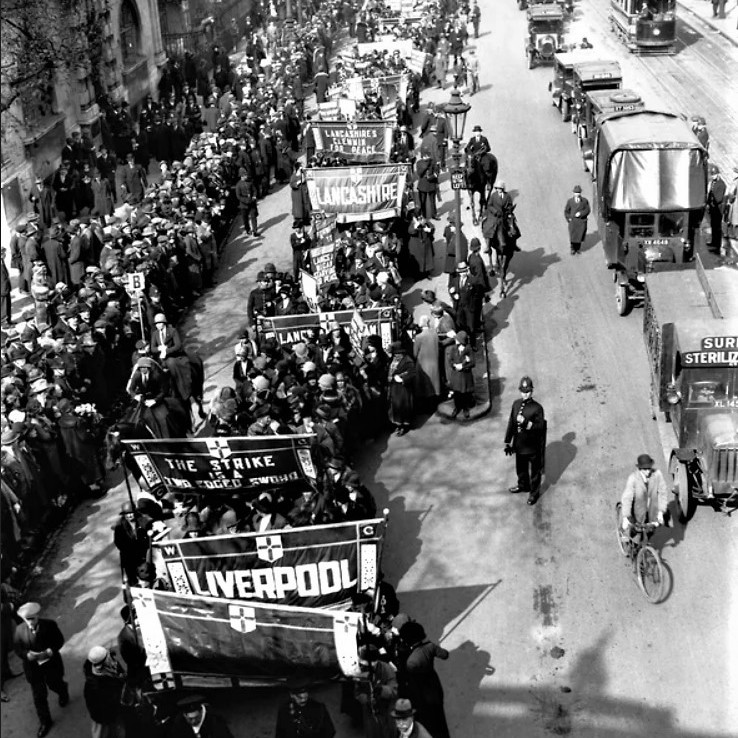
For this year’s centenary. With his usual thoroughness, Zinoviev says the day the General Council of the Trades Union Congress called off the General Strike, May 12, 1926, was a betrayal of the British working class tantamount to that of the Socialist Parties that voted support for their governments at the start of the First World War.
‘May 26th, The General Council’s 4th of August’ by Gregory Zinoviev from International Press Correspondence. Vol. 6 No. 50. July 1, 1926.
The more clearly we see the picture of the English strike and the part played in it by the General Council, the more clearly we realise that this was the General Council’s “4th of August”.
What was the significance of August 4th 1914 to the majority of the leaders of the 2nd International?
At the critical, decisive moment, when so much depended on the general staff of the Labour movement, the general staff of the 2nd International, almost in its totality, went over to the camp of the enemy, to the camp of the bourgeoisie. The alliance of the leaders of the working class with the bourgeoisie against the main mass of the working class, that was what the 4th of August meant. The great crisis which had arisen dissipated all illusions, phrases, idle talk, show, everything superficial and revealed facts as they are; the leaders of the 2nd International proved to be agents of the bourgeoisie within the Labour movement. Secret things were brought to light. When the imperialist war broke out, the leaders of the Social Democratic parties and the Reformist trade unions revealed themselves as public purveyors of workers as cannon fodder to both groups of imperialists. It is just at such moments that the leaders of the masses of workers ought to have done their duty by them. But they “did their duty” by the imperialists and the Kings, their real masters.
Have the Reformist leaders changed since then? How would they behave if a fresh imperialist war were to break out? Would they now do their duty towards the workers?
Of course not!
We have had some experiences, and they were not without importance: the attitude of the Social Democratic leaders to the Russian October revolution, the part played by such shining lights of Social Democracy as Scheidemann, Ebert and Noske in the all-decisive days of the revolution in Germany (end of 1918, beginning of 1919), the treacherous behaviour of the Social Democratic leaders during the occupation of the Ruhr, the attitude of the Social Democratic leaders to the events in China, to the wars in Syria and Morocco etc.
The newest and most important example is the behaviour of the English General Council in the days of the great general strike in May 1926. This was not a foreign war. It was “only” a war within the country, class against class. The working class had every prospect of victory, the objective situation was entirely in their favour. The army of the workers flung themselves into the fight. But the staff! It waited a few days, chose the most opportune moment (for the bourgeoisie) and despicably betrayed the cause.
If a new imperialist war were to break out tomorrow (or let us say a war on the part of England against the Soviet Union) the present General Council under Thomas would undoubtedly fly to the bourgeoisie and serve the capitalists of their “own” country with loyalty and devotion. If they played their “own” working class false in a fight such as that in May 1926, they would be all the more likely to play the workers of the Soviet Union and of other countries false, all the more likely to betray the English workers in the complicated situation of the beginning of a new imperialist war.
The treachery of the General Council in May 1926 can (and should) only be compared with the treachery of August 4th 1914. It was all the more infamous firstly because it was not the first but the second time that it was guilty of betrayal, and secondly because it was done in “peaceful” circumstances, when the guns were not yet firing, when there was nothing of the chauvinist frenzy which always accompanies the beginning of a war with a “foreign” power.
Let us examine more closely into the part played by the General Council in the days of May 1926.
The first aim of the Conservative Government was to challenge the miners alone, to isolate them and to vanquish them completely. The second task which the Conservative Government set itself was, as far as possible, to hit the trade union movement and the growing revolutionary spirit with which it was pervaded, with the object of bringing confusion into the movement which was becoming more radical, of disintegrating it, provoking some, encouraging others with words; in short, to demoralise the rising Labour movement.
Both these aims were more or less common to the Government and to the bourgeois leaders of the Labour movement. Thomas, Clynes, MacDonald, Henderson & Co. There can now no longer be any doubt that this group of leaders was, from beginning to end, in the hands of the Government, was a partner in its game, some simply as venal agents of the bourgeoisie, the others because of a certain political trend which pursued its own aims.
“The General Council”, writes Brailsford, the English Reformist “did not want the general strike. The absence of any preparations proves this. It hoped and even believed to the last mine that the Government would ultimately come to terms….The General Council glided automatically into the strike.”
“Up to the very last moment, none of the leaders actually believed in the possibility of a strike. Thomas and his comrades believed that it would somehow or other be possible to come to an understanding with the Government”, writes the “Manchester Guardian”.
The movement of the masses grew beyond the strength of the leaders.
The fighting spirit of the masses of English workers was underestimated both by the Government and by the trade union leaders mentioned. They were playing with fire. Forces came in play which could no longer be restrained by them.
The general strike began and demonstrated the enormous, incalculable forces of the English working class. Thomas, Mac Donald, Clynes, Henderson & Co. placed themselves at its head, apparently to the satisfaction of Baldwin. To place oneself at the head in order to behead is a “method” which has already been tested out more than once.
From the first moment it was evident that the chief danger to the strike lay in the leaders of the General Council Right as well as Left. The first word of the Comintern was: “The leaders of the General Council are the chief danger.”
The organisation shown by the masses was marvellous. In the course of the first week the strike developed continuously on an ascending line. The masses started committees of action which actually developed into something resembling district soviets of deputies of workers. Under the influence of the masses, the trade unions began to assume responsibilities, such as the control of the “free” bourgeois Press, the formation of a subcommission for electricity whose task it was to distribute electric power throughout the country, the appointment of commissariats etc.
These were highly important beginnings of something new. These were already elements of a certain dual power, promising phenomena of revolutionary constructive work of the masses. The workers began to fraternise with the troops. The workers began to drag the genteel bourgeois out of their motor cars. The workers began to put out of gear the strike-breaking motor-buses which made their appearance in the London streets. The attitude of the working class was such that there seemed every reason to hope that events would develop entirely in favour of the proletariat.
The proletarian army however had no staff, or rather it had a staff which harboured treachery in its very heart. Although the victory of an army need not be exclusively due to its stall, it is at any rate difficult for it to be victorious in opposition to its staff, and in the case in question it could only have carried off victory by opposing its own staff.
The staff. i.e. the General Council, had waited for the “opportune” moment (opportune for the bourgeoisie) and capitulated in the most infamous manner, thus carrying confusion in the ranks of the army from which, at that stage, it was unable to recover.
MacDonald could “testify as a witness” that in the course “of all the negotiations and discussions during the meetings of the General Council not a single reference was made by anyone to political questions, regardless of whether this member or that of the General Council belonged to what is known as the Right or the Leftwing…”)
The “Left” thoroughly deserve this fawning of Mac Donald’s. The “Labour” correspondent of the “Manchester Guardian” writes:
“From the very beginning, the General Council made every effort to persuade the workers to accept a temporary reduction of the wages of the best-paid workers…After the strike had begun, the General Council lost no time in bringing the conflict to an end as soon as possible…It accepted the suggestion of the Archbishop and carried on assiduous negotiations with Samuel…
The General Council felt that a further spread of the strike would have had extremely serious consequences… Revolutionary forces would have been let loose even contrary to the wish of the General Council, the centre would have been proved to be cut off from the masses, and every local strike committee would have become a Soviet…The General Council proved to be the exact opposite of a revolutionary committee. It consisted of weary trade union officials who lived in the unhealthy atmosphere of stuffs rooms, tortured by sleeplessness and in constant conflict with the miners (!), with the members of the Cabinet, with delegations of strikers; the General Council consisted of persons who were constantly obsessed by a fear of distances (…The General Council resolved to act quickly, it was evidently prepared to bring the situation, which has arisen, to an end at any price (Manchester Guardian of May 16th 1926),.
The Reformist Brailsford testifies:
“On Sunday May 2nd, the friction between the General Council and the miners almost led to a breach…From what I heard on that evening, I had the impression that we were on the eve of a new breach and a new “Black Friday” (“New Leader” of May 21st, 1926).
The Reformist Wheatley states:
All voices of the Press are unanimous in stating that there was no slackening in the strike, but that on the contrary an excellent spirit prevailed among the masses and that the “second line” of workers was clamouring to be allowed to enter the struggle.
Otto Bauer’s words are flatly contrary to the truth.
This is how the leaders of the 2nd International twist the traitors of the General Council have set in motion in order to drown the truth.
“The General Council gave Baldwin more than he facts. After that it is easy to imagine what an ocean of lies demanded.” (“Forward” of May 22nd, 1926.)
From his point of view as a social traitor, MacDonald was quite right when he wrote that the strike was in the hands of “firm leaders”. (“Forward” of May 22nd, 1926.)
After the General Council had been beaten, the leaders of the 2nd International began to shift the blame on to the workers, as might have been expected, just as, after August 4th 1914, the leaders of the 2nd International tried to justify their own vile social patriotic treachery by pointing to what they described as the “patriotic” mood of the mass of workers. In this respect an article by Otto Bauer, the “Left” leader of the 2nd International, is extremely instructive, in that he “proves”, without the slightest foundation of fact, that the general strike in England came to grief in consequence of the wholesale blacklegging of the workers. Otto Bauer goes so far as to maintain as follows:
“The experience of 1921 was decisive. At that time the miners also demanded a general strike; the leaders of the railwaymen and transport workers however refused it. After that they were for years contemptuously called “traitors”. It is not everyone who can bear such insults. This time they were afraid of being again represented as traitors. For this reason they voted, obviously against their conviction, for the proclamation of a general strike.” (Vienna “Arbeiter Zeitung” of May 16th 1926.)
Is it possible to imagine a meaner sophism? So the heroes of “Black Friday” 1921 were unjustly described as traitors! And now, poor Thomas & Co., in order to avoid new insulting accusations of treachery, voted “against their conviction” for the proclamation of a general strike, whilst the “backward” masses of workers were guilty of blacklegging, thus shattering the general strike. But there still remains to be explained for what purpose Thomas & Co. organised the capitulation of the General Council on May 12th 1926. Was this treachery also committed only that they might not be called traitors?
The only thing that is true in all this is that the leaders of the General Council “voted for the proclamation of the general strike against their conviction”. This recognition must be registered as a fact by which the further behaviour of these leaders can best be explained.
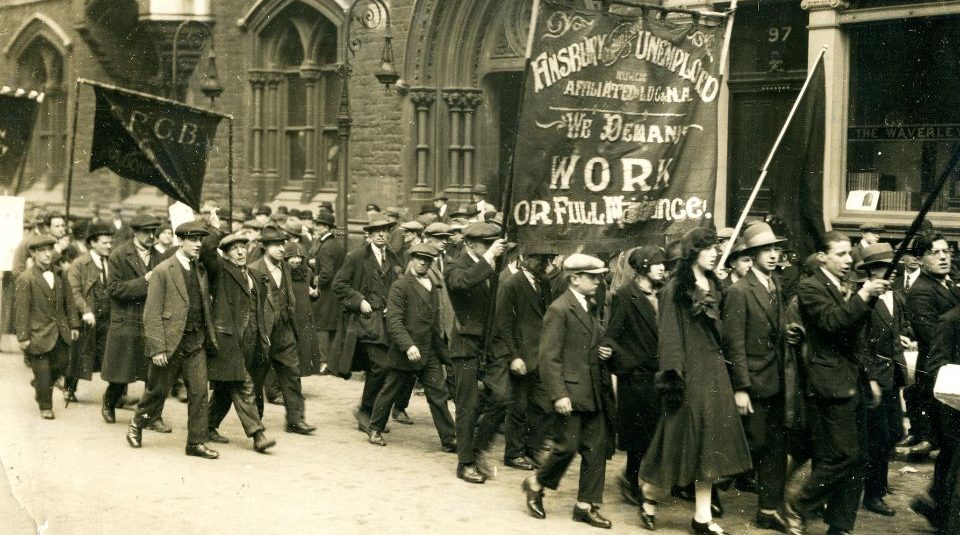
Large numbers of the English workers have only developed far enough to understand solidarity among workers in one trade, but not to understand class solidarity this is the gist of Otto Bauer’s remarks. The workers are still far behind Mr. Thomas, the “defender of class interests” (perhaps the interests of the bourgeoisie?). This is how Otto Bauer who became the “Left” theorist of the 2nd International sums up the position. It never occurs to Otto Bauer that if some strata of the English workers are still up to the neck in craft prejudices, the duty of real Labour leaders should be to train them up to an understanding of class duties. Otto Bauer is not in the least aware that, during the strike, the leaders of the General Council did exactly the opposite.
Even the Reformist Brailsford is obliged to admit:
“For nine days the masses of workers gave evidence of a solidarity such as has never been seen before in the industrial history of our country. From beginning to end it was a soldiers battle. But no single leader was equal to the task of giving expression to the unanimous will of the masses of workers…The most remarkable fact of this general strike was the unbounded devotion to the common cause…The masses of workers flocked up in such numbers that the difficulty was, not how to mobilise the workers who came into consideration for the strike, but how to hold back from striking those workers whom the General had not called out.”
At the decisive moment. Thomas & Co. were masters of the situation in the General Council. Like every great crisis, the British general strike has dissipated a number of illusions and to be under the thumb of Thomas, although officially the Right revealed the true relation of forces. The General Council proved was in the minority in it.
A number of reliable reports speak for the fact that almost all the members of the General Council voluntarily submitted to the leadership of Judas Thomas from the very beginning of the general strike. Many equally reliable communications point to the fact that a “Left Winger” such as Purcell, looked at the general strike, even before it began, through Thomas’ eyes. When it was a question of accepting the help of the international trade unions, especially the help of the trade unions of the Soviet Union, Hicks, a member of the “Left”, took up an equally treacherous standpoint as that of Judas Thomas (Hicks’ speech on the “Damned Russian money”). The fate of the strike was actually sealed at the moment when the General Council refused the help of the international trade unions.
All the “Left” members of the General Council, together with Thomas & Co. exercised continuous pressure on the miners and demanded that they should capitulate. All the “Left” leaders of the General Council with one doubtful exception, voted for the capitulation and took part in the shameful pilgrimage to Baldwin in order to offer him the head of the general strike on a charger.
Some directly sold themselves to the bourgeoisie, others clung to the bourgeoisie out of Reformist short-sightedness and lack of character, others again were in a blue funk, which increased with the growth of the movement, whilst still another group vacillated to the last moment. Objectively the so-called “Left” members of the General Council played a much more treacherous part than Thomas himself, for, in view of Thomas’ sadly treacherous past, the masses would not have entrusted so much actual power to Thomas, had he not been backed by all the other members of the General Council.
The general strike had no clear aim, no clear programme. Whereas in reality it had, and had of necessity, a political character from the very beginning, the General Council persisted in asseverating at every street corner that the strike was only an economic one, that it was not directed against the Constitution and so on. In the meantime the Government assiduously organised its strike-breakers. The General Council called upon the striking masses to spend its leisure time in games, dancing and sport. The General Council, in which the masses had at first placed unbounded confidence, and to whom it had with enthusiasm entrusted the fate of this great movement was capable of vacillating, even in view of the Government’s threat to declare the strike illegal, a threat which was coupled with the “promise” to confiscate the personal property of the official trade union leaders.
The Magdeburg trial recently proved with absolute certainty that in 1918, when the great strike began in Germany, the leaders of the Social Democrats. Ebert. Scheidemann and Noske, deliberately joined in the organisation of the strike in order to wreck the strike of the workers. They openly admitted before the Court that, whilst they were members of the strike committees of the workers, they were at the same time in touch with the staffs of Hindenburg and the Crown Prince Something of the same sort has now been done by the Right leaders of the General Council. Just as in 1913 the independent Social Democrats Haase, Dittmann & Co. in the Government of “People’s Commissaries” acted in the same way as Ebert and Scheidemann, so Purcell and Pugh have now acted in the same way as Thoms and Macdonald.
The 12th of May 1926 (the day of the capitulation of the General Council), is for the General Council what the 4th of August 1914 was for the majority of the leaders of the 2nd International. The behaviour of the leaders of the General Council after the capitulation completely confirms this. The majority of the leaders of the General Council not only took up a neutral standpoint (a la Pontius Pilate) towards the continuation of the miners’ strike, but even directly opposed the miners.
Hicks, the leader of the “Left”, stated in a public speech that it was “disloyal” of the miners to fight for the maintenance of their wages, whilst in other trade unions there were categories of workers who are worse paid than the miners. What is that but the language of a strike-breaker?
The upper stratum of the Executive of the Railwaymen’s Union refuses even to answer the miners’ request for help and declares that it has no reason to discuss anything with the miners. That is quite in Baldwin’s style who also refuses to negotiate with the miners before they have capitulated. Cramp, the “leader” of the railwaymen, now calls the general strike a “soap-bubble”.
At the National Conference of the Shoemakers’ Union in Blackpool, Joseph Simon and Smith have already made actually Fascist speeches against the “Reds”:
“The Reds have the habit of agitating for the proclamation of the general strike, and when the strike is proclaimed, they act as strike-breakers and take possession of the most advantageous functions”, declared Smith. Is not that the language of a Fascist?
Swales of the “Left”, the only one of the members of the General Council, who put up a weak “opposition” to the capitulation, is now finding no better occupation than trying, in common with Hicks and Ben Tillet to gloss over the attitude of the General Council and to represent the majority of the members of the General Council as having been led astray by Baldwin and Samuel. With regard to the causes of the defeat of the strike, this same Swales declares:
“The chief cause of the defeat of the strike is to be laid at the door of the miners. Baldwin felt himself justified in not carrying through the Samuel memorandum since the miners had also declined to accept it and to submit to the General Council. The disorganised behaviour of the miners…” etc.
If Swales is not a deceiver but “only” deceived, he is in reality more dangerous than any deceiver.
Frank Varley, a member of the Executive of the Miners’ Federation (to say nothing of Hodges), openly suggests a project of reducing wages and of compulsory arbitration for the miners.
Finally, Purcell of the “Left” publishes, in the Danish “Social Democrat” an interview in which he states:
“The great strike was called off as soon as it had accomplished its task, that of ensuring negotiations in the coal industry on the condition that the mine-owners, who had dictated terms to the workers implying the cutting down of wages, should withdraw their demands. It is only in this field that the great strike had aimed at obtaining results.”
This is a treacherous declaration.
It is now a perfectly established fact that, if during the last year or two the General Council has professed in words to be “Left”, it was only a reflection of the trend to the Left of the masses. The masses are liberating themselves from traditional trade unionism which is saturated with conservative ideology. The masses demand above all an approach to the working class of the Soviet Union. The fighting spirit of the masses is growing. The “Left” leaders adapted themselves to this attitude of mind of the masses so as not to lose their influence. They have now dropped their “left” mask. This is what should be explained above all to the broad masses of the Inglish workers. The broad stratum of the “leaders” of the English trade union movement, from the local and district officials trade unionism to the upper stratum of the General Council represent a uniform reactionary caste. It is sufficient to remind ourselves that even the cause of the fusion of the small trade unions, of overcoming craft unionism, of amalgamating the trade unions and reorganising them into industrial federations is everywhere obstructed by the egotistical interests of the trade union officials, who openly sabotage this work. The matter went so far that it became necessary to guarantee the trade union officials their salaries for ten years so as to stop them hindering the fusion of the small trade unions into large ones.
In these circumstances the English trade union movement cannot make a serious step forward, if the proletarian vanguard does not unmask the treacherous part played by the bourgeois and petty bourgeois trade union leaders, the climax of which was the treacherous behaviour of the General Council in the recent general strike.
The bankruptcy of the General Council means a new bankruptcy of Reformism both of the Right and of the “Leit” wing.
The Communists must of course understand how to make a distinction between the Right and the “Left” Reformists. In the present period the situation in England is such that the so-called “Left” are causing a particularly great amount of harm. Just as in 1914/1918, the so-called “Kautskyans” were the arch-enemy, so a: present the “Centre party”, who call themselves “Left”, are the chief obstacle in the way of the further development of revolution in the English Labour movement.
The fight against Reformist illusions will now become the chief task in England. The strike has prepared the soil for this fight. It is not out of the question that the Labour party, even in its present form, will again have great success at the elections; this however will soon result in the Labour party turning against the predominance of the Right. The by-elections since the strike have shown this. The task to be performed is to show up to the masses of workers just the “Left” Reformists, who in reality side with Thomas.
In the summer of 1920 a delegation of English workers visited Soviet Russia for the first time. At that time, Soviet Russia was particularly in need of support from the English trade unions. Nevertheless Lenin in an open letter to the English workers (of May 3rd 1920), says straight out:
“I am not surprised that a number of members of your delegation do not take the standpoint of the working class but that of the bourgeoisie, the class of the exploiters, for the imperialist war has revealed a festering sore in all capitalist countries, i.e. that the parliamentary and trade union leaders of the workers are going over to the side of the bourgeoisie…”
Rosa Luxemburg, after the 4th of August 1914, called German Social Democracy a “stinking corpse”. Lenin entirely agreed with this description.

Since the 12th of May 1926, the General Council in its present composition, is also a stinking corpse.
This does not mean that it no longer represents a force. The stinking corpse of German Social Democracy has continued to poison the atmosphere for more than 10 years since the 4th of August. This may also, for a few years, be the case with the General Council. As leader of the fighting masses of the workers, the General Council is anyhow a corpse. The English workers will understand how to clear it out of the way and to elect their own leaders into the General Council; they will understand how to build up the General Council out of real, fighting Labour leaders.
Let us avoid any misunderstanding. After August 4th 1914. Lenin issued the slogan of a direct split in the Social Democratic parties and the creation of independent Communist parties, of a split in the 2nd International and the formation of the Third International.
Are we now to issue the slogan of a split in the English trade unions, of secession from the unions? Of course not! In no circumstances! Were we to do this, it would mean forgetting the difference between party and trade union, it would mean forgetting everything that Lenin taught us as to the necessity of work in the reactionary trade unions.
Let us multiply our efforts to win over the trade unions from within and at the same time proclaim the whole truth regarding the General Council’s “4th of August”! They do contradict each other; on the contrary, they support each other.
International Press Correspondence, widely known as”Inprecorr” was published by the Executive Committee of the Communist International (ECCI) regularly in German and English, occasionally in many other languages, beginning in 1921 and lasting in English until 1938. Inprecorr’s role was to supply translated articles to the English-speaking press of the International from the Comintern’s different sections, as well as news and statements from the ECCI. Many ‘Daily Worker’ and ‘Communist’ articles originated in Inprecorr, and it also published articles by American comrades for use in other countries. It was published at least weekly, and often thrice weekly.
PDF of full issue: https://www.marxists.org/history/international/comintern/inprecor/1926/v06n50-jul-01-1926-Inprecor.pdf

