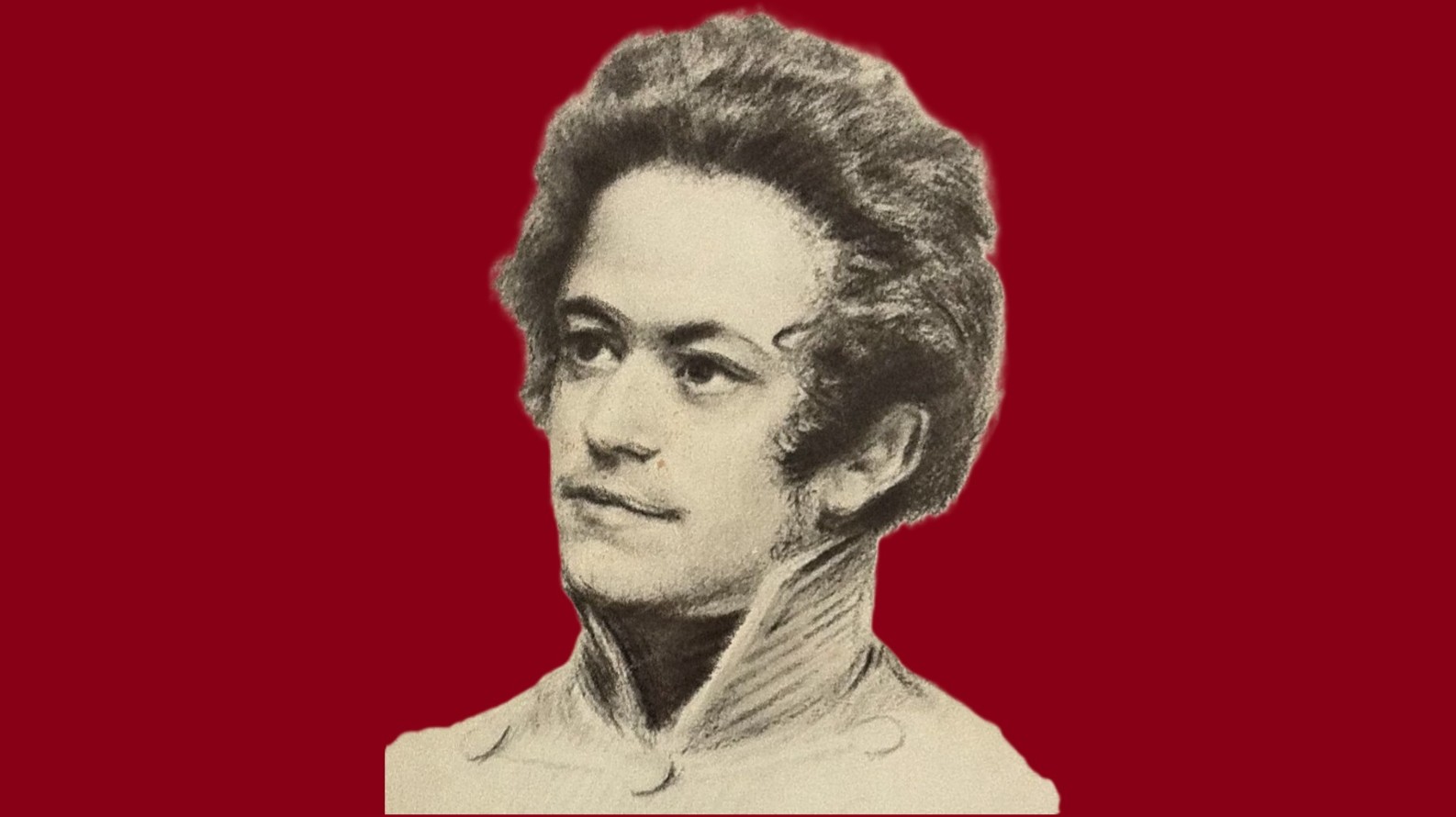
In this extraordinary letter to Pavel Annenkov, a man who would be only an acquaintance from Marx’s Brussels exile, a twenty-eight-year-old Marx writes down his first impressions of Proudhon’s ‘The Philosophy of Misery’ after reading it over two days. In doing so he gives an exposition of his framing of the dialectic in historical materialism. A must read for all students of Marx and those interested in the development of his ideas.
‘Letter to Annenkov’ (1846) by Karl Marx from Selected Correspondence, 1846-1895. International Publishers, New York. 1936.
Brussels, 28 December, 1846
You would long ago have received my answer to your letter of November 1 but for the fact that my bookseller only sent me Monsieur Proudhon’s book, The Philosophy of Misery, last week. I have gone through it in two days in order to be able to give you my opinion about it at once. As I have read the book very hurriedly, I cannot go into details but can only tell you the general impression it has made on me If you wish, I could go into details in a second letter.
I must frankly confess to you that I find the book as a whole bad, and very bad. You yourself laugh in your letter at the “imprint of German philosophy” which M Proudhon parades in this obscure and formless work, but you suppose that the economic argument has not been infected by the philosophic poison. I too am very far from imputing the faults in the economic argument to M Proudhon’s philosophy. M Proudhon does not give us a false criticism of political economy because he is the possessor of an absurd philosophic theory, but he gives us an absurd philosophic theory because he fails to understand the social situation of today in its engrenement [concatenation], to use a word, which like much else, M Proudhon has borrowed from Fourier.
Why does M Proudhon talk about God, about universal reason, about the impersonal reason of humanity which never errs, which remains the same throughout all the ages and of which one need only have the right consciousness in order to know truth? Why does he produce feeble Hegelianism to give himself the appearance of a bold thinker?
He himself provides you with the clue to this enigma M Proudhon sees in history a certain series of social developments, he finds progress realised in history, finally he discovers that men, as individuals, did not know what they were doing and were mistaken about their own movement, that is to say their social development seems at the first glance to be distinct, separate and independent from their individual development. He cannot explain these facts, and in a moment the hypothesis of the universal reason revealing itself is produced. Nothing is easier than to invent mystical causes, that is to say phrases which lack common sense.
But when M Proudhon admits that he understands nothing about the historical development of humanity—he admits this by using such high-sounding words as Universal Reason, God, etc.—is he not implicitly and necessarily admitting that he is incapable of understanding economic development?
What is society, whatever its form may be? The product of men’s reciprocal activity. Are men free to choose this or that form of society for themselves? By no means. Assume a particular state of development in the productive forces of man and you will get a particular form of commerce and consumption. Assume particular stages of development in production, commerce and consumption and you will have a corresponding social order, a corresponding organisation of the family and of the ranks and classes, in a word a corresponding civil society. Presuppose a particular civil society and you will get particular political conditions which are only the official expression of civil society. M Proudhon will never understand this because he thinks he is doing something great by appealing from the State to society—that is to say from the official summary of society to official society.
It is superfluous to add that men are not free to choose their productive forces—which are the basis of all their history—for every productive force is an acquired force, the product of former activity.
The productive forces are therefore the result of practical human energy, but this energy is itself conditioned by the circumstances in which men find themselves, by the productive forces already won, by the social form which exists before they do, which they do not create, which is the product of the former generation. Because of this simple fact that every succeeding generation finds itself in possession of the productive forces won by the previous generation which serve it as the raw material for new production, a connection arises in human history, a history of humanity takes shape which has become all the more a history of humanity since the productive forces of man and therefore his social relations have been extended. Hence it necessarily follows: the social history of men is never anything but the history of their individual development, whether they are conscious of it or not. Their material relations are the basis of all their relations. These material relations are only the necessary forms in which their material and individual activity is realised.
M Proudhon mixes up ideas and things. Men never relinquish what they have won, but this does not mean that they never relinquish the social form m which they have acquired certain productive forces. On the contrary, m order that they may not be deprived of the result attained, and forfeit the fruits of civilisation, they are obliged, from the moment when the form of their intercourse [Fr commerce ] no longer corresponds to the productive forces acquired, to change all their traditional social forms I am using the [French] word commerce here in its widest sense, as we use Verkehr in German For example. The institution and privileges of guilds and corporations, the regulatory regime of the Middle Ages, were social relations corresponding only to the acquired productive forces and to the social condition which had previous existed and from which these institutions had arisen. Under the protection of this regime of corporations and regulations capital was accumulated, overseas trade was developed, colonies were founded. But the fruits of this would themselves have been forfeited if men had tried to retain the forms under whose shelter these fruits had ripened. Hence came two thunderclaps—the revolutions of 1640 and 1688. All the old economic forms, the social relations corresponding to them, the political conditions which were the official expression of the old civil society, were destroyed in England. Thus the economic forms in which men produce, consume, exchange, are transitory and historical. When new productive forces are won men change their method of production and with the method of production all the economic relation which are merely the necessary conditions of this particular method of production.
This is what M Proudhon has not understood and still less demonstrated M Proudhon, incapable of following the real movement of history, produces a phantasy which presumptuously claims to be dialectical. He does not feel it necessary to speak of the seventeenth, the eighteenth or the nineteenth century, for his history proceeds in the misty realm of imagination and rises far above space and time In short it is not history but Hegelian vieillene [old junk], it is not profane history—the history of man—but sacred history—the history of ideas. From his point of view man is only the instrument of which the Idea or the eternal reason makes use in order to unfold itself. The evolutions of which M Proudhon speaks are understood to be evolutions such as are accomplished within the mystic womb of the absolute Idea. If you tear the veil from this mystical language what it comes to is that M Proudhon is offering you the order in which economic categories arrange themselves inside his own mind. It will not require any great exertion on my part to prove to you that it is the order of a very disorderly mind.
M Proudhon starts his book with a dissertation on value, which is his pet subject. I will not begin an examination of this dissertation today.
The series of the economic evolutions of the eternal reason begins with division of labour. To M Proudhon division of labour is a perfectly simple thing. But was not the caste regime also a particular division of labour? Was not the regime of the guilds another division of labour? And is not the division of labour under the system of manufacture, which in England begins in the middle of the seventeenth century and comes to an end in the last part of the eighteenth, totally different from the division of labour in large-scale modern industry?
M Proudhon is so far from the truth that he neglects what even the profane economists attend to. When he talks about division of labour he does not feel it necessary to mention the world market. Good. Yet must not the division of labour have been fundamentally different m the fourteenth and fifteenth centuries, when there were still no colonies, when America did not as yet exist for Europe, and Eastern Asia only existed for her through the medium of Constantinople, from what it was in the seventeenth century when colonies were already developed?
And that is not all. Is the whole inner organisation of nations with all their international relations anything other than the expression of a particular division of labour? And must not these change when the division of labour changes?
M Proudhon has so little understood the problem of the division of labour that he never even mentions the separation of town and country, which was taking place in Germany, for instance, from the ninth to the twelfth centuries. For M. Proudhon, since he knows neither its origin nor development, this separation becomes an eternal law. All through his book he speaks as if this creation of a particular mode of production would endure until the end of time. Everything that M Proudhon says about the division of labour is only a summary, and moreover a very superficial and incomplete summary, of what Adam Smith and a thousand others have said before him.
The second evolution is machinery. The connection between the division of labour and machinery is entirely mystical to M Proudhon. Each kind of division of labour had its specific instruments of production. Between the middle of the seventeenth and the middle of the eighteenth centuries, for instance, everything was not made by hand. There were implements, and very complicated ones, such as looms, ships, levers, etc.
Thus there is nothing more absurd than to derive machinery from division of labour in general.
I may also remark, by the way, that since M Proudhon has not understood the development of machinery he has still less understood its historical origin. One can say that up to the year 1825—the period of the first general crisis—the general demands of consumption increased more rapidly than production, and the development of machinery was a necessary consequence of the needs of the market. Since 1825, the invention and application of machinery has been simply the result of the war between workers and employers. And this is only true of England. As for the European nations, they were driven to adopt machinery owing to English competition both in their home markets and on the world market. Finally, in North America the introduction of machinery was due both to competition with other countries and to lack of hands, that is, to the disproportion between the population of North America and its industrial needs. From these facts you can see what sagacity Monsieur Proudhon develops when he conjures up the spectre of competition as the third evolution, the antithesis to machinery!
Finally, and in general, it is altogether absurd to treat machinery as an economic category, on a level with division of labour, competition, credit, etc.
Machinery is no more an economic category than the ox which draws the plough. The application of machinery in the present day is one of the conditions of our present economic system, but the way in which machinery is utilised is totally distinct from the machinery itself. Powder remains the same whether it is used to wound a man or to dress his wounds. M Proudhon surpasses himself when he allows competition, monopoly, taxes or police, balance of trade, credit and property to develop inside his head in the order in which I have quoted them. Nearly all credit institutions had been developed in England by the beginning of the eighteenth century, before the discovery of machinery. Public credit was only a fresh method of increasing taxation and satisfying the new demands created by the rise of the bourgeoisie to power.
Finally, the last category in M Proudhon’s system is constituted by property. In the real world, on the other hand, the division of labour and all M Proudhon’s other categories are social relations forming as a whole what is to-day known as property outside these relations bourgeois property is nothing but a metaphysical or juristic illusion. The property of a different epoch, feudal property, develops in a series of entirely different social relations M Proudhon, by establishing property as an independent relation, commits more than a mistake in method. He clearly shows that he has not grasped the bond which holds together all forms of bourgeois production, that he has not understood the historic and transitory character of the forms of production in a particular epoch. M Proudhon, who does not regard our social institutions as an historical product, who understands neither their origin nor their development, can only produce dogmatic criticism of them.
M Proudhon is also obliged to take refuge in a fiction in order to explain development. He imagines that division of labour, credit, machinery, etc., were all invented to serve his fixed idea, the idea of equality His explanation is sublimely naïve. These things were invented m the interests of equality but unfortunately they turned against equality. This constitutes his whole argument. In other words, he makes a gratuitous assumption and then as the actual development contradicts his fiction at every step he concludes that there is a contradiction. He conceals from you the fact that the contradiction exists solely between his fixed ideas and the real movement.
Thus M Proudhon, mainly because he lacks the historical knowledge, has not perceived that as men develop their productive forces, that is, as they live, they develop certain relations with one another and that the nature of these relations must necessarily change with the change and growth of the productive forces. He has not perceived that economic categories are only the abstract expressions of these actual relations and only remain true while these relations exist. He therefore falls into the error of the bourgeois economists who regard these economic categories as eternal and not as historic laws which are only laws for a particular historical development, a development determined by the productive forces Instead, therefore, of regarding the political-economic categories as abstract expressions of the real, transitory, historic, social relations, Monsieur Proudhon only sees, thanks to a mystic transposition, the real relations as embodiments of these abstractions These abstractions themselves are formulae which have been slumbering in the heart of God the Father since the beginning of the world.
But here our good M. Proudhon falls into severe intellectual convulsions. If all these economic categories are emanations from the heart of God, are the hidden and eternal life of man, how does it come about, first, that there is such a thing as development, and second, that M Proudhon is not a Conservative? He explains these contradictions by a whole system of antagonism.
To throw light on this system of antagonism let us take an example.
Monopoly is a good thing, because it is an economic category and therefore an emanation of God. Competition is a good thing because it is also an economic category. But what is not good is the reality of monopoly and the reality of competition. What is still worse is the fact that competition and monopoly devour each other. What is to be done? As these two eternal ideas of God contradict each other, it seems obvious to him that there is also a synthesis of them both within the heart of God, in which the evils of monopoly are balanced by competition and vice versa. As a result of the struggle between the two ideas only the good side will come into view. One must extract this secret idea from God and then apply it and everything will be for the best, the synthetic formula which lies hidden in the darkness of the impersonal reason of man must be revealed. M Proudhon does not hesitate for a moment to come forward as the revealer.
But look for a moment at real life. In the economic life of the present time you find not only competition and monopoly but also their synthesis, which is not a formula but a movement. Monopoly produces competition, competition produces monopoly. But this equation, far from removing the difficulties of the present situation, as the bourgeois economists imagine that it does, results in a situation still more difficult and confused. If therefore you alter the basis on which present-day economic relations rest, if you destroy the present method of production, then you will not only destroy competition, monopoly and their antagonism, but also their unity, their synthesis, the movement which is the real equilibrium of competition and monopoly.
Now I will give you an example of Monsieur Proudhon’s dialectic.
Freedom and slavery constitute an antagonism. I need not speak of the good and bad sides of freedom nor of the bad sides of slavery. The only thing that has to be explained is the good side of slavery. We are not dealing with indirect slavery, the slavery of the proletariat, but with direct slavery, the slavery of the black races in Surinam, in Brazil, in the Southern States of North America.
Direct slavery is as much the pivot of our industrialism to-day as machinery, credit, etc. Without slavery no cotton; without cotton no modern industry. Slavery has given their value to the colonies; the colonies have created world trade; world trade is the necessary condition of large-scale machine industry. Before the traffic m Negroes began, the colonies only supplied the Old World with very few products and made no visible change in the face of the earth. Slavery is thus an economic category of the highest importance. Without slavery North America, the most progressive country, would be transformed into a patriarchal land. You have only to wipe North America off the map of the nations and you get anarchy, the total decay of trade and of modern civilization. But to let slavery disappear is to wipe North America off the map of the nations. And therefore, because it is an economic category, we find slavery in every nation since the world began. Modern nations have merely known how to disguise the slavery of their own countries while they openly imported it into the New World. After these observations what will be M Proudhon’s attitude toward slavery? He will look for the synthesis between freedom and slavery, the golden mean or equilibrium between slavery and freedom.
Monsieur Proudhon has very well grasped the fact that men produce cloth, linen, silks, and it is a great merit on his part to have grasped this small amount. What he has not grasped is that these men, according to their powers, also produce the social relations amid which they prepare cloth and linen. Still less has he understood that men, who fashion their social relations in accordance with their material method of production, also fashion ideas and categories, that is to say the abstract, ideal expression of these same social relations. Thus the categories are no more eternal than the relations they express. They are historic and transitory products. For M Proudhon, on the contrary, abstractions and categories are the primordial cause According to him they, and not men, make history The abstraction, the category taken as such, i.e. apart from men and their material activities, is of course immortal, unmoved, unchangeable, it is only one form of the being of pure reason; which is only another way of saying that the abstraction as such is abstract. An admirable tautology!
Thus, regarded as categories, economic relations for M Proudhon are eternal formulae without origin or progress.
Let us put it in another way. M Proudhon does not directly state that bourgeois existence is for him an eternal verily, he states it indirectly by deifying the categories which express bourgeois relations in the form of thought. He takes the products of bourgeois society for independent eternal existences, endowed with a life of their own, as soon as they present themselves to his mind in that form of categories, in the form of thought. So he does not rise above the bourgeois horizon. As he is operating with bourgeois ideas, the eternal truth of which he presupposes, he seeks a synthesis, an equilibrium for these ideas and does not see that the method by which they reach equilibrium at present is the only possible one.

Indeed he does what all good bourgeois do. They all tell you that in principle, that is as abstract ideas, competition, monopoly, etc., are the only basis of life, but that in practice they leave much to be desired. They all want competition without its tragic effects. They all want the impossible, namely, the conditions of bourgeois existence without the necessary consequences of those conditions. None of them understands that the bourgeois form of production is historic and transitory, just as the feudal form was. This mistake arises from the fact that the bourgeois-man is to them the only possible basis of every society, they cannot imagine a society in which men have ceased to be bourgeois.
M Proudhon is therefore necessarily a doctrinaire. The histone movement which is turning the world upside down to-day reduces itself for him to the problem of discovering the correct equilibrium, the synthesis, of two bourgeois ideas. And so the clever fellow is able by his cunning to discover the hidden thought of God, the unity of two isolated thoughts—which are only isolated because M Proudhon has isolated them from practical life, from present-day production, that is, from the union of realities which they express.
In place of the great historic movement arising from the conflict between the productive forces already acquired by men and their social relations, which no longer correspond to these productive forces, in place of the terrible wars which are being prepared between the different classes within each nation and between different nations, in place of the practical and violent action of the masses by which alone these conflicts can be resolved—in place of this vast, prolonged and complicated movement Monsieur Proudhon supplies the evacuating motion of his own head. So it is the men of learning, the men who know how to get God’s secret thoughts out of him, who make history. The common people have only to apply the revelations. You will now understand why M Proudhon is the declared enemy of every political movement. The solution of present problems does not lie for him in public action but in the dialectical contortions of his own mind. Since to him the categories are the moving force, it is not necessary to change practical life in order to change the categories. On the contrary, change the categories and the result will be the transformation of the actual social order.
In his desire to reconcile the contradictions Monsieur Proudhon does not even ask himself if the basis of those contradictions must not itself be overthrown. He is exactly like the political doctrinaire who will have it that the king, the chamber of deputies and the chamber of peers are integral parts of social life, eternal categories. All he is looking for is a new formula by which to establish an equilibrium between these forces (whose equilibrium depends precisely on the actual movement in which one force is now the conqueror and now the slave of the other). Thus in the eighteenth century a number of mediocre minds were busy finding the true formula which would bring the social orders, king, nobility, parliament, etc., into equilibrium, and they woke up one morning to find that there was in fact no longer any king, nobility or parliament. The true equilibrium in this antagonism was the overthrow of all the social conditions which served as a basis for these feudal existences and their antagonisms.
Because M Proudhon places eternal ideas, the categories of pure reason, on the one side and human beings and their practical life, which according to him is the application of these categories, on the other, one finds with him from the beginning a dualism between life and ideas, soul and body, a dualism which recurs m many forms. You can see now that this antagonism is nothing but the incapacity of M Proudhon to understand the profane origin and history of the categories which he deifies.
My letter is already too long for me to speak of the absurd case which M Proudhon puts up against Communism. For the moment you will grant me that a man who has not understood the present state of society can still less understand the movement which is tending to overthrow it, or the literary expression of this revolutionary movement.
The sole point on which I am in complete agreement with Monsieur Proudhon is in his dislike for sentimental socialistic day-dreams. Before him I have already drawn much enmity upon myself by ridicule of this sentimental, utopian muttonheaded socialism. But is not M Proudhon strangely deluding himself when he sets up his petty-bourgeois sentimentality, I am referring to his declamations about home, conjugal love and all such banalities, in opposition to socialist sentimentality, which in Fourier, for example, goes much deeper than the pretentious platitudes of our worthy Proudhon? He himself is so thoroughly conscious of the emptiness of his arguments, of his utter incapacity for speaking about these things, that he hurls himself head over heels into explosions of rage, vociferation and righteous wrath, foams at the mouth, curses, denounces, cries shame and murder, beats his breast and boasts before God and man that he is unspotted by these socialist infamies! He does not seriously criticise socialist sentimentalities, or what he regards as such. Like a holy man, a Pope, he excommunicates poor sinners and sings the glories of the petty bourgeoisie and of the miserable patriarchal and amorous illusions of the domestic hearth. And this is no accident. From head to foot M. Proudhon is the philosopher and economist of the petty bourgeoisie. In an advanced society the petty bourgeois is necessarily from his very position a socialist on the one side and an economist on the other; that is to say, he is dazed by the magnificence of the big bourgeoisie and his sympathy for the sufferings of the people. He is at once both bourgeois and man of the people. He inwardly flatters himself that he is impartial and has found the right equilibrium, which claims to be something different from mediocrity. A petty bourgeois of this type glorifies contradiction because contradiction is the basis of existence. He is himself nothing but social contradiction in action. He must justify in theory what he is in practice, and M Proudhon has the merit of being the scientific interpreter of the French petty bourgeoisie—a genuine merit, because the petty bourgeoisie will form an integral part of all the impending social revolutions.
I wish I could have sent you my book on political economy with this letter, but it has so far been impossible for me to get this work, and the criticism of the German philosophers and socialists of which I spoke to you in Brussels, printed You would never believe the difficulties which a publication of this kind comes up against in Germany, from the police on the one hand and from the booksellers, who are themselves the interested representatives of all the tendencies I am attacking, on the other. And as for our party, it is not merely that it is poor, but a large section of the German Communist Party are also angry with me for opposing their Utopias and declamations.
International Publishers was formed in 1923 for the purpose of translating and disseminating international Marxist texts and headed by Alexander Trachtenberg. It quickly outgrew that mission to be the main book publisher, while Workers Library continued to be the pamphlet publisher of the Communist Party.
PDF of later edition of book: https://archive.org/download/in.ernet.dli.2015.227457/2015.227457.Selected-Correspondence.pdf

