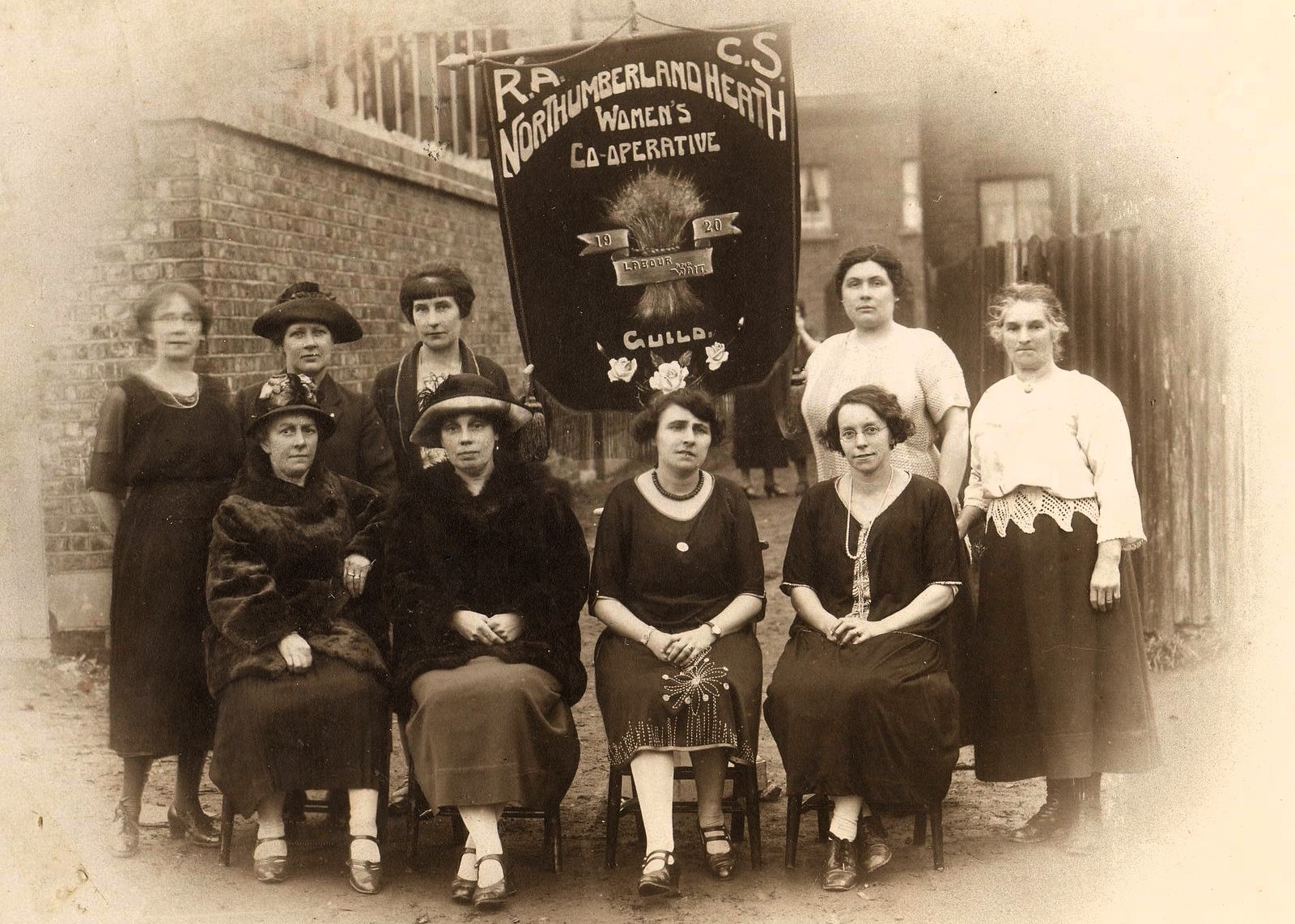
A leading figure on the Women’s Secretariat of the Comintern speaks to the founding of the International Women’s Co-operatives Guild and the fight by women Communists in the co-operative movement to get it to embrace the class struggle.
‘Women’s Work in the Co-operatives’ by Hertha Sturm from International Press Correspondence. Vol. 5 No. 54. July 2, 1925.
What it is and what it should be.
The co-operative society bureaucracy will doubtless discover a warm spot in its heart again for the women, when the International Co-operative Conference once more offers an opportunity of singing the praises of the co-operatives, and of beating the recruiting drum which is to induce more women to enter the co-operative societies. Almost a year has passed since the founding of the International Women’s Co-operatives Guild at the International Women’s Conference of the Co-operatives at Geneva in 1924; but during this time working women have not experienced any benefit from the benevolent effects of the co-operatives in general, or of the women’s guild in particular.
It is thus not to be wondered at that the Co-operatives feel themselves impelled to undertake some sort of action likely to give the masses the impression of activity. The 40 million households organised in the Co-operative Alliance cannot be dismissed as a trifle. The 40 million housewives, of the working, peasant, and lower middle class, ruling these households, constitute a factor which even the most ossified bureaucracy has to take into consideration. The women members of the co-operatives should fully realise their power. They should not permit themselves to be deceived in any way, but should call the co-operative societies decidedly and definitely to account, demanding to know what steps these have taken in defence of their members’ interests, and beyond this in defence of the interests of the broad working masses.
At its inaugural conference, the International Women’s Guild boasted that is was going to create an internationally comprehensive organisation of the broadest masses of women, a “mothers’ international”. It was going to fight against war, it was going to protect the interests of the “market basket”, the symbol of the new women’s organisation, it was going to develop social consciousness among women, and many other desirable things. But even the most credulous of the members must now recognise that the whole conference was nothing more than a theatrical performance for misleading the masses. Nobody has stirred a finger towards converting these fine phrases into action.
“Mother’s international!” But where have the co-operatives been whilst the governments of all countries have been arming for war against each other, against the colonial peoples, and against Soviet Russia? Where have they taken action, or even uttered a protest, against the raging of Fascism and White Terror in Italy, in Esthonia, and in the Balkans? What are they doing for the release of the hundreds of thousands of political prisoners all over the world?
The leaders of this gigantic international organisation share the responsibility for the shedding of the blood of every mother’s son who has fallen on the battlefield of imperialist or class war, and for the starvation of every worker’s or peasant’s child whose father pines behind prison walls.
“The interests of the market basket!” A huge wave of high prices is sweeping across the whole world, taking the bread out of the mouths of the worker’s families. In Czechoslovakia masses of women crowded the market places and streets, desperate and helpless, for weeks at a time; in Italy the starving women storm the bakers’ shops; in England the “imperial government” finds itself compelled by the pressure from the masses to appoint a pseudo-commission for inquiring into the prices of food, and even to call upon a few real housewives out of the working and middle classes to report to this commission. There is a universal outcry for energetic action on the part of organised labour, for the confiscation, price fixing, and distribution of food through the agency of the workers’ control organs in association with the co-operatives in town and country.
But all this does not affect the co-operatives. They are waiting to see if the capitalist governments will not perhaps help the working women, and meanwhile these governments all over the world are tacitly agreeing among themselves to further reduce the working class standard of life by the introduction of protective tariffs, by the increase of indirect taxation on articles of mass consumption, by the raising of rents, by the restriction of tenants’ protection, and by reducing social welfare measures,
The leaders of the co-operative societies share the responsibility for the fact that, week after week, the working class housewife brings home worse and fewer goods in her shopping basket.
“Education of the women to social consciousness?” Truly an excellent aim! No doubt it was in pursuance of this aim that the co-operatives in France and Belgium kept at such a safe distance from the question of women’s suffrage, since this was likely to free women from the narrow confines of the four walls of the home, and to lead them into the broad daylight of public life. And no doubt this is the reason why the working women and peasants have never seen or heard anything of co-operative society help towards an alleviation of their burden of toil in home and factory, towards the organisation of co-operative kitchens, laundries, creches, etc., enabling women to develop from beasts of burden into thinking and acting fellow fighters for their own class. And where has the women’s guild of the co-operative societies ever organised any systematic work of enlightenment and education among its women members?
The leaders of the co-operative societies share the responsibility for the fact that millions of women of the suppressed class are still unenlightened, still stand aside from the class struggle, and strengthen the position of the enemy in every conflict between the bourgeoisie and the proletariat, from Parliamentary elections to strikes and lock-outs.
All this must be changed. But the present leaders of the co-operatives do not want the masses of the women to be mobilised in defence of their claims, for this would mean a rupture of the alliance between the co-operatives and the bourgeoisie. The leaders prefer that the women remain politically unenlightened, for this enlightenment means the loss of the strongest auxiliary forces of these leaders. The revolutionary vanguard of the working class, the communists, must thus work the more systematically and tenaciously for the political enlightenment of the masses of women in the co-operatives, and for the enlistment of these women in the class front of the proletariat.
The co-operative bureaucracy hopes to attain the object of its swindling manoeuvres on one single day, on the 4 July. The communists can hold out longer than this. They will work for weeks, months, and years; but they really will attain their object. Every opportunity must be taken for obtaining access to the masses of women, every public meeting held by women, every trade union, factory council, or co-operative meeting, every factory nucleus newspaper, every co-operative society or labour party periodical, must be utilised by the communists for opening the eyes of the women to their own interests, to the real tasks of the co-operative societies, and to the disgraceful failure of the co-operatives to perform these tasks.
But mere agitation does not suffice. The Communist Party must at the same time teach the masses not only to understand the world, but to change it. Every concrete fighting situation arising in any place or in any country must be made to serve as a starting point for showing the women members of the co-operative societies, and with them the co-operatives themselves, the plain duties lying before them, whether these consist of mobilising for the material support of the starving families of strikers, of safeguarding against duties and usurious taxation by means of proletarian mass action, or of organising political, moral, and material help for the victims of the White Terror. In all such situations special tasks fall to the women. We only need to remember the control committees against rising prices, the organisation of collections, the distribution of food in cases of mass need etc. And all these actions will be carried out by women with the utmost enthusiasm as soon as they have grasped the import of this solidarity.
Above all, these is a task of burning importance which must not be so neglected in the future as it has been in the past. Our best agitation, our best conducted action with the participation of the masses of the women, will be but temporarily successful if we are not capable of creating firm strongholds among the masses of the women in the co-operatives themselves, these to form a constant connecting link between the staff of leaders, the Communist Party, and the masses. For this two things are necessary: Every co-operative fraction of the Party must have its organiser, conducting work among the women in accordance with a definite plan. Further, every co-operative society must have a women’s committee consisting of women co-operative society members representing different tendencies. This committee has to enlighten the women members of the co-operatives as to the tasks incumbent on the co-operatives in class warfare, and to school and stimulate them for these tasks; besides this it has to awaken the interest of the broad unorganised masses of women outside of the co-operatives, to induce them to participate in co-operative action, and to become members of the co-operative societies.
This work demands an extensive staff of class conscious working women. Therefore, every revolutionary woman, every woman communist, must join the co-operative society! A complete system of meetings, courses of instruction, and discussion evenings, is required, if all confused heads are to be enlightened, all indifferent minds interested, and all passive elements mobilised. We may thus form an elite troop of women co-operative society members, fully realising why they are members, and capable of explaining this to the broad masses within and without the co-operatives. And it is only thus that we can finally wrest the minds and hearts of the broad masses of the women out of the clutches of the treacherous co-operative society bureaucracy.
The international co-operative day is a great fighting day in this wrestling contest.
International Press Correspondence, widely known as”Inprecor” was published by the Executive Committee of the Communist International (ECCI) regularly in German and English, occasionally in many other languages, beginning in 1921 and lasting in English until 1938. Inprecor’s role was to supply translated articles to the English-speaking press of the International from the Comintern’s different sections, as well as news and statements from the ECCI. Many ‘Daily Worker’ and ‘Communist’ articles originated in Inprecor, and it also published articles by American comrades for use in other countries. It was published at least weekly, and often thrice weekly.
PDF of full issue: https://www.marxists.org/history/international/comintern/inprecor/1925/v05n54-jul-02-1925-inprecor.pdf

