
In 1924 Paterson, New Jersey, site of numerous previous and future confrontations, the official A.F.L.’s craft unions prove incapable and militants take the lead. The Associated Silk Workers organizes a strike with Workers Party and T.U.E.L. activists heavily involved in this early piece of labor reporting from Esther Lowell.
‘Paterson Silk Workers on Strike’ by Esther Lowell from Labor Herald. Vol 3 No. 8. October, 1924.
OUT of the struggle of the silk workers of Paterson a national industrial union of silk workers is being born. It is a story more fascinating than that of the silk upon which the workers work.
Paterson is practically a one-industry town. It has broadsilk mills, ribbon and hat-band mills, dye plants, and silk machinery factories, but all are part of the one industry. The workers have had two big strikes previous to the present one. In 1894 the ribbon weavers of Paterson, and New York struck, but they did not consolidate their gain of a new price list by forming a union. In 1913 the whole city was tied up by the strike of the silk workers. The strikers held out valiantly until July, but did not succeed in the end. The craft unions which separate dyers from weavers prevented settlements.
For five years now the Associated Silk Workers have been building up an industrial union among the workers. This summer offered an opportunity for the workers to strike against the encroaching 3 and 4 loom system and the tendency to ignore the 8-hour day ruling. Increased wages were necessary as living costs rose. Ten thousand weavers walked out. Winders and others joined to some extent. When no organization of manufacturers could be found to make a collective agreement with the union, the strikers began to make settlements with individual mills.
T.U.E.L. Leads Mass Picketing
Among the strikers are members of the various branches of the Workers Party and Trade Union Educational League. Immediately they took an active part in the fight. They have encouraged the other strikers with them in mass picketing of mills which were reported to be operating with scabs or which obtained injunctions. The League members have acted as a body in emphasizing to the strikers the necessity of organizing in an industrial union to save their strike from the disastrous results of earlier battles. Workers Party speakers are enthusiastically heard by the huge meetings of strikers held every morning in Turn Hall. From the hall the strikers march spiritedly in a body to picket the various mills.
During the 1913 strike the Industrial Workers of the World led the silk workers. There are still a few Wobblies among the older workers and veterans of the earlier fight, many of whom are now in the Associated Silk Workers Union. Many of the strikers in the fight now are newcomers and know little of unions. The Syrians are particularly numerous and have had no organization experience before. Some of the workers who were brought in as scabs in 1913 have since learned that a job isn’t everything and that the employers’ efforts to keep them in slavery must be resisted.
The employers have used the argument that improvements in industry make it possible for the weavers to attend 3 and 4 looms. Workers who have been in the mills for 20 years say that there have been almost no changes in machinery and in the process during that period. The fact that the fabric is dyed after weaving now makes the thread less brittle in working but would not justify the increasing of the number of looms per weaver.
To Abolish Speed-Up System
The abolition of the 3 and 4 loom system has been the cry which the workers responded to most eagerly. They are determined not to allow the employers to double up their work instead of giving more workers employment. The fight against overtime is also fundamental. The employers were using the same old excuse that they couldn’t afford to hire more workers and keep the 8 hour day.
One factor in the situation at Paterson may be as much to the disadvantage as to the advantage of the strikers. The disorganization of the employers has perhaps averted the extreme oppression of the workers during the fight but it has prevented a mass settlement. Few private gunmen and detectives have been used by mill owners against the workers and the injunctions were not taken out until comparatively late in the strike.
The motorcycle police which accompany the marching pickets each day have not taken occasion to arrest any of the workers but the special detachments of police which guard the properties of mill owners have made arrests. There is not the police brutality of the Chicago garment workers’ strike, but the fact that there are so many husky men among the weavers instead of mostly girl strikers possibly deters the Paterson police. That 107 pickets were arrested when demonstrating before the Gilt Edge Mills which attempted to re-open, indicates again that when a large employer wants police assistance, he can buy it.
T.U.E.L. Fights for Strike Relief
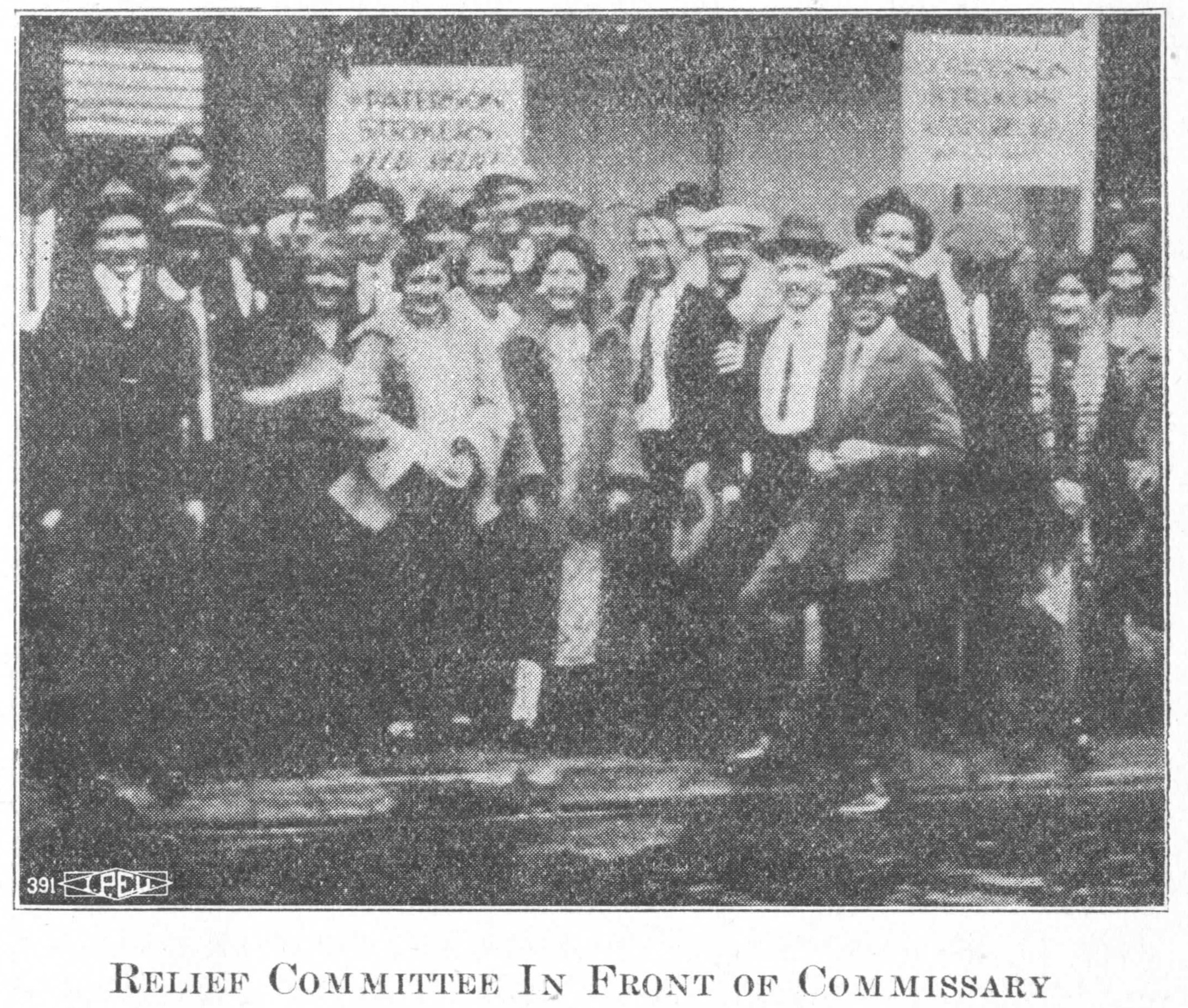
Prior to the strike the workers had been unemployed or working part-time for a period of several months. The industry was just reviving when the workers took the opportunity to strike. The number of workers in the union was about a quarter of the number who came out on strike. After several weeks of the strike the strain on the finances of the union and of the strikers was considerable. The local labor council would not assist the strikers, although a few trade unionists are attempting to help get relief funds. The New York branch of the T.U.E.L. was asked to secure aid from sympathetic workers in the city and held a monster benefit meeting.
The Associated Silk Workers union has succeeded in signing up mills having more than a third of the looms with good prospects for signing more. The little mills run by a family with only a few workers, like the sweatshops in the garment industries, are hardest to control. Many of these have failed during the year, partly because of the speculation in the raw silk market following the Japanese earthquake of a year ago and partly because of the depression. But the Associated and the T.U.E.L. members are keenly aware of the difficulties confronting them in the present fight and in the plan to extend the union’s activities throughout the industry and throughout the country.
A conference with representatives from the workers of Allentown, Pa., and from New York has been held and a constitution for the national industrial union proposed. If this is approved by the membership a convention will be held and the actual organization work will begin. The importance of getting all the silk workers into one organization must not be minimized in considering the difficulties. Many workers attribute the failure of the 1913 strike to the fact that Pennsylvania mills continued working. In the present fight the employers are claiming that their business is going to other places but this has not been proved by reports from Pennsylvania and New York.
The United Textile Workers, the largest union in the textile industry outside the silk trade, affiliated with the American Federation of Labor, has no organization left among the weavers, although some pickers and quillers are still in its ranks. The A. F. of L. crafts have not participated in the strike. The United Textile Workers union is really negligible in the silk industry and can scarcely charge dualism to the Associated in its effort to become a national industrial union.
Direct Participation in Struggle
The Paterson strike offers another very good case to illustrate how the T.U.E.L. and Workers Party members can be influential in the struggles of the workers. League members among the silk workers are, as in other fields, more alert to the problems of the workers and to the intimate connection of any group of employers to the whole organized capitalist society. League members naturally forge to the front among their fellow workers, particularly when there is a big struggle like the strike.
League members actively assist in the conduct of the fight and afterwards it is part of their task to see that the union agreement is kept in their mills. They carry the fight to the job. Their enthusiasm for the fight against the employers inspires other workers and gives the opportunities to educate them in the necessity for studying revolutionary tactics.
The Labor Herald was the monthly publication of the Trade Union Educational League (TUEL), in immensely important link between the IWW of the 1910s and the CIO of the 1930s. It was begun by veteran labor organizer and Communist leader William Z. Foster in 1920 as an attempt to unite militants within various unions while continuing the industrial unionism tradition of the IWW, though it was opposed to “dual unionism” and favored the formation of a Labor Party. Although it would become financially supported by the Communist International and Communist Party of America, it remained autonomous, was a network and not a membership organization, and included many radicals outside the Communist Party. In 1924 Labor Herald was folded into Workers Monthly, an explicitly Party organ and in 1927 ‘Labor Unity’ became the organ of a now CP dominated TUEL. In 1929 and the turn towards Red Unions in the Third Period, TUEL was wound up and replaced by the Trade Union Unity League, a section of the Red International of Labor Unions (Profitern) and continued to publish Labor Unity until 1935. Labor Herald remains an important labor-orientated journal by revolutionaries in US left history and would be referenced by activists, along with TUEL, along after it’s heyday.
PDF of full issue: https://www.marxists.org/history/usa/pubs/laborherald/v3n08-oct-1924.pdf

