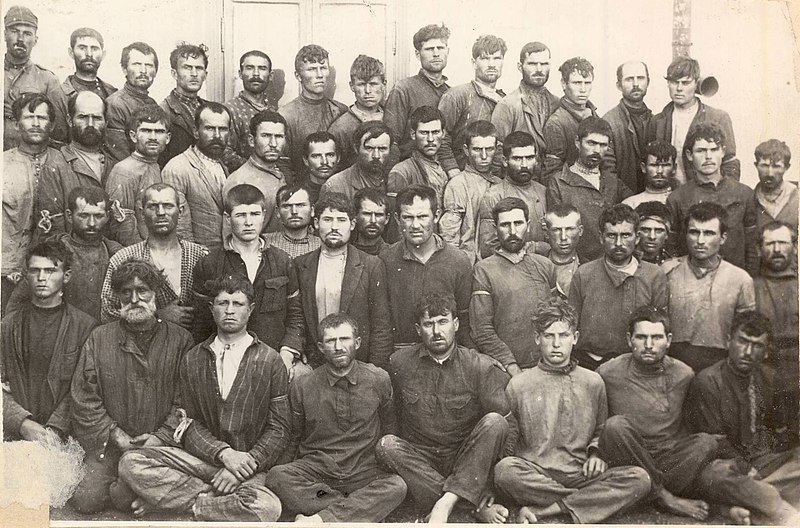
An early look at Romanian Third Internationalists shortly after that country’s failed peasant uprising of 1918.
‘The Revolutionary Movement in Roumania’ from The Communist (Old C.P.A.). Vol. 1 No. 9. November 29, 1919.
(From “Nova Ostina”, the official organ of the South Slavic Communist Party, Zagreb, Croatia).
MANY will remember the tragic results of the peasant revolution in Roumania in 1907. The “hero” who suppressed that revolt was the well-known blood-hound Bratianu. The great business politician Take Jonescu, then at the head of the government, had not the courage to proceed against the revolutionaries; he transferred the power to Bratianu, who, with King Carl, was responsible for the slaughter of eleven thousand peasants. King Carl is dead, but Bratianu still lives and holds power, and is the foremost terrorist and enemy of Socialists in Roumania.
Until 1917 there was an orderly Socialist movement with the weekly organ “Roumania Munciatore”, published in Bucharest. But since 1907, after the oppression of the Socialists by Bratianu, mentioned above the entire movement changed its form, but became much stronger. All the world knows how many times our comrades of Roumania were driven out of the country, but the number of arrests and the chicanery will never be known.
Then the World War came. With all their power our comrades opposed the criminal war. For two years (1914-1916) our comrades fell as victims of the heroic struggle against the bloody imperialistic game. All in vain. The dark days did not spare the Roumanian proletariat.
The 15th of August 1916 stands out as a day of terror in the memory of the Roumanian proletariat. On that day the Roumanian battalions marched into Erdely, where they were met by the Germans, and in a short time, practically exterminated. The frightened Roumanian oligarchy, with King Ferdinand and Bratianu, fled to Moldavia, while the Roumanian people were left in the trenches to starve and freeze. This horror and the terrible conditions in general were not sufficient all our leading comrades were thrown into subterranean prisons as Socialist agitators. Many of them, Max Vesler among others, were shot as anti-militarists.
Comrade Rakovsky was dragged from prison to prison during the night time, in order to keep the place of imprisonment secret. The blood hound Bratianu declared that he would not be satisfied until he had purged the Roumanian people of Socialism. But to his astonishment his unparalleled persecution brought results exactly contrary to his expectations. In Russia the revolution broke out and the Roumanian oligarchy lost the ground from under their feet. The Russian revolution freed those of our comrades who were still alive, and many of them went to Russia. Comrade Rakovsky was among that number, and he is in Russia at present.
But German hegemony and militarism also came to an end in the Fall of 1918. Mackensen, with his hordes, left Bucharest. In order to free themselves from the power of Bratianu, our comrades took advantage of this propitious moment, to inaugurate an extensive propaganda among the oppressed masses. A daily paper, “Treasca Socialismul” (Long live Socialism) was issued. Millions of leaflets and manifestos were distributed. Bratianu apprehended the great danger; he realized the far-reaching influences of the Socialist propaganda; therefore before his return to Bucharest he organized a reactionary army, composed of Coyars and other elements unfit to fight at the front. This new army of parasitic hordes fell upon the discontented masses who were demanding freedom. Armed to the teeth, they marched into Bucharest and succeeded, momentarily, in suppressing the will and the hope of the people. They closed all gathering places of the workers throughout the country, and the paper was immediately suppressed. This terrible regime aroused the workers of Bucharest and the surrounding towns. Preparations for a great mass demonstration were made to take place on December 13, 1918. But the reactionary hordes of Europe and the Roumanian counter-revolutionaries prepared to counteract the demonstrations.
At the very moment when the demonstrants entered the Calea Victoria (the main street of Bucharest) they were met by the “Elite” troops with a rain of bullets from mitrailleuses and machine guns. In a moment sixty dead and numberless wounded covered the ground. The Roumanian reaction had come out into the open. But notwithstanding this last atrocious crime of Bratianu, our comrades succeeded again in reviving their movement. Today a bitter life and death struggle persists in Roumania, and the bourgeoisie trembles like a decaying tree which is artificially propped up. The class war between the proletariat and the bourgeoisie has been declared: no Roumanian considers a Magyar or Bulgarian worker his enemy: he recognizes as his only enemies the bourgeoisie, the reactionaries and the hordes of Bratianu who brought the country to the verge of ruin, and for whose capitalistic-imperialistic ambition 600,000 people were sacrificed. Bratianu now tries to popularize the slogan “Roumania Mare” (Great Roumania), but very few are impressed by that sort of thing.
On December 13, 1918, the persecution of the leaders of the socialist movement was launched. On that day 65 of our comrades were sent to prison in Wacaresta (a penitentiary for criminals and murderers) and were kept in the same tiers with men afflicted with typhus and other infectious diseases–forced directly into the jaws of death. This, too, was done by order of Bratianu. More than half of the comrades died in that prison from typhus! among them the prominent champion of the Roumanian proletariat, Jovan Frimu. All of them were arrested “ad preventia” and kept incommunicado pending a final trial on charges of “sedition”. After five months they had not yet been brought to trial.
Comrade Frimu died in May and was buried at night time by soldiers, and his family did not know what became of him.
Everything was undertaken to free our comrades and to have the dates set for a trial. Bratianu was at that time in Paris, occupied with forming the foundations for “Great Roumania,” and no one else had any authority to act in the matter. This was the third crime of Bratianu, the crime of the bourgeoisie; the Roumanian proletariat swore to avenge these outrageous deeds.
Although weakened, the comrades at liberty did not rest a moment, but conducted an heroic campaign to re-open the workers’ halls, and they began again to publish their daily paper “Socialesmul”, which is still being published today. The organizations went “underground”, but since December 13, 1918 they have become increasingly stronger. They are more powerful today than they were at any time during the ten years preceding the war. The struggle for freedom became proportionally intense and determined as the reaction grew. In February 1919, when the workers’ halls were reopened, the reaction resorted to stool-pigeons and agents-provocateurs. The most clever among them visited all the meetings of the workers. It was their role to provoke a premature rebellion, and often they shouted: “Down with Ferdinand,” “Long live Leon Trotzky” etc.
After such prearranged provocations the gendarmes arrested the speakers and broke up the meetings. But soon the comrades became aware of these methods, and they adopted the necessary precautions against such interference, in order to forestall the plans of the reactionaries.
The Roumanian movement is now one of the soundest Marxian movements in Europe. Christian Socialists, Social-patriots, revisionists and traitors of proletarian interests are barred from the movement. The Second International is dead for the Roumanian proletariat, and no one mourns it. Because of the terrible persecution, the Roumanian comrades could not openly affiliate with the Third International, but they adhere to it unreservedly with wholehearted zeal they are striving for the dictatorship of the proletariat; and they stand ready, at any moment, to make any sacrifice for the realization of the stupendous aspirations toward which the International Proletariat is striving.
Emulating the Bolsheviks who changed the name of their party in 1918 to the Communist Party, there were up to a dozen papers in the US named ‘The Communist’ in the splintered landscape of the US Left as it responded to World War One and the Russian Revolution. This ‘The Communist’ began in September 1919 combining Louis Fraina’s New York-based ‘Revolutionary Age’ with the Detroit-Chicago based ‘The Communist’ edited by future Proletarian Party leader Dennis Batt. The new ‘The Communist’ became the official organ of the first Communist Party of America with Louis Fraina placed as editor. The publication was forced underground in the post-War reaction and its editorial offices moved from Chicago to New York City. In May, 1920 CE Ruthenberg became editor before splitting briefly to edit his own ‘The Communist’. This ‘The Communist’ ended in the spring of 1921 at the time of the formation of a new unified CPA and a new ‘The Communist’, again with Ruthenberg as editor.
PDF of full issue: https://www.marxists.org/history/usa/pubs/thecommunist/thecommunist3/v1n09-nov-29-1919.pdf

