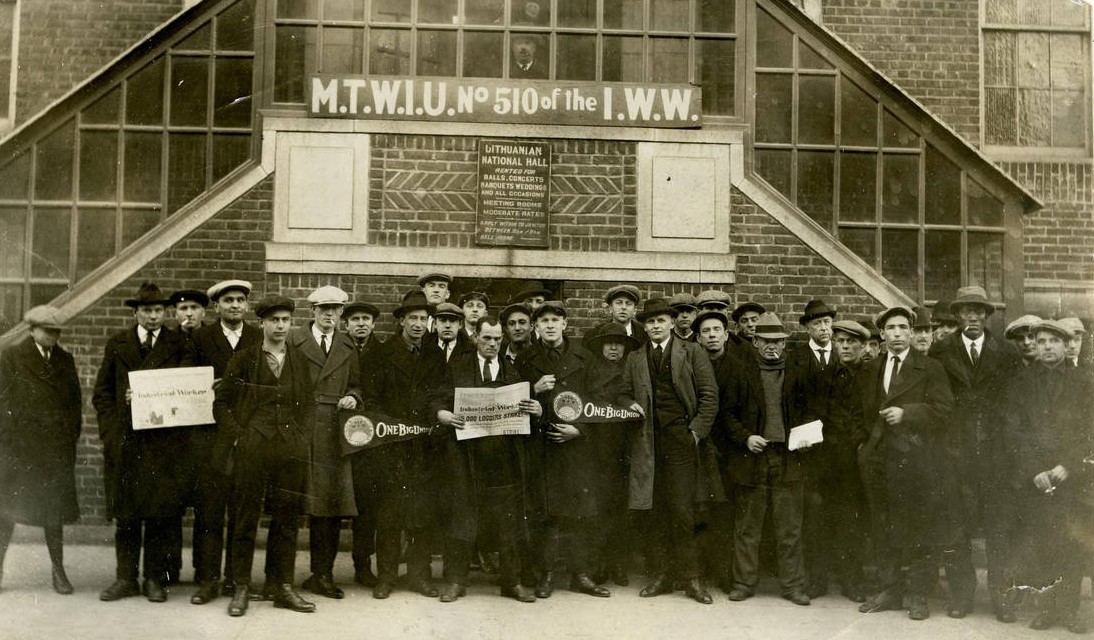
Building workers’ power on the ocean, ship committees and a “International and Universal” form of organization; the seventh chapter in Barker’s fantastic book-length serial.
‘The Story of the Sea: VII. The Way to Power’ by Tom Barker from Industrial Pioneer. Vol. 1 Nos. 4. May, 1921.
VII. THE WAY TO POWER.
THE rank and file of the ships and docks have to create something new and modern if they are to fight the boss with any degree of success. This new form of organization will not come from the trade union jonahs, many of whom have never seen a ship, and can’t speak any language except the one they picked up when they were children. Most of these poor old fossils are in their second childhood, for while their legs are alive their heads are dead. I have seen the secretary of the Auckland branch of the New Zealand Seamen’s Union come down to the union office in a pony chaise. He was about sixty inches around the waist, and his legs could not stand the strain. The assistant secretary would come out and report how things were going on, after which John would whip up the tired pony, which waddled away with his mountainous load of trade union officialism. That was his day’s work.
The craft unions have to be broken up, as they are worse than useless. When they meet the owners they act like a dying duck in a thunder storm. They keep their watery eyes fixed on the ground, and have as many legs as a caterpillar. The idea of DOING anything never occurs to them, and any man who takes trouble up to the union office is an unwelcome visitor. When the unemployed army gets large they cry for unemployed doles, and chase their colored members off ships in order to make room for their white members. If a man with red blood tries to stir things up, the officials will conspire with the companies to boycott him. They have a way of trying to silence the opposition with the assistance of retired pugilists and toughs. Some of the dockers’ unions are run on the same system, and the officials are more noted for their physique in a few cases, than for their brains.
The Meaning of Power.
Modem workers want something more than good old craft unionism has to offer. They want to put the boss to work on the docks and the ships, and to see that his wife is going to nurse her own children, wash her own clothes and her own floor. They want economic freedom, the right to live a full life and to have their material requirements attended to. They want to own the ships instead of being treated as so many slobs when they are aboard.
In October, 1920, some 930,000 miners went on strike in Great Britain. They were on strike a very short time, but that little time stirred things up. Factories closed, railway services were reduced, in fact everyone was more or less affected. The coal mining industry is only a national industry, but a strategic one. Let us have 900,000 marine workers and 1,200,000 dockers in one organization all over the world, with the same spirit as the British miners, and how much more power could we wield, especially if we had the co-operation of the land transport workers and the miners of the world behind us.
We have, then, to build from the bottom up. Every person working aboard a ship, whether on (the bridge, the deck, the firehole, the engine-room, the steward’s room and the wireless room must be in the one organization. Everyone is exploited by the same masters, everyone must organize together against the common enemy. Each department will elect its own delegate, and the delegate will be responsible for his fellows, see that they are in good standing, distribute educational matter and see to it that their grievances are redressed. These delegates, as their function extends, and as the power of the workers tends to perfect their organization, will tend to become more and more the administrative body on board a ship. One of these delegates will be elected to represent the ship in the various ports. As soon as the ship arrives in port it will be his duty to render a report at the shore office, and clear the ship to the longshoremen for working the cargo. He will put in a document showing particulars about the ship, the names of her crew, their standing in the union, etc. The combined delegates aboard a ship should act as a ship’s committee.
Cards and Officials.
There should only be one dues card, by which means it would be possible for a man to pay his dues in any part in the world, where the World Organization has control. Once a man is a member, always a member. Delegates should also act as messengers between the various countries and districts, thereby guaranteeing the delivery of correspondence of their own and similar organizations. In the case of International Congresses dealing with the people of the sea, the delegates should be required to work their passages to the place of the conference; an end should be put to the system of traveling first class, such as is adopted by the modern jonahs who are retarding the movement.
No union official is worth more than the average wage in the industry that he is organizing. The union members who allow their officials £10.0.0 a week while they themselves are only getting £4.0.0 are damned fools. If the official wants a raise then let him get busy getting his members a raise, when he will benefit accordingly. No politician should be allowed to hold a union job, nor borrow a shilling, nor ask for a vote. A politician is the rottenest type of man there is on God’s green earth. He is lower than a white-slaver, and would pinch the Great White Throne itself, if ever he had the remarkable luck to get into heaven. Which reminds me of a politician who did try to get into heaven. He was turned down and shuffled off to hell. When he was questioned at the gate about his mode of life on earth, he replied that he had been a politician. This was reported over the phone to his Satanic Majesty—who was busy frizzling up some respectable shipowners and seamen’s missionaries—who ordered, “We don’t allow politicians in hell, otherwise they’d make everybody as bad as themselves. Give him a bucket of pitch and let him go away and make a hell of his own.” And thus the gentleman who had scabbed on the unemployed by holding two men’s jobs as union official and member of Parliament got fixed up for eternity.
Our Class and Our Boss.
Last year when there was a strike of firemen on the East Coast of the U.S. the ship-owners sent blacklegs on board. As soon as they arrived, the engineers—members of their own craft union—did the manly thing and struck, also. That settled it. Solidarity gets the goods. The secret of success is to stick together, like mud to a blanket. You belong to the one class and you are always right when you have your fist under the nose of the human sharks who skin you. The cook’s labor is just as necessary as the skipper’s, the fireman’s energy as the engineer’s technique. The boss doesn’t employ you because he loves you, for as a matter of fact the rail boss never sees
you, and doesn’t want to see you, either. There is profit in your carcass and he wants to coin it into a bank balance. Day by day he coins up your energy into golden dividends, and as soon as he has stripped your hide of the last ounce of your nervous and physical power, then he fires you to bum your food along the water-front for the rest of your days.
Fellow workers, get the class idea; our class against their class. Let us consider our children before their children, our women-folk before their women-folk, ourselves before both them and their lily-handed avarice. And if they want a loaf of bread, let them earn it.
Coffin Unionism.
You know, fellow worker, that if you pay off in Genoa from an overseas ship you do not, so far, get protection from the local unions. The same was true in Buenos Aires and Rosario before the Marine Transport Workers were established there. There is no union there for you, and so you are shanghaied or shipped for any old wages at all. Now, fellow workers, we have to put an end to this for once and for all. You know that there are several great international shipping centres in the world that are similar to Genoa. There are Antwerp, Rotterdam, Hamburg, Barcelona, Hull, Newcastle-on-Tyne, Glasgow, Liverpool, London, Cardiff, Melbourne, New York, Philadelphia, San Francisco, Seattle, Valparaiso, Callao and Rio de Janeiro. They are in precisely the same condition to the men working on overseas ships as Buenos Aires was before May, 1919.
Now you know, you British seamen, that even if Havelock Wilson’s Union does such a lot for you in the ports of the United Kingdom, he does nothing for you in Helsingfors, Barcelona, or Shanghai. Neither does the Seafarers’ Union nor the Hull Union. The Belgian Union doesn’t protect its members in Copenhagen, Malmo, or Hong Kong. The International (?) Seamen’s Union of the United States has no power in London, Rio, or Auckland, N.Z. When a badly injured Norwegian union-man sent a note from his ship in the Commercial Docks, London, to the delegate of the British Union to assist him in getting justice, he was informed that “the law of this country prevented their union from doing anything for him, but that they would work to get an Act thru Parliament that would help poor foreigners when they get hurt.” So, fellows, you see how useless this kind of unionism is to the men who follow the deep sea. It is money wasted and time lost, it is the bosses unionism, for it plays into his hands.
The Amsterdam Federation.
The Yellow International Transport Workers’ Federation has federated no one. Things are in as bad a state as they were in the year 1914. Their conference held recently in Kristiania was remarkable for nothing except the banquet. In fact the average international congresses have become little else, except excuses for joy trips on the part of the Labor Generals of the different countries. They are tedious and useless, and couldn’t organize a peanut stall. The future of the Marine Transport Workers will circle more round Moscow than Amsterdam.
Towards Power.
The establishment of Ship’s Committees is imperative. We have to open offices in all the ports that I have just mentioned. In some places the local organizations will gladly fall into line, and welcome them, for they are tired of carrying half a dozen union cards, and possessing no protection overseas. They require the “International and Universal” form of organization. Every sensible man is ripe for it, whatever his creed may be. While in port the ship’s delegates will meet weekly, and arrangements shall be made to overcome language difficulties, which is the chief obstacle. It would breed a fraternal spirit. Further, such a form of organization would so completely smash the existing national unions that the Vigilance Committees of the longshoremen will fall in line. The Marine Transport Workers would not control the Argentine ships in Buenos Aires, but they would in London, Glasgow or Genoa. The M.T.W. in Genoa would control all non-Italian tonnage and work hand in hand with the “Lavoratori del Mare”. By these methods of organization we would encircle the world with a girdle of steel that would render the employers powerless. We would be on the way to control and to posses the ships. And, without being too hard on the theoretical internationalists, we would point out that there can never be an effective, usable World Power of the Workers until this, or some other similar project is launched and perfected. The closet philosophers may disagree with it, and the academicians who never coiled a rope, nor took a turn at the wheel, may see other ways to do it; they may offer opposition, if it merits so much of their attention, but they will not seriously deter it. It is enough to say that intelligent men who follow the sea feel that this method of industrial not-work is the Starting point for the Federated Workers’ Republics of the Planet Earth.
From practical experience it will be found necessary to have paid delegates to visit the ships in port, and to interview all ranks aboard. Men who are staunch industrialists and can speak two or more languages are the most desirable. They must be trained for the work, for they have to impart the ideas of industrial control. Scandinavians, Germans and Hollanders on deep-water traffic generally speak more or less English. In Buenos Aires we found that Scandinavians made the best delegates. For the Latin ships, you have to find men who can speak two or more languages, such as French, Italian, Greek and Spanish.
Shore Delegates.
It will be the duty of the shore delegates to visit each ship in his area daily, to note how many men have left the ship, and to see that they register at the union office on paying off for further employment. The delegate must see that every ship has a full crew signed on at least three days before the ship is ready for sea, otherwise the dockers must be acquainted and the ship tied up. All employment must go by rotation, and be engaged only at the union office. In Buenos Aires we had three sections, viz., deck, engine-room and steward’s. Officers and engineers were also shipped thru the union, when vacancies occurred in the port.
No seamen were allowed to visit ships to look for their own job, nor were they allowed to stay at, or visit non-union boarding-houses or bars. Captains were not allowed to be fastidious about the men that they wanted, for we took the standpoint that every man had a stomach, whether he was small or whether he was otherwise. If a man proved that he was a sailor, then that was all there was to it.
The shore delegates were responsible for the distribution of literature that was printed for the different grades in various languages. Special leaflets were issued to captains, officers and the men in the foc’s’le. Whenever, in Buenos Aires, we had a serious fight an explanatory manifesto was issued in Spanish for the dock-owners. When the M.T.W. tied up the Dutch ships in February, 1920, at the request of the Dutch secretariat, the matter was explained in a Spanish leaflet to the dockers, and in a Dutch leaflet to the Dutch crews. Thus two national groups of workers fought together, although they did not speak a word of one another’s language.
How We Did It in Buenos Aires.
In Buenos Aires we recognized the members of other overseas unions. We transferred them free. If a man was in good standing overseas, he merely registered at the union office for his next job and he paid nothing. All we required was that he should act according to the union rules in the port. This system smashed the shanghaiers out of their business and made it impossible for them to operate. When the dockers boycotted a ship at the behest of our union, they did not return to work until they had been paid for the time they had not worked, a fact that was not appreciated by the shipping companies. Doubtful ships and boarding houses were picketed, and the owners of the latter became little puppydogs under the rule of the union, whereas before they had been man-eaters and terrors to the seamen. We built that power out of 250 starving men of all nationalities, who had been sleeping in railway trucks, and getting a little food from the ships. They were the finest body of men that ever picketed a consulate or “uppercutted” a shanghaier. If we had 5,000 of such men scattered thru the marine industry today, we would have the boss shoveling coal in no time.
A little conference shows the kind of temper these men had. One day the news leaked through that a shanghaier had boasted that he was going to bribe the police to get me arrested. A Chinese cook, who was a member of the union, went to his place, and showing him the point of a vicious-looking knife, he said, “If you allest secletally, I bloody well kill you, savvy?” He savvied all right. On the Norwegian steamer that I came north on, the Chinese steward had more wages than the chief engineer who was signed on in Norway. The least paid man on the ship was the third mate, who received about 30 crowns a month less than the Chinese galley boy. Both the Chinese were members of the Buenos Aires local of the M.T.W.
With power in our hands we may have the pleasure of soon seeing Lord Inchcape going into print again because we are going to compel him to pay the same wages to Lascars and Chinese as he does to the Britishers. He may not like it, but that’s his funeral.
What we accomplished in Argentine can be accomplished everywhere else if the boys will get together and build this movement from the bottom up. We want delegates to give her a start. We are ONE CLASS. We must HAVE ONE UNION, with ONE AIM—the mastery of the ships and wharves, and the establishment of the Dictatorship of the Proletariat on the Ocean.
The Industrial Pioneer was published monthly in Chicago by the Industrial Workers of the World from 1921 to 1926. The precursor of the Industrial Pioneer was the One Big Union Monthly. Heavily illustrated, the journal included arts, prose, and poetry along with historical articles and analysis. Editors included John A. Gahan, Vern Smith, H. Van Dorn, and Justus Ebert.
Full issue PDF: https://www.marxists.org/history/usa/pubs/industrial-pioneer/Industrial%20Pioneer%20(May%201921).pdf

