An informative overview of the New Zealand working class and its organizations from the R.I.L.U.’s Pan-Pacific Trade Union Secretariat.
‘New Zealand: Position of Workers’ by R.I. Griffin from Pan-Pacific Monthly (P.P.T.U.S.). No. 26. May 1929.
THE possibilities of war in the Pacific and the rising revolutionary wave in India and China bring outposts in the southern seas such as Australia and New Zealand into prominence in the play of imperialist forces in the Pacific.
Assuming an Anglo-American war, they might easily become an objective of American imperialism. On the other hand, a rapid development of the Chinese revolution will result also in a stimulus to the Indian nationalist movement and, if led by the proletariat, open uprisings are certain over a large part of India and China under the slogan of transferring all power to workers’ and peasants’ councils.
This inevitably means the combination of imperialism against this development and also directly against Soviet Russia. In this case the white Dominions of Australia and New Zealand would easily become a base of operations for the imperialists in the Pacific.
Furthermore, the interests of the working class of these countries are inseparable from those of their colored brethren of the other Pacific countries. Take a case in point: Indian iron is imported into New Zealand for many purposes and recently a demand was made for a duty on this iron, it being claimed that it was impossible to compete with Indian iron because of the low rate of pay of the Indian workers.
An important thing to remember is that this Indian iron is being produced by British firms, who have transferred their machinery and capital to India to the detriment of the British workers. Indian labor is cheaper and capitalism is able to use it with profit, but the result is unemployment in Britain and New Zealand which again means lower standards in both countries in order to compete with the Indian.
Another case was reported from America of what appeared to be Irish lace being sold at less than cost. Enquiries proved it to be lace made in China, the Chinese being taught by Irish missionaries! The result was that the Irish lace workers could not sell their product because they had a higher standard of living which determined the price of the lace.
The Indian, the Chinese and the New Zealand worker will, and must, learn from these things that they have common interests. First of all, they must unite in the Pacific for their common interests and against war. For this purpose the Pan-Pacific Secretariat has been organized and is meeting with success.
The mistake must not be made of regarding New Zealand as a bob-tail on the Australian kite. New Zealand has an independent Dominion Government and is five days by steamer from Australia–as far as New York from London and has different conditions and characteristics.
The population of New Zealand is one and a half millions, of whom nearly 400,000 are classed as wage-earners. The State is the largest single employer, being responsible for the employment of at least 60,000 wage-earners, exclusive of municipal employees. The number of registered trade unionists is at present about 100,000 organized in some 400 unions.
Little progress has as yet been made in factory production although there continues to be a steady increase in the number of employees and in the value of the total product each year. This is particularly noticeable in motor engineering works, engineering and hydro-electric or establishments for the production of electric current. Printing establishments also show a considerable increase. Freezing works show a decline for 1926 as against the previous year, but have since increased. Saw-milling, which was responsible for the largest percentage of what are classified as factory employees, is also on the decline. The smaller and medium-sized factories (under 100 employees) show the greatest increase. Out of a total of nearly 5,000 “factories” only about 120 employ over 100 workers and a few over 200 or 300. The total number of factory workers is estimated at 67,254.
Four pounds a week could be taken as an average wage. The usual weekly time is 44 hours. Many workers own their homes. Practically all branches of factory production have a trade union registered under the Industrial Conflicts and Arbitration Act. The biggest and most important trade unions in New Zealand are the miners’ and seamen’s unions.
Miners and Seamen
The miners’ union is not registered under the Act mentioned and secures agreements by “collective” bargaining and enforces them by job action. The miners (coal), are mostly immigrants (Scottish, Canadian, etc.), and have strong militant traditions. The total number is about 3,500 organized into one national body, the United Mineworkers, consisting of local unions with a National Council and a special West Coast District Council, where most of the mines are located. The District Councils are subject to the National Council which meets quarterly or oftener.
Although often working broken time, the miners in comparison to miners in other countries have had fairly good wages, averaging £5 per week for miners and £2/10/ for truckers (youths). Eight hours bank to bank are worked and many concessions such as pithead baths, etc., have been wrung from the employers. Housing conditions are bad. The houses are owned by the companies but owing to the militancy of the miners the employers are not able to make use of this factor against them. The unions practically control the camps, owning the picture halls, etc. The secretary of the local generally functions as the local chief administrator or executive officer. The West Coast miners practically control their own daily newspaper.
New Zealand miners are suffering from the general decline in the coal industry, both production and export showing signs of a big drop. This has resulted in a certain amount of broken time and unemployment.
The seamen’s union is at the present time strongly militant and has established ships’ committees (all-inclusive) on all ships. Many concessions have been won from the employers as the result, it being not uncommon for them to hold up ships for better food, etc. The wages are second only to those of the Australian seamen; conditions are sometimes better. The average wage is £15 to £17 per month. An 8-hour day (4 on, 8 off), weekly half-holiday on payment for 4 hours, 14 days holiday or equivalent after 6 months at sea, have all been gained.
The union is a federation of four local unions under a National Council and a Resident Executive in Wellington. The total membership is 2,700. A bad feature is that the union is closed, only one member being accepted monthly. Monthly stop-work meetings are held in all ports and annual elections are by special postal ballot. All officers are elected by a rank and file vote.
Both these unions, the miners and the seamen’s, are militant, and form the most active trade union bodies in New Zealand. In the event of war they are bound to play an extremely important part. In New Zealand, where the number of organized workers does not exceed 100,000, there are 6,000 belonging to the chief unions which if not formally affiliated to the Pan-Pacific Trade Union Secretariat, still can be counted on to stand by that organization.
Other important unions in New Zealand are: The railwaymen’s unions, three separate unions, the men being regarded as State employees, with a total membership of nearly 11,000, excluding officials.
The waterside workers, who have militant traditions and good conditions, relatively, number about 5,000.
The cold storage workers, militant, but whose form of organization is bad, number about 6,000. Recently they held a rank and file conference and agreed on a policy for a new form of organization. They are, however seasonal workers (the season lasting 5 months), who generally go to agricultural work or to general laboring in the off-season. They are important from the viewpoint of contact with the country workers who are practically unorganized.
The building workers, general laborers, carpenters, plasterers, etc., total about 15,000–all in separate unions in the cities, and now mostly in local Trades Councils (or District Councils of the Alliance of Labor). Some of the craft unions are nationally federated.
The timber workers, particularly on the West Coast, are also a militant section of workers. There are approximately 7,000 timber workers in one federation of small and very scattered unions. The industry is in a bad crisis at the present time and the rank and file are extremely backward.
The Central T.U. Body
There is one central trade union body in New Zealand known as the Alliance of Labor, originally intended as a One Big Union form of organization on an industrial union plan. It is now chiefly composed of federated unions and has swallowed up the local Trades Councils and converted them into District Councils of the Alliance of Labor. Practically all the unions in New Zealand are affiliated to this body. The total membership should be about 70,000. Originally Leftist and at one time anti-parliamentarian, the present leadership has been going more to the right. The Alliance as a whole participated in the recent industrial peace (rationalization) Conference called by the Government. The miners and seamen have attempted to function as a left-wing within the Alliance and for this reason put forward definite demands at the last Conference held in March, 1928, but they were in a hopeless minority.
At one time the railwaymen’s union was affiliated to the Alliance, but due to a strike were forced by the Government (the employer) to withdraw. The post and telegraph employees who had also agreed to affiliate at that time were prevented from so doing.
As one of its sections the Alliance of Labor has the New Zealand Workers’ Union, which is supposed to be responsible for the organization of the country workers, but so far they have only succeeded in organizing the shearers, some tunneling workers and some road workers employed by the Public Works Department. The country workers, whose conditions are not good, remain unorganized, there being only 3 per cent organized altogether. The militants have put forward a demand for the organization of the country workers along with the miners and seamen. The Workers’ Union recently attempted to obtain the affiliation of the freezing workers but they were not successful, the cold storage workers deciding on their own industrial union and direct affiliation to the Alliance of Labor.
Unemployment
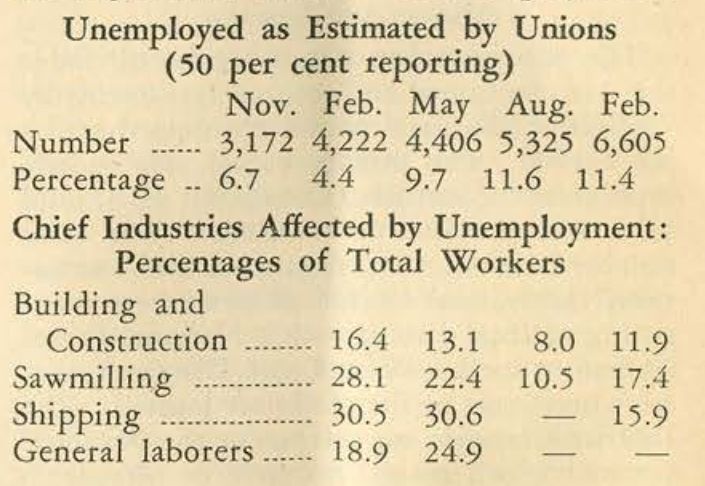
However, the favorable conditions which the New Zealand worker has experienced cannot be expected to continue in view of the keener competition which New Zealand has to meet on the world market. Already, due to the decline in prices for primary products, in 1926, unemployment has become a real problem. Unemployment has kept at a high level this year in spite of the improvement in the export trade. The following figures show the degree and direction of unemployment:
The Pan-Pacific Monthly was the official organ of the Pan-Pacific Trade Union Secretariat (PPTUS), a subdivision of the Red International of Labor Unions, or Profitern. Established first in China in May 1927, the PPTUS had to move its offices, and the production of the Monthly to San Francisco after the fall of the Shanghai Commune in 1927. Earl Browder was an early Secretary of tge PPTUS, having been in China during its establishment. Harrison George was the editor of the Monthly. Constituents of the PPTUC included the Australian Council of Trade Unions, the All-China Federation of Trade Unions, the Indonesian Labor Federation, the Japanese Trade Union Council, the National Minority Movement (UK Colonies), the Confédération Générale du Travail Unitaire (French Colonies), the Korean Workers and Peasants Federation, the Philippine Labor Congress, the National Confederation of Farm Laborers and Tenants of the Philippines, the All-Union Central Council of Trade Unions of the Soviet Union, and the Trade Union Educational League of the U.S. With only two international conferences, the second in 1929, the PPTUS never took off as a force capable of coordinating trade union activity in the Pacific Basis, as was its charge. However, despite its short run, the Monthly is an invaluable English-language resource on a crucial period in the Communist movement in the Pacific, the beginnings of the ‘Third Period.’
PDF of full issue: https://www.marxists.org/history/international/profintern/pan-pacific-monthly/n26-may-1929-PPM.pdf

