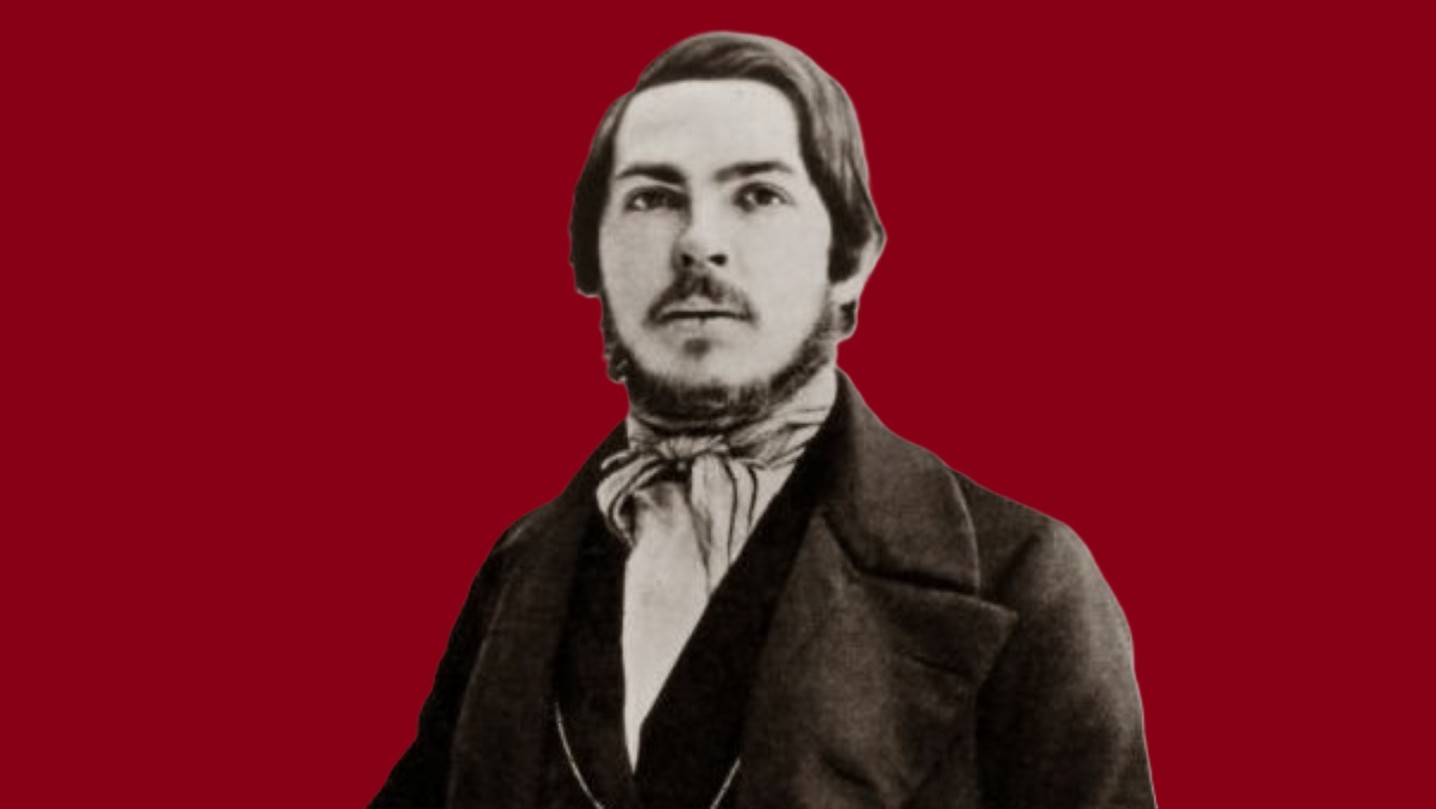
Engels, astute and witty, writes to Marx with his analysis the day after Louis Napoleon’s self-coup of December 2, 1851, the subject of one of Marx’s literary masterpieces, The Eighteenth Brumaire of Louis Bonaparte.
‘To Marx’ (1851) by Frederick Engels Selected Correspondence, 1846-1895. International Publishers, New York. 1936.
December 3, 1851.
“Représentants de la France, délibérez en paix!”
[“Representatives of France, deliberate in peace!”]
And where could the gentlemen deliberate more peacefully than in the d’Orsay barracks, guarded by a battalion of Chasseurs de Vincennes!1
The history of France has reached the stage of completest comedy. Could anything funnier be imagined than this travesty of the Eighteenth Brumaire carried out in a time of peace by the most insignificant man in the whole world, with the aid of discontented soldiers and, so far as one can judge at present, without meeting with any resistance whatever?2
And how splendidly all the old asses have been caught! The slyest fox in the whole of France, old Thiers, the smartest lawyer at the bar, M. Dupin, trapped as easily as the stark republican virtue of M. Cavignac and as the heroic talker Changarnier in the snare laid for them by the most notorious blockhead of the century. And to complete the picture, a rump parliament with Odilon Barrot as Löwe von Calbe and this same Odilon demanding to be imprisoned for such a breach of the constitution, but unable to succeed in getting himself hauled off to Vincennes! The whole thing has been specially invented for the red Wolff; from now onwards only he can write the history of France. Was there ever a coup d’état made in the world with sillier proclamations than this one? And the absurd Napoleonic apparatus, the anniversary of the coronation and of Austerlitz, the provocation against the consular constitution and so on–that such a thing could succeed if even for a day really does degrade our French gentlemen to an infantile level which has never been equalled.
The capture of the great spokesmen of order3 was splendid, of little Thiers and of the bold Changarnier quite excellent. Splendid too was the session of the rump parliament in the tenth arrondissement with M. Berryer shouting “Long Live the Republic!” out of the window, until in the end the whole lot were taken and shut up with soldiers in a barracks’ square. And then stupid Napoleon, who immediately packs up to move into the Tuileries. If one had plagued oneself for a whole year one could not have invented a finer comedy.
And in the evening, when stupid Napoleon had at last flung himself into the long-yearned-for bed in the Tuileries, then the silly blockhead must really have begun to wonder what he was up to. The Consulate without the First Consul? No greater internal difficulties than had been usual for the last three years, no exceptional financial stringency–even in his own purse–no coalition at the frontiers, no St. Bernard to cross, no Marengo to win! Enough to drive one to desperation, really. And now no longer even a National Assembly to bring to nought the great schemes of the misunderstood man; no, for to-day at any rate the ass is so free, so unfettered, so absolutely like the old man on the evening of the Eighteenth Brumaire, so completely unrestrained that he can’t help exposing his asinine self in all directions. Appalling perspective of no resistance!
But the people, the people!–The people does not care a damn about all this business, is as pleased as a child at its boon of the franchise and will probably use it like a child too. What can come of the ridiculous elections on Sunday week if they ever happen at all? No press, no meetings, martial law in abundance, and on the top of it all the order to provide a deputy in fourteen days.
But what is to come of the whole business? “If we regard it from the standpoint of world history” a splendid subject for declamation presents itself. For instance: it remains to be seen if the Prætorian regiments of the Roman Empire, which presupposed a widely extended state organised throughout on military lines, a depopulated Italy and the absence of a modern proletariat, is possible in a geographically concentrated, thickly populated country like France, with a large industrial proletariat. Or: Louis Napoleon has no party of his own; he has trodden the Orleanists and Legitimists under foot, he must now make a turn to the Left. A turn to the Left implies an amnesty, an amnesty implies a collision, etc. Or again: universal franchise is the basis of Louis Napoleon’s power, he cannot attack it, and universal franchise is now incompatible with a Louis Napoleon. And other similarly speculative themes which could be spun out splendidly. But after what we saw yesterday, the people cannot be relied on for anything and it really seems as if old Hegel in his grave were acting as World Spirit and directing history, ordaining most conscientiously that it should all be unrolled twice over, once as a great tragedy and once as a wretched farce, with Caussidière for Danton, Louis Blanc for Robespierre, Barthélemy for St. Just, Flocon for Carnot, and the mooncalf [Louis Napoleon] with the first dozen debt-encumbered lieutenants to hand for the Little Corporal [Napoleon I] and his Round Table of marshals. And so we should already have arrived at the Eighteenth Brumaire.
The behaviour of the people of Paris was childishly stupid. It’s not our business: if the president and the assembly are murdering each other–what does it matter to us! But that the army should take on itself to present France with a government and with such a government into the bargain–that surely does concern them, and the mob will begin to wonder what sort of a “free” universal suffrage this is which it is now to exercise “for the first time since 1804!”
How much further the World Spirit, who is obviously very much annoyed with humanity, will conduct this farce, whether we shall see Consulate, Empire, Restoration, etc., passing before our eyes in the course of a year, whether the Napoleonic dynasty too will have to be thrashed in the streets of Paris before it becomes impossible in France, the devil only knows. But it looks to me as if the thing would take a remarkably crazy turn and as if the Crapauds4 were going to meet with a marvelous humiliation.
Granted even that Louis Napoleon consolidates himself for the moment, such silly nonsense cannot last after all, even if the French have sunk to the lowest possible depths. But what then? There is damned little Red in the outlook, that is pretty clear, and if M. Blanc and Ledru-Rollin packed up their baggage yesterday afternoon they can only unpack it again to-day. The thunderous voice of the people has not recalled them as yet.
NOTES
1. This letter was written the day after Louis Bonaparte, President of the French Republic since December 1848, had carried out his coup d’état, dissolving the National Assembly and the Council of State. Louis Bonaparte was proclaimed Emperor (Napoleon III) in December 1852. [Ed. Eng. ed.]
2. Eighteenth Brumaire (9 November, 1799). The day on which the later Emperor Napoleon I overthrew the Directory and achieved supreme power as First Consul. He was proclaimed Emperor in 1804.
3. The Party of Order was the royalist coalition of landowners, financiers, and big industrialists by means of which Louis Napoleon had governed after becoming President in 1848. [Ed. Eng. ed.]
4. Crapauds. Literally toads. Slang nickname for the French bourgeois used by Marx and Engels.
NAMES
THIERS, Louis Adolphe (1797-1877) French historian, bourgeois politician and businessman. From 1832 onwards Minister in Louis-Philippe’s government. In 1871 head of the Versailles Government, the butchers of the Paris Commune. Until May 24, 1873, President of the Third Republic. In Marx’s Civil War in France he is characterised as “the complete intellectual expression of the class corruption of the French bourgeoisie,” “a master of petty government knavery, a virtuoso in perjury and treachery,” “consistent only in his greed for riches and his hatred for those who produce them “
DUPIN, ANDRE MARIE J.J. (1783-1865) Lawyer and businessman. In 1830 Louis Philippe appointed him Public Prosecutor in the Court of Appeal. He was an opponent of Thiers not on principle but from rivalry. For eight years from 1832 he was president of the Chamber of Deputies On February 24, 1848, having faithfully served Louis Philippe, he recognised the Republic, declaring that for a long time already the administration of justice had been conducted in the name of the French people. But in 1851 he was one of the first to support Bonaparte when he saw that the latter’s success was assured. After the coup d’état of December 2 he retained his position as Public Prosecutor.
CAVAIGNAC, LOUIS EUGENE (1802-57) Bourgeois-democratic general. Executioner of the Parisian proletariat in the year 1848. He made his military career in Africa (he was Governor of the French Colony of Algiers). In 1848 he was Minister for War in the Provisional Government. In the June days of 1848 he organised the brutal suppression of the Paris workers’ rising, when artillery was employed in street fighting for the first time unsuccessfully opposed Louis Bonaparte in the Presidential elections.
CHANGARNIER, NICOLAS (1793-1877) French general, General Governor of Paris after the February Revolution of 1848, then member of the National Assembly. As he was an Orleanist, Napoleon removed him in 1851 from his post as Commander-in-Chief of the National Guard and of the military division of Paris.
BARROT, ODILLON (1791-1873) Lawyer and bourgeois politician. Made Premier at the head of the “Party of Order’ for the first year Louis Bonaparte became President in 1848.
LOWE VON KALBE (1814-66). A doctor. In 1848 became a member of the Frankfurt Parliament, in which he belonged to the Left. In 1849 elected as first Vice-President. When the Left “rump parliament” transferred itself to Stuttgart he was elected as its Speaker. After the revolution he emigrated.
WOLFF, FERDINAND. “Red Wolff” Nicknamed “Red” from his red beard and radical views. A revolutionary close to Marx, a member of the editorial staff of the Neue Reiniche Zeitung. Emigrated and lived in England. In the year Marx died Wolff was head of an educational institution.
International Publishers was formed in 1923 for the purpose of translating and disseminating international Marxist texts and headed by Alexander Trachtenberg. It quickly outgrew that mission to be the main book publisher, while Workers Library continued to be the pamphlet publisher of the Communist Party.
PDF of later edition of book: https://archive.org/download/in.ernet.dli.2015.227457/2015.227457.Selected-Correspondence.pdf

