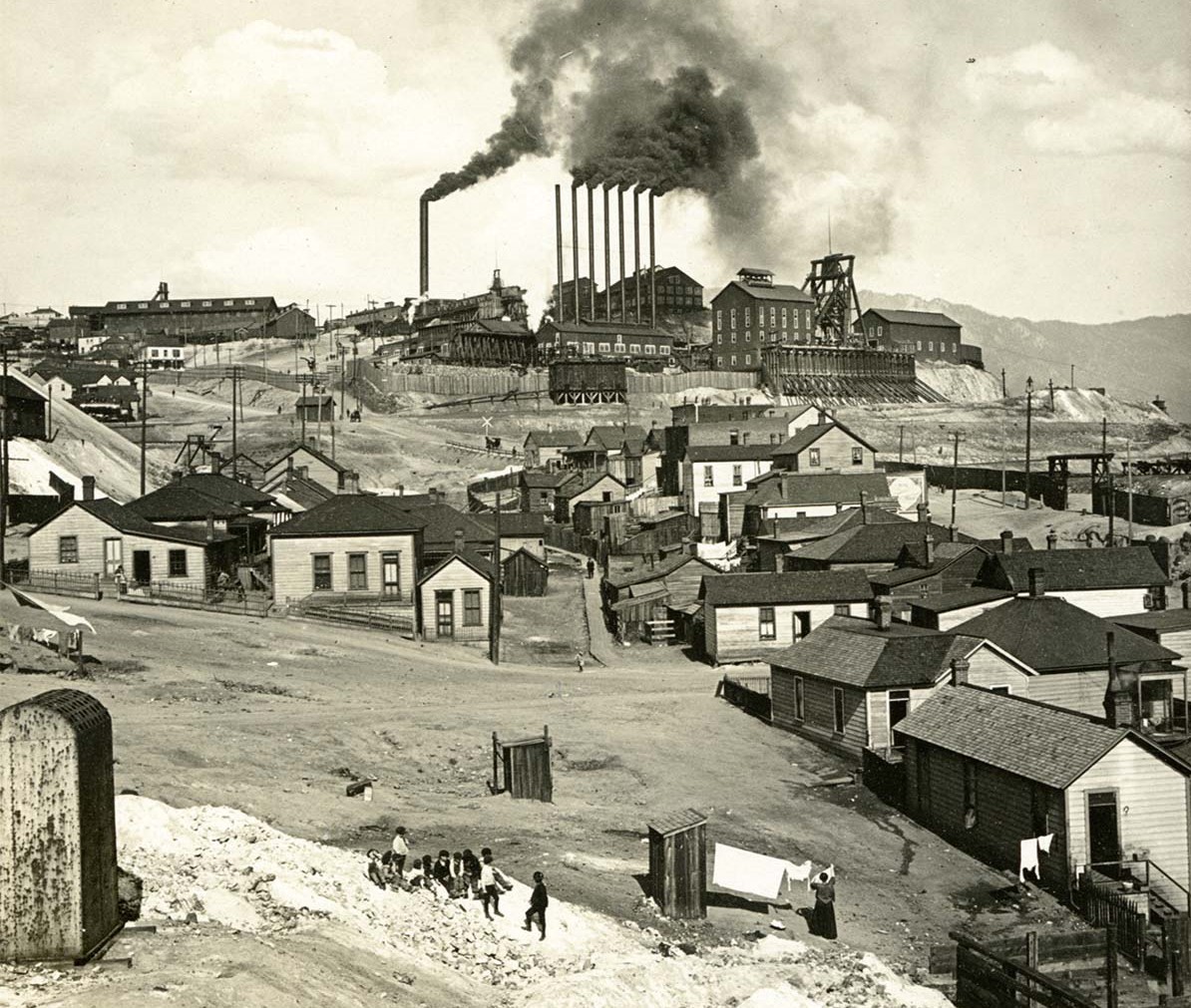
The veteran activist who had worked in many metal mines of the West paints a brutal picture of some very primitive primary accumulation in Montana. That Butte has such a strong, militant working class history is due, in large part, to the brutality of the regime in what was a vast mining camp.
‘Beautiful Butte’ by J.A. Stromquist from Industrial Union Bulletin. Vol. 2 No. 6. April 4, 1908.
When about the middle of the present month (March) it was heralded far and wide that the mines of Butte had started up and would employ full force as soon as things could be once more got into working order, the “prosperity howlers” and the “optimists” who “see the doughnut, while the pessimists see the hole,” began to yelp with joy and pointed the alleged fact out as a proof that the “late” panic was now over and the “full dinner pail” had made its appearance once more. Indeed, so very enthusiastic did they become that, without waiting for particulars from Butte, they at once proceeded to display the good tidings in the various “optimistic” papers far and near, in bold type and under scare headings and, not content with this, large banners were hung across the streets in a number of large centers advertising the fact that in Butte, Mont., there was work for everybody, the estimates of the number of “hands” needed varying from 5,000 to 20,000. So far, indeed, did the overflowing goodwill towards the poor, hungry wage-slave go that in a number of cities the employment agencies, presumably assisted by the railroads, offered free transportation to whoever wished to go to Butte and thousands, undoubtedly, availed themselves of the chance. To the unsophisticated wage-worker the above facts may carry no particular significance but, to him who has, however superficially-studied the relation of classes in present-day society they are convincing evidence of the cynical and unfeeling methods employed by the ruling class, the Capitalists and their parasitical hangers-on, to take the utmost advantage of the very misery and suffering to which the workers are subjected in times such as the present, times for the existence of which this very capitalist class bears the sole responsibility. The object of this encouraged and assisted immigration Butte-wards was evidently two-fold. First, it enabled a number of cities to rid themselves of a great number of unfortunate victims of capitalist exploitation who had been subsisting during their enforced winter vacation by eating “free soup” at public charity institutions and “hitting the back-door” of the residences of the parasites for a “hand-out” and second, it supplied the capitalists of Butte with a large army of unemployed and starving men to hold as a club over the heads of those employed in Butte whereby to intensify their work and–if thought advisable–cut their wages.
The writer hereof, having “enjoyed” a compulsory vacation of more than three months’ duration and being correspondingly “fidgetty” and desirous of being once more under the tender care of a master, thought it would be a good idea to go to Butte with the rest. From many sad experiences in my past days of guileless and unsophisticated youth I had certainly learned to take the flamboyant “prosperity howlings” of the prostituted capitalist press with a large dose of salt and that there would be a goodly number of jobseekers in Butte was, therefore, not unexpected. The reality, however, so far exceeded expectations as to be a cause of disagreeable surprise. The conditions here, from a workingman’s point of view, are, in short, nothing less than terrible and it is this which has moved me to utter a word of warning, through the columns of The Bulletin, I have always been opposed to the “Stay away,” or “Keep off the grass” signs, which are at present so common a feature of labor publications but, if to the reader of these lines it appears to be a case of starving to death anyhow well, my advice is: don’t come to Butte to do it, for it is a decidedly disagreeable place to starve to death in and you are more likely to meet such a fate in Butte, at present, than in most other places.
Now for a few facts, to back up the above. The undersigned arrived in Butte a few days after the “opening-up” was alleged to have taken place and, at the present writing, has been here about two weeks and, having “rustled” various mines for a job every day thereof and, having had a good opportunity for observation, is in a position to testify that, so far from “a full force being put on, as fast as room can be made for them,” a very insignificant number are at present working and practically no new men are being hired and I have yet to see a single man picked out of the crowds which each noon hour surround every shaft waiting for “the boss” to come out. Those few who are hired are those who are old “favorites” with each “boss,” or “suckers.” No one else gets a job unless he can bring “influence” to bear in the shape of a “good word” from some of the boss’ friends, or “some one higher up.” It is also asserted with every appearance of being true, that the “padrone system” is largely in effect, an institution under which anyone who wants a job is compelled to buy it and pay a monthly percentage of his wages besides, for the “privilege” of keeping it. In the opinion of many the present starting-up of the mines is nothing but a bluff resorted to in order to boost the stock market and since the boost has failed to materialize, it would not be surprising if a general shut-down were again ordered. Inasmuch as it was strenuously and plausibly maintained when the shut-down took place last fall, that Butte could not produce copper profitably at less than 14c per lb. it is strange that a resumption should now take place with copper at 12c per lb. But leaving such unprofitable speculations aside and returning to conditions here as they are, I will say that there are at least 5,000 and probably 10,000 unemployed here at present, many more, in fact, than could be employed were everything “running full blast.” The scenes one encounters every day are pitiful. There are a large number of mines here, but at every noon hour–when any “hiring” is done–there are all the way from 50 to 500 anxious, hungry and shivering men waiting around each mine and at the same time the streets are lined with men and saloons and all other public places are filled. Every day, twice a day, they climb “the richest hill on earth” undeterred by the fluttering snowflakes borne on gusts of ice-cold air blowing at times with almost hurricane-like velocity. There they stand for hours, shivering, in their generally insufficient and sometimes ragged clothes, with gnawing stomachs, sunken cheeks and eyes and despair in their hearts, hoping against hope that a crumb will fall from the master’s table in the shape of a “job”–a chance to work themselves to death, or die from disease contracted by working in a hot, foul hole 2,000 feet underground. They congregate an hour, or more, before time and when “the boss” finally comes out there is a rush and a scramble which at times resolves itself into a riot. From the contemptuous manner in which these hired slave-drivers treat those multitudes it is really surprising that acts of violence do not oftener take place. It would be quite easy to display a sign on the office door saying “no help wanted,” or something to that effect, but even this melancholy satisfaction is denied. Some of the bosses have decency enough to announce that there is “nothing doing,” or “fullhanded,” while others simply hide away and leave the crowd hang around for hours until they gradually disperse of their own accord. Outside work is just as hard to get, everything is full-up and many are undoubtedly working for their board and lodging. Two free soup-houses have been running full blast all winter and one is still in operation and well patronized, despite the fact that the majority of those starving would rather do anything, be it steal, or beg, than go there. Besides this, the open and ap parent misery, there are hundreds of families as well as single men living in, the most straitened circumstances, and each day sees someone unable any longer to obtain credit, or to starve, thrown on the street with the rest. Butte is abreast of any place in the U.S. in this respect. Of course, many of the daily arrivals have a few dollars along with them and from these the various small business grafters are reaping a golden harvest, but these small grafters, being the taxpayers, also insist, most strenuously, that when you are “broke” you’ll have to leave, though as long as you have a cent left you are permitted to stay and spend it. The following from the “Butte Intermountain” of March 12th is a vicious yelp from those small grafters and speaks for itself. Says the paper:
“Many undesirables are rushing to this city. The mines of Butte cannot take care of any considerable number of unemployed. Butte cannot more than take care of her own. The Salvation Army and Paul Clark’s soup-kitchens have fed easily 15,000 in the last five weeks. The shipping of this riff-raff to Butte is not relished by Butte people and it may be pertinent to remark that only desirable citizens will receive a welcome here, with more to the same effect.”
Butte, though “boasting” of being “the greatest mining-camp on earth,” built upon “the richest hill on earth” and despite being a city of over 60,000 inhabitants, the metropolis of Montana, is just about as dirty and disagreeable a place as the average little one-horse mining camp. There are some buildings approximating skyscraper dimensions, and some of the parasites have quite elaborate residences, but the average wage-slaves’ home is a miserable, dingy, dirty board-shack and a main feature are numerous boarding and lodging houses, dirty, crowded and unsanitary. The sky-line is dominated by the gaunt “gallows-frames” and unsightly change-rooms, waste dumps and railroad tracks of the various mines. The business center for a few blocks each way is paved with rough stone, but the pavement is usually covered one to six inches deep under an accumulation of dust, soot and garbage. All other streets are unpaved and they, together with alleyways, empty lots and front and back yards are covered with filth and garbage, rags, paper, etc. Although the city has a fine natural drainage, being situated on a strongly sloping plain, no attempt seems have been made to take advantage of this natural asset, for excepting a half dozen streets in the business center, there are no sewers anywhere and everyone throws their slops, garbage or waste of any kind out in front of, or behind their houses, whether it be on the street, or yard. The resulting condition can be more easily imagined than described and that disease is not more frequent is something remarkable. Superimposed on all are the poisonous fumes issuing from the smokestack of the smelter, which have caused the surrounding hillsides, once covered with verdant pine trees, to appear as if swept by a prairie fire. Finally, the place is windy and subject to sudden and extreme changes of temperature, snow having fallen in June of last year, I am told. This, then, is “the greatest mining camp on earth,” but here, as elsewhere, the greatness consists mainly in great wealth for the parasite class and great misery for the producers; the wage slaves.
Butte boasts of another greatness also; it is, so we are told, “the Gibraltar of Unionism.” Such a statement would naturally fill the heart of the class-conscious worker with hope, but even that hope is doomed to be dispelled upon closer investigation. “Butte No. 1” is the largest local union in the W.F. of M. claiming at one time a membership of over 7,000, but so far from numbers being in this case an indication of strength, the “kickers” say that said “Butte No. 1”. has also been the most corrupt union in the W.F. M. and it does look suspicious when one begins to inquire! about matters connected with this “great” organization. For instance, there is the fact that some of No. 1’s chief officers of the past were always able to get from the Amalgamated Copper Co. fat contracts and leases, when no one else could; that said No. 1 retained a wage scale signed agreement with the Amalgamated C. Co., in force after all contracts had been abolished and repudiated by the W.F.M.; that the meeting-hall of this union with some 7,000 members is only large enough to seat some 300 to 400, etc. All straws, perhaps, but like other straws, they show how the wind blows. Finally we have the word of Mr. John D. Ryan, general manager of the Amalgamated Copper Co. At a banquet given in his honor by the citizens of Anaconda, upon his recent arrival in that town from N.Y. he is reported in the “Anaconda Standard” of the 15th March, as follows:
“Turning to the consideration of capital and labor Mr. Ryan heartily and unreservedly endorsed labor unions and expressed his sincere belief that capital could treat with them to far better purpose [boldface is mine, J.A.S.] with all interests involved than it could treat with its employers as individuals.”
I suppose we can take Mr. Ryan’s word for it and then the question arises: “What kind of ‘labor-unionism’ is it that a representative capitalist can heartily and unreservedly endorse, eh?” Draw your own conclusions. Most other things are organized in Butte, too, but on craft-lines and for the purpose of aiding the bosses and all the “rank file” have got to do with it is to pay dues and look pleasant. But even here, better things are coming. Already there are rumors that hours are to be increased, or wages cut, in certain callings and the craft-unionists find themselves powerless to resist and are tremblingly waiting for the blow to fall on their devoted heads.
The Industrial Workers of the World have made a start, however, and have a foothold and even though we shall have to wage an incessant battle against the enemies from without, as well as the traitors from within, ours is the future and the dawn of hope will, I venture to prophesy, soon break into the full day of realization–even in Butte. The political labor movement here is represented by an aggregation of “ballot-maniacs” of the usual pattern, though I gladly acknowledge among their ranks a few notable exceptions. It seems, however, that the majority of these gentlemen will never learn the error of their ways until they shall have tried, some time, to “vote themselves into power” and gotten their heads broken for their pains; another “bloody Sunday,” only on a far vaster and more disastrous scale. It makes one sad to think that in this “age of reason” men are still unable to learn except through experience; experience paid for with precious blood. But if they cannot, they cannot; so let them make their experience, if they insist on so doing. Nevertheless, the future belongs to the working class industrially organized, so let’s take a new hold, fellow-workers all; up and at them! Yours for Industrial Unionism and Victory.
J.A. STROMQUIST. Butte, Mont., March 24, 1908.
The Industrial Union Bulletin, and the Industrial Worker were newspapers published by the Industrial Workers of the World (IWW) from 1907 until 1913. First printed in Joliet, Illinois, IUB incorporated The Voice of Labor, the newspaper of the American Labor Union which had joined the IWW, and another IWW affiliate, International Metal Worker.The Trautmann-DeLeon faction issued its weekly from March 1907. Soon after, De Leon would be expelled and Trautmann would continue IUB until March 1909. It was edited by A. S. Edwards. 1909, production moved to Spokane, Washington and became The Industrial Worker, “the voice of revolutionary industrial unionism.”
PDF of full issue: https://www.marxists.org/history/usa/pubs/industrialworker/iub/v2n06-apr-04-1908-iub.pdf

