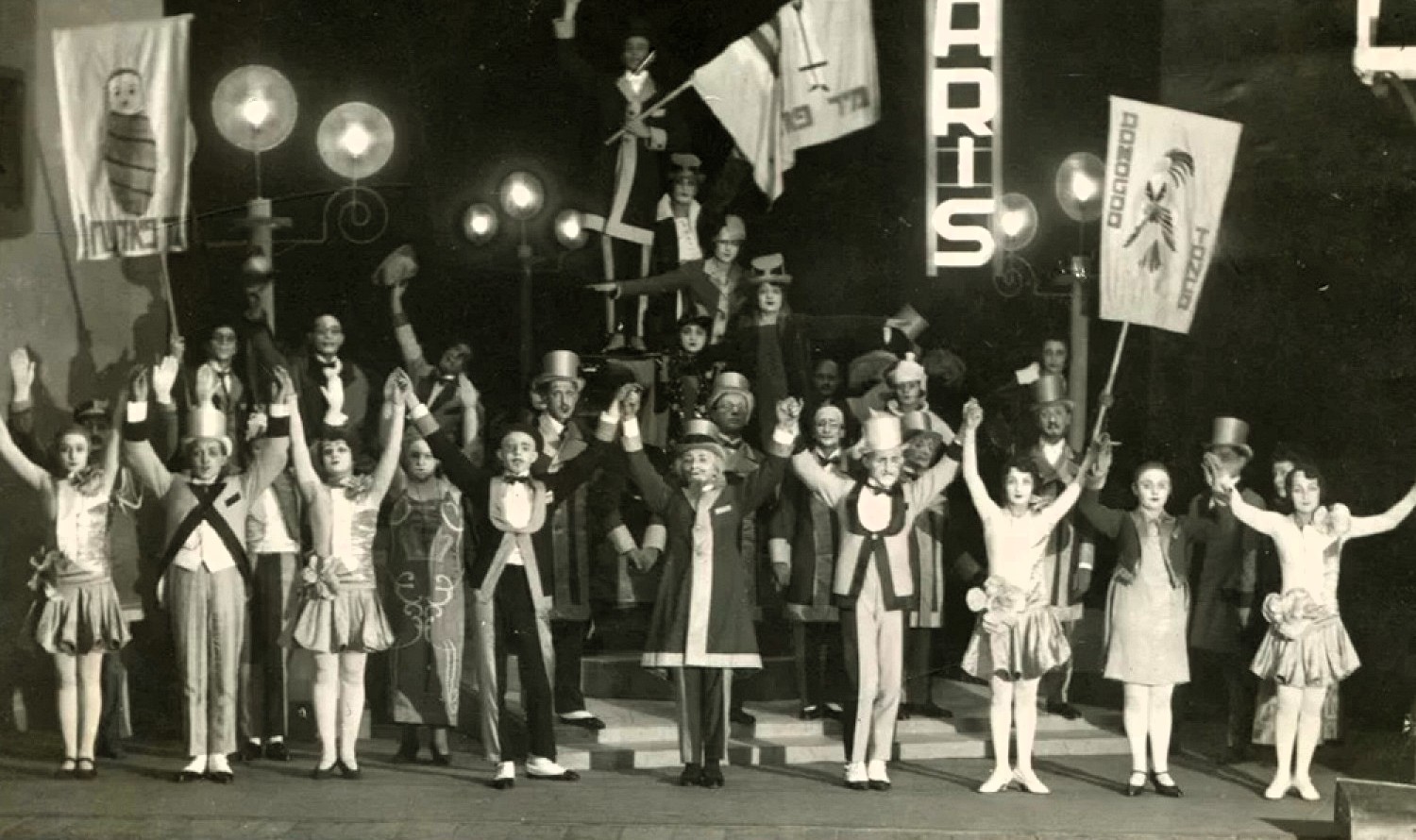
On the land of the pogrom, the years immediately after Russia’s Civil War saw an effervescence of Yiddish language theater and arts in Soviet Russia. Michael Gold visits the Jewish Kamerny and the Gabima theaters in Moscow.
‘Two Great Jewish Theaters in Moscow’ by Michael Gold from The Daily Worker Magazine. Vol. 2 No. 71. April 4, 1925.
AMONG many of the American intelligentsia it is a common belief that the Soviet revolution has killed all art and culture in Russia. This charge has been repeated so often that even friends of Russia credit it with some truth.
But it is not true; it is merely another of those strange, malicious slanders that have been so freely circulated to give Russia a bad name. Time will disprove this mean lie, as it has disproved so many other lies about Russia. Time will show that the revolution was not a destruction of culture, but the great renaissance of a nation and a world.
In ten years artists and students from all over the world will be thronging to Russia just as in the middle ages young intellectual Englishmen and Germans, like John Milton and Erasmus, went to Italy, for new ideas. Russia will be the world’s fountainhead of all free and bold modern thought during the next few decades.
There are, Jews all over the world, for instance, and they have powerful communities in New York, London Paris and Berlin. I have been in all these cities, and have seen the Jewish life in them, but in my judgment the heart of Jewish culture and art exists today in Moscow.
The two greatest Jewish theaters in the world are now playing in Moscow. They are the Jewish Kamerny theater and the Gabima theater. Of them one cannot write calmly–they are a revelation to a student of stage-craft. They are marvellous laboratories of the theater, and they are also the finest blooming of the long-suppressed Jewish race-spirit.
The Gabima theater gives productions in classic Hebrew, the only theater of its kind in the world. I saw the two plays in its repertoire, namely: Gadybuk, and the Eternal Jew, by David Pinski.
The Gadybuk is one of the standard pieces of the Jewish stage and has been given many times in America. But it has never been given with the genius with which it has been clothed at the Gabima in Moscow. There it becomes a rich, glamorous epic of the Jewish folk, a blend of Jewish poetry mysticism, music, melancholy and dancing as well as benighted Jewish superstition and bigotry.
Vahtangov, a young Armenian regisseur of the Moscow Art theater who died a few days ago, was the director of both pieces played at the Gabima. He was one of the great regisseurs of Russia and even though he was not a Jew, his Semitic blood gave him an instinctive understanding of Jewish life that makes his productions as authentic as if they had been born in the mind of a native of Palestine. The Gabima is the spiritual center around which a great deal of mystic Jewish Zionism and nationalism revolves in Moscow. I am not an adherent of Jewish nationalistic mysticism, any more than I can yield myself to the Irish national mystics like Yeats, or the catholic mystics of the stage like Claudel. These mystics write nobly of infinity, god, the soul. the cosmos, but when one goes under the purple and gold of their imagery one finds the skeleton of the same 100 per cent patriotism and nationalism that has plunged the world into so many ugly, bloody wars. To grow mystical over one’s nation or one’s race is to join hands with the ku klux klan of one’s nation and race. One cannot apply a political test to the Gabima, however. It is a great art theater, and a poet and artist finds himself ravished by the beauty of its perfect performances. About one-third of the audience at the Gabima is made up of Russians who do not understand Hebrew, but who come to this temple of pure, noble art, out of devotion to the spirit of great art. The Jewish Kamerny is no less a theater of genius than the Gabima, but it is more in the mainstream of modern life. It is not slow and stately and majestic with the biblican grandeur of the Gabima; it is swift, satirical, full of energy, boldness, youth, I laughter–the spirit, not of the bible, but of young Communism.
The Jewish Kamerny, under the direction of another great regisseur, Granovsky, has fused many of the tendencies of the new Russian theater into a synthesis that is something so new that it is almost impossible to write about. It must be seen and heard to be understood. I despair of making it clear, it would be like trying to tell anyone that the greatest living singer could be heard if Russia, if Chaliapin had not come to America to convince skeptics that he really was the world’s greatest singer. The Jewish Kamerny will soon visit America, too; and perhaps will convince skeptics here more than any words of mine.
I saw three productions of the Jewish Kamerny: Goldfadden’s old play. The Witch, and a play called “200,000,” and a group of one-act parodies on the methods of other Jewish theaters. Of these plays I thought The Witch the finest.
The Witch has been often given at Jewish theaters in America, but in Moscow it was not the sentimental tale of the poor little silly orphan girl over which so many Jewish matrons have shed their plentiful tears. All the vulgar sentimentality and cheap music-hall hokum has been eliminated from the piece; only the fantasy and humanity of the story have remained.
The production cannot be compared to anything we have yet seen in America. The Moscow Art theater and Balleff’s Chauve Souris are not fair samples of modern Russian theatrical art. They are remnants of the old; in Russia the Moscow Art theater is regarded by the younger men as a sort of museum, where ancient modes of acting and scenery are presented by old people who have learned nothing since the nineteenth century.
The Jewish Art theater models itself on this old school of photographic art, and therefore its performance of Goldfadden’s Witch that I saw in New York was as unoriginal and dull as a play mounted by Belasco, however, the play has been made into a theatrical symphony. Everything is in the key of young, vigorous fantasy. The costumes, the scenery, with its planes and levels, the dancing, the singing, the speech, the gestures, all have been planned, and harmonized. Nothing is left to chance; each move on the stage, every word uttered, is as skilfully planned in advance as a ballet is planned.
Granovsky’s ideal has been the syntenic theater of which Gordon Craig and other aesthetes have dreamed. He has achieved the synthetic theater; a theatre where word, movement, music, gesture and dance are woven into a unity from which one cannot eliminate anything; not the gesture of a hand.
Only in very technical terms could one convey the great work of Granovsky.
I prefer not to attempt a description, but to let the Jewish Kamerny speak for itself when it comes here.
All I can do Is prophesy that it will create a revolution in the minds of the younger American dramatists, actors and musicians. Many of them have been feeling their clumsy way toward work like this; and the performances of the Jewish Kamerny will give them a clear picture of what they have wanted in the theater. It will start a new epoch on the American stage.
The Saturday Supplement, later changed to a Sunday Supplement, of the Daily Worker was a place for longer articles with debate, international focus, literature, and documents presented. The Daily Worker began in 1924 and was published in New York City by the Communist Party US and its predecessor organizations. Among the most long-lasting and important left publications in US history, it had a circulation of 35,000 at its peak. The Daily Worker came from The Ohio Socialist, published by the Left Wing-dominated Socialist Party of Ohio in Cleveland from 1917 to November 1919, when it became became The Toiler, paper of the Communist Labor Party. In December 1921 the above-ground Workers Party of America merged the Toiler with the paper Workers Council to found The Worker, which became The Daily Worker beginning January 13, 1924.
PDF o full issue: https://www.marxists.org/history/usa/pubs/dailyworker/1925/1925-ny/v02b-n071a-supplement-apr-04-1925-DW-LOC.pdf

