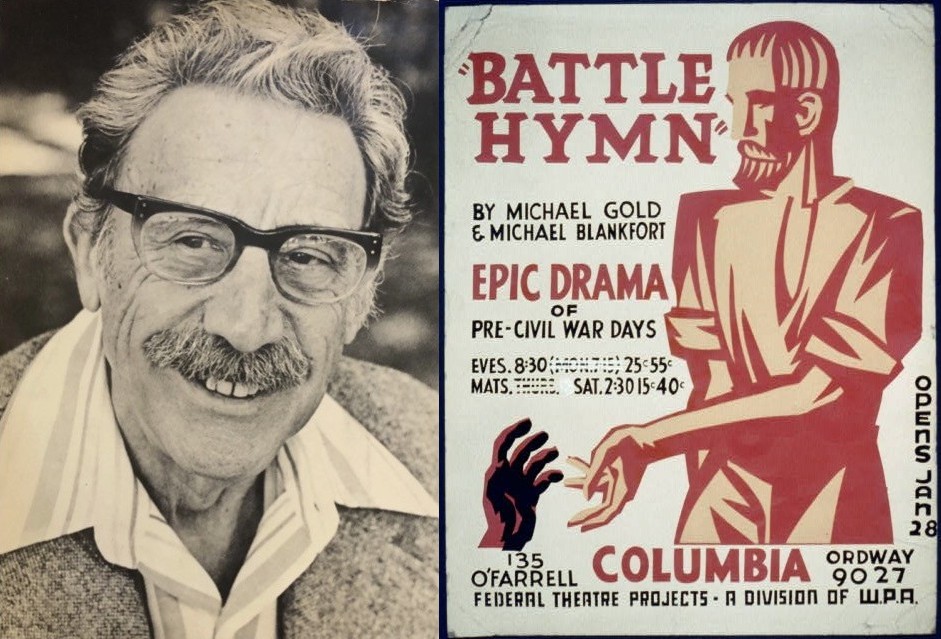
What an interesting series. With themes the great, recently-deceased, radical filmmaker Peter Watkins would recognize, Blankfort’s second article on the relationship of form and content in the context of a revolutionary theater attempting to break down the barriers between performance and audience. In it he explores–with reference to Freud and Plekhanov–the notions of ‘sublimation’ and ‘wish fulfillment’.
‘Sketches Toward An Aesthetic for the Revolutionary Theatre: The Role of Wish Fulfillment’ by Michael Blankfort from New Theatre. Vol. 1 No. 8. July-August, 1934.
Part II
Prefatory Note
In the first of these articles which appeared in the June issue of NEW THEATRE I indicated that the core of the theatre’s appeal was its ability to satisfy the wishes of its audience. I pointed out how wishes emerged from the conflicts in the individual either with himself or with others or with society, and by society, I mean not only “the human nature “of Ibsen, but also the class struggle of Marx. A distinction was made between wishes which were predominantly economic and those which were predominantly psychological, and those, finally, which gave the appearance of being psychological but which, in reality, grew out of a very definite class bias.
In the present article, the specific procedure by which the wish is satisfied will be described, and further, how wish fulfillment is utilized, consciously and unconsciously, by the bourgeois theatre in order to complete the cultural and economic purposes of capitalism.
In the succeeding articles the analysis of the class role of wish fulfillment will be completed; analyses of class-collaboration plays, “injustice” plays, and revolutionary plays will be made; and certain problems both aesthetic and immediate, will be presented.
One more introductory word is in order. The ideas proposed in these articles are set down not so much to make a point or to create a theory, as they are to start the ball rolling. The revolutionary theatre can never rest on its laurels any more than an organizer can. It must continually check on itself and grow. These ideas, therefore, should be in the nature of stimuli. They represent a “thinking out loud” of the problems we face. If by means of argument or counter-argument these problems are clarified, I will have done my job.
How Wishes Are Satisfied
There are so many unconscious wishes in our personalities that it would be a thankless job as well as an endless one to ascertain al of them. Wishes are functions of the individual’s history, his particular class history, and the history and state of the culture in which he lives; they emerge, as we have seen, out of the economic and psychological conflicts raging in and around us. To treat them, therefore, as a branch librarian catalogues new books, is both out of our realm and off the issue. But this we know, however; they are ever present, and are satisfied, transiently or permanently, in the theatre.
It should be clear from the above that it is neither our function nor purpose to treat with the audience as though its wishes were one, or treat with plays as though they satisfy this or that one wish. All we can do is to discern, generally, in what manner the ordinary run of audience wishes are fulfilled, and not what particular wish is fulfilled and how. It is not a matter of ultimate importance to a psychologist that a particular white rat goes to a particular foodbox to eat; it is important for him to discover certain laws of animal behavior. So here, we are interested not what the specific wish is, nor how it is specifically satisfied, but in certain general observations of theatrical behavior.
There are three ways in which the wish is satisfied. The first way was described by Mr. Nathan when he said, “A theatre audience enters a theatre with the deliberate intention…of forgetting itself for a couple of hours. The psycho-analysts use a word which can be used here too: Sublimation. To Freud the process of sublimation is an unconscious and a sexual one, but in the audience it is both conscious and unconscious, and it may be social, economic and psychological as well as sexual. If to Freud, the concept implies “an exchange of infantile sexual aims for interests or modes of pleasure-finding which are no longer directly sexual” then to us, the concept implies an exchange of socio-economic conflicts for conflicts which are neither directly social nor economic, nor even remotely connected with them.
A business man harassed by and in conflict with bankruptcy or strikes has undoubtedly a wish to escape. He seeks out, therefore, that which will allow him to escape. He seeks for an experience which is as far from reality as possible. When he goes to the theatre he exchanges the conflicts of the day for the surcease of the evening.
The tired business man has been made the scapegoat of “aristocratic” critics who have never wanted to understand that the stenographer or the linesman, the truckdriver or the label maker are even more tired, and are the real victims, to say the least, of more vicious and sharper social and economic conflicts. This group, of course, cannot afford the luxurious relaxation of the Follies or an Ah! Wilderness or a Men in White. They have to content themselves with a burlesque show, a movie, or a warm bath. This is not said in a plea for sympathy, for the worker who escapes in that sort of pabulum pays less for it, but it is necessary to point out that the wish to escape from an uncomfortable reality is not a bourgeois wish as distinguished from a proletarian wish, but is, simply, a human, all too human wish.
However, in the bourgeois theatre, this wish is satisfied in a bourgeois manner as would be expected. The soothing syrup is doled out in a way, as we shall see, which is subtly connected with the aggrandizement of bourgeois virtue, morality, ethics and economy.
When we arrive at the second way of wish-fulfillment we discover that the theatre may offer more than relaxation. It can be more than a warm bath; it can be a good cathartic as well.
The question of the purgative value of the theatre is an ancient one. Many writers have tried to explain it one way or another but whether they conceived of it with Aristotle or with Hegel, whether the purgation was an affirmation of the human will as Nietzsche saw it, or a release of unconscious rebellious energy as Bergson conceived it, the theatre as represented in the tragedy, fulfills its function of subduing, for the moment, the audience wish.
When we view a modern tragedy, a bourgeois tragedy, if you will, there is something more than suppositious Aristotelean “ennoblement.” Let us assume, for the moment, that O’Neill’s Strange Interlude makes verbal many of the thoughts which we have dared think but have been too cowardly to speak. In this way it has satisfied a wish of ours. But O’Neill is a Catholic, let us say, believing in God and the rights of private property. His characters and the ideas they illustrate represent a class overburdened by property and neuroses. Those of us then who are satisfied by this tragedy must have participated at one time or another, in psychological adventures not unlike the characters in Strange Interlude. This must be true or else the conflicts in the play would be unintelligible to us, leaving us with a wish or wishes unsatisfied.
Before going into a more detailed analysis of the wish as satisfied by tragedy, let us see what the third method of wish fulfillment is.
If Strange Interlude satisfies those of us, who, bourgeois-minded to that degree that we can understand and be satisfied by the portrayal of upper-class, psychological conflicts (neuroses which emerge from decay), then there are a long list of dramas from Bouccicault’s The Long Strike to the latest cinematic transcriptions from Hollywood which satisfy those of us who are on the borderland of economic insecurity, the middle class, and un-class-conscious workers: (Class conscious workers are also economically insecure but they are not easily satisfied). In these plays, in one form or another, the hero or the heroine rises out of her station. The worker marries the boss’ daughter or the starving stenographer is found by a casting director, and after having frustrated his attempts at seduction, marries and gets a job at five hundred a week. Moving pictures like If I Had a Million or plays like The Milky Way in which a milkman is made over into a millionaire world’s champion prizefighter are further examples. Another aspect of the “democratic” and consoling spirit in the theatre may be observed in plays like Biography or in any moving picture starring Joan Craw ford. Here, the hoi polloi, the lower middle class and the proletariat, are allowed, for a small admission price, to gaze unseen on the adventures of the rich and the mighty.1 Out of this specious liaison with the upper-class, a fiction is created that beneath their trappings the wealthy are just as human and even more troubled than the poor and the poor ought to be glad they’re poor. “Let them eat cake” is no longer in style as a slogan. Today the upper class might conceivably say, “Even we eat bread.”
The Role of Wish Fulfillment
As we have intimated before the theatre doesn’t exist in a cataleptic fit all its own, in a private ward with airtight windows, artificial ventilation and indirect lighting. Rather it is in the full-bodied mainstream of life, and those of us who believe that life today is inseparable from the clash of cultures around us, cannot accept the advice of that ostrich critic who said, “If we wish to understand dramatic literature itself, we must seek understanding in the great plays and not in the dead material out of which plays are made.” Rather our course is laid down by Plekhanov who wrote:
“In the productions of art and literary tastes of a given time is expressed the social psychology; and in the psychology of a society which is divided into classes much will remain paradoxical to us if we continue to ignore as the historical idealists do, despite the best intentions of the bourgeois historical scientists–the mutual relations of classes and the class struggle.”
Our next question therefore is this: How do the three means of wish-fulfillment in the theatre play a role in the “mutual relation of classes and the class struggle?”
If there are classes in society, there are class interests. The class in power strives to perpetuate itself and its power. It uses all the conscious organs of self-perpetuation: the schools, the church, the press, legislation, the courts, etc., and its many unconscious organs, the social sciences, philosophy and art. The combination of both is its culture. Therefore, it should be no shock to anybody that artists (and playwrights whether they are artists or not) express, consciously or unconsciously, the culture which gave them birth. This is what happens in most cases. May art, therefore, be defined as a sort of defense, a species of apology for the culture of the status quo? Our answer to this question will grow apparent when we discuss the revolutionary use of the audience wish.
It is a natural law of society that the class in power strives mightily to impose its culture on the whole population. Frequently it even succeeds in establishing its fictions, its rationalizations (philosophy, politics, religion, psychology, etc.) on large sections of the class whose real interests are diametrically opposed. In this manner they are vitiated and thwarted. It does so in the theatre by the way it satisfies the wish.
The three major theatrical devices for the fulfillment of the wish, you will remember, were sublimation, purgation, and consolation. (Democratization would be a better term than consolation to describe the fiction that everyone may be an Horatio Alger hero, but it has certain political inferences which might make its use confusing.)
Sublimation: The Pulitzer prize play of 1934, Men in White, concerned itself with hospital life. It treated this life in such a way that the realities inherent in the situation were, consciously or unconsciously, suppressed. All that came through was a hackneyed triangle situation, the tale of a man with two maids. But despite its triteness, or rather perhaps because of it, this play was the most popular one of the season. Why? It satisfied its audience. How? It exchanged the social and economic conflicts which harassed its audience for conflicts which were no longer directly or even remotely social and economic. It succeeded, in short, in making the audience forget itself and its despairs. No one would want to deny that that was a worthy achievement. But when the wish “to get away from it all” is sublimated in this play, it is identified with the interests of the status quo, with the contradictions and decay of bourgeois society.
Men in White in sublimating the social and economic conflicts inherent in its theme disregarded, and in disregarding, objectively condoned, the culture and economy which gave birth to these same social and economic conflicts. Its treatment of the conflicts of hospital and medical life omitted the most important considerations of that life, considerations without which there could be no reality. By being false to reality the play betrayed the core of life around us, the life which inevitably includes the struggle between classes, the decay of one culture and the emergence of another.
It is no accident when a play appeals primarily to a bourgeois audience. When it does so it is playing ball with the interests of that class and satisfying the wish in its behalf. You may ask, has not the theme love versus duty a universal tang about it? Such a theme might easily be one for a workers’ theatre but only when its resolution (the manner in which it satisfies the wish) is identified with the class of the workers. The Russians have this successfully in a movie.
But Men in White, despite the best intentions of everybody concerned, identified the fulfillment of the wish with the interests of the bourgeoisie. This play of Mr. Kingsley’s is representative of a whole category including the genre of 20th Century, Dinner at Eight, Once in a Lifetime, Grand Hotel, etc. Sometimes a play is openly reactionary, i.e., it make no pretense at camouflaging the identity of its wish fulfillment with the dying culture of the bourgeoisie–such a play like O’Neill’s Days Without End; and some times a play may be considered reactionary when it strives to be otherwise, like Tobacco Road, in which the poor white in the South is practically blamed for his own destitution.2
It might well be asked at this point, how can a play satisfy the “wish to escape” without identifying the satisfaction of that wish with the class and cultural interests of the bourgeoisie? You may remember that earlier it was stated that “the wish to escape for an uncomfortable reality” is not a bourgeois wish as distinguished from a proletarian wish, but is simply a human, all too human wish.
If war is an uncomfortable reality then Peace on Earth satisfies the “wish to escape” from it, and at the same time identifies this wish fulfillment with the class interests of the workers simply by means of showing: that war can be eliminated by the united efforts of the working class. This sort of escape from reality is not the ostrich kind that puts its head in a comedy or a meretricious romance and says “war does not exist,” but, on the contrary, it is the kind that says that war can be overcome. Escape in the bourgeois sense is withdrawal and retreat, and in the proletarian sense, defiance, attack, and change. You can escape by killing your adversary as well as by running away from him.
Other examples of the working class “escape” play may be found in Stevedore and to a lesser degree in “1931.”
1. This type of wish fulfillment is observed more frequently in the moving pictures because, by virtue of lower admission scale, its audiences are predominantly middle and working class. It is to these two classes that the idea of rising in the world has most appeal.
2. Tobacco Road like The House of Connelly by Paul Green and several of the Tchekov plays present the question whether or not a picture of decay of the upper class, or a picture of the misery of the working class is sufficient to satisfy the requirements for a worker’s theatre. Whether a play has to have a call to action is one of our meat important considerations. More will be said about this later.
The New Theater continued Workers Theater. Workers Theater began in New York City in 1931 as the publication of The Workers Laboratory Theater collective, an agitprop group associated with Workers International Relief, becoming the League of Workers Theaters, section of the International Union of Revolutionary Theater of the Comintern. The rough production values of the first years were replaced by a color magazine as it became primarily associated with the New Theater. It contains a wealth of left cultural history and ideas. Published roughly monthly were Workers Theater from April 1931-July/Aug 1933, New Theater from Sept/Oct 1933-November 1937, New Theater and Film from April and March of 1937, (only two issues).
PDF of full issue: https://www.marxists.org/history/usa/pubs/workers-theatre/v1n08-jul-aug-1934-New-Theatre-NYPL-mfilm.pdf

