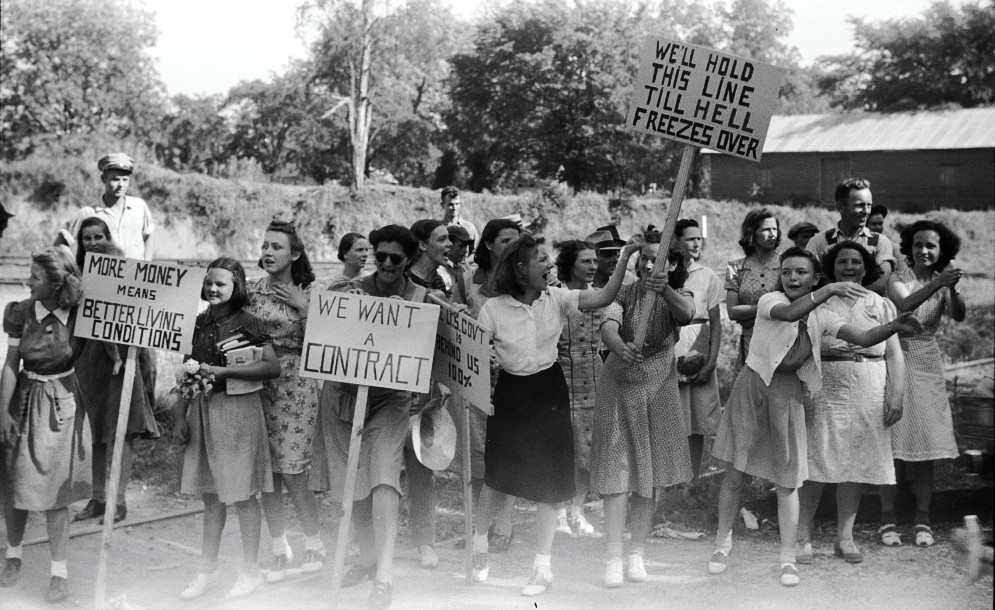
Foster speaks to the near terminal crisis fro the American Federation of Labor in the late 1920s. In 1917, the A.F.L. counted 3,104,600 members, at the end of the post-War strike wave in 1920, its membership rose to 5,110,800 with the 1920s seeing a reversal to 3,000,000 members with no wage gains or hour reductions for workers anywhere in the economy. Trapped by its ideological and organizational limits it would not be until the C.I.O. that the labor movement found a new vehicle and was able to organize the unorganized.
‘The Crisis in the Labor Movement’ by William Z. Foster from The Communist. Vol. 7 No. 1. January, 1928.
THE trade union movement now finds itself in a dangerous crisis, precipitated by the breaking down of the Miners’ Union and coming as a climax of long years of wrong policies and crassest misleadership by the controlling union bureaucracy. The Miners’ Union is in grave danger of being shattered by the employers’ offensive. This would enormously stimulate the open shop movement in every industry. It would encourage the employers to attack the labor movement generally with redoubled vigor; an attack which the unions, with their antiquated structure, confused ideology, weak numbers, and criminal misleadership are in no position to withstand. The situation is so critical that the unions are actually in danger of being wiped out or so reduced in strength and control as to be of little or no value to the workers. Even the right wing union leaders admit the danger. In many recent statements, Green speaks of the threatening attempt of the employers to destroy the unions. The trade union movement now faces the deepest crisis in its history. It is the task of our Party to warn the workers of this crisis and to make the most energetic efforts to liquidate it by rallying the masses of workers to stop the capitalist offensive and develop a counter-offensive to save and rebuild the unions.
THE BANKRUPTCY OF THE “HIGHER STRATEGY OF LABOR”
During and after the 1922 railroad shopmen’s strike, which was the disastrous climax to a long series of struggles unfavorable to the workers in nearly all the industries, the left wing proposed the reconsolidation of the workers and the development of a militant policy by the unions. But the trade union bureaucrats rejected this completely. Practically abandoning all idea of struggle against the employers, they came forward with a whole program of intensified class collaboration. One phase of this, eventually dubbed “the new wage policy,” called for co-operation in production with the employers, an agreement to speed up the workers, in return for which the employers should pay the workers added compensation and allow them to maintain company unionized trade unions. Another phase, trade union capitalism, proposed co-operation with the employers in the realms of finance and business. This whole system of no struggle was finally named “the higher strategy of labor.”
This intensified class collaboration movement was greeted with enthusiasm not only by the right wing leadership but also by the progressives, as the solution to the difficult situation in which the unions found themselves. Some left elements were also deceived by it. Illusions were widespread that the new wage policy would give the workers higher wages, and, with permission of the employers, would extend the trade unions far and wide, at least among skilled workers. Trade union capitalism, it was hoped confidently, realizing the Carveristic illusions of labor becoming capital, would raise the trade unions to the power of big capitalist combinations and enormously strengthen the labor movement in every direction.
FAILURE OF “NEW WAGE POLICY”
But the practice of the past five years has demonstrated the utter failure of the whole “higher strategy of labor.” Trade union capitalism has received a deadly blow in the B. of L.E. financial debacle. It is a punctured balloon, so flat that even the wildest enthusiasts of a few years ago, those who expected to see the organized workers buy out the industries shortly, have largely lost faith in it. Likewise, the new wage policy has demonstrated its bankruptcy. It has not raised wages, shortened hours, improved conditions, or increased employment, as its champions hoped.
As we shall see, it has not even served to maintain the existing organizations, much less provided a basis for extending the trade union movement.
The employers, especially in the big trustified industries, have met coldly the proposals of the trade union leaders, which are in substance, “Allow us to organize our degenerated trade unions in your plants and we will give you greater and cheaper production than you can secure through your company unions or by keeping your workers completely unorganized.” The bosses do not fall in line with this proposition. This is partly because they are not prepared to accept trade unions as vital factors in production. Even their company unions, despite the elaborate argumentation of efficiency experts, developed principally as bars against trade unions. Their widest expansion took place during the war years, under mass pressure from the expanding trade union movement. Now that that pressure is greatly reduced the company union movement has come to a standstill, if it is not actually receding. Those that were organized after 1918, especially in the packing and railroad industries, were formed directly to defeat the trade unions. The employers are more inclined to rely upon welfare systems, group insurance, etc., rather than company unions, to demoralize their workers. Hence when the trade union leaders come with their “union-management co-operation” schemes the big employers, suspicious of all forms of trade unionism, skeptical of the positive role of labor organization in production, and confronting no great mass upheavals of the workers which can be conveniently sloughed off through such means, commonly reject their propositions.
For example, the American Federation of Labor, as the basis of its campaign to organize the automobile workers, approached the employers with offers of “union management co-operation.” The employers rejected these flatly and the organization campaign blew up completely. This is the typical attitude of great unorganized industries in the present absence of strong mass pressure from the workers. The new wage policy has organized no new industries for the unions. It has only been adopted by employers where the unions are strong or potentially strong, and then in order to weaken these unions. Thus on the railroads some companies accepted the B. & O. plan (new wage policy) and most of them joined with the union leaders in formulating the Watson-Parker law. But these measures they accepted not to extend the unions, even in view of the many no-strike and co-operative features the latter offered, but to hamstring the existing organizations and to place barriers in the way of trade unionism generally.
Despite all the offers of co-operation by the trade union officials, the general policy of the powerful employers, rich with the spoils of their imperialist policy, and seeking cheaper mass production and a free hand in their industries, is to smash the most proletarian and ideologically the most advanced sections of the trade unions, to prevent the organization of the great masses of the semi-skilled and unskilled and to undermine the skilled workers’ unions in various ways. The breaking up of the miners’ and clothing workers’ organizations, coming in the wake of so many other shattered unions, and the vicious resistance to the Passaic and Colorado strikes, indicate the determination of the employers to exterminate all effective mass organization among the workers. Through Watson-Parker Laws, “union-management co-operation” schemes, injunctions, etc., they systematically weaken the skilled workers’ unions, pending the time when the employers deem the situation auspicious to deliver them still heavier blows.
HOW FAR WILL EMPLOYERS’ OFFENSIVE GO?
This raises the question of how far will the employers push their offensive against the existing unions? Will they try to break them up altogether? Or will they aim to preserve them as a bar against revolutionary unionism and action of the masses? Are the unions really in danger, or not?
The employers, especially in the more trustified sections of industry, while looking on the conservative trade unions in a general way as barriers to radicalism among the workers, do not generally tend to preserve and extend them. They feel capable of handling the situation without the help of the union leaders and an organized trade union movement. They have confidence that the workers, at least decisive upper layers of them, are not at such low wage levels as to give them revolutionary moods. They feel also that, with their vast power, they can take care of such upheavals as may occur from time to time. Undoubtedly they consider that their anti-union policy in the steel, packing, automobile, rubber, and many other industries, is highly successful. For the most part, they look upon the unions as a hindrance, not a help, in facilitating the exploitation of the workers. Were the capitalists confronted with broad, surging upheavals among their workers, they would change their minds and listen more sympathetically to the trade union leaders. But this is not so at present. How far they are willing to go against the unions was evidenced by the great drive of 1919-22, when even such unions of skilled workers as the printing and building trades were confronted with life and death struggles in spite of militant mass resistance by the workers. It is certain that, should strong left movements among the masses not develop in the meantime to check them, the employers would gladly shatter many existing unions and undermine the whole structure of trade unionism if they could see immediate advantages to be gained thereby. The unions are in danger.
The upper union leaders are doing nothing to meet the employers’ offensive except to vainly hawk their “union-management co-operation” offers to the unresponsive capitalists. Instead of organizing the unorganized, they allow the A.F. of L. base to be narrowed more and more to skilled workers. They do not amalgamate the unions although the employers are constantly consolidating their forces. They are now more opposed to the labor party than ever, having completely surrendered to the old parties. They have become abject tools of American imperialism at home and abroad. Never were they so cynical and corrupt, never were they so vicious in their attacks against everyone and everything progressive and revolutionary in the unions. The sum of their policies is a complete lay-down before the employers. °
For several years past the employers’ offensive has continued with varying degrees of intensity. The unions, undermined by speed-up systems, specialization, and confronted by an ever more consolidated and powerful enemy, have been in almost constant retreat, losing post after post, section after section, and with a steadily lowered morale and weakening organization. Even in the years of prosperity they did not regain their shattered forces by increasing their numerical strength. This course now culminates in a real crisis with the breaking of the Miners’ Union. The coal operators, representing the most powerful financial interests in America, are tearing the union to pieces in this strike in the key Pennsylvania and Ohio bituminous districts. Should they break the union in these districts, and the danger is exceedingly great, it will undermine the organization nationally. So badly has the union been injured already in the struggle because of the criminal misleadership of Lewis that even in the unlikely event that it secures a general settlement in the three strike-bound districts the whole union will be in a very serious crisis. The failure of Secretary Davis’ coal conference indicates the intention of big capital to smash the Miners’ Union.
LABOR MOVEMENT FACES CRISIS
The serious weakening of the U.M.W.A. throws the whole labor movement into a deep crisis. The open shop employers, encouraged by such a major victory and the growing unemployment, will redouble their attacks on all fronts against the retreating trade union movement. The approaching industrial depression is not likely to produce in the near future such a mass movement as to so terrorize the employers that they will consciously seek to preserve the conservative unions as bars to more revolutionary unions. They will seek to wipe out the trade unions, or to disastrously weaken them by legislative action (Coolidge’s proposed mining law); by multiplication of injunctions (I.R.T., Penna., Stone-Cutters, etc.); open terrorism (Pennsylvania and Colorado) and by sharpened antiunion policies in the shops.
Against this employers’ offensive the controlling trade union leaders will organize no real resistance. On the contrary, they will surrender all the more abjectly and seek to force the unions to surrender also, thus aiding the employers’ union-smashing campaign. The reactionary policy of the miners’ officials in the present strike illustrates this general tendency. They cannot maintain the existing organizations, not to speak of building a powerful movement. Their class collaboration policies are leading straight to the liquidation or complete degeneration of the trade unions. So real is the crisis that surely unless ways and means can be found by the left wing to mobilize the masses for real struggle, in spite of the surrender policies of the union leaders, to halt the employers’ offensive, the labor movement is in for a major defeat.
DISCONTENTED MASSES, DISILLUSIONED PROGRESSIVES
Vitally important for our Party to understand and to take advantage of is the spreading discontent in the trade unions and among unorganized workers, bred of the sharpening offensive of the employers against the workers’ standards and organizations and of the failure of the trade union leadership to develop policies to stop that offensive.
In the Miners, Needle workers, Chicago Traction workers, Machinists, Locomotive Engineers, and many other unions, there is a widespread and growing opposition to the corruption and no-struggle policies of the bureaucracy. These organizations and groups of workers offer fertile fields for our Party. Likewise, our experience in the unorganized industries, rubber, automobile, textiles, etc., indicate a widely growing spirit of discontent at the ever-sharpening speed-up, constant wage cuts, and steadily worsening conditions. These tendencies towards mass discontent and mass movement are bound to increase with the development of the industrial depression. There are many potential Passaics and Colorados now in the industries.
Highly important in the present situation is the growing disillusionment of the “progressive” wing of the trade unions, especially in the lower ranks, with the new wage policy, trade union capitalism, and other features of the intensified class collaboration program of the right wing. When in the deep crisis following the Shopmen’s strike of 1922, the right wing came forward with this class collaboration it was eagerly accepted by progressives everywhere. This was one vital reason, together with the lessening of the industrial crisis and slackening temporarily of the employers’ offensive, why they dropped the Trade Union Educational League’s amalgamation fighting program. They were the biggest boosters for labor-banks and the B.&O. plan. In fact, the reactionaries took much of this program from that of the progressives. That was one of the paradoxes of the situation; when the right wing took its sharp turn still further to the right it was along the line of some of the “progressive” policies. Thus the right wing and the progressives formed a united front; in fact, the progressives were pretty much swallowed up by the right wing. The alliance, based largely upon labor banking and the B.&O. plan (new wage policy) was further cemented by the concentration of the trade union forces generally around the candidacy of LaFollette. This was the period of the Party’s and the T.U.E.L.’s greatest isolation.
But now the united front between the right wing and the progressives tends to dissolve. Labor banking has been deeply discredited by the B. of L.E. grafters and has lost much of its attractive power for progressives. The new wage policy has failed completely and many progressives sense this, though they may not have analyzed it. They no longer look upon it as a panacea. The Watson-Parker Law, embodiment of the worst features of class collaboration and the masterpiece of the right wing, has a growing host of enemies among progressives. More and more the best elements among the progressives reject the right wing position regarding the Soviet Union and adopt an open attitude of friendliness as evidenced by the trade union delegations. The coming national election will hasten the disintegration of the right wing progressive united front which has been so disastrous to the trade union movement. The reactionaries will ask the workers to support the candidates of the old parties. Large numbers of sincere progressives, especially rank and filers and the minor officialdom, will rebel at this. They will cast about for some form of opposition policy on the political field. They will be ripe for labor party movements.
The characteristic of the present situation is that the right wing and the degenerated progressives (Hillman, Fitzpatrick, etc.) flounder further to the right, bankrupt in the face of the offensive of the employers, while growing numbers of confused but sincere progressives tend to break with them and to develop a program of resistance. This tendency is exemplified typically by the growing opposition to Fitzpatrick in the Chicago Federation of Labor. The general tendency will increase as the crisis, intensified by the growing industrial depression, sharpens in the trade unions and among the unorganized workers. In the deep crisis following the shopmen’s defeat the right wing was able to demoralize and capture the progressives with its glittering “higher strategy of labor” which it put forth with blowing trumpets as a saving panacea. But in the present still greater crisis, they have nothing substantial to offer. Mere whipping up of their discredited intensified class collaboration program and clinging terroristically to union control will not prevent the breaking away of the more sincere and militant progressives. The trend of these is towards the left. To give them a program and to draw them and their extensive following under the general leadership of our Party and its auxiliaries is a basic task in the present situation, a major consideration for halting the capitalist offensive, for preventing the disintegration and devitalization of the trade unions, for organizing the unorganized, and for giving our Party a real mass following.
WHAT MUST BE DONE—SLOGANS ON THE CRISIS
In order to most effectively mobilize the progressives and their following, as well as the more conscious left elements, it is necessary that the Party and the left group in the unions approach these masses with slogans indicating that the trade unions are actually in danger. They must be told frankly that the policies of the right wing leadership are leading the unions and with them the workers’ wage and working standards straight to drastic defeat. The left wing policies must be put forth to them not only in the sense of ultimately building a powerful labor movement, but primarily as immediately necessary for the saving of such organizations as now exist. The crisis in the trade unions must be the keynote of all our work among the organized masses.
Crisis slogans must not be put forth in any panicky sense. If so, they will lose their effectiveness. But our work must be shot through with the propaganda that the unions are actually in danger and that only by an aggressive mobilization of the best elements for struggle against the bureaucrats and employers, only by the application of the left wing action program, can the unions be saved and rebuilt. In 1922, the railroad shopmen, sensing their danger, rallied to the correct T.U.E.L. crisis slogan, “Amalgamation or Annihilation,” although their reactionary leaders prevented their taking definite action. In 1926, the crisis slogan, “Save the Miners’ Union,” as a means for a broad united front in the Miners’ Union. And which was also basically correct, served the crisis slogans, “The trade unions are in danger,” “Save the trade unions,” etc., will serve to unite masses with the left wing in the coming months. Many disillusioned progressives and backward rank and file masses can be made to see the correctness of such slogans and the necessity of taking definite action on left wing lines. These can be utilized for revolutionizing the unions, for organizing the unorganized. It would be a mistake, however, to attempt to call conferences of left wingers and progressives simply around the slogans that the unions are in danger. Opposition organization must be built around more concrete programs, labor party, organizing of the unorganized, resistance to wage cuts, recognition of Soviet Russia, amalgamation, etc., etc., and then the movement infused with the realization that the very life of the unions is menaced.
The Party must support aggressively the formation of T.U.E.L. groups in the various localities and industries upon the basis of the T.U.E.L. program, taking advantage of the impetus given by the T.U.E.L. National Conference. Systematic efforts shall be made to draw progressives into these groups, stress being laid upon the deep-going crisis in the labor movement. Progressives are awakening to the seriousness of the situation and this can be used to draw them into the organized opposition in the trade unions.
Every effort shall also be put forth to get up special committees and left movements around specific questions. Unemployment becomes an increasing menace and offers growing opportunities for left wing agitation and organization in the unions and among the unemployed. Resistance to wage cuts offer another effective lead for left wing work. The growing friendliness for the Soviet Union presents increasing opportunities for organization of trade union delegations, committees for the recognition of the Soviet Union, opportunities which must be systematically exploited by the Party. If the sentiment for recognition now existing in the trade unions were solidly organized it would constitute a powerful weapon against the right wing bureaucracy and would split its ranks.
The best specific issue for organizing a united front between the left wing and the progressives against the right wing at the present time is that of a labor party. Compared with 1922-24, the sentiment among the workers for a party of their own is relatively small this year. But it is being rapidly fed from two quarters. First, the growing industrial crisis is compelling larger and larger masses to look for a means to express their grievances and discontent, which means a growing labor party sentiment; and second, the fact that the A.F. of L. Convention has decided that old party candidates shall be supported in the coming elections alienates large numbers of progressive unionists who believe in a labor party and who went hand in hand with the union bureaucracy in 1924 in supporting LaFollette. The development of labor party sentiment and organization in this period is not only the mobilization of masses of workers against the bureaucracy, but also the furthering of a split in the bureaucracy itself.
Our Party must redouble its activity in the matter of the labor party. It must support and initiate the formation of national and local trade union committees to work for a labor party and look forward to the establishment of local, state, and national labor tickets and labor parties wherever the amount of mass support justifies such organizational steps. All the labor party work in the industrial centers must be linked up and coordinated with the farmer-labor party developments in the agricultural states. The Socialist Party, confronted with the necessity of at least partially splitting with the trade union bureaucracy or of supporting old party candidates, is attempting to set itself up as a labor party or a substitute for it. This we must counter by supporting energetically bona fide labor party developments, especially the formation, at this time, of trade union committees for the labor party. Our labor party work should be permeated with systematic, but not overemphasized or panicky propaganda, that the trade unions are endangered and that the building of the labor party, as well as the application of the left wing program generally, are immediately necessary for liquidating the crisis, and for extending the unions among the unorganized.
The organization of the unorganized remains the central task of the left wing in the trade union work. Every force must be expended and every situation utilized to this end. Building a strong left wing progressive opposition in the trade unions is basically important—the left wing will never surrender the 3,000,000 trade unionists to their reactionary leaders. Carrying through this task must facilitate, not hinder, the organization of the unorganized masses. The question of organizing the unorganized, especially in the basic industries, must be put in the sense that it is indispensable for liquidating the present crisis as well as for the eventual building of powerful labor organizations.
Definite contacts can and must be made with the progressive elements on the basis of organizing the unorganized. The unions must be saturated with movements to draw in the unorganized. Meanwhile the movements for independent organization must be intensified in those industries where the existing unions are too weak or reactionary to serve as the basis for unionizing the workers. Developing wage cuts in various industries will render greater masses ready for organization and struggle. Our aim must be to bring into the mainstream of the labor movement such unions as are organized on an independent basis. The question of organizing the unorganized must be raised to a major issue throughout the labor movement. In connection with it must be emphasized as vitally important the amalgamation and democratization of the unions.
There are a number of journals with this name in the history of the movement. This Communist was the main theoretical journal of the Communist Party from 1927 until 1944. Its origins lie with the folding of The Liberator, Soviet Russia Pictorial, and Labor Herald together into Workers Monthly as the new unified Communist Party’s official cultural and discussion magazine in November, 1924. Workers Monthly became The Communist in March ,1927 and was also published monthly. The Communist contains the most thorough archive of the Communist Party’s positions and thinking during its run. The New Masses became the main cultural vehicle for the CP and the Communist, though it began with with more vibrancy and discussion, became increasingly an organ of Comintern and CP program. Over its run the tagline went from “A Theoretical Magazine for the Discussion of Revolutionary Problems” to “A Magazine of the Theory and Practice of Marxism-Leninism” to “A Marxist Magazine Devoted to Advancement of Democratic Thought and Action.” The aesthetic of the journal also changed dramatically over its years. Editors included Earl Browder, Alex Bittelman, Max Bedacht, and Bertram D. Wolfe.
PDF of full issue: https://www.marxists.org/history/usa/pubs/communist/v07n01-jan-1928-communist.pdf

