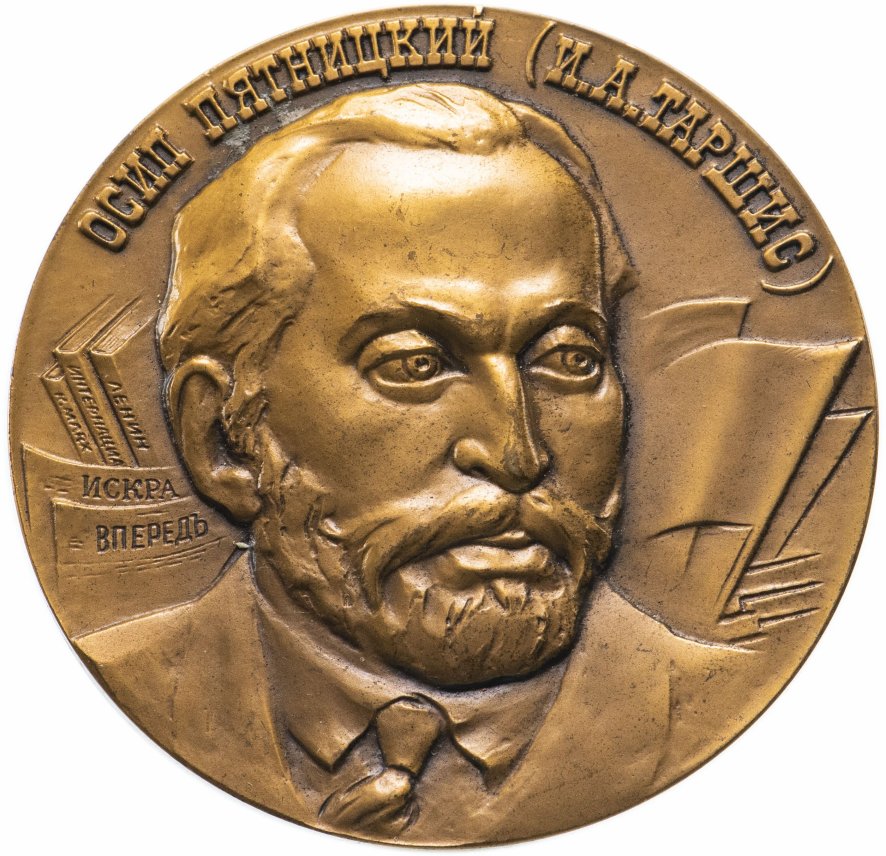
Piatnitsky was tasked with the overhaul, Bolshevization, of the Comintern sections that began in 1924. Aside from wishing to create a uniform political apparatus, the main focus of the reorganization was to move away from the electoral-based organizational model of Social Democracy to one rooted in the workplace. Piantnitsky reflects on one year of that process.
‘Political and Organisational Experiences of Nuclei’ by Osip Piatnitsky from International Press Correspondence Vol. 5 No. 63. August 6, 1925.
The Most Recent Experiences in Factory Nuclei Work. Speech of Comrade Piatnitsky at the Session of the Org. Bureau, July 14th, 1925.
At the first Org. Conference of the CI, we not only discussed the question of nuclei, but examined the entire organisational structure from top to bottom. This has proved to be very useful. In Germany and in Norway the organisational instructions and the model statutes which were decided at the Org. Conference, were accepted as the basis of the Party Conference decisions. However, it may be that at the organisational discussion we did not pay sufficient attention to nuclei and fractions, because we had to concentrate on a member of incorrect aspects regarding the organisational structure, (double organisations, workers’ groups, functionary bodies). Today I shall devote my speech mainly to two chief questions, the work in the Nuclei and Fractions.
It is an easy matter to constitute the Party in accordance with prevailing conditions when these two forms, nuclei and fractions, exist within our Parties. If, however, this basis does not exist then it is very difficult to carry on successful Party work; actual realisation of Party decisions is almost impossible without this basis.
At the Organisational Conference we received various statistics; sections reported that in such and such a country there were 500 nuclei and in another there were a thousand. But when we looked a little closer on to how the nuclei were working, then we had to acknowledge that many of these nuclei were working badly and had therefore possessed very negligible influence. On that account it is difficult for them to prove how more advantageous this method of organisation is than the old one.
The Political Significance of Nuclei Work.
Progress may now be noticed in those Communist Parties which have begun to work systematically in accordance with the theses of the Enlarged Executive and decisions of the Org. Conference.
Just recently we had reason to see the necessity of active nuclei work as the basis of Party organisation in connection with the campaign of the Communist Party of France against the Moroccan war and on behalf of trade union unity. The CPF was only in a position to carry its correct policy with the assistance of its Factory Nuclei, to create Factory Unity Committees, to organise the Factory Delegate Conference in Paris, in the North and in the Southern Districts and to develop a mass campaign against the war.
The campaign of the Communist Parties on behalf of national and international Trade Union unity has also proved that it is possible to attain our aim if the factory workers are not won over for the cause of unity, and create a united front organ in the factory. For only by means of organisational pressure from below by creating Trade Union Unity Organs in the Factories is it possible to bring about unity. Wherever Communist factory nuclei are active, there we may say trade union fraction work is successful, for the basis of the trade union work is the factory.
The Communist Party of Italy has been able to gain a firm footing by means of Factory Nuclei in the most important large-scale industries, its membership has increased and the Party has gained a large circle of sympathisers. By means of factory nuclei, the Party is at present carrying on a successful campaign against the reformist trade union split policy and fascism, and on behalf of the trade union unity.
Just as the Communist of France has been successful in carrying on the campaign against the Moroccan war, so too the Campaign against Intervention in China and against the anti-Russian agitation have only been possible with the help of the factories. Further we see the possibility and necessity of our agitation and propaganda in the factories, from the fact that the German factories were able to realise the despatch of a workers’ delegation to Russia in spite of the agitation of the Socialist Party of Germany.
The Position of Organisational Work in the Larger Sections of the CI
The larger Parties are properly speaking divided into two groups: firstly those countries which formerly had a well-established Social Democratic organisations and in which the Communist Party was formed from the left wing of the Social Democratic Party like in Germany, Czechoslovakia, Austria, Holland, Switzerland, Sweden and Denmark. In such Parties the organisation and formation of nuclei is a difficult task. Secondly, we have that group of countries like France, Great Britain, Italy and America, where Social Democratic Parties did exist, but their organisations were not so strongly developed as in the first group of countries. It is now evident that reorganisation of the Party and the formation of nuclei is much easier and is being carried on much more successfully in the second group of countries.
France. Reorganisation of the Party organisations was carried on here in the industrial centres with very good results. Comrades were thus convinced that reorganisation is essential and is very beneficial, and even in the ranks of those right elements of the CPF, which are in conflict with the Party, no active opposition was made against reorganisation.
The demonstration on the occasion of the transference of the body of Jaurès in Paris showed that these still weakly developed nuclei were able to mass together the entire Party membership and the majority of the industrial workers. It was an interesting spectacle to observe that, though the Left Bloc demonstrated simultaneously in conjunction with the Socialists, they were unable to secure the support of the masses, whilst the Communist Party led an enormous demonstration of workers. This event was no mere chance, for we see that the second demonstration in honour of those who fell during the Commune and against the Moroccan war, presented the same picture.
A further example of the inner contact of Party organisation with the working masses was that of the Workers’ Congress. A campaign was carried out on an extensive scale on behalf of the Workers’ Congress, meetings were held both in and outside factories, the entire agenda discussed in the factories and delegates elected. On an average 40%-50% of the workers from factories took part. This experiment shows that by using correct policy, the Party is able with the help of the nuclei to secure contact with the masses and to convene Workers’ Congresses, the decisions of which receive the support of the working masses at large. Besides these good results of Party work I must also refer to a few mistakes which have been committed in the course of organisation.
For example, factory nuclei, did not receive instructions not to concentrate on factory work only, but to perform Party work generally including work in residential districts. This method gave very unsatisfactory results during the Municipal elections. On the occasion of the election special workers groups in residential districts were formed and proved utterly useless. Instead of setting to work, they discussed Party tactics and neglected election work, with the result that small trades people, dealers, etc., who might eventually have supported the Party, were entirely overlooked. A further error was the fact that the boundaries of the districts (Rayons) did not coincide with the boundaries of the administrative districts, a fact which rendered election work immensely complicated.
A third shortcoming was that of the lack of nucleus groups. The districts (Kayons) were not divided into minor organs which directly linked up the nuclei. District Executives which were weak, were thus unable to give proper instructions or to control the numerous nuclei in their district. And the fourth drawback consisted in the lack of capable district executives who really led and controlled the work of the minor Party organisations. The district executives did not systematically instruct the nuclei or give practical help in the matter of politising and rendering more active the nuclei generally.
These shortcomings of the Communist Party in France were and can easily be remedied, because there is a basis, the factory nuclei. In a detailed letter we pointed out these weaknesses to our French comrades, and they realised them and have already begun to form nucleus groups and street nuclei and consequently to improve the work of the Party Executives.
Italy. The oppressive measures employed by fascism were responsible for forcing the CPI to work almost entirely illegally. It became evident that the Party, as a result of its organisational structure (lack of districts Executives, organisation of members on a residential basis), was not able to hold all Party members and to remain in close contact with the masses. When the Italian workers again began to be active, the shortcomings of Party organisations and the inadequate contact with the workers were manifested.
Hence Party comrades proceeded to create groups of sympathisers in the factories in the various capitals, (Turin) and to form so-called factory groups in which Party members and sympathisers are organised. This experiment shows that real contact with the working masses is only possible through these factory groups; the result was factory groups were forced to develop into Party organisations.
Hence in the beginning two organisations existed; the Party in the residential districts and factory groups, which also included sympathisers. In order to avoid parallel work the Party was obliged to carry out reorganisation on the basis of factory nuclei and to dissolve residential organisation. The Party was in a position to exercise greater influence on the working masses in view of the fact the Communists in the factory groups were formed into factory nuclei, which constituted the basis of Party organisation. Numerous sympathisers in this way joined the Party.
Simultaneously, it became apparent that the struggle against fascism could best be organised in the factories. The necessity of factory nuclei work was also demonstrated in the prevention of trade union splits and at the Factory Council Election in Turin, where the Communist Party secured the majority of Factory Council mandates. The CPI has been completely reorganised on the basis of factory nuclei in Turin. In view of the fact that practically the entire Party membership worked in factories, it was possible to link up the few comrades outside the factories with the factory nuclei. The factory nuclei performed the entire Party work including propaganda in residential districts. In Milan the Party has been reorganised on a factory nucleus basis, and those members who are not occupied in factories, have been combined into street nuclei.
The fact that in Italy the Party was forced in its struggle against fascism to reorganise on the basis of factory nuclei, and then in January 1924 put the instructions of the Enlarged Executive successfully into practice, is a splendid confirmation of our organisational decisions.
Great Britain. In London, the few nuclei (31) which have been founded there, gave the Party the immediate possibility of securing direct contact with 50,000 workers. In a short time the Party secured in London 70 workers as new members. That is a very significant fact for a Party with a 5,000 membership. It is also an interesting fact that British workers who are very economical, buy up factory newspapers and read them so that very often it happens that the same factory newspaper must publish two or even three editions. In London there are 27 factory newspapers published fortnightly, having a circulation of 7,000.
America. The few nuclei which have been formed in the American factories have made great progress and prove that the nuclei possess the possibility to influence and organise the masses at large. Campaigns and big meetings have been held in protest against Child Labour, against the condemnation of Sacco and Vanzetti and on behalf of a holiday on May 1st. In factories which hitherto had always worked on May 1st, there was a stillstand in the work as a result of our factory nuclei activities. In some few localities it was possible to win over some reformist trade unions.
In the American factories the workers employed speak many languages. Comrades belong to nuclei and very often each one speaks a different language so that 5-10 languages are spoken. In spite of this however, it has been possible to overcome these difficulties, and the Party has made great progress in the formation of nuclei. In the first, national groups reorganisation has been possible without any palpable obstacles of a traditional nature.
In the first group of countries like France and Italy there are no parallel residential organisations, thereby the nuclei are more active and work better than those countries where the old-fashioned residential organisations still exist. We do not wish to imply with this that in the first group of countries nuclei work is quite satisfactory, whereas great difficulties are felt in the organisational work in the second group of countries.
Czechoslovakia. Here the objective premises for reorganisation are favourable, since the Party is composed of 70% of workers and is strongly represented in the factories; unemployment too is comparatively on a small scale. Reorganisation met with obstacles because of the deeply-rooted Social Democratic traditions of organisation. Further, during the Party crisis organisational work was neglected; but despite these obstacles we are able to record that factory nuclei were created in the most important industrial centres, though they are not specially active. At the moment many nuclei have not been able to unite all the Party members working in the factories, and also only a small section of the nuclei members have attended the meetings and carried out Party work. In spite of the fact that in the Skoda works in Pilsen there are many Party members and 5 Communists are on the Factory Council, the Social Democratic Party rules over the factory and all elected factory organs. In view of the fact that the nucleus does not work well, the struggle against Social Democracy cannot be successfully carried on, and even the 5 Communist Factory Councillors can do very little because the nucleus is not working systematically in the factory.
In connection with the Factory Council movement and the campaign for trade union unity there is a certain vitalisation evident in the factory nuclei; the Party learned during the Ostrau struggle and other economic struggles in Northern Bohemia how necessary, especially in Czechoslovakia, the creation and vitalisation of factory nuclei is. In Czechoslovakia the organisation is mainly dependent on energetic, systematic leadership of organisational work by the Party Executive. The traditional difficulties demand a strong pressure from above and render it necessary that organisational work should be assisted by instructors. For in organisations as they exist in Czechoslovakia, written directions are of little use and personal instructions and control are essential. In our opinion the Communist Party in Czechoslovakia has to solve the following questions:
a) Activisation of all the nuclei in conjunction with the execution of the political tasks of the Party.
b) Inclusion of all comrades working in the factory nuclei and distribution of Party work to all nuclei members through the Nuclei Executives.
c) Inclusion of all comrades not organised in factory nuclei, in street nuclei and liquidation of the old residential organisations (groups of 10).
d) Limitation of the right of the functionary bodies, the creation of Delegate Conferences, as decisive factor, elimination of the condition of affairs that functionaries in place of Party members work and decide on matters without the inclusion of all members in Party work.
e) Improvement of the work of the Party Executives and development of control and more extensive reports.
Germany. There is great unemployment to be recorded here. The fact that Social Democrats are strongly entrenched in the factories and possess good trade union officials naturally makes our work very difficult in the factories. Very many factory nuclei have already been formed in Germany, but the nuclei have not received sufficient attention, nor have all kinds of Party work been allotted to them, especially the political work of the nuclei has not been sufficiently attended to and hence they have often done nothing and remain dead organisations.
The double organisation has been primarily the cause of this neglect of factory nuclei work. Party members who belong to the factory nuclei are also members in a residential district, and they pay their Party dues there. When there is a factory nuclei meeting on the same evening as that of a meeting in the residential district, then the factory nuclei meeting must finish up quickly to enable comrades to get to their residential meeting in good time. The centre of Party work is in the residential districts, there comrades use their right to vote at elections and for delegations. Comrades must be both in the nucleus and in the residential districts. If they want to be present at the nucleus meeting then they must miss their train and besides there is a danger that on account of nuclei work they will be dismissed from the factory.
Hence comrades ask themselves why they should take part in the nuclei work when they have an opportunity to carry out their Party work in residential districts. It is much more agreeable to go home before the meeting in the residential districts, to be able to wash themselves and have a meal. It is characteristic when we read in the Berlin-Brandenburg district that only 4 nuclei collect Party subscriptions and that the circulation of material (leaflets, newspapers, etc.) only function where there is a good residential organisation. It is quite natural that, as long as the residential organisation forms the basis of the Party organisation, a development of activisation of the factory nuclei is impossible.
We believe that questions of Factory and Street Nuclei are dealt with very clearly in the decisions of Comintern. In accordance with our decision every comrade who is working in a factory should belong to the factory nucleus. The work of the factory nucleus consists in dealing with all questions appertaining to Party work and in collecting Party subscriptions. The Party member belongs to the local group or town organisation to which the factory nucleus belongs.
Besides inasfar as it is possible, unemployed comrades and others, not working in factories are attached to the factory nuclei. This is necessary because certain tasks of the factory nuclei are often such as to be impossible for comrades to perform who are actually working in the factories (organisation of meetings in the factory, distribution of factory newspaper, newspaper and literature sales outside the factories). The number of Party members thus included should only form a slight percentage of the nucleus members actually occupied in the factories in order to secure that the factory workers constitute the main centre of the nucleus.
Other comrades (traders, housewives, small business people, literary people, etc.) are organised in street nuclei. Members of factory nuclei who live at a distance from the factory are registered by the nucleus group executive of the residential district and allotted to a street or factory nucleus in their district for Party work after working hours and on holidays. These comrades in the residential districts have no decisive rights in general Party questions since they carry out their duties and possess their rights in the factory nuclei of their place of work.
At the Org. Conference the German comrades very energetically defended the “working groups”. We told them that these were exactly the same as the residential organisations. We were very glad to notice that the German comrades have now given up this idea and decided at their Party Conference to carry out reorganisation on the lines laid out by the Executive of the Comintern.
I shall quote from the report of the Berlin-Brandenburg district some interesting figures in view of the significance of the organisational conditions of the workers. In Berlin there are 1,501,050 workers and employees, but only 398,625 are organised in trade unions. Many comrades declare that it is not possible to win over the workers organised in the reactionary trade unions because these are completely under the influence of trade union officials. It is quite natural that where the Social Democrats with the help of good Party and trade union officials have gained a firm footing in the factories and where Communists are not combined and carry on no systematic work, the Social Democrats have a stronger influence than Communists. However, by systematic work in the factories we can win over a large section of workers organised in trade unions.
Comrades overlook the fact that there are still 1,102,425 workers who are not organised in trade unions, these are workers who are not burdened with a Social Democratic organisational tradition and are not under the organisational influence of the reformist trade union leaders. How are we to combine these Social Democratic and non-Party workers if there are no active factory nuclei? They hardly ever read our newspapers nor go to Communist Party meetings, neither do they receive Communist leaflets, so how are they to be made sympathisers or Party members? The great majority votes for Social Democracy and supports it simply because our work is inadequate in the factories. It is true that this work is very difficult but then Communist Party cannot win over the masses without a certain amount of sacrifice.
How are the existing nuclei to fulfil these tasks if they are not made active and do not work systematically and the Party Executives pay little attention to them, or if parallel organisations on a residential basis exist where the centre of gravity of the Party is located. Double organisation stems the work of the factory nuclei and often makes it absolutely impossible. As a result political activity in the Communist Party and development into mass Parties is obstructed by this form of organisation. Hence, Party Executives must do their utmost to ensure that all Party work with which the lower Party organs are occupied should be transferred to the factory nuclei. The old organisations on a residential basis should be dissolved as soon as factory nuclei and street nuclei have been created and linked up with the nuclei groups and districts.
The Activisation of Communist Parties.
The execution of the political decisions of the Communist Party is obstructed mainly by the passivity of the lower Party organisations. In the local groups the official usually carries out his work while the masses of the members do hardly any. As a rule Party members are not even drawn into discussions and decisions relative to Party questions. The meeting of functionaries makes all decisions. Party questions are neither previously or subsequently dealt with by the lower Party organisations.
This is an old Social Democratic tradition. The Social Democrats require this system, because Social Democratic leaders deceive the workers and therefore officials only make decisions and not the members. In contradistinction to this the Communist Party should not be based on functionaries but must bring all Party Members into discussions and decisions for the execution of the Party tasks. Definite work must be allotted to every Party member by the nucleus. If however, the mass of the Party members who work in the factories, do not know what is happening in the Party then it is impossible for them to carry on agitation and propaganda or organisational work amongst the workers. Comrade Lenin in his article “The St. Petersburg split of 1906” formulates the necessity of the activity and participation of all members in all decisions on Party questions as follows:
“The Russian Social Democratic Workers Party is democratically organised. This means that all Party work is carried out directly, or through representatives, by all Party members with equals rights and without any exceptions; all officials, all leading colleagues, all Party institutions are elected, must render account and are subject to recall. In view of the impossibility of assembling the entire Party members (about 6,000) at once, the Delegate Conference of the organisation is the highest instance of the St. Petersburg organisation. These delegates must be elected by all Party members, and the decision of the delegates is the highest and final decision on a question for the entire organisation. It is essential that all members of the organisation, when delegates are being elected, should express their view independently and individually on all contentious questions which are of interest to the Party…”
“On this account, the St. Petersburg Committee decided that the elections of the delegates should only take place at the Conference after the question has been discussed by the Party members as to whether an agreement should be made with the Cadets, and after all Party members have cast their vote on this point. The elections are a matter in which the masses directly participate. Socialists consider the consciousness of the masses as the most important force. Hence, every Party member must decide the question consciously whether or not at the elections the vote should be cast for the Cadets.” In another article: “The Reorganisation and Liquidation of the St. Petersburg Split (1907)”, Lenin wrote:
“In accordance with the new (Bolshevik) statute of the St. Petersburg organisation, the conference is a permanent institution. It meets not less than twice monthly, and is the highest organ of the organisation. New elections take place every six months.”
This quotation shows what significance Lenin attached to including all Party members in discussions and decisions on Party matters. For only with the assistance of the masses of the Party membership in the factories has the Party contact with the masses of the workers and can thus successfully carry out agitation, propaganda and organisational activities. The passivity of the Party can therefore be mainly overcome by dealing with Party questions in the basic organisations, in the nuclei, and thereby Party members take an active and conscious interest in Party life and specific Party tasks.
Opponents.
In Austria and Germany the Social Democrats have proceeded to create organisations in factories, respectively factory agitation committees. In various circulars Social Democrats point out to their officials that the best place to deal a blow at the Communists is in the factories.
But not only do the Social Democrats form factory organisations, but the fascists are also doing so. Various fascist leagues are constructed on the basis of factories. Fascist activity in factories, especially in the vital factories, prove the necessity of increasing the activity of Communist factory nuclei.
There is no doubt that the struggle against the Social Democratic policy and fascist organisations in factories is extremely difficult because Social Democracy has the support of good trade union officials, who have usually worked for years in factories, possess strong influence and have as a rule much more freedom of action and have a good standing with the factory management. In order to carry out a successful struggle against these organisations it is essential that factory nuclei should function.
Factory Nuclei Newspapers.
Although factory nuclei newspapers have existed for a very short time they have already given good results. Factory newspapers tell the workers what is actually happening in the factories, and at the same time discuss questions outside factories. Workers who do not read the daily papers are very interested in the factory newspapers. They are comprehensible for them. Workers are much more inclined to subscribe to a Communist daily paper after having regularly read the factory newspapers. Unfortunately however, the ideological influence of the factory newspaper has not yet been sufficiently utilised organisationally, because the factory nuclei are not yet active enough and the Party Executives devote too little attention to nucleus work.
We see from the fact that the employers are also publishing factory newspapers that our factory newspapers are having a great effect. The employers agitate in their organs naturally not from our point of view; they relate the difficulties which exist in the factory, the shortage of orders, etc., in order to hold back the workers from the class struggle in order to suppress Communist agitation in factories some concerns have offered from 310,000 marks reward for the location of the editorial board of the factory newspaper. If the nuclei work well and the paper is regularly published and factory questions properly linked up with the political questions of the day, then the mass of workers under our continuous influence and under Communist leadership will become active in the political movement.
Recruiting of Members.
The strong influence of the Communist Parties on the masses of workers was evident at the Factory Council Elections in Germany, Czechoslovakia, and Italy, at the Workers’ Congresses in France, and is also noticeable in the Minority Movement in Great Britain. Communist Parties however, have been unable up to the present to utilise this ideological influence organisationally. In numerous Communist Parties recruiting is regarded as a periodical activity which should be carried out annually during definite recruiting weeks. This however is incorrect. Party members under the leadership of the nucleus must carry out systematic recruiting work daily. In France we have members of the Red Trade Unions, who support us, but our nuclei have very inadequate contact with its members. The Trade Union comrades demonstrated with us, they participated in all our campaigns, but few have joined the Party, although they could easily be won for our Party. A similar state of affairs exists in Germany. In many factories the workers vote for the Communist Factory candidate, but still the Party has not been able to secure the majority of these workers for the Party. In the district reports at the Party Conference many districts mention the fact that they have had several recruiting weeks, but only one district disclosed the results. Less recruiting weeks are required, and should be substituted by continual daily recruiting work.
In Bergen, in Norway, there are 20,000 workers, of these 10,000 read the Communist daily paper but only 6-7,000 belong to the Party. From these figures we see that one of our most urgent tasks is to make Party organisations more active and to develop systematic daily recruiting work.
Some legal Communist Parties still continue to put difficulties in the way of factory workers pointing the Party by their candidate system, probation time or other such formalities. These obstacles must be done away with. The nuclei and every individual Party member must carry on continuous daily work and endeavour to secure members from the ranks of the factory workers.
Fractions.
The fractions are in a much worse condition than the nuclei themselves. In France very little has been done in this connection. Neither in the CGTU, nor in the CGT, are there active fractions, for only now has the Party begun to build up fractions systematically. In Czechoslovakia a similar state of affairs prevails, there are but a few fractions which are not very active.
Not only in Trade Unions, but i all non-Party organisations fractions must be formed. In Norway, comparatively strong trade union fractions exist, but in non-Party organisations very little work has been done. Recently for example a Sport Conference took place, our Party was well-represented but the Communist delegates did not know one another, for they had not been united. The Party Executive had not understood the importance of having fractions in all non-Party organisations.
Concluding Remarks
In my opinion the Org. Department of the ECCI must concentrate its main attention on the questions of factory nuclei and trade union fractions. Not only should letters be set to the Parties, but also articles and we must point out by personal contact to the instructors the dangers which exist if we are not successful in overcoming Social Democratic traditions without which it is impossible to attain a Communist mass Party.
It has become apparent now since we have begun to issue instructions by means of letters, articles, and providing instructors and the control of the execution of decisions that the Org. Department alone cannot compare this work, for organisational work touches on all branches of Party work, (Agitprop, Information, Trade Union, Cooperative, Agricultural, Women, etc.). The letters of instructors do not limit themselves only to definite organisational questions, but deal with the tasks of other departments. All departments must concentrate on factory work, for successful agitation and propaganda can only be carried out in the factories.
You will see from my report that the position of organisational work in the CI gives us no cause for optimism, but we should not overlook the fact that the position was formerly much worse. I appeal to the Org. Bureau to adopt the resolution which has been submitted on the immediate organisational tasks, which contains in the main the chief points of my report.
International Press Correspondence, widely known as”Inprecorr” was published by the Executive Committee of the Communist International (ECCI) regularly in German and English, occasionally in many other languages, beginning in 1921 and lasting in English until 1938. Inprecorr’s role was to supply translated articles to the English-speaking press of the International from the Comintern’s different sections, as well as news and statements from the ECCI. Many ‘Daily Worker’ and ‘Communist’ articles originated in Inprecorr, and it also published articles by American comrades for use in other countries. It was published at least weekly, and often thrice weekly.
PDF of full issue: https://www.marxists.org/history/international/comintern/inprecor/1925/v05n63-aug-06-1925-inprecor-CARTOONS.pdf

