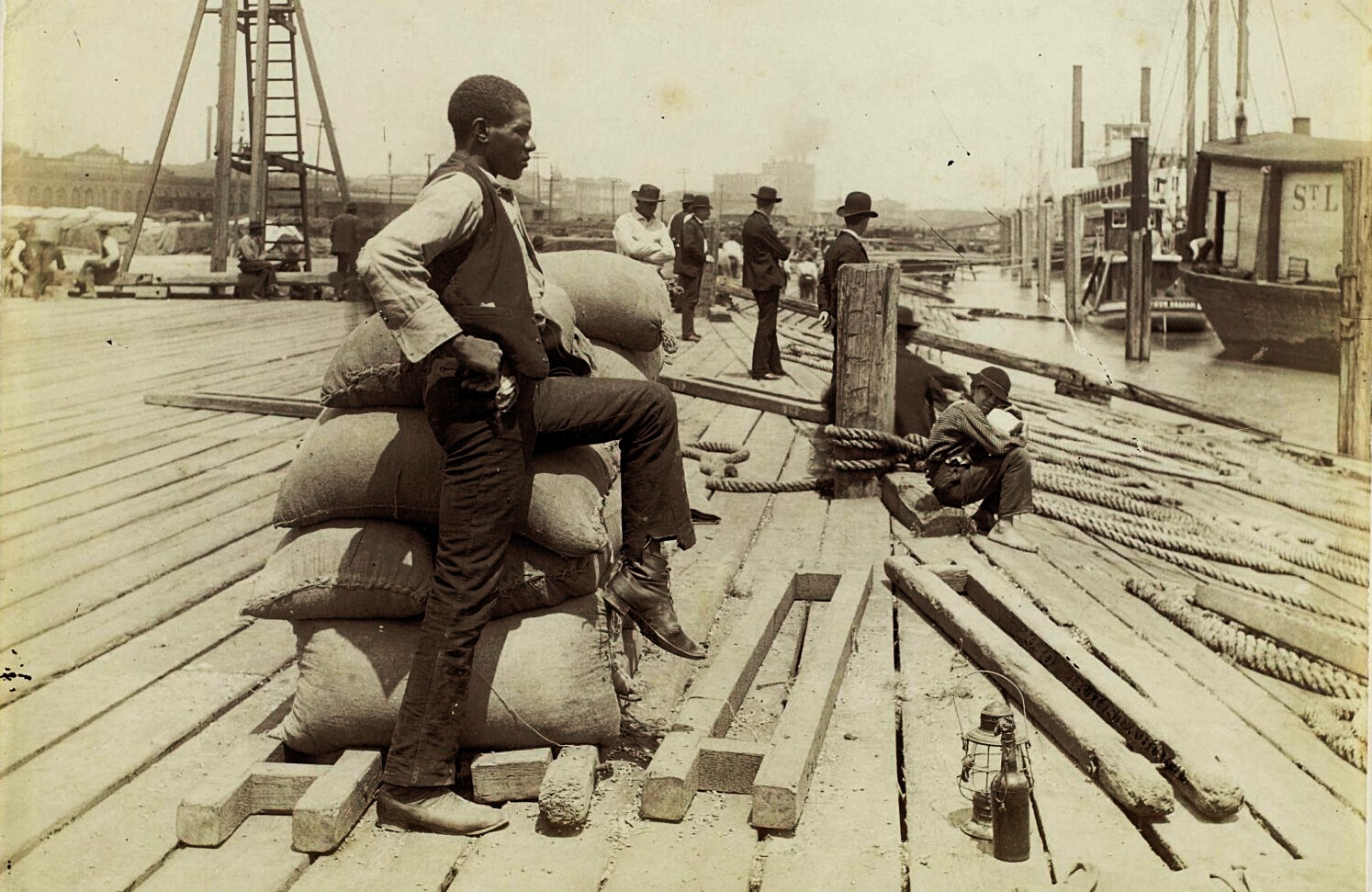
Workers on the docks and in the fishing vessels are the subject of these chapters of Barkers’ fantastic ‘Story of the Sea.’
‘The Story of the Sea: VIII-IX. Dockworkers and Fishing Stations’ by Tom Barker from Industrial Pioneer. Vol. 1 Nos. 5. July, 1921.
VII. THE DOCK WORKERS
WHEN I left Buenos Aires, in February, 1920, the Federacion Portuaria had perfected a scheme to enforce two shifts a day on the docks and to abolish night work. The men on the first shift would begin work at 6 A.M. and, with a half-hour spell for breakfast, would work till 12 noon. They then would quit for the day. The second shift would be from 12 noon till 6 P.M., with another half-hour for “smoke-oh.” No more work would then be done until the following day, when the men would go on the alternative shifts. The work for one day’s pay would therefore amount to five and one-half hours. The men were to be engaged at the Union “stand” by rotation. It was considered better for everyone to have some work than for the “royals” to do it all and keep other men out of job.
There were at that time many unemployed in Buenos Aires and, as it does no good to ask for unemployment doles in that country, the marine workers had to solve their own difficulties. They put an end to the career of the work-hog who used to work the day shift on one ship and would then scoot away to another dock to work the night shift on a different ship. They set themselves the task of seeing that every man had a job. In Buenos Aires no docker is now allowed to hang around the boss’s coat-tails or to buy him a drink. If it were proven that a docker had committed the above crime, he would very likely be kicked off the wharves. A man can do such a thing only once.
Labor-Saving Machinery
In Buenos Aires, as in London and other parts of the world, the shipping and stevedoring companies have been introducing labor-saving devices. Wheat is now loaded in Rosario by elevators and unloaded in Liverpool by suction pipes. Electric cranes and winches reduce the number of days now spent in port by ships, and fewer dockers are necessary to work them. The slings get larger, and the contractors attempt to get six men to do the work of eight. The introduction of oil as fuel is displacing thousands of workers formerly engaged in bunkering ships. The oil-lines are laid on the ship, and in a couple of hours her bunker tanks are full. As the number of oil-burners will increase, less ships will be engaged in the carrying of coal, and more and more port workers will find themselves out of work. The big oil tankers that bring oil from Mexico unload their huge cargoes in a few hours and then depart. They can make three voyages while coal-carrying ships can make only two. This reduces the number of men on ships as well as on shore.
Speedier loading means more profits for the ship-owners; also, more misery and poverty for the dockers and coal-dumpers. The “unemployment dole” will not solve this problem. The “dole” would be feasible if the world were poorer than formerly, but such is not the case. The ruling class is, as a matter of fact, richer than ever before, and when our class starves it starves in the midst of plenty. Hence, there can be no solution of our troubles short of the abolition of the private ownership of shipping and the inauguration of control of industry by the workers.
The Links in the World Chain
The introduction of labor-saving machinery is throwing men out of work in other industries as well. Many of these unemployed drift to the wharves where skill is not essential, thus making bad conditions still worse. It is much the same in every country. The Hindoos who load rice, the Spaniards who load iron-ore, the men who fill the holds with guano on Christmas Island, and the New York or London dockers who unload the cargoes, are all suffering from the same disadvantages. The man who is at work fears the man who is not, and vice versa. Wages fall and more and more workers are driven into the slums. These conditions drive good men to jail and weak men to begging. Others steal, and some go to the lunatic asylum. Capitalism is devoid of a logical reason for its existence. It is inhuman, impersonal, and relentless. It is decadent and inefficient, and it must therefore be destroyed.
The driving power of hunger makes men do things that their manhood revolts against. When munitions of war are to be loaded, the sympathies of the docker are divided between his hungry children and his class brothers overseas. His children are before his eyes daily, the downtrodden workers overseas he does not see. Therefore, when we see such a shining example of working class solidarity as was displayed by the men who refused to load munitions aboard the “Jolly George,” in the port of London, to kill their brothers in Russia, we must give due credit to such action. It is a demonstration of power. Power does not come in a sudden outburst, it requires a growth which must develop its technical and administrative sides. It is constant work and application that wins in the end.
I have attempted in this book to convey a slight idea of the power of our masters, and of the present disorganized condition of the marine transport workers. We see the dockers in New York divided into a dozen warring factions. We see them in the British Isles led by men who are living on their past reputations. We see organizations without power, and officials who have no knowledge of how power can be attained. Day by day our future becomes blacker; and, adding insult to injury, our union officials humbly request from our masters but a few crumbs from the enormous hoard that we have created and placed at their feet.
It is the duty of industrial unionists to explain to the marine transport workers how they can obtain power. The national and sectional unions are almost useless, for even within their zones they act independently, fighting among themselves like Kilkenny cats. The dockers of Buenos Aires, on the other hand, are making an effort to solve their own difficulties. They are holding themselves responsible for their own unemployed. They are attempting to counter the boss’s labor-saving appliances with shorter hours and no night work. And yet, unlike the “superior” Anglo-Saxon, fifty per cent of these dockers cannot read.
Under the present forms of sectional organization, we can hope to do very little; the only road to power is the creation of one organization for all the workers on the ships and wharves. We have to be so organized that all the men handling, loading, transporting and unloading cargo goods, regardless of their nationality, must be in one union. One union on all ships and in all ports. This will put an end to long distance scabbery, and create an organization which, as it grows, will throw the gauntlet to the shipping octopus and drive it from the seas. This organization will be the link connecting the industries of different countries; it will be the cornerstone of the International Labor Movement.
Fellow workers of the docks, you are the homeguards of the Marine Industry. The men on ships are your fellow workers. Together you are a mighty force, an unbreakable power. Separated you are so many straws in the wind. Get the class idea, fight for it, live for it and, if need be, die for it…There is no slavery except ignorance. The other class is powerful because we are ignorant. Let us spread the gospel of class interest, develop our spirit of self-reliance, and remember that we shall be enslaved only until we gain the power to break our chains.
There is only one working class. Let there be only One Big Union!
IX. THE INTERNATIONAL FISHERMEN
Scattered in out-of-the-way corners of Mother Earth are to be found the deep-sea fishermen. Up in the vicinity of Alaska and the Behring Straits you will find them engaged in the whaling and sealing industries. Down in the Southern Ocean, on the edge of the Antarctic Seas, two thousand miles from the amenities of civilization, they carry on a mighty war against the denizens of the deep. The men of the Northern Seas, in and around the port of Seattle, are semi-organized, while many of the men who work on the inhospitable, treeless shores of South Georgia and Shetland are members of the M.T.W. of Argentina.
These fishermen are mostly Scandinavians and Russians. They are vilely paid, when you take into consideration the loneliness and excessive cold of the desolate isles on which they live. Their employers, who never visit these isles, make enormous profits from oil and guano. The men generally sign, under stress of starvation, very one-sided agreements; on occasion the companies violate these contracts–they have been known to rob their men of every cent that they had earned over periods running sometimes into years.
South Georgia
During January, 1920, there was a strike on the Grytwiken Station in the Island of South Georgia. The strike was against vile conditions, rotten food and low wages. It was won, but shortly afterwards the British cruiser “Dartmouth” came into port. The new agreement was promptly nullified by the manager when he found he had force to back him up. The men struck again to enforce the new agreement. They were then brought, between a file of armed navy-men, before the manager and the Resident Magistrate, and told that if they would not work under the old conditions, they would be deported. Two whaling steamers were packed with men and they were thrown ashore in Buenos Aires. Several of the men were penalized to the extent of their full wages, running into several thousands of Norwegian krowns–because “they had instigated a strike.” The remainder of the men were grossly insulted in the company office.
These conditions will prevail until the fishermen will become organized into the Marine Transport Workers.
Once the companies get their men away into these isolated islands they treat them like dogs. For instance, the men who were “deported from South Georgia”–for this was inscribed across their passports by the Resident Magistrate in order to prevent the men getting work again–were working for a company registered in Argentine, on an agreement printed in Norwegian on a British island. This deprived the men of getting legal redress in any excellent contrivance on the part of the companies of the capitalist courts.
Colonial Office Geography
When the matter was brought before the British House of Commons by Neil MacLean, M.P., the Colonial Office informed him that it was unaware that there was such a place in the British Empire as South Georgia. The office holders do not seem to be as interested in whale oil as in the oil that flows from the wells in Persia and Baku. The smart young men in the Colonial Office may easily mislay some part of the Empire if they do not wake up. A few years in the foe’s’le of a ship would teach them more about the Empire than they are likely to learn from the school books for Standard 6, whence they evidently derive their vast knowledge.
Unionism for the Fishermen
Most of the men who follow these dangerous occupations belong in the marine transport industry. Therefore we have to make provision for them both to protect them and to organize the places where they work. It will facilitate their return to the industry. They will be an accession of strength to the Marine International; owing to the scattered and isolated nature of their work, it cannot be adequately covered by any existing national organization.
South Georgia and the Falkland group can be organized from Buenos Aires, the islands of Inaccessible and Tristan D’Acunha from Cape Town or Durban, and the Northern Pacific from Seattle or Nome. The roaming whaling ships should be organized in their home ports. Care should be exercised that all contracts, if there are to be any, shall be written in plain language, and that food, clothing and accommodation shall be of the best. The “payment by results” system should be done away with, as it causes recklessness and loss of life, especially when fighting whales.
If the companies do not agree to these things, then the World Organization must blockade the islands and refuse to move the oil or guano therefrom. Reliable men should be chosen as delegates, and plenty of literature in various languages should be devoted to educating the fishermen in these desolate, out-of-the-way corners of the earth.
The Industrial Pioneer was published monthly in Chicago by the Industrial Workers of the World from 1921 to 1926. The precursor of the Industrial Pioneer was the One Big Union Monthly. Heavily illustrated, the journal included arts, prose, and poetry along with historical articles and analysis. Editors included John A. Gahan, Vern Smith, H. Van Dorn, and Justus Ebert.
Full issue PDF: https://www.marxists.org/history/usa/pubs/industrial-pioneer/Industrial%20Pioneer%20(July%201921)_0.pdf

