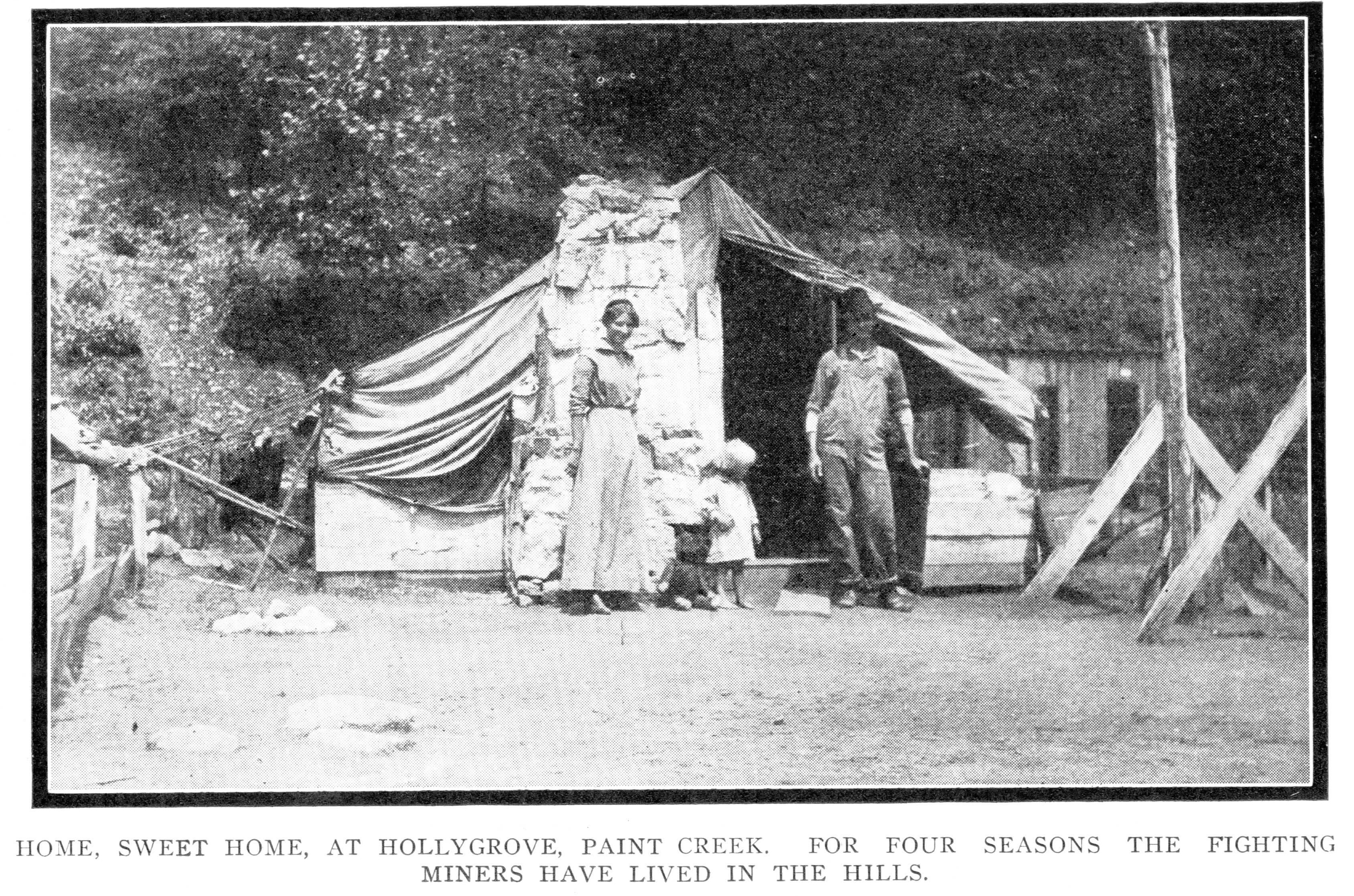
A ‘just transition’ for workers from coal mining has been talked about for over one hundred years. The problem, of course, is that capitalism is incapable of anything ‘just.’ The First World War saw a massive increase in capitalization and employment in the coal industry to greatly retract the following decade creating a severe crisis both within mining communities and the U.M.W.A. Below is a T.U.E.L. response to the crisis.
‘Unemployment and the Coal Miners’ by Freeman Thompson from Labor Herald. Vol. 2 No. 5. July, 1923.
DURING the war period this country saw the number of coal mines doubled, with an enormous increase in the number of miners. Today there are approximately 11,200 mines and 1,000,000 miners, capable of producing 850,000,000 tons of coal annually. The normal demand for coal ranges from 300,000,000 to 500,000,000 tons per year, according to industrial conditions. The result of this lop-sided condition of the industry is unemployment or partial unemployment for hundreds of thousands of miners.
Is there any likelihood of the industries of America increasing their demand for coal enough to put our miners back to work on the regular 8-hour day, 300 days per year, or 2,400 working hours, which is now necessary to get a decent livelihood? Will the growing demands of transportation and machinery get us back to work again?
No. For each year the demand for new sources of power is being met, not with coal, but with oil, gasoline, and hydro-electric plants. These relatively new drivers of American machinery are slowly eating the heart out of the coal industry. And the latter is burdened with exorbitant freight rates, profit-grabbing coal barons, and profiteers, exploiting the miners and fleecing the public.
Turn your eyes to the great Keokuk dam, witness the high tension wires carrying the electric power hundreds of miles, where it drives the great slave of tomorrow, the “Machine,” tirelessly and without ceasing. Turn your eyes to Niagara Falls, with only a portion of that great power harnessed, and see the marvels accomplished there. Write to Henry Ford and ask how the new-found force is revolutionizing his industry. See Steinmetz, the great electrical wizard, and get his ideas of the future of this great revolutionary power in modern life. Then look about you at the tractors, trucks, automobiles, flying machines, and the innumerable machines which feed upon gas and oil. See the greatest locomotives and steamships—”oil burners!”
Do we want to destroy this achievement? No! But it is creating a problem of life-and-death for the coal miners. What are we going to do with employment for little more than half of our numbers? It has been said by Ellis Searles, editor of the Mine Workers Journal, Frank Farrington of the Illinois Miners, and Mr. Peabody, conspicuous Coal Operator, operating 36 mines with annual capacity of 18,000,000 tons, among others, that we have fifty per cent too many coal mines and coal miners.
What solution do these men suggest? Editor Searles suggests that the surplus miners go back to the farm. With the farming industry bankrupt and hundreds of thousands of farmers deserting to the cities each year because they cannot make a living though already established on the land, this is indeed an astonishing suggestion. And even if the farming conditions were favorable, which they are not, how many miners could find a farm to go to?
In reply to a letter asking what could be done to get an equal division of work among the miners of Illinois, Frank Farrington said: “For the life of me I have nothing to offer.” This means only to let the operators continue the present game, closing down mines and laying off men to suit their whim.
Mr. Peabody said let the big corporations compete the little ones out of business. Well, no miner will weep any tears about what happens to the little labor skinners, but we are deeply concerned about what will happen to the fifty per cent of the coal miners who will lose their jobs when the fifty per cent of the mining companies go into bankruptcy. So that is no solution to our problem.
But if the eminent Searles, Farrington, Peabody, et al, are dumbfounded by the problem, that does not mean there is no way out. The members of the United Mine Workers must and will tackle it, and solve it. You, the coal miner, do you know that if the work were properly and equally divided among all the miners, there would be about 16 hours work per week for each? And do you know further, that you produce nearly four times as much as any other coal miners in the world in the same working time, so that 16 hours per week should be the basis of the workday and should pay a living wage? And is it not as plain as day that the only way we can escape unemployment, starvation, competition for jobs, and eventual destruction of our organization, is to force this equal division of work and keep the earnings of the miners up to at least the present level?
There are obstacles to overcome before we can accomplish this task. We must complete the organization of the miners, and we must hook up closer with the rest of the labor movement, particularly with the railroad workers. Today when we confront a struggle with the coal barons we find they have 120,000,000 tons of coal piled up on the surface; and in addition 290,000 miners still unorganized, capable of producing 275,000,000 tons of coal per year. This vast tonnage constitutes four-fifths of the nation’s needs for a whole year. The partially organized miners, standing alone, find this a most difficult and perplexing situation.
Organization of the unorganized miners is the first step to meet the need. All the so-called ‘organizers’ who today spend their time running around the well-organized fields building political fences, if put to work on a real organizing campaign and told to deliver the goods or get off the pay-roll, could soon solve this part of the problem. To get this done demands new blood in our district and national administrations.
The second step is alliance with the railroad workers. If the miners and railroaders would only get together and talk it over, they would immediately understand how to enormously increase the power of each. A fighting alliance would be set up, in which the miner would pledge; “Not a pound of union-mined coal to make scab steam while the railroad companies refuse to settle satisfactorily with the railroad workers;” and the railroad workers would say: “We will not haul a single scab into a coal mine, nor a pound of coal to market, while the coal operators refuse to meet the demands of the miners.”
What do you think the results of this would be? There can be no doubt that this is the course to take, if we want to cure the evils in the mining industry. The conditions now stifling the mine workers and stunting the generations that are to follow should swing all miners into a great movement for these measures, which lead directly to social ownership and workers’ control of the mining industry.
The Labor Herald was the monthly publication of the Trade Union Educational League (TUEL), in immensely important link between the IWW of the 1910s and the CIO of the 1930s. It was begun by veteran labor organizer and Communist leader William Z. Foster in 1920 as an attempt to unite militants within various unions while continuing the industrial unionism tradition of the IWW, though it was opposed to “dual unionism” and favored the formation of a Labor Party. Although it would become financially supported by the Communist International and Communist Party of America, it remained autonomous, was a network and not a membership organization, and included many radicals outside the Communist Party. In 1924 Labor Herald was folded into Workers Monthly, an explicitly Party organ and in 1927 ‘Labor Unity’ became the organ of a now CP dominated TUEL. In 1929 and the turn towards Red Unions in the Third Period, TUEL was wound up and replaced by the Trade Union Unity League, a section of the Red International of Labor Unions (Profitern) and continued to publish Labor Unity until 1935. Labor Herald remains an important labor-orientated journal by revolutionaries in US left history and would be referenced by activists, along with TUEL, along after it’s heyday.
PDF of full issue: https://www.marxists.org/history/usa/pubs/laborherald/v2n05-jul-1923.pdf
 Revolution's Newsstand