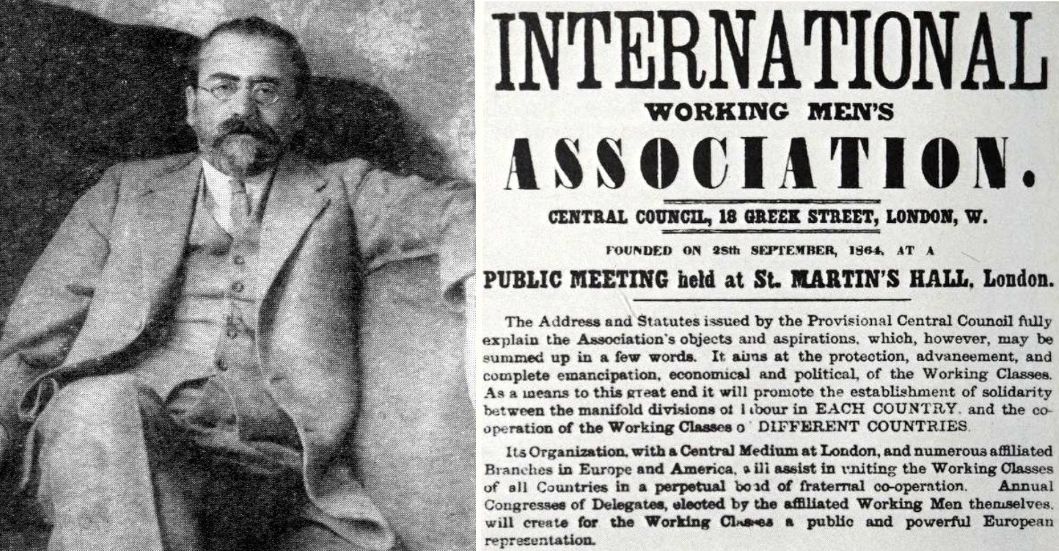
The veteran Russo-British Marxist reflects on the First International on the sixtieth anniversary of its founding.
‘The First International’ by Theodore Rothstein from International Press Correspondence. Vol. 4 No. 67. September 25, 1924.
Ten years ago, when the socialist world, just on the eve of the Fiftieth Anniversary of the First International, flung itself into the blood and dust of imperialist war, we who witnessed this unheard-of debacle hardly imagined that we should celebrate the Sixtieth Anniversary in a situation in any way similar to the present. All is lost, was the thought of most of us. The crushing of the Paris Commune had thrown back the revolutionary proletariat for many years; for how many decades would the socialist movement be thrown back by an event which constituted not a physical, but the most shameful, the most shattering moral defeat ever experienced by the working class? And in a certain and very important sense we were not mistaken. Only look at the present “socialist” movement, which appeared as the renaissance of the former, and which now, with unexampled hypocrisy, is preparing to make a solemn festival of the anniversary of that very International which it so brazenly betrayed on the eve of its anniversary ten years ago.
What does the Second International represent? A whited sepulchre, even in comparison with that living corpse, which as we now realise constituted Social Democracy on the eve of the world war. Had there not been the October revolution, had there not been the foundation of the Third, of the Communist International, what would have become of the political movement of the working class? It would either not have existed at all, or it would, as a whole, have based itself on the bourgeois social order. The Third International, which sprang into being as a result of the dialectical antagonisms of History, as the offspring of that very war which engulfed its predecessor, constituted at the same time the unique factor which rescued the working class from the clutches of political death, and raised its organisation and its struggle to a level never attained before. And this is the reason why it is not the Second International which is seeking to maintain the semblance of life in a form of the International Labour Movement which no longer exists–but we, the Third International, who are the spiritual successors and the heirs of that International, the anniversary of the foundation of which we are now commemorating.
This does not mean that the Second International did not occupy a legitimate place in the International expression of the Labour Movement. It constituted not only a legitimate, but an absolutely necessary stage of this development, corresponding to the given stage in the development of capitalism. It reflected the process of the rallying and organising of the forces of the proletariat in each country in an epoch when the powerful growth of industrial capital, on the one hand, destroyed the last remnants of artisanship and hand-manufacture, and, on the other hand, created a powerful state organism which it required both as a support and a tool. The lack of such concentrated and organised forces in all countries except England, constituted the chief cause of the decay of the First International. On the basis of nationally organised labour parties, there arose the Second International, as the form of their coordination on an International scale. It was rather a mechanical than an organic uniting of the international proletariat, because industrial capital was acting within the limits of states and nations, and the fight against it could only be conducted within the same limits. To the extent that the Second International was mainly a mere total of the movements of various sections of the international proletariat, it constituted the negation of the First International; but as far as it nevertheless moved and roused into consciousness real masses and not insignificant vanguards, it constituted the continuation of the First International at a higher stage.
Its mission was ended at the very moment when financial capital began to transcend the limits of states and nations, and when industrial capital, which became continually more closely allied to it, began to create a uniform world market. If one regards the period from 1890 to 1900 as the period of the highest prosperity of industrial capital, so the new century marked the commencement of the era of the expansion of financial-industrial capital beyond the limits of the individual states. The International ought therefore to have re-aligned its ranks, to have assumed new forms of organisation and created new methods for the fight, not only on an international, but even on a national scale. The fight against capital by single national sections could no longer meet with any success as soon as this capital no longer confined itself to the limits of one country. From this moment the fight ought to have been conducted on a united front with the whole world for arena. Along with this there ought to have been drawn into the fight the toiling masses of even the most backward countries. Finally, partial and local gains lost their importance when confronted with enormously developed and tremendously strengthened world capital.
The International ought to have turned to the example of the First International and have become one revolutionary party. This it failed to do, and was therefore bound to perish in the first conflict with this world capital in the world arena.
History repeats itself, but in a higher synthesis according to the laws of dialectics. The First International was a uniform, international, revolutionary organisation, but which did not yet have organised working masses behind it. Its successor was merely a loose federation of single national parties, which were supported by the organised working masses. The historical development demanded that the organised mass movements of the various national parties should be welded together into one firm and indivisible world revolutionary organisation which was the characteristic form of the First International as a higher synthesis. This higher synthesis took shape in the form of the Communist International. We returned to the initial stage, but on a higher and improved basis. The continued existence, however, of the Second International in our epoch, constitutes an artificial attempt to dress up an anachronism in a modern garb. It is for this reason that for us, the members of the Third International, the commemoration of that organisation which arose so modestly and so unnoticed out of a small meeting in St. Martin’s Hall in London sixty years ago, constitutes something greater than a formal historical ceremony. We are the same First International, but in a far more highly developed form and which has become richer as the result of the experiences of the everyday class struggle of the epoch of the Second International on the one hand, and of the great October Revolution on the other. For us, the First International is a stage which has been outgrown, as can also be rightly said of the Second International. Or better said, the First International is to be found in ourselves like the germ of which we are the fruit; because in the First International there was already innate, not so much in material form as in the thought and genius of Marx, all that we represent today. Although Marx could only find objective support in the English working class and its experiences, he nevertheless was able to anticipate such an international organisation of the working class as has been realised in our International, i.e. the organisation of all the forces of the international proletariat for the revolutionary fight immediately aiming at the realisation of socialism. It was through no fault of Marx that he did not succeed in realising it: even the greatest genius cannot leap beyond the bounds of the possibilities of the given epoch. But he anticipated it, he saw its historical inevitability, he demonstrated its inevitability and became the leader of that class which was destined to achieve it. Those who are familiar with the history of the First International know, that when Marx emphasised the importance of Trade Unions, of the reduction of working hours, of co-operative societies, of factory legislation, of the political struggle, of unrelaxed attention to the problems of foreign policy know that he did all this in order to mobilise and organise the backward working masses of the Continent on the basis of their immediate needs, but at the same time he pointed out that the masses have to go far beyond the minor questions of the day and have the task of carrying out the social revolution.
Another generation, another guiding genius succeeded in realising for the first time, and on a gigantic scale, that which the First International only represented in rough outline, and in creating, in the shape of the new International, the instrument for mobilising and organising the most backward working masses. Between both generations, between both their leaders and between both Internationals, there exists a vital, ideological and material connection; and in devoting these days to the commemoration of one of them, we actually devote them to the contemplation of our own being, of our work and of our tasks.
International Press Correspondence, widely known as”Inprecorr” was published by the Executive Committee of the Communist International (ECCI) regularly in German and English, occasionally in many other languages, beginning in 1921 and lasting in English until 1938. Inprecorr’s role was to supply translated articles to the English-speaking press of the International from the Comintern’s different sections, as well as news and statements from the ECCI. Many ‘Daily Worker’ and ‘Communist’ articles originated in Inprecorr, and it also published articles by American comrades for use in other countries. It was published at least weekly, and often thrice weekly.
PDF of full issue: https://www.marxists.org/history/international/comintern/inprecor/1924/v04n67-sep-25-1924-Inprecor-loc.pdf

