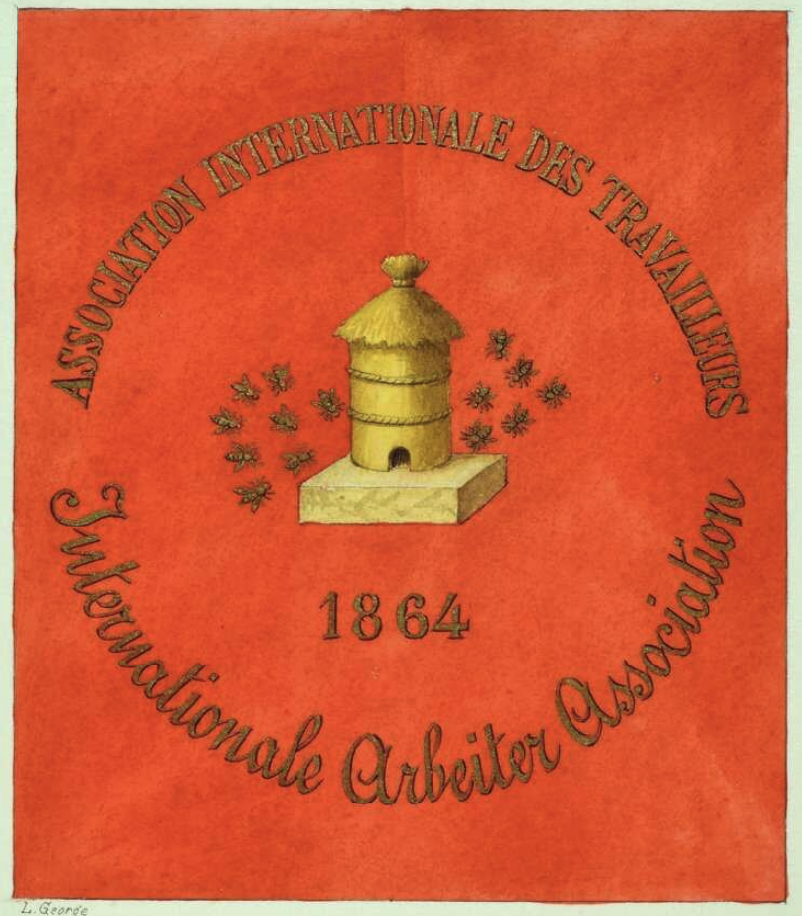
Asserting that the Third International is the only legitimate successor to the International of Marx, a lengthy thesis on the politics of the First and Second Internationals issued the Comintern’s Agitation and Propaganda Department on the sixtieth anniversary of the I.W.M.A.’s founding.
‘Thesis of the Sixtieth Anniversary of the Foundation of the First International’ from International Press Correspondence. Vol. 4 No. 67. September 25, 1924.
A. The First International.
I. Who Has the Right to Celebrate?
1. In August 1914 a solemn congress of all the social democratic parties of the Second International was to have been held in Vienna, to celebrate the fiftieth anniversary of the foundation of the First International and the 25th anniversary of the Second International. Instead of the celebration of international socialism, and of the manifestation of the solidarity of the international proletariat, instead of the demonstration against imperialist war which had for years been foreshadowed, and under the threat of which the last Congresses of the Second International had taken place, the cannons thundered, and the Second International hurried to the defence of the various fatherlands. The international proletariat was put into uniform and proceeded to murder, dismember and kill one another.
The Second International celebrated the anniversary of the First International on the battlefields of the imperialist slaughter and celebrated its own anniversary by its dissolution and with Kautsky’s statement “the International is an instrument of peace” and has no place in war.
2. Instead of the fiftieth we are celebrating the sixtieth anniversary. Who has the right to celebrate? Not those who helped to transform the international solidarity of the proletariat, whose symbol and instrument the First International was, (Marx said in a speech at the last Hague Congress of the First International, “the basic principle of the International is solidarity because the revolution must be the work of solidarity”), into the international massacre of 1914. Not those who, turning the revolutionary teachings and practice of the First International into their direct antitheses, placed the International proletariat in the service of international capitalism. Not those who misused the confidence of the masses of the people which they had gained in the 25 years of their existence and turned the stored-up energy and organisations created by the international labour movement in those 25 years against the working class itself, who, instead of realising the revolutionary aims of the workers, realise the international aims of capitalist exploitation, and who rendered service to the reaction of the capitalist class instead of serving the revolution of the working class.
The heroes of the Second International, the social democrats, the international marauders of the proletariat have no right to celebrate the foundation of the First International. They have not even a right to celebrate the foundation of their own, the Second International, for in 1914 they betrayed even their own past and what was good and useful therein.
3. Only those have a right to celebrate this anniversary who not only honoured the theories and practice of the First International but also transformed them into deeds. Only those who always remained true to the workers’ revolutionary past and always fought against the opportunism and treason of international menshevism and who even at the very moment of the deepest debasement of the working class, during the imperialist war, raised the red banner of international indignation, of the revolution, that banner which had been deserted by the social democrats, trodden into the mire and exchanged for the different national colours, was the banner with which they placed themselves at the head of the working class!
Only those have a right to celebrate this anniversary who saved even the good and useful in the past, that was in the Second International, from betrayal and annihilation, and who had more respect for that past than the Second International leaders!
Only the communists, only the true heirs of Marx and Lenin have the right to celebrate the anniversary of the foundation of the First International, of the first international of revolutionary solidarity! It is they who continue the theory and practice of the First International; they are the pioneers of the international revolution. The Third International has fulfilled Engel’s hopes, “I believe that the next International will be definitely communist”.
II. The Significance of the First International.
4. The working class must know its history, must honour its own revolutionary past and must on the hard road to revolutionary victory collect everything that can render this victory easier. The First International was not an “honourable beginning”, it was a revolutionary instrument shaped by the conditions of the life of the working class. At its head there stood the greatest thinkers of the working class Marx and Engels. Their theory, further developed by Lenin, is today an efficient weapon in the hands of the revolutionary vanguard of the international proletariat, the world Communist Party. Their practice, based on this theory, and embodied in the First International, their fight against the deviation to the “right” and to the “left” in the ranks of the working class at the time, and their principles of organisation are not dead, are not merely “the past”; but contain the germ of what was realised in the Third Communist International a proof of their correctness and vitality.
5. Three great periods can be distinguished in the history of the international labour movement. The first period which reached its climax in the First International is described by Lenin as follows:
“The first period is the birth of socialist ideas and of the germs of the class struggle of the proletariat. It is the long and bitter fight amongst the numerous socialist theories and tendencies. Socialism seeks its path, seeks itself. The class struggle of the proletariat, which is just about to rise out from the mass of the petty-bourgeois ‘people’, is of the nature of individual violent uprisings such as that of the Lyons weavers. The working class itself is feeling its way.
“This is the period of the preparation and birth of Marxism, the only doctrine of socialism which has stood the test, of history. This period comprises roughly the first two-thirds of the 19th century and ends with the complete victory of Marxism, with the bankruptcy of all pre-Marxist forms of socialism (principally after the revolution of 1848), with the separation of the working class from petty bourgeois democracy and its entrance upon its own historic path”.
III. The foundation of the First International.
6. The revolutions of 1848 were belated bourgeois revolutions. They completed the work of the great bourgeois revolution, principally of the French Revolution. They were of a petty-bourgeois, pompous nature, and the same time put the democratic state, which corresponded to the capitalist development of Europe, everywhere on its feet. At the same time they were a turning point for the proletariat. The proletariat, formerly an ally of the petty-bourgeoisie, appears as an independent factor in the field and frees itself from the petty-bourgeoisie, but not from the latter’s illusions. It suffers bloody defeat on the 28th of June 1848 in Paris. It suffers defeat in English Chartism. And it is betrayed by the German Philistine bourgeoisie.
7. The causes of this defeat are clear. The proletariat is from the very beginning of its development to a class international and especially the conditions of the class struggle of the proletariat are international. This need of the working class made its way to the front in the different attempts at international organisation made by the working class, such as the “Union of the Outlawed”, the “Union of the Just”, which then was transformed by Marx and Engels into the “Union of Communists”, whose manifesto, the “Communist Manifesto”, they drew up. But the different countries of Europe were in different stages of development and consequently the proletariat at different stages of advancement. In England the working class won the 10 hour day and the right to organise trade unions, but fought politically together with the bourgeoisie and petty-bourgeoisie and was betrayed. In France it was forced into independent action, isolated and deserted, and was decimated. In Germany the working class only began to stir, but even these first movements were bloodily suppressed by the bourgeois classes.
8. At the time of the 1848 revolutions the foundations of Marxism had already been completed and Marx and Engels were on the side of the working class. They attempted to exploit the bourgeois revolution for their ends. The great goal for which they fought was the unification of Germany, the fight against Russian Tsarism and the support of all national revolution in Europe, in short, the creation of European democracy as a prerequisite for the fight of the proletariat for emancipation.
9. After the defeat in 1848 reaction set inn Bonapartist France, in Germany and in Austria the revolutionary fighters languished in dungeons over all Europe–the Russian gerdarme stood watch.
Nonetheless, what 1848-49 did not produce began to be realised at the end of the Fifties and the beginning of the sixties. In many respects these years, although less noisy and sonorous than 48, were of greater importance. The prediction of Marx that after the defeat of ’48-49 a new revolutionary wave would arise with the first economic crisis began to be fulfilled. The economic crisis broke out in 1857 and brought distress and misery to the working class. In 1859 (the year of the publication of Marx’s “Critique of Political Economy”) an “amnesty” had to be granted simultaneously to the political prisoners under the pressure of the masses of the people in France and Germany. The four years’ civil war broke out in America between the North and the South the civil war from which Marx expected for the working class what the American War of Independence of the 18th century had been for the bourgeoisie. Then came Italy’s fight for freedom and of greatest importance the emancipation of the serfs in 1861 in Russia, where from that time on revolutionary movements followed one another unceasingly until 1905 and 1917 and kept the Russian “gendarme” busy enough at home. All this showed that capitalism in Europe had finally conquered, that the bourgeoisie was establishing itself, the era of bourgeois revolutions had ended and that the preparation of the proletarian revolution had to begin. If then Marx had during these years “liquidated” his previous conviction that Europe faced a new uprising (this is maintained today in order to justify the “liquidation” of the revolution of today), he did so because that had been realised, though not as he had expected. The ground had been prepared for the proletarian class struggle; the conditions for the organisation of the revolutionary struggle of the proletariat existed.
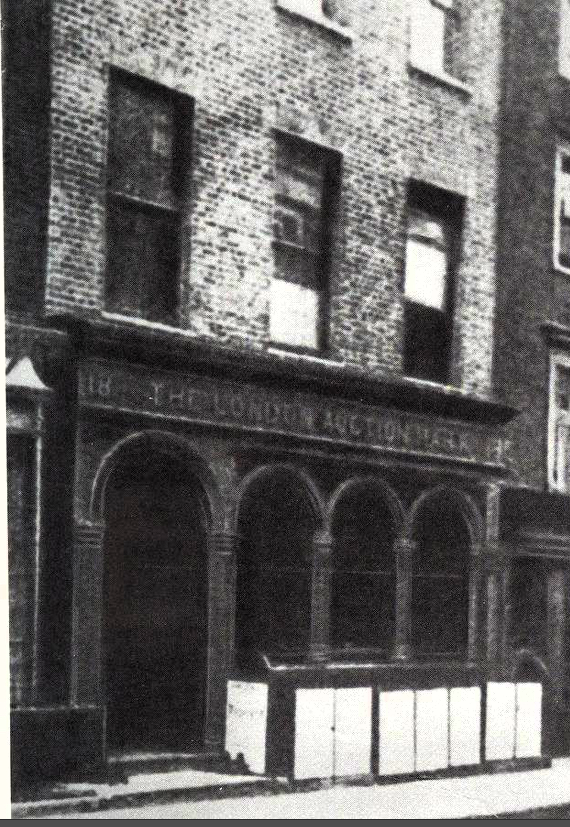
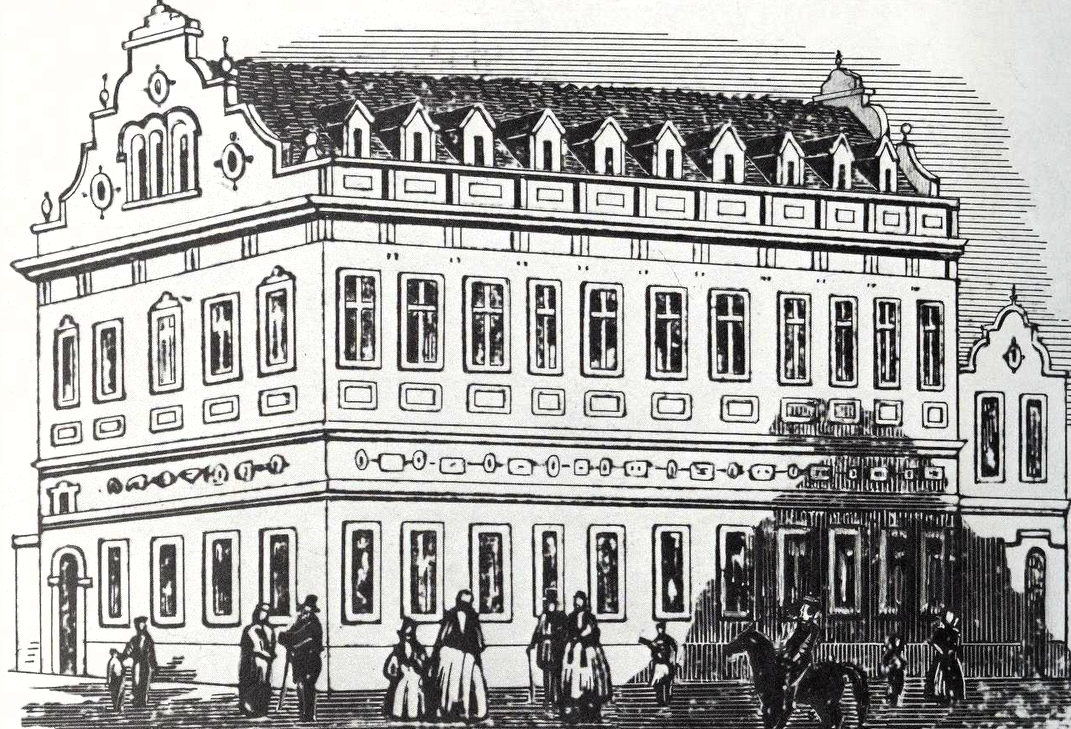
10. Thus the “International Workingmen’s Association”, i.e. the First International was founded on September 28, 1864. The leaders of the English trade unions were the most vigorous champions of an international organisation of workers since just then the English bourgeoisie began to cast about on the Continent for strike breakers and cheap foreign labour in order to break the power of the trade unions. The revolutionary awakening all over Europe and the bloody Polish rebellion, crushed by Tsarism with unprecedented brutality, drew the attention of the workers of the principal European countries to foreign affairs, to the idea of international solidarity which was instinctive in the working class, and which sought tangible form and found it in the First International.
Thus two fundamental conditions of the proletarian class struggle were actual at the very inauguration of the International:
1. The purely trade union problems were a driving force towards an international organisation of solidarity:
2. This international organisation immediately took the form of a political organisation as well as of a political general staff of the working class.
IV. The Basic Problems and the Policy of the First International.
11. The ideological and theoretical leadership of the First International was in the hands of Marx and Engels. The first problem was to make the First International a communist-Marxist International in other words breaking with the old ideas and tactics of the working class and acquainting it with the only correct theory, policy and tactics of Marxism. It was just during the period of the First International that Marx wrote his fundamental economic works, “Critique of Political Economy” (1859) and “Capital” (1867) and in the first one he formulated clearly and in a masterly manner his new theory of society, “Historical Materialism”. The working class thus had a theory meeting the needs of its situation and the condition of struggle as well as two brilliant leaders who had tested their theory in the battles of the revolution of 1848 and were trained tacticians.
However, this theory and practice were opposed by other theories, partly petty-bourgeois reformist and partly revolutionary but adventurous fighting tactics Proudhonism and Blanquism in France and later Bakuninism in Italy, Spain and Switzerland. These countries, whose industry was still to a large degree small industry, and whose proletariat was still largely petty-bourgeois, were again and, again the breeding places of theories and practices hostile to the class war theory and practice of the big industrial proletariat, and to Marxism. Thus the tasks of the First International was from the very beginning a two-fold one:
1. The organisation and leadership of the fight of the working class against the bourgeoisie;
2. The fight against the half-reactionary, half-adventurous tendencies within the working class against sects and for an active fighting workers Party.
12. The organisation of the fight against the bourgeoisie was–and still is–of two kinds: the theory teaching us the course of society and what the working class should fight for: and the practice, the immediate problems of the “broad” as well as the “narrower” policies of the working class, both of which are closely connected with each other. The theory was then Marxism; today it is Marxism-Leninism. The practice had to agree with this theory, because just that characterises the greatness of Marxism and Leninism, that they are the theoretical expression only of the living conditions of the modern proletariat, are not isolated from practice, but both got their being from practice and serve the needs of the revolutionary struggle of the proletariat.
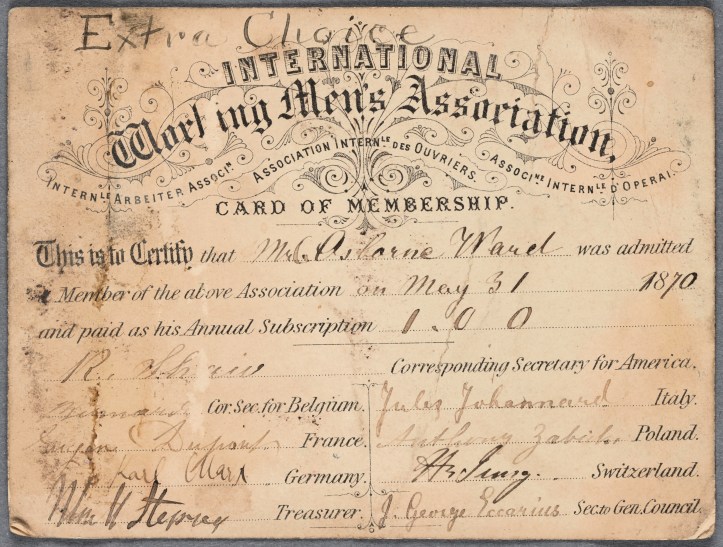
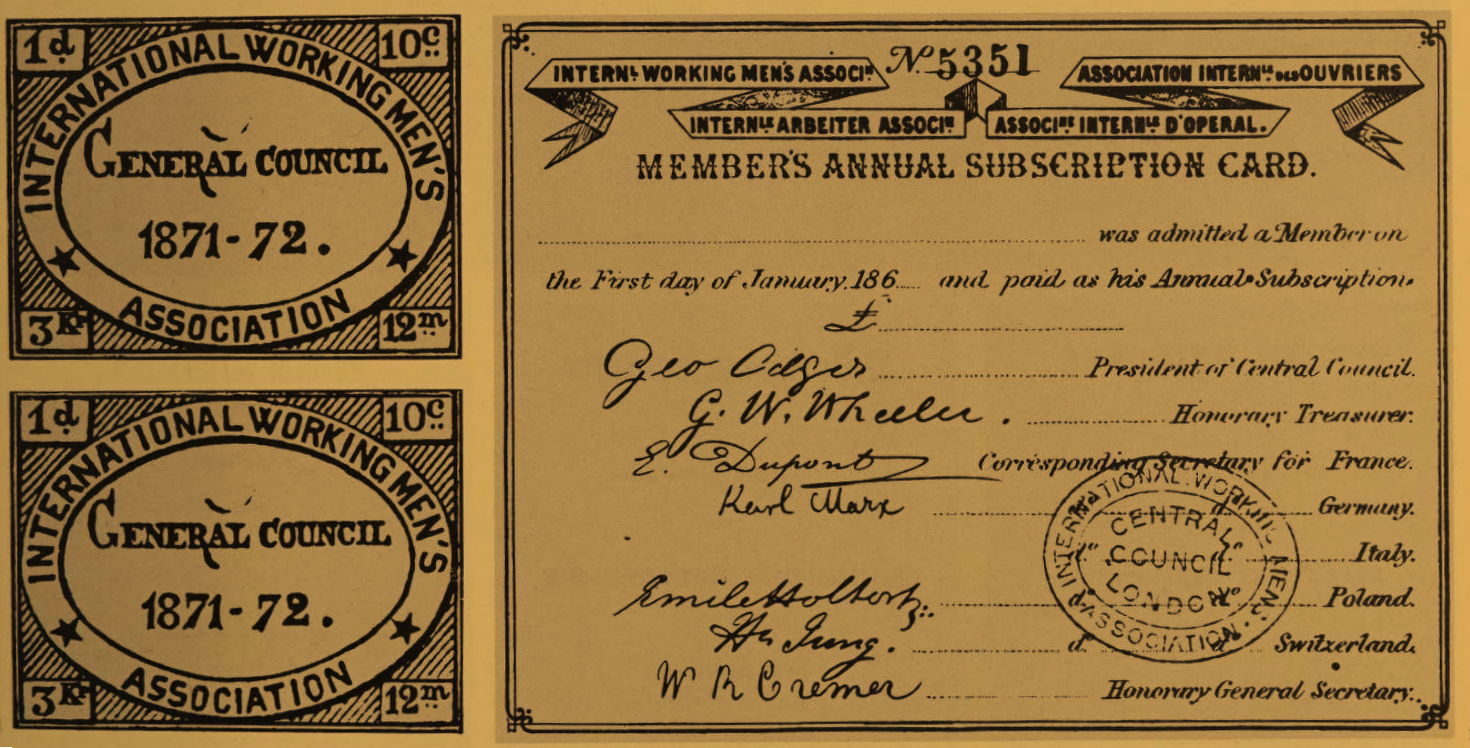
13. The first proclamation, the first decision of the First International, the so-called Inaugural Address, was based upon the “Communist Manifesto”, even though certain general meaningless phrases found their way therein under the pressure of the petty-bourgeois sentimental representatives of the French workers. But the fundamental principle of the working class was printed on the back of every membership card as the gospel of the workers:
“The emancipation of the working class must be carried out by the workers themselves. The fight for the emancipation of the working class is no fight for new class privileges but for the destruction of all class rules. The economic subjection of the worker to the expropriator of the means of labour, i.e. of the sources of life, is the root of serfdom in all its forms, of social misery, of intellectual stunting and of political dependence. The economic emancipation of the working class is therefore a great goal which all political movements, must serve. All attempts to reach this goal have hitherto failed because of the lack of unity among the different branches of labour in each country and among the working class of all countries. The emancipation of the workers is neither a local nor a national task. It concerns all countries where modern society exists. It can only be obtained through the methodical coordination of these countries. Therefore “Workers of the world, unite!”
14. This was the formulation of the great task of the “great profession” of the working class “the conquest of political power” for the reorganisation of society on the basis of general cooperation, of socialism. Therefore the working class must keep abreast of the foreign policy of the ruling classes and their governments and must confront it with its own policy.
15. This foreign policy, however, was a policy of war. War is no accident, but the inevitable consequence of the capitalistic economic system. It was so then, it is so now, and will remain so as long as capitalism exists. The Austro-Prussian and the Franco-Prussian Wars took place at that time, and the congresses of the First International often considered this question which is a vital problem of the working class, which is in some ways the philosophers stone of workers’ organisations, whether they side with the working class against the bourgeoisie or with the bourgeoisie against the working class.
16. In 1867, at the Congress of Lausanne, the International adopted the first detailed resolution on war and its attitude to war. It is pointed out in this that for the prevention of war it is not sufficient to abolish the army but that a change of the social system is necessary.
In 1868 the International Brussels Congress recommended “that the workers down tools in case of war breaking out in their own countries”. “For war is today a civil war”–workers fighting against workers. Fifty years later that was forgotten.
The General Council (led by Marx) adopted in 1866 at the beginning of the Austro-Prussian War a resolution in which this war is branded as the quarrel of two despots, and the proletariat is advised to utilise the given situation for its own emancipation.
In July 1868, the General Council wrote to the trade unions as follows: “The fundaments of society must be the brotherhood of the toilers freed from petty nationalism. Labour has no fatherland.”
And in the address of the General Council on the Franco-Prussian War the following appears:
“While official France and official Germany plunge into a fratricidal struggle, the workers send each other messages of friendship and peace. This one great fact, without precedent in the history of the past, unfolds the prospect of a better future. It proves that, contrary to the old society with its economic distress and its political insanity, new order arises whose international principle will be peace, because the same principle labour will rule every nation.”
The spirit of the First International was true internationalism, which set the international interests of the workers, the interests of the international revolution, higher than those of the “fatherland”. And this spirit flamed up brighter than ever, whenever a “national” war threatened to involve the workers. “Against chauvinism” was the slogan of the First International. And that at a period when national wars were comparatively justified, as Marx and Engels recognised, and not at a time, as in 1914, when national wars were only an exception and imperialist wars of plunder were the rule!
And the young German working class was true to this international duty! Liebknecht and Bebel did not vote war credits as later Scheidemann and Haase, but went to jail rather.
V. The Conquest of Power, the Role of Force, and the Role of the Party.
17. True internationalism was the internationalism of the revolution. “There are wars and wars; there are unjust and bad wars and there is the war for one’s own rights the revolution. The revolution is violent–The workers must one fine day seize the political upper hand and must build up the new organisation of labour. They must overthrow the old politics…If, however, that is the case, we must recognise that in most of the continental countries force must be the lever of our revolution. For the final establishment of the rule of labour, we must at a given moment appeal to force” (Marx).
Marx therefore saw in the Franco-Prussian war a step forward in the fight of the proletariat for emancipation. “Whatever the outcome of the war, it has taught the workers to handle arms and that is the best guarantee for the future”.
18. A theoretically trained, powerful centralised party, and allies amongst the toilers are essential to the proletariat for the realisation of the revolution.
Marx attempted to secure this by proposing the expropriation of the landowners and thus winning over the peasantry…I am convinced that the social revolution must start from the foundation; must begin with the ownership of land”. Numerous resolutions of the congresses of the First International confirm this view.
19. The establishment of an efficient party served in the fight against the sects. The International was founded in order to establish the real organisation of the working class for struggle in the place of the socialist or half-socialist sects. The original statutes as well as the Inaugural Address show this at a glance. On the other hand the International would not have been able to hold its own if history had not already killed sectarianism. The development of socialist sectarianism and of the real labour movement are always inversely proportional to each other. As long as the sects are justified, (historically speaking) the working class is not ripe for independent historical action. As soon as it reaches this maturity, all sects become basically reactionary. In the meantime, the history of the International repeated what had everywhere taken place in the past. Out of date practices endeavour to reform and maintain themselves within the newly established body.
“The history of the International was a continuous struggle of the General Council against the sects and amateur attempts which tried to maintain themselves within the International itself against the real movement of the working class. This fight was carried on in the congresses and even more in the private negotiations of the General Council with the various sections”.
20. The creation of the Party firstly served the subordination of all the phases of the labour movement to the Party, and secondly the organisation of the International.
In principle at least, the International itself directed the trade union movement, strikes, etc. The necessity of trade union struggle helped the birth of the First International. Marx and the First International considered the trade unions as an important part of the labour movement, as “the school of socialism”, but subordinated to the Party. “The workers must not…exaggerate the final result of their daily struggle. They must not forget that they are fighting against the effects and not against the causes…that they are employing palliatives but are not curing the disease. They should inscribe on their banner the revolutionary slogan: ‘Abolition of the Wage System’. The trade union movement must therefore develop into the political struggle; the pure economic defensive fight must be turned into the fight of one class against another. “But the fight of class against class is a political fight”.
21. The creation of a centralised efficient party was the object of the statutes of the International. Its basis was the section; its head the General Council. And, according to Bakunin, this General Council was dictatorial. In reality this “dictatorship” was the principle of centralisation as against the loose federative endeavours of the anarchists. The First International wanted to be a Party of the class struggle. The Bakuninists fought against its becoming a real party. They fought most bitterly against the incorporation of the following passage in the Statutes of the International:
“In its fight against the collective power of the possessing classes, the proletariat can act as a class when it organises its own political party, opposed to all parties founded by the owning classes. Such an organisation of the proletariat in political parties is absolutely necessary for the assurance of the victory of the social revolution and of the attainment of its final goal, abolition of classes. The uniting of the forces of labour, already attained in economic struggle, must also serve in the hands of this class as a lever in the fight against the political power of its exploiters. In view of the fact that the owners of the land and of capital always use their political privileges for the protection and perpetuation of their economic monopoly and for the enslavement of labour, the conquest of political power becomes the great task of the proletariat”.
If the principle of centralisation today, in the period of revolution itself has become a daily necessity of the struggle, but since mass parties are fighting this struggle in the four corners of the earth its organisational form must necessarily be another, the bitter struggle carried on then as now against “centralisation” by all those who oppose any revolutionary party at all, proves that this heritage of the First International the “centralised” party and international are one of the most important weapons of the revolutionary struggle. A fight without organisation is impossible, Organisation without a central head, a central organ drawing up a unified plan and supervising its execution, is a chimerical organisation.
VI. The First International and the Paris Commune. The Destruction of the Old State Power.
22. The Paris Commune of 1871 was a turning point in the modern labour movement, and was an important step forward in the theory of Marxism. The Third Address of the General Council of the First International (“The Civil War in France”) is the last great deed of the First International. In the glorious uprising of the Paris workers of 1871 the last of the old illusions and methods of struggle of the working class were buried. On the other hand this fight of the exploited revealed the peculiarity of the revolutionary struggle and the basic forms of the new proletarian State power. The internationalists took active part in the Paris Commune and their influence was strong. Engels said: “The influence of the Proudhonists and Blanquists was however overwhelming”. Now both of these sacrificed themselves; both of them assisted in helping the uprising to victory, and on the other hand used the power of the working class for social reforms in the interest of the workers. Nonetheless the Paris Commune on the whole was a defeat both for the petty bourgeois reformism as well as for sectarian conspiracy. But since the Paris Commune was a real people’s movement in which the proletariat played the leading role, it revealed the peculiarities of the social revolution. The destruction of the old State power and the creation of a new one, in the service of the light of the working class the dictatorship of the proletariat–this was attempted for the first time and Marx incorporated the great lesson of this heroic fight of the workers into the theory of Marxism.
23. Marx, who was against the uprising because he foresaw its defeat, did not complain, did not say “I told you so”, he studied its lessons. He and the members of the first International took part in the fight, the internationalists actively on the battlefield and Marx theoretically, with advice and theory. His action was a model example of what the attitude of the theoretician and leader should be to the fight of the working class. His example was soon forgotten, together with the lessons he learnt, to be rediscovered by the modern communists under Lenin’s leadership.
24. Among the lessons of the Paris Commune, not those should be emphasised which explain its defeat, which was due to the prevailing historical circumstances and which only had limited temporary and local importance, but those which are of a fundamental nature. Among them we have already mentioned the destruction of the old State apparatus. Three other questions which must here be mentioned because they were closely connected with the activity of the First International, are of almost as great fundamental importance; the question of the transformation of national war into a civil war against the exploiters; the question of the allies the proletariat requires; and the question of the Party.
The Paris Commune arose after the defeat of the French by the Germans, and turned this booty campaign of the French Emperor into an armed uprising of the Paris proletariat against its exploiters. The slogan later proclaimed by Lenin, “Transform the imperialist war into civil war”, was not then consciously formulated, and it was precisely the revolutionary wing of the proletariat, under the leadership of Blanqui, which hesitated for a moment and wanted to employ all its forces for the “defence” of the “fatherland” against the German “invasion”. But because this wing was sincerely revolutionary, this period of hesitation was only of short duration, and what was not formulated was nonetheless carried out. An example was given here for all later proletarian revolutions, an example from which something could be learned. The only ones who wanted to learn this lesson during the imperialist war were Lenin and his comrades.
The principal mistake of the Paris Commune was that it remained isolated. We have seen that the First International considered the fundamental task of the revolution the expropriation of the large landowners. The Paris Commune instinctively sought the methods through which it could assure the support of the peasants. It did not find them and remained isolated.
All these questions brought up by the progress of the revolution the conquest of State power the organisation of the civil war, and the relations of the proletariat to the other oppressed classes were not answered decisively because the proletariat itself was not organised; there was no trained, conscious, disciplined party. Without this latter no victory. Therefore the Commune was only the spiritual child of the First International, as Engels said, but not its real child. For all these questions were precisely those for the realisation of which, under the given circumstances, the First International fought under Marx’s leadership. They could not then be solved. Only by Lenin, by the Communist Party, by the Third International could they be taken up again, newly formulated according to new conditions and solved in a revolutionary manner.
25. The Paris Commune broke the labour movement. The centre of gravity was transferred to Germany. What was the First International? Engels described it as follows:
“…The old International is completely finished with. That is good. It belonged to the period…when the oppression ruling Europe and the beginning of the re-awakening of the labour movement prescribed unity and abstention from all internal polemics. It was the moment when the common cosmopolitan interests of the proletariat could come to the fore. The theoretical character of the movement was in reality very unclear in 1864 all over Europe, i.e. amongst the masses.
The first great victory had to shatter the naive collaboration of all the groups. When the International became a moral power in Europe through the Commune, the squabble immediately began. Each tendency wanted to exploit the victory for its own ends. The inevitable decay set in…The International dominated ten years of European history in the direction in which the future lies, and can look back upon its work with pride.
“But it had outlived itself its old forms…I believe that the next International after the writings of Marx have operated for a few years will be directly communist and will unhesitatingly raise the standard of our principles.”
B. The Second International.
25. “The First International (1864-1872) laid the foundation for the international organisation of the workers in preparation for their revolutionary onslaught against capital. The Second International (1889-1914) was the international organisation of the proletarian movement, which grew in expanse while sustaining a temporary drop in the height of its revolutionary level, accompanied by a temporary strengthening of opportunism, which led in the end to the collapse of this International.” (Lenin.)
I. Three Types of Labour Movements.
26. What did the Second International do with the great legacy it had inherited? What became of the revolutionary theory of Marxism? What shape did it assume in practice, did it remain revolutionary? Did it serve the cause of the revolutionary struggle, did it correspond with the spirit of the First International?
The second International was impregnated with opportunism and reformism from the very start; slowly but surely the revolutionary elements eliminated from its theory; the revolutionary practice of the First International was “forgotten” in the reformist practice of the Second; the militant revolutionary organisation of the First gave place to a “democratic” one in the Second.
27. The labour movement of this period was of three types. The leadership in the Second International belonged to the German Party, to the German social democrats. After the fusion of the two groups (the followers of Lassalle and Eisenach respectively), the German Party with a brief interruption during the time of the anti-socialist laws entered upon the broad path of legal development with more than a million members in the Party, four million votes in the Reichstag elections, 35 deputies elected in spite of the anti-socialist law, several hundred thousand members in the trade unions; with a central organ, “Vorwärts”, with a circulation equal to that of the big capitalist newspapers,–the Party was indeed, the mightiest, and leading Party of the Second International. Nevertheless the handicap of opportunism was soon to reveal itself. The splendid growth of the German Party, corresponding to the growth of the German proletariat, in its turn kept pace with the great growth of German capitalism, which was rapidly turning Germany into a big capitalist State after the termination of the Franco-German war. This growth of capitalism brought in its train a change in the structure of capitalism, in the shape of imperialism; at the same time, there arose a section of the proletariat which was to be the support and basis of the opportunist and reformist practices of the Second International the Labour Democracy.
28. Most overwhelming and characteristic was the growth of this section in England, where the second type of labour movements came into being. The mighty colonial empire of Great Britain, thanks to the infamous exploitation of the colonies, had placed the British capitalists in an exceptional position. Extra profits and monopolies enabled the British capitalists to pay higher wages to the skilled workers in the heavy industries, thus causing the latter to feel interested in the “development” of capitalism in “their country”. English workers paid little attention to the general international interests of the proletariat; the influence of socialism was weak; the working class of England aided and abetted in the oppression of the colonies, in the subjugation of Ireland, and so on. Through its mighty trade unions the English working class secured to itself a share of the spoils; the trade unions became imbued with a narrow-minded and cramped spirit. Not only the international interests of the Working class failed to meet with a response on the part of the English working class but even the unskilled workers and agricultural labourers of Great Britain were handed over defenceless to the capitalist exploiters.
29. The third type was evolved by the labour movement in France. After the suppression of the Commune, the French labour movement broke up into sects. Even after the subsequent fusions of these sects into a party, this party was and continued to be weak. The revolutionary past of this country, and particularly of the proletariat, coupled with the great lessons of the Commune, failed to put the French proletariat on the road towards organisation: the Party as well as the trade unions remained organisationally weak. The theory of Marxism did not strike deep roots: phrase mongering reigned supreme. The weakness of the labour movement was the next result of the economic development of France, which was half agrarian, and in comparison with England and Germany rather of a rural, petty-bourgeois nature.
30. Thus we find that in the three leading countries of Europe, where the three principal parties of the Second International were formed, it was the advanced section of the proletariat which imposed the petty-bourgeois mentality upon the workers organised in the trade unions and in the Party. This was effected in different ways. In England and in Germany, it led to a community of interests with the bourgeoisie, while in France the whole of the working class became imbued with the petty-bourgeois nature. Substantially, of course, it amounted to one and the same thing.
II. The Dissipation of the Labour Movement.
31. The results of this development were twofold:
1. the independence of the separate branches of the labour movement in regard to the Party;
2. the independence of the Parties in regard to the International.
One of the substantial features of the First International was the subordination of the whole labour movement to the only real goal: the revolution. All the various questions of the day were subordinated to this goal; all the organisation questions were examined from the standpoint of the revolution.
In the Parties of the Second International, the revolution was in theory partially recognised, but it did not constitute the desirable “ultimate aim”. Since the individual parties relied chiefly upon the organised workers, i.e. upon the labour aristocracy, the interests of these elements determined the policies of the Second International.
32. First of all, the trade unions in Germany became more independent and reformist. Instead of becoming “schools for socialism”, the mighty font whence the revolutionary movement was to draw its soldiers who had been trained in the economic struggle, the trade unions steadily drifted away from the revolution and from socialism. This was particularly noticeable about 1895, when the trade unions, having a membership of 260.,00, felt themselves strong enough to start an “independent” policy of their own. Their membership had increased to nearly 700,000 in 1900, and to 1,340,000 in 1905. The “General Commission” became master of the situation; it deliberately withdrew the trade unions from under the control of the Party, transforming the revolutionary trade unions into craft unions. Legal actions, “solemn battles”, “sobriety and self-criticism” and finally “preservation of the State in the real sense”, these became the avowed aims and the language used by the trade union bureaucracy. The greater the class antagonisms grew both nationally and internationally in consequence of imperialism, the greater the strain among the different classes, the more anxious were the trade unions to maintain the peace. They consistently opposed the use of the strike as a political weapon, they were opposed to “politics” to the extent in which it spelled “revolution”, and in the debate on the mass strike at the Cologne trade union congress they openly declared that “such irresponsible mass risings cannot be prepared, but they arise spontaneously out of the strained relations and that the labour movement would only render them futile. To prepare them would mean to prepare the revolution”. They urged as more important the strengthening of the political and economic organisations of the proletariat, Because the latter offered the best bulwark against violence.
33. The trade unions became entirely independent of the Party, they even became the masters of the Party. The same thing happened with another organ of the labour movement in Germany: the parliamentary faction. We have seen that the First International urged the formation of independent labour parties “for the purpose of the fight against the organised power of the exploiters”. The Party outside of parliament and the Party inside of parliament, were to be the Party of the proletariat, for the light against the exploiters, and for the leadership of this revolutionary fight. Yet we find that the social democratic factions in the bourgeois parliaments became like the other parties, with the only difference that they were less class-conscious than the parties of the bourgeoisie. They made use of their parliamentary privileges not for the fight against the bourgeoisie, but against the masses of the proletariat and against the Party, in as far as the Party sought in any way to influence the reformist policies of the faction.
34. On the other hand, the individual parties of the Second International were complete. For a long time the Second International had not even a central organ; it was only in 1900, at the Paris Congress, that the International Socialist Bureau was formed, on each Party it had 1 or 2 delegates. But the influence of this Bureau upon the Parties remained extremely theoretical. There was no trace of centralisation, which constituted the substance of the First International. The Bureau had no power whatsoever and in case of conflict among the Parties, or within the Party, it could do no more than offer its advice. The president of the Bureau was Vandervelde.
III. The Opportunism of the Second International.
35. The result was that the Congresses of the Second International formed the battleground between reformism and the revolutionary left wing of the labour movement. At the Paris Congress of 1889 the resolution was passed to celebrate the First of May as the day of international proletarian solidarity, on which day the workers in all countries were to unite in the common fight for the eight hour day.
The Brussels Congress of 1891 and the Zurich Congress of 1893 laid emphasis on the importance of the political struggle, and all organisations which did not recognise the political struggle were expelled from the International. Thus the anarchists were debarred.
Socialist Parties grew up everywhere, and the International steadily increased its scope. At the London Congress of 1896 the representatives of the illegal organisations of Russia made their first appearance.
36. Opportunism at the same time raised its head. Already the Paris Congress, which was attended by 700 delegates, had to deal with the Millerand case, i.e. with the question whether a member of the social democratic party should join a bourgeois government. Upon this question a compromise was reached. It was decided that “the class struggle forbids the alliance with any faction of the capitalist class,” but “there may be exceptional circumstances rendering such alliance unavoidable”. Under such “exceptional circumstances” subject to decision and control by the Party, socialists may be permitted to join bourgeois governments. The question of cooperation with bourgeois parties did not come up again for discussion. At Amsterdam in 1904, at Stuttgart in 1907, and at Copenhagen in 1910, the difference between the opportunists and the left wing of social democracy became more pronounced, on this question as well as on the question of colonial policy and war. The direction to which the right wing was steering became manifest at the Stuttgart Congress, when the opportunists demanded the complete independence of the trade unions in respect of the Party. And it was characteristic of the long drift of opportunism away from the spirit of the First International whose aim had been to unite the labour movement for the ultimate goal of revolution, that also upon this question of all questions, upon the question of the unity of the labour movement, a compromise was struck; the demand for independence of the trade unions from the Party was rejected, but the influence of the Party was restricted to mere ideology. And even this soppy compromise was effected under pressure from the left wing.
37. Thus we may distinguish two periods in the history of the Second International: the first period from the Paris Congress (1889) to the Amsterdam Congress (1904), the second period from Stuttgart to Basle. “Against tsarism”, was the slogan of the first period; “against imperialism”, was the slogan of the second period.
Already the Zurich congress of 1893 dealt exclusively with the question of war, and since that time this question was not removed from the agenda. At the Stuttgart Congress (1907), at the Basle Congress (1912), everywhere we find this question in the centre of the discussion.
The founding of the Second International in the 80’s coincided with the transition period of capitalism to imperialism. The Franco-Russian alliance had been formed, in opposition to the Triple Alliance.
IV. The Second International and the War.
38. The Franco-Russian Alliance was quite openly directed against Germany, and it greatly strengthened the power of tsarism. Against tsarism!” became the slogan of the Second International, as it had once been the slogan of the First International. It had been a revolutionary slogan then: according to Marx, the war against Russia was a revolutionary war against the strongest counter-revolutionary power in Europe, to remove the obstacles in the path of the proletarian revolution. The slogan: “against tsarism” would have continued to be a revolutionary slogan, had it not been converted into a slogan of the national defence by the German Social Democrats, against whose fatherland” the Franco-Russian Alliance was directed. This became clear the moment the spectre of the war drew near and it was no longer to be a war between France and Germany, but an imperialist world war. At the International congresses the imperialist war was “unanimously” condemned, in words, in resolutions. It became increasingly evident that the coming war would find the leaders of the Second International ranged on the side of their respective fatherlands, and that the opportunist, social-chauvinist leaders would have smashed the Second International into pieces long before the war, had they not been united on the platform of phraseology in order to conceal their real plans and designs.
39. Whereas the First International was a revolutionary though preparatory organisation of the international proletariat, the Second International was an organisation of mass parties, which implied the disappearance of the revolutionary spirit and the stifling of the revolutionary solidarity of the proletariat in the individual countries. A total of 25 million organised socialists, and in reality a retrogression from the revolutionary spirit, organisation and tactics of the First International. This retrogression revealed itself also in the theory of the Second International.
V. The Theory of the Second International. International Menshevism.
40. The theory of the Second International was “formally” that of “revolutionary Marxism”. “Formally” this theory was represented by the best Marxists, like Kautsky etc. In reality, the lead was in the hands of the opportunists and the “orthodox” Marxists trimmed also their theories to suit the opportunists, in order not to endanger the “unity of the Party”. Thus the revolutionary theory of Marxism was converted into a collection of dogmas, which would no longer keep pace with the revolutionary situation. The following are the chief points on which the Marxian theory was adulterated:
1. The First International had a revolutionary theory and endeavoured to revolutionise the practice in accordance with the theory.
The Second International had a reformist practice and it wanted to reform the Marxian theory to suit the reformist practice (Bernstein, Revisionism).
2. This was first of all revealed in the basis of Marxism, in the theory of the class struggle. Instead of the revolutionary doctrine that modern society consists of antagonistic classes (bourgeois and proletariat), among which the antagonism is bound to grow in acuteness, the opposite theory was evolved to the effect that this antagonism becomes gradually mitigated.
3. Next, as to the theory of the State. The class society has its counter part in the class State; the whole struggle of the classes revolves around the possession of the State as the instrument of class-subjection. This revolutionary theory was converted into the theory that the State is a neutral organisation which stands above the classes of society, thus a tool of common organisation, rather than an instrument of subjection. Thus the ground was prepared for the idea of the “State under Socialist Rule”.
4. The theory of the seizure of power by the proletariat underwent a reformist change, and was transformed from this revolutionary process into the peaceful reformist “evolution towards socialism”. The theory of the dictatorship of the proletariat was dropped and “forgotten”; the destruction of the old capitalist machinery of the State, this great doctrine of communism, was substituted by the capturing of the majority in the bourgeois parliaments. The proletariat was told that the only way to gain power was by constituting a majority in the country and by developing all the administrative organs etc. already before the revolution. In short, the revolution was substituted by a democratic system with ballots and majority votes.
5. The theory of the role of the Party which Marx, in his debates with Bakunin and the anarchists, defined in general theoretical outline as the leader and guide of the revolutionary movement, as the gatherer of the militant and class conscious elements, of the proletarian vanguard, this theory was entirely forgotten, and instead of a disciplined and active Party it became a loose democratic conglomeration of voters, whose activity consisted in voting at elections.
6. The great doctrine of the alliance of all the toilers was not applied, although the preliminary work in this direction had been done by Marx. On the contrary, the boundaries between the proletariat and the petty-bourgeoisie were obliterated.
7. The revolutionary kernel was removed from the Marxian philosophy which was converted into a peaceful theory of evolution.
The so-called “orthodox” tendency (Kautsky) defended the Marxian theory against the theory of “evolutionary growth towards socialism” (Bernstein) in such a manner that they denuded the Marxian theory of its revolutionary content. The revolution, the essence of Marxism, was buried once and for all, while the revolutionary dictatorship of the proletariat, as the transition period between capitalism and socialism, was eventually substituted by the period of coalition governments.
8. Thus the work of the Second International respecting the negation of the Marxian theory was accomplished. All the theories produced by the First International were thrown overboard. Instead of Marxism, the new theories of Hilferding (Society) and the so-called Guild Socialism constitute the theoretical content of international Menshevism, which wavers between social-fascism and social-pacifism.
THE DAY OF THE FIRST INTERNATIONAL IS A DAY OF THE COMMUNIST INTERNATIONAL.
1. The sole heir to the First International is the Communist International. It is not only the sole guardian of the traditions of the First International in the domain of theory and practice but it is the executor.
2. Leninism is the continuation of Marxian theory and practice in the epoch of imperialism and of social revolution. The Communist International is the realisation of the world Party which the First International was intended to be according to the conception of Marx and Engels, of course upon an enlarged scale. The fight of the Communist International against international Menshevism is the continuation of the fight against the various forms of petty-bourgeois socialism in the First International. The fight against sectarianism is continued in the shape of the fight against the “ultra-left” deviations which do not understand the importance of the mass organisations of the proletariat.
3. The circumstances of the struggle have naturally changed considerably. The First International was active in the heyday of capitalism, and free competition, devoid of strong labour organisations. The Communist International is fighting in the epoch of imperialism, the last stage of capitalism. Behind the communist International are not only mass parties which carry on their revolutionary struggles and the leadership of the Communist International, but also the first proletarian State, the U.S.S.R. It is now a question of realising the slogans of the First International: “The capture of political power is the supreme duty of the working class.”
4. In order to realise this, the Communist Parties themselves must organise in conformity with the slogans of the Inaugural Address: “The masses will only throw their weight into the scales when there is an organisation to hold them together and knowledge guides them.” In order to win the victory against the armed forces of the bourgeoisie and of their henchmen, the social democrats, we must so mould our organisations, in order to enable them to mobilise for the struggle the majority of the socially important elements of the proletariat, and meet armed violence with armed violence. The factory nuclei are the form of organisation most likely to ensure the permanent contact with the working masses, while the tactic of the united front is at this. stage the best method of stirring up the masses for the fight.
5. The Communist Parties in order to be able to lead effectively, must be in possession of the whole arsenal of Marxian and Leninist theory. The problems confronting us at this stage in the development of the international revolution are far too complex to be understood without a thorough knowledge of theory. The theory cannot be the privilege of a group of leaders in the Party, every member of the Party must possess a certain minimum of political knowledge. The Communist Party is the leader of the proletariat, and every member must be a leader in his circle of activity. In order to exercise this duty of leadership, every member of the Party must at least familiarise himself with the basic principles of Marxism-Leninism.
6. The chief slogan of the fifth Congress of the Communist International: “To the masses, through the bolshevisation of the Parties”, is in this sense the realisation of the traditions of the First International. The fight against any form of reformism, the strong militant organisation in the shape of factory nuclei working in close contact with the masses, in every factory nucleus a circle for the study of Marxism-Leninism: this is the way which leads to the bolshevisation of the Communist Parties, towards the realisation of the heritage of the First International. Only in this way can the Communist International accomplish the task of becoming a real world party and the leader of the working class in the international revolutionary struggle.
The Agitation and Propaganda Department of the Communist International.
International Press Correspondence, widely known as”Inprecorr” was published by the Executive Committee of the Communist International (ECCI) regularly in German and English, occasionally in many other languages, beginning in 1921 and lasting in English until 1938. Inprecorr’s role was to supply translated articles to the English-speaking press of the International from the Comintern’s different sections, as well as news and statements from the ECCI. Many ‘Daily Worker’ and ‘Communist’ articles originated in Inprecorr, and it also published articles by American comrades for use in other countries. It was published at least weekly, and often thrice weekly.

