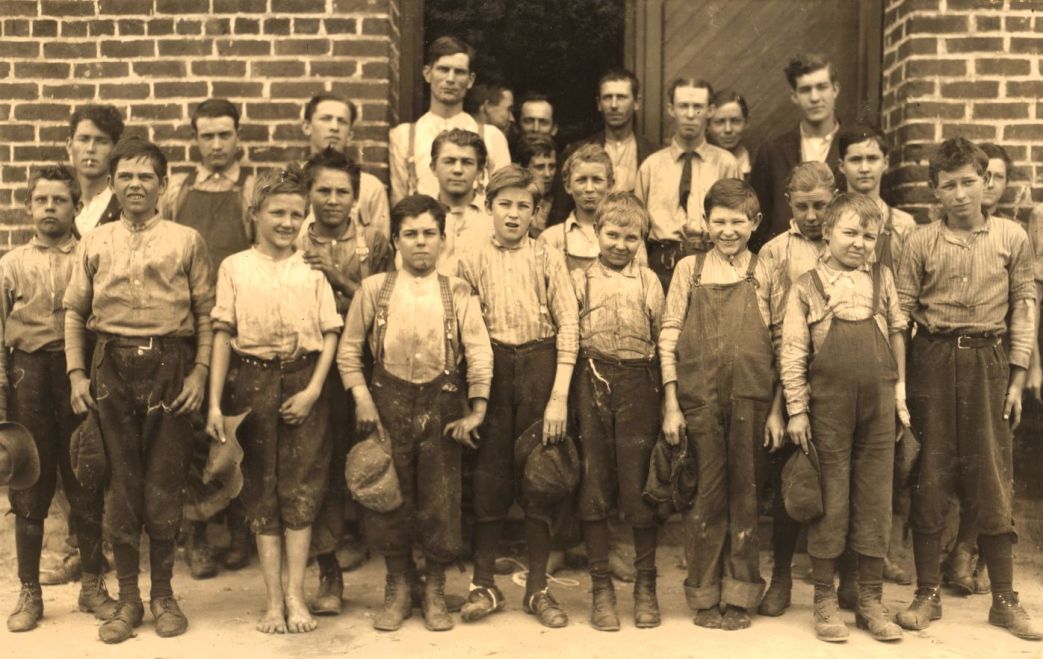
Alfred Hoffman, southern organizer of the American Federation of Full-Fashioned Hosiery Workers, doing the tough, dangerous work of organizing a local of the United Textile Workers in a hardscrabble North Carolina mill town.
‘Hell In Henderson: A Walk-Out in Darkest America’ by Alfred Hoffman from Labor Age. Vol. 16 No. 11. November, 1927.
THE week of August 1st of this year was memorable, and will remain a memory for a long time of the South. For, in the Harriet Cotton Mills of South Henderson, N.C., the rumblings of revolt, secret for three long years, were bubbling up and breaking through the surface, and in this week a petition was circulated asking for the reinstatement of a 122 per cent cut given in 1925. Throughout the mill this round robin circulated and gained the signature of 90 per cent of all the workers in the Harriet Mills. In the petition also was a statement that unless the demands were granted a walk-out would occur on Friday, the 5th of August. A second hand sending two boys into the Superintendent’s office caused a premature revolt, for these two boys reported seeing the petition in the waste basket of the mill official. On Thursday morning, August 4th, the walkout occurred in No. 1 mill, spreading into the other three mills in South Henderson and into the four mills in North Henderson, a subsidiary corporation of the Harriet Mills, known as the North Henderson Mills.
Eight hundred workers in South Henderson were out and within five days five hundred North Henderson workers were out in sympathy. Behind this petition is a little, tiny, brisk, gray-haired lady, old and overworked but with a tremendous spirit, who started the revolution. For it really was a revolution against some of the most horrible conditions existent in so-called Modern America–in my opinion Darkest America.
Behind this revolution is an age of history which must be told, for therein lies the secret of this situation. The Coopers, towering dominant in the little city of Henderson in Vance County, North Carolina–with two mill corporations, tobacco warehouses, cotton warehouses and gins and transfer companies and private railroad lines into their property–are the most important figures in the life of this region.
The mills were started by two brothers, the elder, D.Y. Cooper, being the leading figure back in the eighties. They built their mills and villages according to the prescribed standards of the day and carried on their work with a beautiful degree of paternalistic feudalism, knowing their workers by name and visiting them and looking after them. When the two old men died their sons, one of each, took over the mills–Sidney P. Cooper as President, and James Cooper as Secretary and Treasurer. Having neither the rugged pioneer spirit nor the intelligence of their ancestors, trouble began to brew.
During the war wages were high in the mills and conditions good. In the latter part of 1923 a cut of 5 per cent was made, taking off a bonus. In the early part of 1924 another cut came with a slash of 10 per cent, which meant the loss of another bonus. A little later came a cut of 122 per cent, which was a real loss in wages. With it came an 8-day strike, ended by the promise of the mill officials of a reinstatement of this cut when conditions warranted. At this time a union was organized, Local 1337 of the United Textile Workers, and from the statement of the old hands it had two hundred male members. A sorry man, as the Southerner says, sold out a complete list of union members for $300, a second-hand car, and a job as a straw-boss. This broke up the attempt at unionization and caused the discharge of several active spirits.
A Cyclone Fence
At the same time, the mill company was building a heavy wire cyclone fence around the mills, with heavy gates, and reinforcements of barbed wire on the top of the seven feet of meshed wire. Dissatisfaction caused by long hours and slave conditions rankled in these people for a long time, with the mills running full force day and night, and only the most important holidays being granted very grudgingly. This led the workers to believe that conditions were ripe for the 1212 per cent raise. Then came an edict that all mill gates were to be locked, and workers let out on at certain periods. Women going home to cook hurried meals for their sons and daughters and husbands were forced to walk as much as a quarter mile farther around mill property to get home. The camel’s back was broken.
The strikers held meetings in a great open space in a beautiful pine forest, and the Reverend Hopkins, preacher of the Sanctified Holiness Church, led these people. He preached love of the mill owners and asked the guidance of the Good Lord. He preached humility and stubbornness. Let it be said of him that he is a preacher only when he is not following the plow.
While the strikers were out in the woods praying and singing hymns, it seems that private property was in danger. The Sheriff of the County, being away, troops were needed, so the local company of State Militia was brought in, a company of infantrymen, some of whom were strikers. They camped behind the heavy wires of the cyclone fence with mounted bayonets and loaded revolvers. But they were not enough. The strikers began to mutter at sight of them, and a machine gun company was brought in from Durham.
Someone played a joke on someone, for after several days of inactivity the troops were moved. And, by the way, they were disgusted. Strikers were brought into court on ridiculous charges but the number of spectators caused the postponement of the trials twice.
While these things were going on in Henderson, 300 miles across the State in Hendersonville the North Carolina State Federation of Labor was in convention, with William Green present, and this body was resolutionizing most militantly upon a program for the organization of the unorganized in North Carolina. Thanks to Mr. Denist, the local editor of the Henderson Dispatch, nothing about the strike leaked out until the troops arrived.
A Race Across State
The story broke on the papers with a great bang on Thursday morning the 11th, and delegates leaving the State Convention were shocked into activity. Two cars raced across the State, breaking all known traffic laws to reach the scene of action. One was my car, containing G.E. Hayes, the full-fashioned delegate to the Convention, and myself, and the other was T. A. Wilson, the newly-elected President of the State Federation of Labor, a printer of Winston-Salem. With him were Ed. L. Crouch, Vice President of the State Federation, and Vice President of the Tobacco Workers, also of Winston-Salem, and Frank J. Torlay, a free lance and former Organizer of the Typos.
At seven-thirty that night the union representatives arrived and reviewed the situation. Protests were immediately sent out against the troops being stationed in Henderson, by T.A. Wilson. The next day a conference with the firm was held by local strike leaders, and the strikers’ demands were turned down, and that time also saw the union representatives start their fearful machinations. On Monday another conference was held with the firm which resulted in nothing. And the union representatives assumed full control.
Relief work was immediately started throughout the State, and Durham and Raleigh were shaken up. Appeals went out all over and in Durham special meetings of several unions were held just to vote funds for the strike. Immediately thereafter, Reverend Hopkins, worn out by his work, stepped out, and I stepped into the lead together with eight local men chosen prior to my arrival as a strike committee. Mr. Dunnigan of the Federal Board of Mediation came in, but left after several days without gaining results. All throughout this time the Coopers remained obdurate in their refusal to grant the demands. Three mass meetings were held daily two in South Henderson and one in North Henderson. Toward the end of the third week the North Henderson workers became discouraged in their sympathetic efforts and gradually drifted back to work, while in South Henderson about 25 scabs were floating in and out.
Detectives were in town a while but disappeared, and soon dynamite explosions took place which have never been traced. Naturally they were blamed upon the strikers. At any rate, although none of the strikers seem to have been connected with them, the mills shut down like a veritable tomb. Explosions continued from time to time, and it soon developed that some of them were plants.
Special guards were put around the mills and the village and watch lights were put up, but no arrests followed. One night a committee of three was chosen to call upon the scabs working. But, as the village was dark, streets full of nails and broken glass, and mud puddles numerous, friends of the committee numbering 250 felt that they should go along and see that the boys did not get lost. So 250 men in double file, not even whispering or muttering, marched through the village at midnight, and the calling committee of three went upon porches of the scabs and talked to them. The mills remained shut down.
Relief came in sufficiently to support the strikers, from private citizens, farmers, businessmen, and the unions.
The American Federation of Full Fashioned Hosiery Workers not only sent in the most but loaned the services of an organizer for over two months. The farmers would send in a thousand heads of cabbage, or tons of green stuff, and in return the strikers went to the farms and voluntarily helped harvest tobacco. Home cured meats and preserves came in from farmers’ wives, and loads of flour from flour mills. A relief store was opened and rations given once a week, that is hard supplies, while green stuff was given out three times a week. A strike headquarters was opened in an old grocery store and scores of mill girls spent days at work in the building.
Not for years have farmers been so in sympathy with industrial workers as the farmers of the section were with the strikers. Their spokesman, J.T. Fleming, of Middleburg, spoke at strike meetings. He is an old unionist of 17 years standing. He promised relief and we certainly got it. Later on, we will tell of the aftermath of the farmers’ activities.
During the process of organization, carpenters, storekeepers, painters, electricians, truck drivers and ice wagon drivers flocked to get into the Textile Union. An avalanche movement seemed to be carrying the section. For six weeks the strike remained a first-page story in State papers, and of them all Josephus Daniels’ Raleigh News and Observer was the fairest and most militant in denouncing the rotten conditions in the South Henderson Mills. The Greensboro Daily News also assumed a partially fair attitude, trying to do its best to remain neutral.
Interesting bits along with the strike should be enumerated. A Mill superintendent in a nearby city donated $5 weekly to the strikers. The local Railroad Brotherhood men donated. One crossing watchman gave $5 per week to the strikers.
Men prominent through their work in the strike should be cited. J.L. Clarke, a South Henderson barber, served on the strike committee and worked tremendously. W.H. Johnson, a South Henderson grocer, donated his trucks for all the strikers’ uses, brought in enormous quantities of vegetables, gave unlimited credit to the strikers, and to finish things off gave a Brunswick Stew. This, for explanation, is a combination stew of all kinds of meats and vegetables, and is cooked out of doors over red coals for a very long time. Johnson donated all the vegetables and fuel for a Stew, which filled 10 enormous pots and contained 175 gallons, feeding 1,200 people. Lace McDade, a second hand in the mills, was strike chairman and has never gone back to work. Some of the other committee men went back in disgrace and are now ostracized. G.E. Hayes, a full fashioned knitter blacklisted in this district, and a former Durham hosiery striker, donated his services for seven weeks, handling the detail work connected with running the strike, and is still active in organization work here.
The Sell Out
Just before Labor Day I left for Philadelphia to attend the National Convention of the Hosiery Workers and to get more funds. While I was away three local committeemen sold out, the mill made a compromise offer and the strike was broken. The mill offered the workers a profit-sharing scheme, free books for the children, free shoes for the needy, free back rent to some groups, investigation of all bosses, repairing of the houses, cleaning of the wells, repairing of streets, unlocking of the mill gates, and several more concessions on conditions, but no talk of wages. Then, at a mass meeting of 600 workers, the first three committeemen sent the workers back by vilifying the union, stating that no money was on hand, that I was not coming back, that they would not beg for the strikers, and that the union had sent in no money but that union relief talk was just a frame-up to get them into it, etc. When the loyal committeemen got up to speak the crowd was too excited listen and their pleas for solidarity died in the noise of a milling crowd and excited buzzing. The damage had been done. One by one the workers floated back and upon my return 150 loyal workers remained out, to get my word to go back to work.
There are little sensational bits in this strike which must be told, for behind this bare outline of facts is a wealth of color, feeling, and suffering. And after all, the human side is our side. The mill village should be taken up, then hours and conditions, the people, their psychology and their reactions, and then what today is the most important result.
One’s introduction to the South Henderson mill village is a rutty, dusty road, and on the left a miserable barn-like store, with windows broken–a bankrupt store, and as fit companion a row of unpainted, weather-beaten, decaying houses. Further on a burnt down mill, and then, lo and behold, the long line of factory buildings. Red brick with a seven-foot meshed wire fence, steel poles, and barbed wire entanglements on top. Little watchmen’s houses at each gate, that with big searchlights on the mill towers gives it its name “the penitentiary.” On the left are a row of dirty brown houses in various stages of decay, and in their midst a little gray Methodist church. Then comes the “hill,” with its red mud road and straggling forlorn shanties. On the other side is the little gray Baptist Church, and below it the toughest section in North Carolina-Moccasin Bottom and Black Snake Hollow, rendezvous of bootleggers, gamblers, and so-called disreputables. But to me, folks, it meant a heaven, for there dwelled the staunchest, toughest, roughest, fightingest bunch of union men, women, and children in captivity.
Right here I wish to contradict Paul Blanshard’s statement in the New Republic, in his article on “Slaves of the Spindle.” In Moccasin Bottom dwelt, as I have already stated, the most loyal unionists, and I might say the most independent and well fed, for many of them were selling liquor. And although Mr. Blanshard states that in Southern mill villages bootlegging is not a paying profession, in those Carolina towns, it is, especially in Henderson.
The houses in Henderson, for they can’t be called homes, average from three to five rooms, with rent charged at the rate of 25 cents per room per week. None of the homes have a bath, running water, or sewage lines. Behind each row of houses stands a line of privies, and here and there is an open well or spigot from which water is carried. The water is dirty; it need not be tested to see that, for a glassful contains many interesting things, and as the story goes, one of them contained a dead cat. What the other might contain would surprise us. Women have to tote water from 10 yards to a block and sometimes several blocks. Now I have mentioned the privies–a geologist might, in conjunction with a health officer, find a mighty interesting study of drainage.
The insides of the homes are worse than the outside–built of thin boards, without paper, some without paint, thin floors through which one can feel the wind sweeping under the shanties set up on pillars–and without basements. Screens are seen as rarely as Packards in the village, and the furniture is that of bare necessity. A bed and a table, possibly a stove, and boxes to sit on make comfort–such homes were actually seen.
The streets, until the strike, were winding little rutted things much like cowpaths in Wisconsin, but less smooth, and other roads were veritable sumps of mud. Until the strike there had been no work done on the roads for years, but due to the fact that labor representatives had cars the roads were fixed. One day during the early part of the strike a gallon of roofing tacks was found strewn over the main road in the village. In fact, the strike leader had 15 punctures in 8 days, driving to mass meetings over village streets.
They Call These “Wages”
Wages in the village are ridiculous; for 55 hours work in the day time one finds an average of $5 and $6 for women and $10 for men. For full time days, Lucy Roberson drew $5.20 per week. Sterling Wagner, a man, drew $7.40 but after a deduction of $2.50 for rent he had $4.90 left. Irene Pounds for full-time made $3.65, with a $1.25 deduction for rent she drew the munificent wage of $2.40 per week. Ella Parker made $6.60, had $1 deducted for rent and drew $5.60, while Lizzie Johnson working 60 hours at night earned $7.60. These pay slips are in the hands of the editor of LABOR AGE. They are not hand-picked, but are the remains of a bundle of 4,000 slips we had. Some ran as low as 75 cents for women and as low as $6 for men after deductions were made.
The mill sells coal and wood to the employees at $1 per bushel for either. In other words, mine run coal worth $3 to $5 per ton on the car, is sold to the workers for $1 per bushel. Wood of the cheapest kind, outside pine trimmings and packing box boards, sell for the same price. Not satisfied with giving them starvation wages the mill tries to make enormous profits on commodities sold the workers.

The workers themselves are native-born, Anglo-Saxon whites, 100 per cent Americans, voters, and many of them good Klansmen. They have come in from the rural portions of Virginia, North Carolina and South Carolina and were lured in by big wages during the war, about $12 to $14 per week for women and about $20 to $24 for men. Settling in this section, wages got lower and lower. They couldn’t leave and are now practically slaves because of their poverty or their debts. Many of the workers are very religious and some of them most Bostonianly so, while others of the workers are liquor drinkers and sports–that is, to the extent of their earnings, which would allow penny ante poker. Liquor in Henderson can be purchased at low rates, $2.50 a half gallon or $3.50 a gallon. This is first class kerosene, and the makers thereof, in meeting competition, boast as to the freshness and still warmth of their wares. Do not allow me to say that all of the Hendersonians are bootleggers, for they are not.
Dipping Snuff
The popular sport in the village for women is dipping snuff. For the benefit of the more benighted northern brethren, let me say that in the South there is a soft wood tree known as the toothbrush tree, whose twigs when chewed spread out like a brush; this brush is dipped into snuff and rubbed on the gums—i.e., dipping snuff. The men, besides drinking liquor, do nothing much except work 11 to 12 hours per day, and do a little hunting.
Prayer meetings on some Mondays and Wednesdays and church on Sundays, with a religious revival occasionally. _ There is no park or playground in the village. There 1s no recreation center or meeting place, except church and the new union headquarters, to have a good time, and their pleasures are small.
One sees attractive women sloppy and dirty and careless from the continual grind of drudgery and work. Men loaf about in dirty mill clothes from lack of ambition, after 11 hours of being part of a machine, to change clothes. Women wear cheap cotton slips and gingham house dresses, and sun bonnets. Men cannot afford anything sporty. Children run around without underclothing, shoes or stockings, and it is not uncommon to find women wearing nothing but a gingham dress, no shoes or stockings, just because these have to be saved for Sunday. Among the newer generation, especially the girls, one finds the ambition of marrying away from the village and the mill. Young men dream of getting away, but still girls get married at the doll age of 15 and boys at 17.
Both men and women are undernourished, stoop-shouldered, tired, and aged beyond their years. Here and there one finds the yellow face of jaundice, but most it is the yellow face of consumptive emaciation from long hours of work. Now and then one can see the overbright, or too dulled eye of a dope fiend, using either paregoric or some other queer drug to ease the bareness and misery of their lives.
A Consumptive Generation
Crowded homes, consumptive parents, lack of nourishing food—and our Babbits can shout about the “Coming Generation”—if Henderson were characteristic, a generation of consumptives, stunted robots would characterize America. Mothers come to me and say “Ah nevah had no larnin’ but me boy Johnathan are goin’ to larn readin’ and writin’, but ah wish he were old enough to work so’s he could help.” The pathetic stories of mothers feeding six in the family with their own labor alone seems melodramatic and untrue, but investigations will bear out such facts. Numerous strikers came to us and stated that they were getting more and better food out on strike than they ever got while working. And what did we give them? Their own choice—fat back salt meat, white flour, corn meal, compound lard, syrup, coffee, sugar, and salt and vegetables. That is a characteristic diet of the Southern mill worker, together with acorns, yarms, potatoes, and beans and in prosperous times a change to a little tough beef, or sausage. When beef was given out as relief, women were amazed because of the rarity, for they hadn’t tasted any for years. I think many of them are born and die without ever tasting veal, lamb or mutton.
Labor Age was a left-labor monthly magazine with origins in Socialist Review, journal of the Intercollegiate Socialist Society. Published by the Labor Publication Society from 1921-1933 aligned with the League for Industrial Democracy of left-wing trade unionists across industries. During 1929-33 the magazine was affiliated with the Conference for Progressive Labor Action (CPLA) led by A. J. Muste. James Maurer, Harry W. Laidler, and Louis Budenz were also writers. The orientation of the magazine was industrial unionism, planning, nationalization, and was illustrated with photos and cartoons. With its stress on worker education, social unionism and rank and file activism, it is one of the essential journals of the radical US labor socialist movement of its time.
PDF of full issue: https://www.marxists.org/history/usa/pubs/laborage/v16n11-nov-1927-LA.pdf

