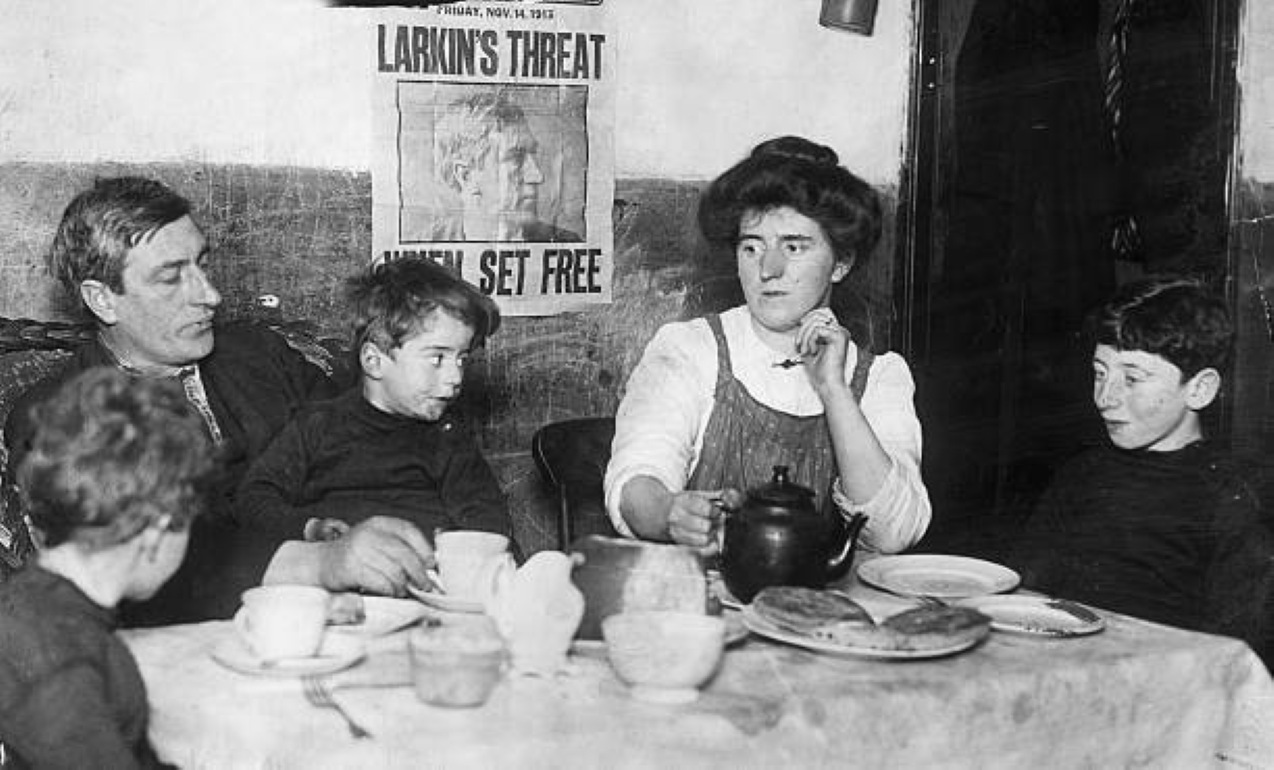
A wonderful essay by Larkin introducing REVIEW readers to the ethos of the Underman and the history of the Irish Transport and General Workers Union. James Larkin, founder of the I.T.G.W.U. and of the Irish Citizens Army, became well-known in the States for his leading role during 1913’s Dublin Lockout. Meeting during a European visit, William D. Haywood encouraged Larkin to tour the U.S. introducing him to comrades here, including ISR. Arriving in November, 1914, it would be nearly nine years, a prison term and several revolutions later that Larkin would return to Ireland. In the meantime would become a figure in the U.S. Left, closely associated with John Reed and Louise Bryant, a founder of the Communist movement, he would be imprisoned in Sing Sing for “criminal anarchy”
‘The Underman’ by Jim Larkin from International Socialist Review. Vol. 15 No. 9. March, 1915.
FROM the days of Solon down to the era of Syndicalism the wise and unwise have given speech, written learned tomes, sung in undying numbers of the Underman. Some have been more than generous enough to name him the Bottom Dog. Admitting that there has been something doglike in his slavishness, namely, his meekness under the lash of and his fidelity to and trust in the Master Class, yet, again and again, has the divine spark of discontent burst into flame and the Underman given good proof of his quality.
In every epoch of the world’s history he has given the exploiting class cause to remember his resentment. “Not for nothing” died Spartacus and his fellow worker rebels, and the age-long struggle of the Plebs proved they, too, realized within themselves what their place in the Roman polity should have been.
And so along down the weary years the monotony and degradation of their lives have been illumined by the glorious if somewhat unsuccessful attempts of the slave class to break their fetters. If they failed to achieve all they aimed at there is some satisfaction in knowing that though the shackles still bind their limbs, they have arisen from their knees and now stand erect. That position has been reached not by trusting to redeemers, leaders or intellectuals. Every advance won, every advantage gained, every measure of improvement enjoyed has been gotten by mass action.
The redeemers, so-called, have advised on all occasions respect for constituted authority. Leader after leader has used the work-weary, degraded bodies of his class as a ladder whereby he might ascend to and become one with the oppressing, dominant class of Overmen. The self-styled intellectuals have used our moans, miseries and movements as subject matter for their mental gymnastics and to their own social and economic aggrandizement. I don’t care to be unfair, but it is too true that all down the ages the redeemers and intellectuals, under the guise of altruism, ethics, brotherhood, but in reality for egotistical reasons and with malice aforethought, have deliberately obscured the vision of the Underman with their word-spinning, phrase-mongering, laws of logic, political economy, and heaven-when-you-die philosophies.
Many of these would-be saviors of mankind warned us in terrifying tones that the realization of our hopes of material and social betterment would destroy our character, our love of home, respect for our betters, “loranorder,” the constitution and unfit us for our “station in life.” The immutable laws had decreed our place in the cosmic scheme–obedience and willingness to serve, prayer, abstinence (and plenty of it) was our portion, our sole concern–individual salvation. They told us to take and pause; that our idea for a class movement, for a collective uplift, was subversive of authority and tended to disrupt society. They hesitated not to insult our intelligence by telling us that we were designed to be a necessary evil, but a useful class, our duty to slave and breed, breed and slave, to the end that a useless and unnecessary class should live in idleness and luxury on our labor.
Our leaders, with few exceptions, appointed or elected to articulate our grievances, desires and demands, have abused our confidence and their tendency to compromise with the Overman has assisted in, consciously or unconsciously, welding more firmly the shackles that sear our limbs. Right down the ages this cursed game of compromise has been to our detriment. In this day we have our leaders advocating state control of labor, arbitration boards, wages boards, conciliation schemes, health and unemployment insurance, to scientifically explain the cause of industrial unrest and why the many are poor. It is enough to make Marx and his predecessors turn over in their graves.
The workers in the industrial and economic field should get the full social value of the product of their labor and such a result can only be brought about by the obliteration of the present capitalist system and the taking over by the workers of the machinery of production and means of distribution. Thus control of the job would carry with it control of all the forces in the social organism. Such a simple solution is characterized as blasphemy, heresy, revolution.
Then we have the spectacle of the intellectuals rushing to the rescue of the leaders. These mental prostitutes, owing to their position in society, are the most dangerous of all the Undermen. Their viewpoint of the problems of life is determined, like all other sections and classes in society, by their economic status. They have always in the past, are now in the present, and, if allowed, will be in the future, the most subtle foe to the advance of the Underman. Well might the Overmen–the Carnegies, Rockefellers, Morgans and Sages–take control of the thought-forming sources of the community through subsidized foundations. Full well they know that the control of those who are privileged in training the minds of the people means an extended lease of power for them (the exploiters) over the slave class.
We cannot afford to halt to join battle with the intellectuals in their own sphere. When we assume complete control of the economic basis of society we will in that hour free all classes, and the educated intellect of the future will be free and in return for services rendered to them they will give of their best to the advancement of humanity. Our duty, therefore, is to be true and loyal to our own class, waste no time on those respectable busybodies who are always deploring and condemning our insistence on class conflict. Be not led astray by praise or prayer, press or party. The fundamental line of advance is industrial organization. All other activities are of secondary importance, and you have to remember that the Underman is the main factor in the problem. Without his labor the work of the world comes to a stop.
Unskilled Workers in Ireland.
And now may I, as one of the Undermen, recount briefly what has been accomplished by what Wolfe Tone, one of the leaders in the Irish revolutionary movement of the eighteenth century, termed “That large but respectable body, of citizens–the men of no property.” Within the last seven years in Ireland, not by political effort or under the guidance of redeemers, leaders or by the instruction and teaching of the intellectuals, but of themselves and by themselves. I do so because I believe their achievements will be of service in guiding and stimulating the great uprising of the Underman, particularly that section which is termed in derision the unskilled worker, which I venture to predict will take place throughout this continent within the year. Previous to the year 1907 in Ireland the unskilled workers of that country had time and again risen in revolt, but all their efforts proved in vain because of their method of organization. They, like the unskilled workers of this country, had been bossed by leaders who used them as a means to gain political power for themselves.
Each section, of course, docker, teamster, factory worker, builders’ laborer, shipyard laborer, farm laborer, railway worker, etc., was enrolled in separate unions. When one section went out on strike the other sections scabbed on them. They had high initiation fees, some unions charging as high as five dollars, or one pound in English money. Their officials as a rule when’ not advocating political action were always advising their members not to strike, but to petition or submit their claims to arbitration or conciliation boards and were ever active in telling their dupes of the “dignity of labor” and the identity of interest between the master class and the wage slave! One of these so-called unions set forth in the preamble to its constitution the following noble sentiments:
“The General Laborers’ Union is organized for the glory of God, the support of the king by divine right and his heirs and the royal family; loyalty to the constitution and to establish a brotherly understanding between our employers and the members of said union, etc., etc.”
Their motto: “Organized to defend, not to attack.”
It reads like a report of some of the sectional unions of this “Home of the free and land of the brave.”
The founders of the Irish Transport and General Workers’ Union, vulgar persons, determined within themselves that that kind of organized scabbery should cease, and so we started an Industrial Union for all workers, not interfering, of course, with the aristocrat of labor–the skilled worker. We knew from our experience in the struggle that when we had the unskilled workers properly organized, especially the men who matter, the transport workers, we could make the skilled workers fall in line. That opinion has been verified. Today in Ireland and in Great Britain the skilled worker realizes, aye, even the great, enlightened, humanitarian British government realizes that Kitchener and his merry men are at the mercy of the men engaged in transporting commodities.
Within seven short years these few common, vulgar coalporters, dockers, teamsters, factory hands taught the Federated Employers of Ireland who controlled industry. And it is to be remembered that we did not allow our organization to be exploited by any and every philosophical freak who wanted a platform to air his or her views about “killing God,” limitation of families, eugenics, sex license or twilight sleep. Obliterating the scab, limiting the power of the boss to rob us at the point of production, insisting upon decent homes, good grub, good clothing, a chance to live, absorbed our energies. Wherever a woman or child of our class was degraded or oppressed we rallied to her assistance. Our motto was and will be to the end of time: “An injury to one is the concern of all.”
We make no apologies to or agreement with the boss. As soon as we succeed in organizing 60 per cent of the workers in any industrial undertaking the others must join or get out. He who is not with us is against us, and although every branch of our union has full autonomy, we make it plain to them that they cannot jeopardize the whole army for the benefit of a section; that the class uplift and not the betterment of the individual is our concern. We have our own union halls, which are not used only for dues-paying purposes. Our whole life functions around our union.
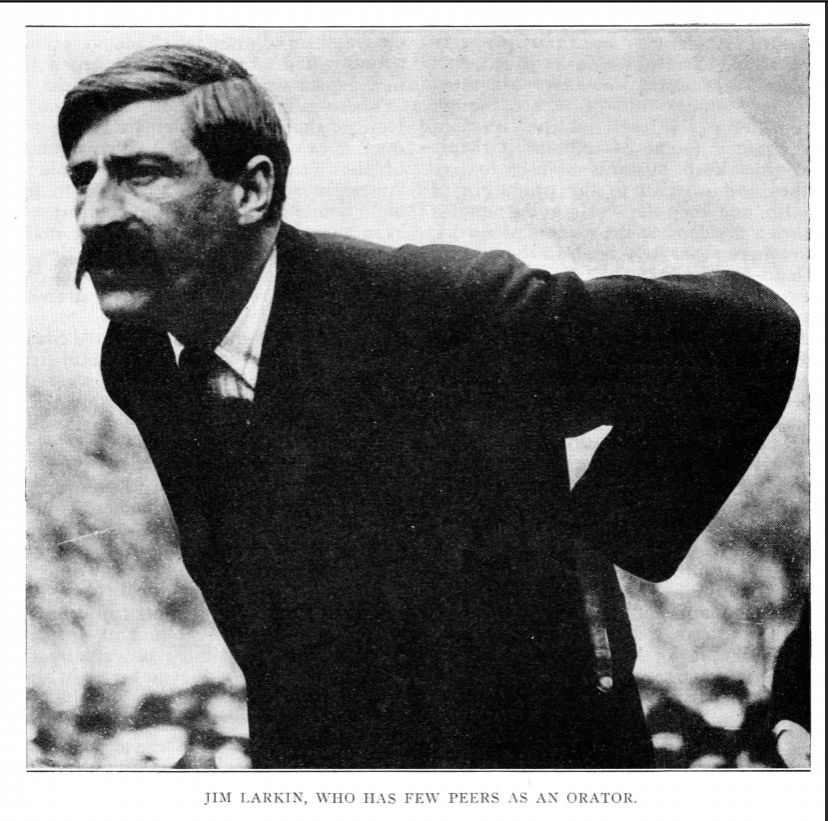
All forms of social relaxation, dancing, instrumental and vocal music, billiards, roulette; all forms of athletic effort are encouraged, boxing, swimming, etc. Educational facilities of all kinds are provided. We teach the Gaelic, French and German languages. We have our dramatic and choral societies. Our dramatic company, composed of members of the Irish Women Workers’ Union and the Transport Workers’ Union, toured Eng land last year for four months and brought back, in addition to paying all expenses, $3,500, which was used in setting up a production cooperation factory wherein members of our Women Workers’ Union who are discharged for their activity in organizing their fellow slaves are employed in making up underclothing, etc., which is sold to the union members. We are also shareholders in the Industrial Cooperation Distributing Society, from which we buy practically all our foodstuffs. Our women run a cooperative restaurant.
In Dublin, which is the headquarters of our union, we have our own park of sixteen acres whereon we hold sports and gatherings every weekend. We have a cooperative hotel or guest house, where our members or friends can rent for nominal charge for weekends. On Saturdays and Sundays we foregather there. We have three and a half acres of gardens. Any member on application will be allotted a portion of the garden that he or she may learn something under skilled tuition of the beauty and bounty of mother earth. We make a special feature of looking to the benefit of our kiddies. We have swing boats, hobby horses and sand gardens. We have hammocks swung from the trees so that the tired mother slave may hand over her baby to the volunteer girl nurses, who will look after baby while the mother can go and trip the “light fantastic” with her husband. We have tents for camping out, and in the summer months our army camps there every night after their work. All their drill is carried on there.
The citizen army is not confined to our own union, but is open to any union man, the conditions of membership are that each applicant engages not to join any army controlled by the government and undertakes at all cost to defend his class and to assist if needs be in establishing a cooperative commonwealth.
With all these many activities proceeding apace, we never forget our principal work to gain control of the job, keen and ever ready to take advantage of any opportunity that presents itself to demand a greater share of the results of our labor. Needless to say, the employing class does not allow us to rest. Ever and always he is on the attack. During 1913 and 1914 they made concerted attack. They locked us out for eight months. The condition they laid down was that no member of the Irish Transport Union would be permitted to work in or about Dublin city and county. Thanks to our comrades of the rank and file in Great Britain and Australia, we beat off their attack and we are now concerting our forces to resume the attack.
From this brief and hurried account you will at least appreciate the spirit of our movement. Now, if such a work can be accomplished in the most backward and oppressed country in western Europe, what might be accomplished in this great continent if the harassed wage slaves would combine, stop wasting their time in theoretical discussion and get to work. Some authorities have stated that there are some 35,000,000 wage slaves in the United States, but let us reduce that figure by 10,000,000. I suggest that with only 3,000,000 workers organized out of 25,000,000 there is something radically wrong with your present form of organization. It does not reach the people. I am including in my computation all forms of industrial organization–those in and out of the American Federation of Labor. The idea of a federation of labor in these days of the trustification of industry connotes that the leaders or controllers of the trade union machine have been rusticating in the Garden of Eden. It is full time they climbed the tree and took a bite of the apple. And when we find the prominent leaders associated with the most unscrupulous of the capitalist thugs in civic federations and other recreation institutions, it gives one pause. And I am credibly informed that what is considered the most advanced union in America, the United Mine Workers, has suffered thirteen consecutive defeats, sections of their union being practically annihilated.
The Railway Workers are organized in thirteen different unions, each of them charged with having scabbed on the other, and when one is humiliated as a worker by being compelled to listen to a gentlemen named Brandies boasting that a union spent $1,000,000 in assisting a shoe manufacturer to break a strike. When we remember the Ludlow massacre, the murder of wage slaves at Calumet, the latest manifestation of the golden rule in industry at Chrome in New Jersey, one is forced to the conclusion that the workers in this country are unworthy of their class. As the skilled workers seem too utterly selfish and unresponsive to any appeal to their class instincts, would it not be possible through the medium of the REVIEW and those papers which take the same position to make an appeal to the Underman or unskilled section of the workers to take up the responsibility of the class and set an example to the skilled worker. An attempt is being made to solidify those unions with the A. F. of L. The secretary of this movement is Mr. Ryder, 34 Park Row, New York. I would like to return to the question of the unskilled in the next issue.
The International Socialist Review (ISR) was published monthly in Chicago from 1900 until 1918 by Charles H. Kerr and critically loyal to the Socialist Party of America. It is one of the essential publications in U.S. left history. During the editorship of A.M. Simons it was largely theoretical and moderate. In 1908, Charles H. Kerr took over as editor with strong influence from Mary E Marcy. The magazine became the foremost proponent of the SP’s left wing growing to tens of thousands of subscribers. It remained revolutionary in outlook and anti-militarist during World War One. It liberally used photographs and images, with news, theory, arts and organizing in its pages. It articles, reports and essays are an invaluable record of the U.S. class struggle and the development of Marxism in the decades before the Soviet experience. It was closed down in government repression in 1918.
PDF of full issue: https://www.marxists.org/history/usa/pubs/isr/v15n09-mar-1915-ISR-riaz-ocr.pdf

