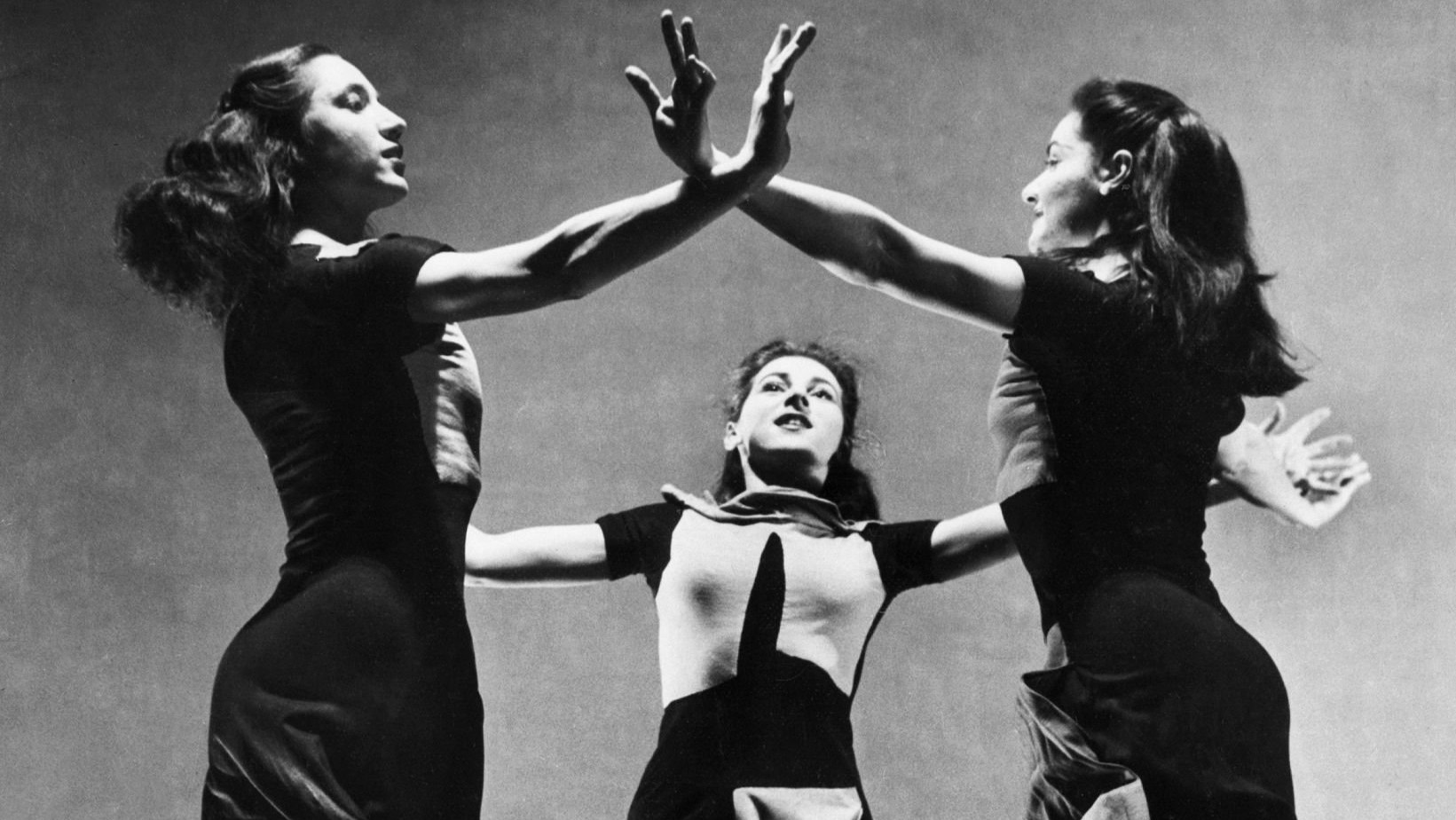
A form of collective art and expression. Here with the New Dance Group, Jane Dudley on the rehearsal and performance of the mass dance, with her ‘Strike’ as an example. As dancer, choreographer, and instructor, Dudley was a leading figure of modern dance from the early 1930s in the radical dance learning under Martha Graham until her death in 2001 at 89 shortly after retiring as director of the London School of Contemporary Dance.
‘The Mass Dance’ by Jane Dudley from New Theatre. Vol. 1 No. 11. December, 1934.
THE mass dance, or choric dance, as well as the folk dance, can be put to revolutionary uses, the extent of which has not yet been tested. Large groups of lay dancers, even at times the most superficially trained people can, by careful direction, set simple but clear patterns of group movement into a form that presents our revolutionary ideas movingly and meaningfully. The dancer learns to move communally, to express with others a simple class-conscious idea. In this way, large numbers of people can be mobilized not only to dance but to observe, and through the discussion of the theme and the problems of movement brought forward by the leader and dancers, clarity of ideology can be given. Certainly the clarification that will come with the discussion of the theme at the end of the class, plus the experience of dancing in groups of twenty or thirty people such a theme as strike or anti-war, cannot fail to educate (propagandize) the members of such a mass class. The following is an outline of procedure and specific directions for the formation and teaching of a class in mass dancing.
Themes for a mass dance should be chosen as well for importance as for timeliness, e.g., current events, important days, historical events in the class struggle, anti- war issue, Negro rights, class war prisoners, Fascism. Care should be taken, however, that the approach to the theme is one that underlines the important issues and interprets them correctly, and that the approach to the theme is a danceable one. These classes should be called either at regular intervals, or during important events (such as the textile strike, San Francisco general strike), or before or on important days, i.e., May First, etc.
Twenty or thirty people are essential for this class, and as many as fifty can be used if space permits and the leader is skillful. Laymen interested in dancing can participate, and members for the class can be drawn from all groups, since no one technic is necessary. For accompaniment, such instruments as drums, cymbals, piano, gongs, even voice, chants, songs, are valuable, and should be used in order to provide rhythm, and so keep the unity of movement, and to help build intensity.
Finally there should be a chairman to lead discussion before class begins, and after class when questions are asked, and an actual dance leader for the class who can direct large groups of people, who understands the nature of a mass class, and who understands the theme as a revolutionary dance leader. A committee should be formed to decide on the theme and leader. The committee’s responsibility would be to see that the leader thoroughly understands the theme. The committee can also handle the organizing of the class, the sending out of notices, selecting the studio, etc.
Before the class begins, discuss the theme decided upon. If an event, describe it, and interpret it. If a day, give history of day, its significance, etc.
In order to give the members of the class an understanding of what it means to move together as a group, a few simple exercises should be given, such as standing together and swaying from side to side, walking together backwards and forwards, sinking down and rising up. These are exercises purely on a movement basis. It is possible to color the exercise by adding meaning to the movement, e.g., the group should go towards a point as though asking for something, demanding something. What must be remembered is the goal–achieving a group sense in the class. The group is not a collection of solo dancers; the unity of every one’s movement should be worked for.
After these exercises, the leader begins on the theme. In the directing of this theme, several facts should be kept in mind. Choose movements that are simple, not limited to one technic, and movements which a dancer, no matter what her training, can do. Choose movements, the sequence of which must be suitable to group dancing. Remember that the more members in a group the more unwieldy it becomes, and the slower must be the changes in direction. For this reason, the simple, fundamental steps–the walk, the run–are the most useful and effective. Think of the possibilities in the walk marching, creeping, hesitating, rushing forward, being thrown back, the group splitting apart, scattered in all directions, uniting, coming forward, backing away, being thrown down, rising up. For this one does not need “steps,” bas de basque, tour jete, etc. All that is important is the movement of the group in space. Keep in mind the technical level of the group. More difficult parts can be given to the better trained members.
THE leader tells the group or groups how it begins, what the movement is, where the movement is directed, how many times the movement is done. She gives them a phrase, as much as they can easily remember. If the first phrase of movement has been correctly danced, the leader can go on to the next phrase or section. In this way piece by piece the dance is built up.
The process of building the entire dance may have taken an hour. Parts will have been repeated: it will have been danced through up to the place where a new part is to be added. By the end of the period, the dance should be done. It can be danced through three or four times by the group. It need not take more than three minutes to perform. It will of necessity be simple. It must be moving, especially to the participants. It must have significance. It is the leader’s duty to emphasize this significance to them, explain it to them. Her description of the theme, of the movements, must be vivid, must mobilize the members in such a way that they throw themselves into the dancing of the theme.
As an example I will try to describe a mass dance suitable for a group consisting, of any number of people. The theme is Strike. It is the conflict between pickets who call to the workers within the factory to put down their tools and come out on strike, and the militia which stands as a wall between the pickets and the workers. For the theme three groups are needed, the pickets, the militia, the workers. It is the leader’s first job to divide the large group she has into three smaller groups, and to tell each of the three which part it takes. She explains how the dance starts. The rear of the floor space is for the workers. She puts them in a formation in groups of three or four depending upon their number. To all of them she gives the same rhythmic work movement, a large swing perhaps so that it can be seen. She tries the movement out with them; sees if they can do it all together, exactly at the same time.
In front of the workers she places the militia. In this group no more are necessary than it takes to form a line across the width of the space, the members placed at least a step apart. They are facing the audience, on guard. The dance starts. The workers begin their movement. The militia stand on guard throughout the first section. After the rhythm of their movement has been established, a picket enters. He crosses the space–recrosses it; another picket enters; pickets come singly, in pairs, four at a time. It is a chaos of people passing back and forth in front of the militia. Slowly this chaos resolves itself into a unified group which turns, faces the workers, leans forward. With raised arms they call the workers out. The workers stop, turn. The militia shoulder their guns.
This is the first section of the dance. Those who are the pickets must enact the sequence of their entrances. The first section is a continuous crescendo climaxing in three sharp accents. One: the pickets turn to the workers with raised arms. Two: Workers stop. Three: Militia shoulder arms.
The first action should now be danced through two or three times so that the group grows more familiar with the sequence of movement. When this is done the leader outlines the next part–the conflict between pickets and militia. The militia on this part stand as a wall between the pickets and the workers. They do not move from their place until the end. The quality of their movement is brutal, explosive as the shot of a gun, sharp as the edge of a bayonet. In these qualities lies the approach to movement for the militia. If one merely copies (pantomimes) the action of shooting, brutality is lacking. But, by using the actual gesture of shooting only as a basis, and the qualities spoken of above as the means of amplification one adds the emotional impact. The quality of the movement of the pickets in contrast is dynamic, the crescendo and decrescendo of swaying forward, being thrust back.
The first section ends with the militia shouldering their guns. The arms of each picket, which had been raised to call the workers, sinks and the pickets slowly back away from the guards. But this withdrawal is a preparation. The whole group of pickets surges forward. The militia strikes down. The group is thrust back unevenly. The group attacks again, but this time in sections. And in sections it retreats, preparing to strike again. One side charges forward on the diagonal to the center and is forced back on the diagonal to the other side. The center of the group rushes forward. Its front ranks are mowed down by the stroke of the militia, like tall grass under the stroke of a scythe. The whole group is now massed on one side.
DURING this there has been no movement on the part of the workers. Now from the group of pickets one breaks away, runs towards the workers. They lean towards him. The militia raise their arms, but as the picket backs away another from the group runs forward. This time the workers move to the side where the picket stands.
Now from the group of pickets single members break away, run towards the workers; they are thrown back by the militia and one is thrown down. Again the two forces face each other as at the beginning. Meanwhile the workers have shifted their group from the side to the center. As the pickets one after the other call them out, the workers, a few at a time, will shift positions into the center in back of the militia. The tension within the group of workers grows. As the pickets prepare to attack, the workers raise their arms to break through the militia. As the pickets move towards the militia the workers, their group wedge shaped, lunge forward. The line of the militia splits in the center. Through the opening surge the workers to join the pickets. From the center the workers and pickets together press the militia back to each side. Here the dance ends.
The New Theatre continued Workers Theater. Workers Theater began in New York City in 1931 as the publication of The Workers Laboratory Theater collective, an agitprop group associated with Workers International Relief, becoming the League of Workers Theaters, section of the International Union of Revolutionary Theater of the Comintern. The rough production values of the first years were replaced by a color magazine as it became primarily associated with the New Theater. It contains a wealth of left cultural history and ideas. Published roughly monthly were Workers Theater from April 1931-July/Aug 1933, New Theater from Sept/Oct 1933-November 1937, New Theater and Film from April and March of 1937, (only two issues).
PDF of full issue: https://www.marxists.org/history/usa/pubs/workers-theatre/v1n11-[p9-10-mfilm]-dec-1934-New-Theatre.pdf

