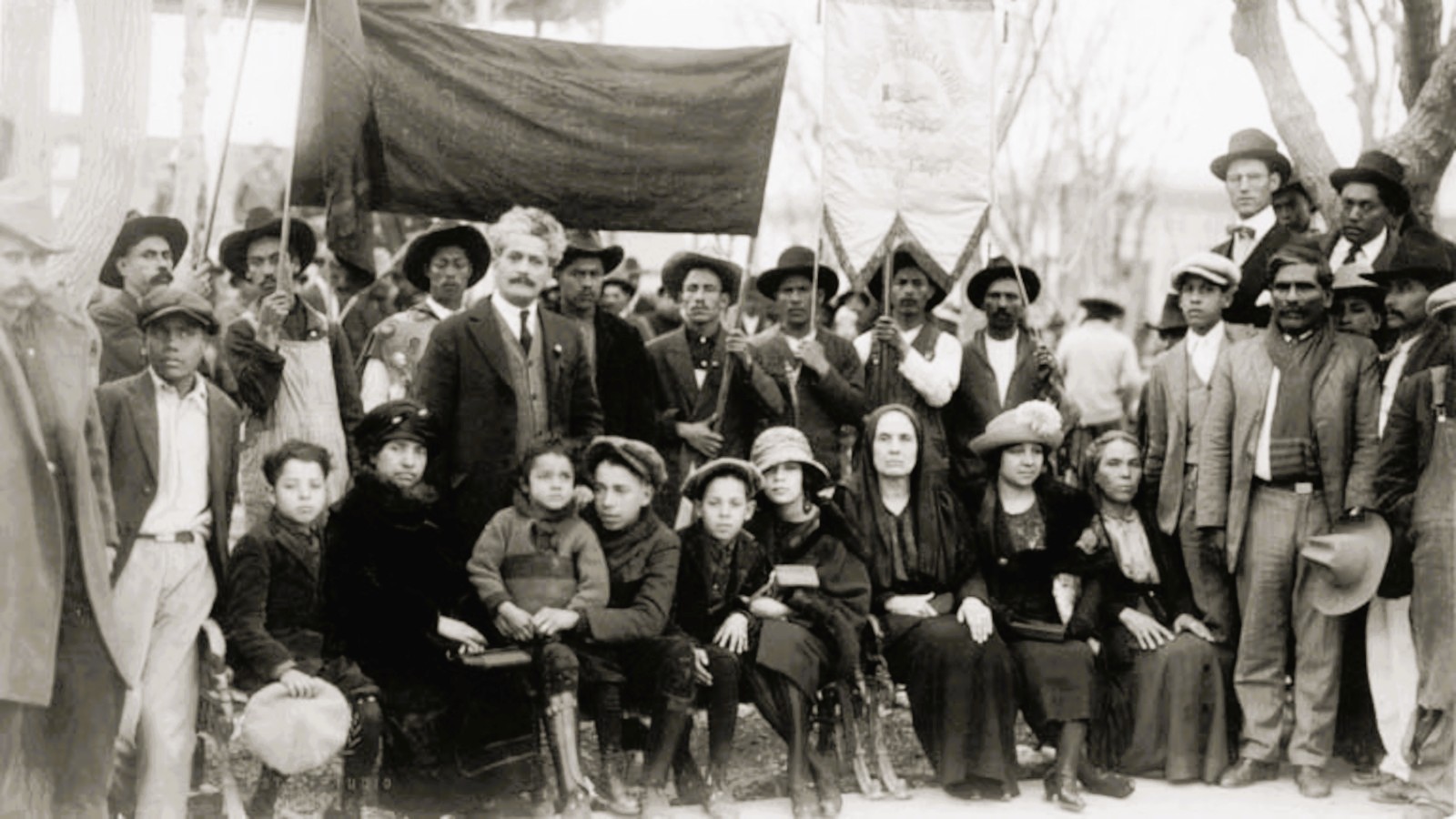
The younger brother of Ricardo Flores Magon writes on the turmoil surrounding de la Huerta’s 1923 rebellion against Obregon’s government.
‘Mexican Workers Taking their Freedom’ by Enrique Flores Magon from Industrial Worker. Vol. 5 No. 83. December 22, 1923.
Oil Interests Start War–Land Is Torn With Strife–Peons Fighting For Land
(Special to the Industrial Worker.) The Tampico strike is still going on. It has become a complete tie-up. Even water is scarce now in the city, for the pumps cannot work since there is not electric power to move them. The striking electricians put out of commission the plants’ boilers, and fixed up several short-circuits in the power lines, besides heavily picketing both main plants, those from Tamaulipas Street and the Andonegui Hills.
Authority set the city clocks one hour ahead, to save light; other measures of the kind have been taken. All to no avail. Commerce is crumbling. Many merchants are closing up their stores on account of the crisis created by the strike. The situation is growing graver for the bourgeoisie each passing day, and there is the fear, on the part of capitalism, of something going to happen if things keep on the way they are now going.
And the leech, Mr. Leach, stubbornly refuses to honor the workers’ demands. Authority has stepped in and called a delegation of the strikers and Mr. Leach to a conference, but this gentleman did not want to attend and did not go at the call of Madam Authority.
So the other fat leeches of the port, fearing to grow slim if the workers do not come back to have their blood sucked, have turned against Leach and raised such a howl, demanding the 33rd article applied to the fellow, that Obregon had to assent and order the expulsion from Mexican soil of the said Leach. This leech kicked and bucked, sat on his chair and said he would not move. And then Obregon ordered his men at Tampico to allow Leach but ten days to pack up and move on, and if he does not go they are to take him by force at the end of the ten days and throw him off Mexico by giving him a swift kick in the backyard; you know.
In nearly every state of this Mexican region, and mainly in Puebla, Tlaxcala, Veracruz, Morelos and others, where Emiliano Zapata, the agrarian revolutionist, operated until Carranza succeeded in having him murdered in the most treacherous and cowardly way, the peasants took possession of the land by way of direct action. Afterwards Obregon, to appease them, promulgated his Agrarian laws through which, in reality, he sanctioned nothing but was what then an accomplished deed; thus the peasants went back to their huts and to the plow. And many an Hacienda–very large ranch–was wholly taken by the peasants.
This state of affairs is far from pleasing to the land-sharks, who sigh for those “beautiful” days when they could go horse- back riding for several days and call their own all the land they were going through; when they could take away from their peons the wives, sisters or daughters, at their will, and even order killed by the acordada–the rural police–the man who would dare to resent such “honor” bestowed on the women of his family. Those were beautiful “feudal” times for the lord.
But now that the peons have rebelled and even call their own their former Master’s land…by gosh! Things are awful and need some fixing. And the land-sharks have hired and armed lots of hooligans and good-for-nothing scissor bills, and pushed them, in Veracruz now, against the peasants. And the other hooligans, called “rangers” up there in the states, accordada and rurales in this country, as well as the municipal-county authorities, have taken the side of the land-sharks, and bloody encounters have followed between the peasants and the two-footed dogs–with apologies to the genuine four-footed dogs.
During the battles that our peasant brothers have had with the human curs, several of the general secretaries of peasants’ syndicates have been killed or wounded. Of late I cannot gather any other news about these affairs because for two days this city’s communications with Veracruz have been cut off by Adolfo de la Huerta’s men–the soldiery from the State of Veracruz–revolting against Obregon, trying to set Huerta in the presidential chair, Huerta believes General Calles, in the coming elections. In different places of the State of Durango and Coahuila, the peasants have been taking possession of the land. They simply organize themselves, march to the place they pick open the bowels of Mother Earth with their plows, and watch for the seed to grow and for the enemy to come and try to chase them away.
Naturally, the landlords are angry, and naturally, too, mayors, acordadas and their like, have come to the side of the sharks and against the peasants. What may happen? It all depends in one all-important fact: Have the toilers guns in their possession?
If they have any, warm, real warm, will be the reception they will accord to the sharks and their myrmidons.
Peasants love the land, and for the possession of it they gladly render up their very lives. This is why Mexico never will be at peace while the land question has not been solved, And agrarian laws, as all stupid human laws, never will solve the problem.
Ambition, greed, personal gain, lust for power, ill passions, are rocking the Mexican political world. Brothers are being hurled against brothers in the midst of the rakish political ambitions. With the approach of the presidential elections, all of the candidates are promising to make the real social revolution if defeated at the ballot-box, so as to rally under their respective colors the strength of labor. They are even distributing guns and ammunition.
In several places, as in the states of Jalisco, San Luis Potosi and, of late, Veracruz, several political fakirs have gone already on the warpath, taking parts of the army and other public forces and hurling them against the others.
So far, the workers have shown good judgment and have kept aloof. Many have taken the weapons offered to them, and kept them for better use in the future, “when our own time comes,” they say, meaning to let the politicians and their herds decimate themselves in their political strife, and when they are weak and bled to death, then to jump into the fray and finish them all and the capitalist system, and to implant Libertarian Communism, without Gods nor Masters.
The Industrial Union Bulletin, and the Industrial Worker were newspapers published by the Industrial Workers of the World (IWW) from 1907 until 1913. First printed in Joliet, Illinois, IUB incorporated The Voice of Labor, the newspaper of the American Labor Union which had joined the IWW, and another IWW affiliate, International Metal Worker.The Trautmann-DeLeon faction issued its weekly from March 1907. Soon after, De Leon would be expelled and Trautmann would continue IUB until March 1909. It was edited by A. S. Edwards. 1909, production moved to Spokane, Washington and became The Industrial Worker, “the voice of revolutionary industrial unionism.” A victim of finances and internal disputes, the IW ceased publication in 1913, only to be revived in 1916 and surviving as a weekly, sometimes more, until 1931. Easily among the most important working class newspapers in U.S. history and an essential resource on the wobbly, and larger radical labor experience
PDF of full issue: https://washingtondigitalnewspapers.org/?a=d&d=IWW19231222

