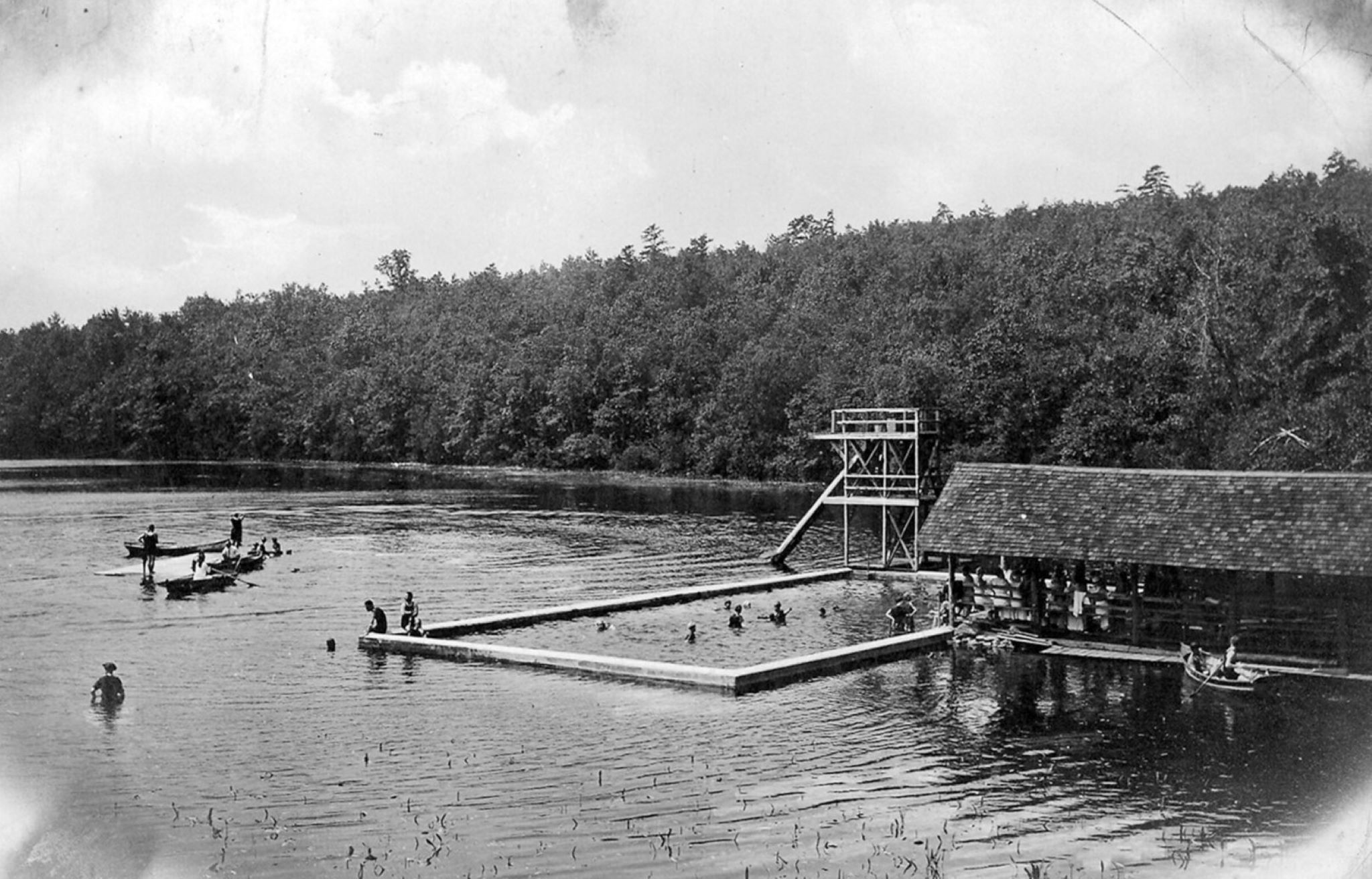
Fannia M. Cohn, a pioneer in labor education, sings the praises of the Unity House on its second full year of operation. The I.L.G.W.U. had one of the most robust and successful cultures of social unionism and in 1920 Local 25 purchased a former resort in Pennsylvania’s Blue Ridge Mountains, a three-hour train run from Manhattan, to create Unity House, a retreat and educational center for its members that would become a central institution of the union.
‘Happy Days at Unity’ by Fannia M. Cohn from Justice (I.L.G.W.U.). Vol. 3 No. 27. July 1, 1921.
Friday evening, June 17, a long train of cars on the Lackawanna left for Stroudsburg. Two coaches especially attracted the attention of passengers. Happy voices and laughter came through the open windows. “Who are these jolly folks?” “Who under the sun are they?” “My! They certainly seem to be having a good time!”
The conductor was put to it to answer the many similar questions that were asked.
High spirited? No wonder. Were not they all on their way to the Unity Home of the Joint Board of the Dress and Waistmakers? Weren’t they all on their way to attend the opening celebration at Forest Park?
Happy as they were, many of the passengers had never seen the Unity House before, in spite of the fact that the party looked like a convention of our International. There were representatives of almost every Local Union of our organization from the City of New York, and it was pleasant to hear those who had already seen the Unity Village try to describe to the others its beauty and grandeur.
When upon arrival at Stroudsburg we had left the train and had entered the bus, I found a young woman sitting next to me. She was a member of the Union, visiting Unity House for the first time. She kept craning her neck and looking out.
“Where is it?” she asked me. “Where is what?”
“Why, the Unity House.”
I pointed to the expanse ahead of us.
“Here it ” I said, not trying to conceal my pride.
“O, is this it?” She pointed to the smallest cottage. “What are the other buildings?”
I smiled.
“The entire estate, my dear, is the Unity House.”
“Please don’t fool me,” she said. There were almost tears in her eyes. “I’m really serious. I mean our Unity House.”
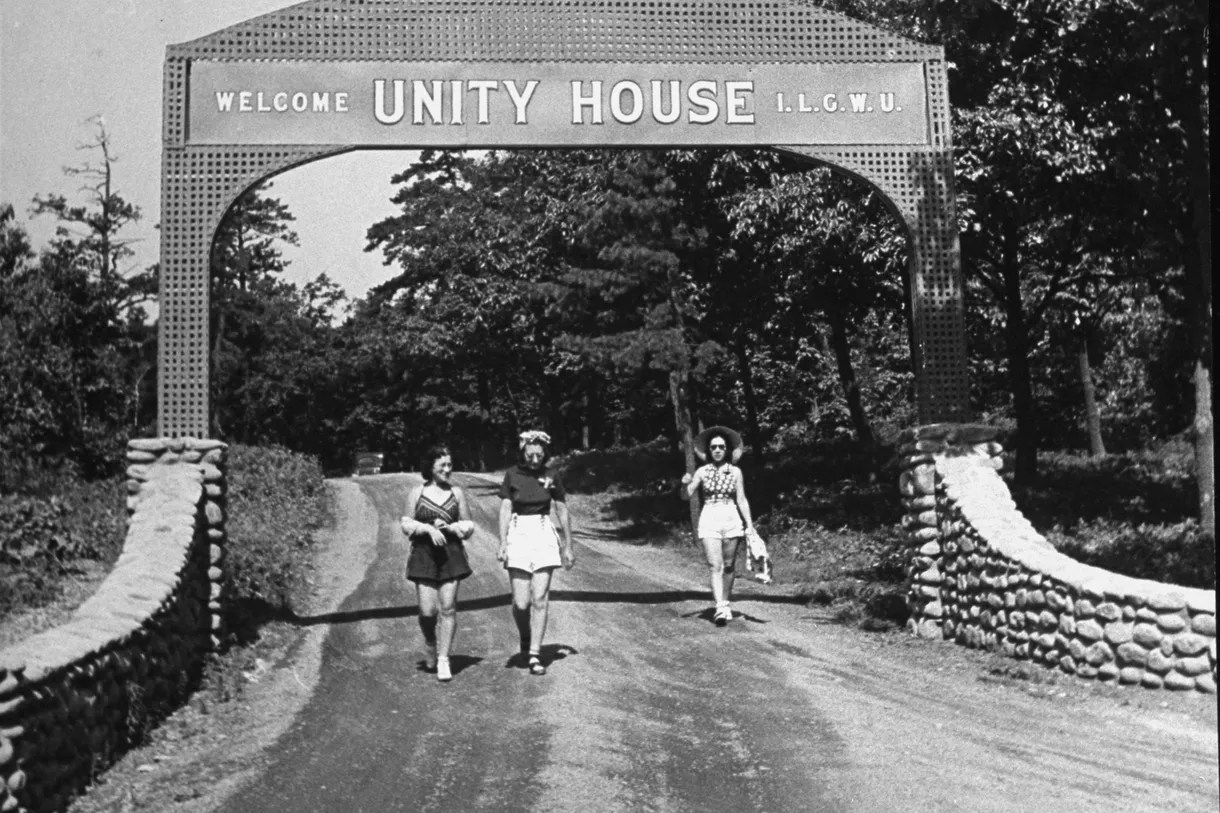
And I had no easy time of it convincing her that everything she saw, as far as her eye could reach, forest, lake, tillage, buildings, 750 acres of land, was all, all, the Unity House, and that she was one of its owners!
Finally the bus brought us to our destination. In the twinkling of an eye we were Impressed, and profoundly, that here was an undertaking unique and of far reaching significance in the labor movement. For the Unity House is a labor enterprise. It is a protest, and a brave one, against the economic conditions which turns life into a sordid business of machine-tending a protest uttered by women who dreamt of a new life in the midst of a deadening-existence.
And, indeed, it does not take long to find oneself changed, after one has reached the Unity House. Are you serious? Are you grave? Are you downcast? Are you toil-worn?
A new lease of life, joyous, care-free, is immediately given to you. Grownups at once realize the wistful dreams we all have at some time or other–they become happy children. The Unity House!
You see before you a mountain, set in a well-nigh impenetrable forest that stretches for miles in every direction. In the dense trees a large tract of land has been cleared, and here there rise a number of proud looking cottages, equipped with everything that civilization has prepared for the pleasure of the leisured rich, when those seek refuge on their country estates, from the welter of the working city.
To-day these proud cottages are not set in this place for the leisured rich. They are ours. They are mine. They are yours to enjoy and to do with as we see fit.
Here are ample opportunities for seclusion, or for sociability and gaiety. There you can be alone, or you can find pleasant companionship. The more one examines the thousand details of the Unity House, the more one is astonished. Here are the covered walks connecting all the cottages, so that when it rains, one can reach the most distant building untouched by the downpour. You walk a distance down the hill and there stretches before you a wonderful, mirror-like lake, luring and calling you to its cool, refreshing bosom.
Not the idle rich, the rulers of the world, are the owners of this land, this lake. It is the treasured and proud possession of the 30,000 members of the Joint Board of the Dress and Waistmakers’ Union of our International.
It is amazing, indeed, to see how quickly our members adapt themselves to their new environment; how our dressmakers, embroidery workers, cloakmakers, and other members of the International fit easily and comfortably into these surroundings.
What especially attracted me was how capably our girls manage this new commonwealth of theirs. For instance, our good sister Bessie Switzky, as chairlady of the Unity House Committee, is the manager of Unity House. She is in charge of the administration of the entire establishment. Judging from the arrangements made for the opening celebration, it is obvious that the Unity House is in good hands. Certainly it will be efficiently supervised and looked after with painstaking love and tenderness.
Our sister Rebecca Silver has, perhaps, one of the most important functions in the House–looking after the “eats.” She buys the food and sees that it is of the best quality. From evidence in the past, everyone expects the best of the best.
The newcomers are invited to inspect the grounds and buildings. In the main building, we saw the dining room, looking out upon the cool lake. Its white, snowy tablecloths, the vases of flowers on the tables, its immaculate walls, all add to the pleasure of eating good wholesome food in cool, delightful air.
From the dining room, on the way to the front of the house, we pass the parlor, with its imposing fireplace its many windows looking out on the porch, its walls hang with paintings, its floors covered with soft Turkish rugs. Opening out from the parlor is the writing room. A place to write in, indeed, love letters, friendly letters, or just plain letters. Its coxy armchairs, its long table, littered with writing material were all but hidden on that day by the many comrades who sat writing enthusiastic descriptions of Unity House. Across the lane is the library and reading room, with files of the leading papers, stacks of magazines, hundreds of books. Two hundred volumes were recently added, including the latest works, both on social and political questions as well as fiction. The reading room with its wicker chairs, pretty rugs, and oak reading table makes a most attractive picture.
The general office, the kitchen, telephone booths and post office are all in the main building. The post-mistress, Rose Harriett, is not a Washington appointee. She is a graduate of the Dress and Waistmakers’ Union.
The cottages contain the bedrooms, many of them with running hot and cold water, and all of them with fine, snow-white bedding. The bathrooms with their porcelain tubs have running water furnished by our own central water system. Many of the rooms have outside doors or French windows, so that one can step out on one’s own balcony, and enjoy contact with the beautiful outdoors while reading or meditating, face to face with the cool and restful pine groves.
O, but it is great to be carefree! Even the thermometer has little effect on the spirit of Unity House. Wet days or hot days do not disturb the joy of the vacationists. During the worst spells of heat, the lake, that delightful haven, becomes the refuge, and many make for the swimming pool. This is the part of the lake which has been walled off and lined with concrete in order to make it perfectly safe. There are some 70 bathhouses hidden among the trees on the bank. On warm days pleasure seekers alt in the small pavilions on piers extending into the lake itself. The water is covered with canoes and beats. From the strong branches of the trees hang swings, in which the more indolent keep rocking and creating their own breeze.
Those who prefer their rest in solitude, put up a hammock on their balcony, or saunter off in the woods with a book or magazine.
Recreation activities are under the supervision of a competent instructor, Miss Mollie Besson. They are delightful, and crowds come to enjoy them. As I passed, I saw our members learning to play tennis and basketball, learning to bowl and to dance. Not only a pleasant but a noble aim, to teach our members how to keep well and be happy.
In the evening the Unity Village glows with electric lights supplied by our own lighting system. The terrace is cool and shady enough during the day; in the evening it is still cooler, due to the ice-cream served in the open. And delicious ice-cream, too–how could one expect it otherwise? You see, Sarah Shapiro, our good comrade, is the doughty little manager of this department.
Since we are talking about eating, we may as well continue in the pleasant strain. After enjoying a delicious supper among so many good friends, we strolled into the concert and dance-hall. This had been a day of surprises; but we were most exceptionally and pleasantly surprised to find a program of instrumental and vocal music arranged for us.

The audience quickly assembled, relaxing in convenient chairs, facing the stage from which they could easily see the artists, as they were being introduced to us, one after the other, by our eloquent sister, Jennie Matyas.
The evenings at Unity House are especially beautiful. The twilight plays upon the lake, and the moon steals out from behind the clouds tinting everything with silver. The lake becomes a fairyland at this magic touch. A lovely scene, colored by the moonlit sky overhead, and the stretching grass underfoot massed all around and everywhere.
Members and guests trooped down to the lake. We sat down on the shore. We built a fire on the beach. Someone struck up a Rastian melody on a mandolin, and soon there came Bongs of all nations. Spontaneously, now this one and now that contributed to the general pleasure a recitation, a song. The round jolly face of Brother Baroff wreathed in its best fatherly affection upon the assembled number of youthful faces about him, and the place rang with laughter, song, and joy. The Unity spirit moved softly into the hearts of all. I heard behind me the voice of a girl:
“It is still hard to believe,” she said quietly, “that all this belongs to us. And when I think that this in ours, I feel like saying with enthusiasm:
Fellow workers! Let us all combine in a strong determination to make this enterprise a success. This will be the best proof to the world that we, the workers of the world, too, appreciate beauty, and that we can manage our own affairs without the kindly aid of private capital, and the profit that goes to private capital!”
She turned to me and grasped my hands.
“I feel so rested,” she said, “so contented and so happy.”
And it seemed to me that a thousand voices echoed her sentiments.
The weekly newspaper of the International Ladies Garment Workers Union, Justice began in 1909 would sometimes be published in Yiddish, Spanish, Italian, and English, ran until 1995. As one of the most important unions in U.S. labor history, the paper is important. But as the I.L.G.W.U. also had a large left wing membership, and sometimes leadership, with nearly all the Socialist and Communist formations represented, the newspaper, especially in its earlier years, is also an important left paper with editors often coming straight from the ranks radical organizations. Given that the union had a large female membership, and was multi-lingual and multi-racial, the paper also addressed concerns not often raised in other parts of the labor movement, particularly in the American Federation of Labor.
PDF of full issue: https://www.marxists.org/history/usa/pubs/justice/1921/v03n27-jul-01-1921-justice.pdf
 Revolution's Newsstand