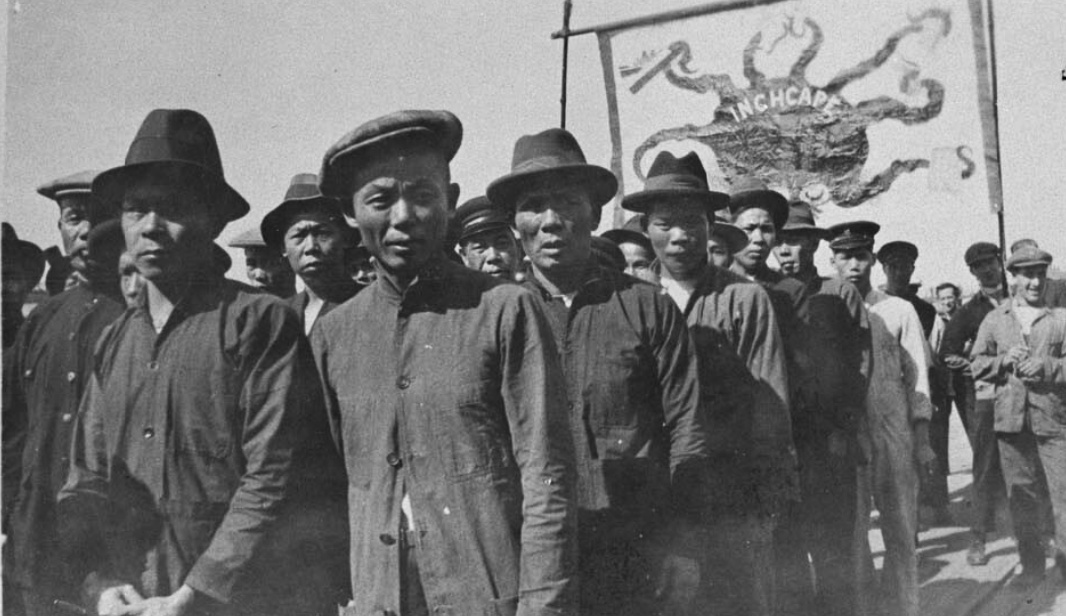
The final chapters of Barker’s fantastic work on the history, conditions, and prospects of the marine proletariat has the leading I.W.W. seaman speak to organizing power on ships and docks, as part of a larger fight for working class power, and the possibilities it could open for millions of maritime workers internationally.
‘The Story of the Sea: X-XIII. What We Could Do With Power’ by Tom Barker from Industrial Pioneer. Vol. 1 Nos 7. August, 1921.
X. Some Things That a World Organization Could Do
ONCE the war has ended there has been constant changes in the value of currency in the various countries. The central powers have felt these variations most keenly, while some of the allies have also suffered considerably. The currency of the United States has maintained the strongest position, while the neutral countries like Holland, Sweden and Argentina have been affected in a minor degree.
These alterations in the currency value in the different countries are due to several causes, including the borrowing of money on a large-scale and the swamping of markets and bourses with large amounts of paper money which have an insufficient gold backing.
This is observed if you go to change gold and paper notes in overseas ports. On the thirteenth of November 1920, an English sovereign would purchase American money to the value of $4.87 while a one pound treasury note is only worth the sum of $3.37. It is much the same in other ports outside of the British Empire.
An International Wage Scale
When a seaman signs on in a British ship he signs for so many pounds “sterling.” People are under the impression that the word sterling means gold. It is not correct, for when the man pays off in a foreign port he will be paid at the paper rate.
This matter has not interested the national unions, in fact it is doubtful whether they even know that it is going on. The least that they can do is to insist that their men should be signed on in “gold” currency. At present by the slick juggling of the exchange the shipping companies rob the marine workers of hundreds of thousands of pounds each year.
The highest wages in the marine world are paid out of the ports of North and South America. American officers get forty per cent more wages than those sailing out of European ports. The wages for seamen out of American ports are $85.00 per month Which is equivalent to about twenty-five pounds English. The British seamen work twelve hours a day and the Americans work eight. The following table shows the wages out of various countries and the amount that should be paid if the men received an international wage upon the same basis as is paid out of the United States—$85.00 a month.
Counteracting the Effect of Cheap Asiatic Labor
The creation of an International Wages Scale would compel the ship-owners to pay full wages to Chinese, Lascars and other Asiatics who work under rates. We cannot ignore these men. They have to be unionized. Wailing against their presence on ships has never done anything and never can. We can settle that vexing question by organizing them and getting them to fight for the same wages and conditions.
It will be interesting to see whether the Inchcapes and the Pirries employed these men because they love them or because they work cheaper than the whites. By forcing the power of the Marine International we are on our way to settling for all time the matter of colored labor on ships.
Hence you will see, fellow workers, the necessity for an international wage scale based on the highest wages paid out of any port. There is no reason why seamen and allied workers should be penalized on account of the changes in the currency. Any national “funeral” society that does not stand for this is better swamped. If the forthcoming conference at Brussels does not take this up then it will be their funeral. This question is merely a reform but it is a thing that will be welcomed, and it will go far towards proving to men the utility of an international.
Reduce and Standardise Hours of Labor
Some time ago the League of Nations convened a meeting of ship owners and union officials in Genoa. They were supposed to be very much concerned about the marine workers but when the question of hours came up for the seamen it was contrived that the proposal for the forty-eight hour week be defeated by one eighth of a vote. The British ship-owners wailed that it would mean bankruptcy for them and a compromise was fixed at sixty-six hours a week—which is more real work than most of these delegates have performed in a life time.
In Australian and American ships the eight hour day has already been established and for a time likewise in Denmark and Sweden but Denmark lost out after the March, 1920, strike. The League of Nations Labor Office is merely a capitalistic tool to sidetrack the workers into hoping for something. The workers of the sea are to them what the frog is to the snake. Beware of Monsieur Albert Thomas with his nice black whiskers, fellow workers.
An International Marine Organization could enforce the 44-hour week in port, and the 36-hour week in port in tropical countries, and a 48-hour week at sea, with no overtime except under extraordinary circumstances. As I have pointed out, we are not doing our duty to our fellows as long as we are working 12 hours a day while they are starving on the docks. We have to be responsible for our own unemployed. A strong organization would reduce the hours in the stoke-hole from 8 to 6, with four watches for firemen. If there are not enough firemen to work the extra shift then let the ship-owners work the additional watch.
Instead of waiting for the bellwethers to do things for us, we have to do things for ourselves. We have to counteract the new laborsaving processes, the new rates, by strong and determined world unionism. We have to wage ruthless war against the decadent and vicious class who have coined enormous fortunes out of our overwork, our hunger and our misery. We have to develop the feeling that we are out to win and that the forces of hell cannot prevail against us.
Again we have to force the right for our members to pay off in any port and to get their wages in full, that the system of logging be abolished, and that the business of signing period articles shall be abolished. All men shall be engaged solely through the union office and by rotation. Any delegate grafting or selling jobs should be expelled from the organization and blacklisted. No union dues shall be collected under the nose of the shipping agents as is the case in many countries today.
In Regard to Accommodations
Ships that are minus decent living accommodations could be held up until they are refitted. The Marine International should approach all the workers engaged in the ship-building industry and ask them to refuse to build ships unless there are separate cabins for the men as well as properly fitted mess-rooms and hot and cold water baths. Deckhouses should be built for the steersman, so that he is protected from the weather during his watch. Lifeboats should be in excellent condition, and electrically launched. Ship’s Committees to insist that only third class passengers clear a ship before the crew when she is in a dangerous position. Let the parasites save their own hides. The Committees to have the power to stop the officers from racing in foggy or iceberg frequented seas, and to reduce the speed to one that is considered safe. Put an end to enormities such as the ‘Titanic’ disaster, where the parasitical herds are saved and the firemen and seamen go down to their last grave leaving their desolate wives and hungry children to mourn the loss of their breadwinners. Our class, first, last and always.
A Marine International will give us a true appreciation of ourselves and a contempt for the idlers with their white hands and the best saloons and the best good food. We do not want seamen’s missions, nor pipes at Christmas, nor tracts at Easter. We want power, for that is the basis of everything in the future.
As to Food
The food schedules have to be drawn up again. Food must be inspected before the ship sails, and must be of the best. No margarine should be carried. There should be a refrigerator aboard every foreign-going ship. Ice or oatmeal water must always be available for the firemen. Ample fresh fruit and vegetables shall be procured at each port, and the ship should not be moved until those conditions have been carried out. As for the minimum food scale provided by politicians, we will fit a few ships especially for those type of people and send them to sea on their own schedule in order to educate them.
As to the Future
When you read this, fellow worker, don’t gasp, but get into the fight to bring it about. The things that I have mentioned, after all, are merely minor reforms, and will not make any serious hole into the banking accounts of our masters. But they are a basis of common agreement, things that we all desire, and things that we can bind the workers of the sea together on. They will help us understand each other and encourage us towards the glorious day, when the workers of the sea will be the dominant force on the ocean routes. In a few months you will see the ships of the Russian Workers’ Republics on the sea. They will be built for men to live in, not for wild animals, who are housed like dogs and worked like bullocks, such as we are today. All things are possible with an intelligent organized working class.
Let us be in such a position that we will be able to go into any port in the world carrying the same card as the docker. Let us stick together in fine or dirty weather, for a fight is the fight of everyone of us, whatever our flag, our ship, or our job.
XI. A Few Words on Fighting.
It must be plain as daylight to intelligent marine workers that the Shipping Octopus cannot be defeated by organizations as they exist today. The legislative acts of a country have no operation outside of its own boundaries. The men on deep water ships only work a small portion of their time within their home ports. No political party can claim to protect the sea workers outside their own radius of action. In addition to this, not one in five sea workers possesses a vote. Under the control of capitalism, the relative and actual position of the working class becomes steadily worse from year to year. The other class becomes richer and more powerful. These tendencies continue under Labor Governments (as in Australia) just the same as under the bourgeois political parties.
Under these conditions the marine workers have to find other means of expression than merely voting for politicians, or relying upon the limited power of their local organizations. Political power does not come from nose-counting; it comes from industry. A slave class industrially is a slave class politically. Men who cannot conquer freedom where they work can never conquer any other kind of freedom. That has been demonstrated in nearly every country, since the termination of the war.
The scientific fighting organization upon which the future depends has to rise from the workers, and not to fall from the professional secretaries and officials. The idea of CLASS has to subordinate all other things to its own predominance. To that end, we have to regard all capitalists, reactionary college professors, politicians and other undesirables as enemies and foreigners, and all workers as our class brothers. That is to say, the Liverpool dockers and the Antwerp crane-drivers have more in common with the Chinese firemen and the Lascar seamen than they have with the Liverpool shipowners or the Belgian importers.
Capitalism is tottering. Hoary with a million crimes it staggers towards its death. Social systems like human beings have their birth, adolescence, zenith, decay and death. From the womb of the old system, comes the new. Chattel slavery grew out of tribal communism, feudalism out of chattel slavery, and capitalism out of feudalism. One class after another has climbed to the possession and control of the earth, to be overthrown in its turn by another better fitted to manage, direct and possess. The last of the classes, and the most numerous, is now preparing itself to overthrow capitalism. “It is the historic mission of the working class to do away with capitalism.” “By organizing industrially we are forming the structure of the new society within the shell of the old.” On the side of the working class are all the vital social forces. Treachery, faulty organization, political opportunism, and side issues may delay the coming of the triumph of the workers, but cannot prevent it.
The working class is destined to master the world. It is the destiny that can only come from clear and decisive knowledge. It must find its origin in the growth of the ideas of control and possession of the ships and wharves on which men work. The disintegrating forces of capitalism must give way to the aggressive, masterful masses of the workers.
As to Classes
On certain days at Buckingham Palace or the White House you will see the representatives of the ruling classes of the different countries meet despite their varying religions, colors and languages, on terms of equality and comradeship. They do not war, nor wrangle, nor squabble about their respective differences. They leave that to the working class; furthermore, they foster it as much as possible, for in sectionalism and nationalism lies their own safety.
And yet, in February, 1921, I sailed out of the port of Buenos Aires on the Norwegian steamer “Vela,” which had eleven nationalities aboard. All the crew, with the exception of the officers and engineers, were members of the M.T.W. in Buenos Aires. We stuck together and agreed among ourselves. Our united efforts gave us strength, for we were as unbreakable in our solidarity as our class enemies who meet in courts and castles. The Chinese in the galley, the Chilians, Spaniards, Italians, Swedes and Finns in the stokehole and the Norwegians, English, Germans, Esthonians and Russians on deck, agreed like brothers. When we had a strike in Buenos Aires–against the captain for attempting to take a crew from a notorious shanghaier–it was the Argentine dockers and carters who aided us, and together we compelled the captain to submit to the law of the organized workers enacted in the Union Hall.
Such is the method upon which the units of the Marine International must depend for their triumph. It will establish a fraternity and a brotherhood in every ship and every port, and create an impregnable buttress against exploitation. In its extension and practice it will give the marine workers the power to determine their own lives, the course of the ships on which they sail and the cargo that they shall carry.
This will leave the hell-found instruments of war rust in the railway sidings, or to be forged into implements of peace; the grey monsters that blight the bosom of the ocean will cease their vile work, and the Workers of the World, united through the far-reaching arms of the Marine Workers International, shall extend the rule of the proletariat to the uttermost places in the world.
The Barbed Wire in the Path
It is a lamentable fact that the people who know least about the requirements of the workers are the officials of their organizations. We hear the Yellow Amsterdam International, composed of the bellwether leaders of pre-war days, talking the same old platitudes, since they are now even more than fever embedded in their nationalism. The world has gone bast them, but they persist in believing that the world of labor is following them. The world of labor is not only sick of their incapacity, but of the machine that sends them, year after year, and generation after generation, to talk the same generalities in so-called International Congresses.
And yet the men in the different industries are I more than ready for something better. There are no men more capable of responding to the call for a fighting International than the men who risk their lives in every latitude. It is in their bones, it is the unspoken thought in their minds, that merely needs expressing for them to realize its vast importance.
In the past these men have sailed the seas. The National Unions have collected their initiation fees and dues and given little in return. I have seen men with five or six union cards in their possession. Ignorance and incapacity of the officials has withheld any systematic co-operation between the different unions. No effort has ever been made to educate the workers, and with the single exception of the “Australian Seamen’s Journal”, the maritime union papers are the most woeful productions that were ever consigned to a butcher’s shop for wrapping up meat.
In the former chapter I mentioned the dinner given to the ship-owners by the British Union. Compare this with the following advertisement which appeared in the columns of the London “Observer” on the 28th day of October, 1920:
They Look for You For Help
“The spectre of hunger, cold and misery is staring in the face of the widows and children of the British Merchant Seamen, there are 320 incapacitated merchant seamen, 887 widows, 1100 dependents and children on our books who lack the means of existence. Can you help them?
“Please send, a donation today to Thomas Scott, Secretary, British Merchant Seamen and their Dependents’ Fund. Tower Building, Liverpool.”
The advertisement is not only a condemnation of the swinish inhumanity and greediness of the ship-owners; it is as well a striking proof of the failure of the existing form of organization. If there are any eight course meals to come from union funds, it would surely be more just that some of the workers and their dependents above mentioned should have the honor and pleasure instead of the rich plutocrats of ocean transport. But, I forgot that it is the work of the union in question to bury its members when they are dead.
Forward! The Advance Guard!
Let us unite, fellow workers! Let us establish the New School of Unionism-Industrial Unionism, World Unionism. Let us remember that we have to rely upon ourselves, and to build for ourselves. We have not merely to conquer the ships in which we work but we have to run them as social floating machines engaged in supplying the economic wants of society.
Instead of waiting for coup d’etats, or for the bottom to fall out of capitalism, it is our duty to work for the day, and to realize what the Red Navy at Kiel realized, that there can be no success, unless there is a powerful, well-equipped organization in the field of industry. We learn by experience, and there is no field so fruitful in results, so encouraging to the enthusiast as the creation of the foundations of an Industrial Commonwealth. Therefore it is our duty and our joy to encourage action, to dissipate ignorance, and by working within the field of our experience, and with the things and the men with whom we have contact, to make steady progress towards our objective. The compilation of knowledge dealing with our particular industry is imperative, for the time is coming when our future will depend upon what we know–upon the organization that we possess, its virility and its mobility.
On our side are vital social forces, and the advantage of numbers. We need but the Will to Power. The time is nearing when the merchant navies will pass into the control of the workers aboard them. A common flag will fly at the masthead; it will be the insignia of the Universal and International Organization, on a red banner. For whatever may be the tint of our skins, in our veins surges the red blood of our class, and we do not envy the titled and blue-blooded plutocrats their special variety.
Hail the sunrise of the Industrial Communards on the ocean routes, ye men of the sea! Hail the dawn of our class solidarity! It will strike the shackless from our limbs, and make us free as the laughing wind which whitens the wave-tips on the Pacific.
XII. Towards Industrial Communism.
Some time ago I was an interested spectator at a socialist conference in London. One of the speakers, in putting up the case in favor of participation in parliamentary action, suggested that when the workingman came to understand the capitalist tiger, through his activity in parliament and on local councils, all he would have to do would be to push his hand down the tiger’s throat, grab him by the tail, and then turn him inside out. Thus we would have socialism, which the speaker stated, was but an inversion of capitalism. It was so wonderfully simple that I wondered why it had not occurred to anyone before.
The labor movement, unfortunately, has got into the habit of taking its formulas from other parts of the world; for example, from Russia, where the workers have obtained power, and are maintaining it. No allowance is made for the different degrees of industrial development in countries like the Great Britain, Belgium or the United States. In a copy of the “One Big Union Monthly” I read an article by a very capable writer, who uses the nom de plume of “Industrial Engineer”. Says he:
“The majority of the labor organizations are not capable of operating it as well as the capitalist, but that is not sufficient. There are none that can operate and co-ordinate the present producing mechanism with the needed accompaniment of a change of technique. A reply is often made to the statement of this condition, to wit, “The workers will acquire the knowledge and the organization after they come into power.” In Russia, where 92 per cent of the population are peasants, and where there is only a young industrial development, a dislocation of industry, while serious in itself, does not bring starvation to any large percentage of people. In the United States to attempt to acquire an operating knowledge of an industry and an organization after the change would be preparing for birth while the autopsy was already being carried on. The interdependence of industry with industry is such that the absence of a producing organization capable of directing and operating industry would bring about nothing short of chaos and dissolution.”
But even if in the United States there is enough food grown to meet the elementary needs of the people during a revolutionary crisis, in England, Belgium and France the results will be disastrous if matters are allowed to drift in the haphazard fashion of today. Most of the advanced members of Communist parties are more concerned with the spectacular outward forms of revolution than with the actual creation of a working class power having at its command the technical knowledge necessary for the requirements of the people, as well as the organization and industrial discipline that will make it possible to keep in working order the land and the overseas transport systems. When we contemplate the fact that Great Britain can barely feed herself for three months, and that in a crisis very likely the shipping would be tied up or would lay idle through lack of initiative, we can form some idea of the hunger and starvation that would be bound to ensue. Russia in its worst hours would be a paradise when compared with England under such conditions. The more pastoral a country, the less necessary for successful revolution is a technical industrial organization. In highly industrialized and specialized countries like the Unted States, Great Britain, Belgium, or France, the political organization is of very minor importance, indeed. And yet in spite of this, a lamentable confusion of thought prevails among the workers concerning this subject, when everything ought to be as clear as daylight.
With such an organization of marine workers as I have mentioned, we would be in position to do things. Our men know what has to be done. They know that foodstuffs are vitally necessary, and they know further, where to get them. They are in touch with the men who load goods in Buenos Aires, Melbourne, or Odessa, for the long chain of organization of the transport industry runs into every corner of the earth. The technical branch of the organization knows that coal is needed in Argentine, and iron rails in Chile. It knows the number of surplus bushels of wheat in Odessa, and how many yards of cotton are needed in Java. It knows how many ships there are, and where they are distributed and whither they are bound. In this it is the knowledge of facts that will count; upon that will depend the success of the working class, or a lapse into disorganized confusion. There is far more talent for running ships than there are ships. In fact, I know ten men who could, owing to their knowledge of ports and marine transport, assume control of the world’s marine transport tomorrow; but to look at them one would not believe that they had ever worn anything else but a dungaree suit. The industry is overflowing with good men and true, and with a little initiative the whole industry could be altered as much as we altered the port of Buenos Aires in the month of May, 1919.
The philosophy of industrial unionism provides for the creation of real unions with far-flung connections. Industrial unionism takes the economics of Marx out of the class-room, popularizes them and applies the lessons learned to wages, shovels, food, clothing, horses, anvils, spanners, saws, hammers, hours of labor, machines, ships, cranes, winches and compasses. It uses the language and the “why and the wherefore” of the job; a twenty minute talk on the job in the vernacular is worth twenty meetings dealing with generalities.
The Ship Committee
This is the unit of the organization. On large ships there will be delegates for each section of the men employed aboard. On small ships one delegate will be sufficient. At each port a report will be issued by the delegate to the shore office, giving names, grade and standing of the crew and name, nature and condition of the ship. It will be every man’s duty to fit himself to undertake the duties of a delegate, so that he may educate his fellows.
The Shore Council
This shall consist of the delegates of ships temporarily in port. The shore delegates shall be members of this council also. They shall meet twice a week on certain nights, in order to deal with general matters affecting their ships.
Port District Council
This shall consist of delegates from the dockers and the seamen. They shall engage themselves in the supervision of the port, in order to force speedy action. They should meet at least weekly, except on important business, when they should be called together at an hour’s notice. Whenever possible the marine workers and the dockers will occupy the same building, and utilize the same hall for meetings.
Transport Workers District Council
Shall consist of delegates elected from the dockers, marine workers, railwaymen, tramwaymen, and road transport men. This shall be the connecting link between the various organizations within the district port zone. The Council shall meet regularly, and shall have the business of solidifying the ranks within the industry, and be prepared to take action, in case of necessity.
Regional Council
This shall be equivalent to the National Union of Marine Workers, but for the sake of economy and efficiency of organization its jurisdiction shall not be determined by national frontiers. It shall be, as far as possible, in the centre of an area, and shall conform more to language needs than national requirements. For instance, Copenhagen could be utilized as headquarters for the whole of Scandinavia and Finland; Liverpool for the United Kingdom; Buenos Aires for the River Plate; Genoa for the Levant; Melbourne for Australia, and so on. It shall be the duty of the Regional Council to provide sound and educational literature to the marine workers within its jurisdiction. It will print the necessary dues-books made to a universal design, in the prevailing language of the district. It will, also, undertake the tabulating of the general information on shipping, cargoes, clearances, etc. One of its duties will be to have such information at its command as will enable it to take control of the shipping industry at any moment. It will keep a complete roll of membership, and shall render at stated intervals reports on finances and other information to the International Headquarters. In addition to being an Information Bureau, it will possess administrative powers to act in matters of controversy within its own jurisdiction, providing that the conflict is of a local nature. It will exercise a watchful eye over the whole scope of its responsibilities, and will use all its efforts to create and perpetuate solidarity in the industrial field. It shall be maintained by a per capita tax from the membership, and shall act as the connecting link between its own region and the International Headquarters, and from thence to the regional organizations in other parts of the world.
The International Headquarters
The International Headquarters should be established in some large cosmopolitan port, like Liverpool, New York, Rotterdam, or Antwerp. The International Council should consist of one delegate from each area, and should be permanently stationed and maintained at the Headquarters. The delegates should be selected for their militancy; if possible, they should be able to write and translate in several languages. The Headquarters, in addition to being the world administrative organization in the Marine Industry, shall have full instructions to act in international crises, and to call for general action. Standardized propaganda material shall be issued by the Headquarters for translation into different languages. Information shall be carefully tabulated and published for the benefit of the whole industry. Standardized conditions shall be insisted upon in all countries, and a general standard of remuneration enforced. Instead of being a mere cypher boasting of so many hundreds of thousands of affiliated members, it shall be a live, growing force, expressing the will and determination of the men of the ships and the docks. Where a region is backward it will be the duty of the Headquarters to realize that a chain is only as strong as its weakest link; therefore a sustained propaganda must be carried on to bring the backward or conservative area into line. The Headquarters should be maintained by a per capita tax, to be collected through the Regional Councils.
The Headquarters could also be used as a centre for distributing literature from one region to another. It should arrange means of communication through ships’ delegates to the affiliated councils in different regions. It should mobilize all its forces against war, declare blockades of reactionary countries, and refuse to allow ships to be used for the carrying of weapons or munitions likely to be used against the workers of any country. It shall issue regular reports in different languages and shall deal with such questions as wrecks, new tonnage, withdrawn tonnage, general port statistics, clearances, and all things pertaining particularly to the marine workers, and generally to the working class. It shall be pledged to the World Revolution, and irrevocably opposed to the yellow International of Oudegeest, Jouhaux and Thorne.
XIII. Conclusion.
The last chapter of this small book will form a summary of suggestions for building a Marine International. Conditions vary in different countries, existing organizations are of different shades of militancy and reaction, but still the principles of capitalism are much the same, although more pronounced at one point than at another. I have suggested that we have to build something better than the employers have something stronger, something more powerful. Capitalism is a standardizing force; hence our idea of standardizing conditions is only in accordance with the general tendencies. In company with many fellow workers of different nationalities, I have thrashed the matter out. We honestly believe that the thing can be done, and further we know that there are the men to do it.
The reactionaries may, of course, doubt it, but what has been said is true, nevertheless. Fine houses, good cigars, well-clothed friends may have convinced them that human stupidity is likely to last an eternity. When I state that the men of the sea are tired of things as they are, I state facts, for I have been in possibly the best position of any man to judge of the present-day direction of the men who go to sea. For twelve months I was secretary of the deep sea men’s organization in Buenos Aires, the largest port south of the equator. Our membership was the most cosmopolitan in the world; members from every conceivable marine organization passed through our office. I am told that we have had the most intelligent and the best union meetings in that port, by men of great experience. A better body of men I have never met, but I do not believe that they would be exceptional under the correct form of organization. I believe that almost any other port could produce such intelligent and militant types, if the organization were based upon the principles of Industrial Unionism, and a correct attitude taken in regard to organizing the workers for fight, and not for the benefit of the ship-owners.
Many and many’s the time a fellow would come in to join and would demand to know first, “Is this an International Union?” That’s what the men want. A little initiative here and there, a little of the right kind of propaganda, and the results soon become visible. The results give you a determined and energetic membership-men whom you are proud to know, and men who are proud to be in the organization. Furthermore, the men get the idea of possessing and controlling, and when a man feels like that you have got him for all the time.
The Russian workers have overthrown their brutal oppressors and established a Workers’ Republic. In a short time we will see the ships of the Soviets with the Red Flag at the mastheads. The battle is coming on the sea to determine, whether the workers’ or the capitalists’ flag is to be supreme. Oil and water cannot mix; neither can the Octopus of Inchcape, Ellerman, Schwab and Spreckels agree with the growing giant of the Marine Transport Workers. Conflict is coming, and the race is to the strong. The Marine Transport Workers calls you to organize in the only effective manner, upon the basis of Class. It calls upon you to exercise your power, to guard it jealously and to increase it daily.
We can look forward to a time when workers’ control of industry will make work a pleasure; when machines will perform the heavy laborious work, when the stokehole will give way to the tiny engine room with its super-Diesel engines; when in building ships the first consideration will be given to the housing and accommodation of the men who will have to man them; when seamen will be of more importance than cargo; when the men’s wives will be able to go to sea with them—and the children, also; when the avaricious grip of the wealthy magnates will be forever broken.
We look forward to the time when the marine worker, upon reaching the age of fifty, or when broken by accident, will have his wants attended to; when he will not be obliged to beg from door to door or to sleep in the dismal wards of a parish workhouse.
All the injuries inflicted upon our martyred comrades call us to go forward. All the hundreds of thousands of dead who lie beneath the waves of the Seven Seas cry to us to end the vile rule of the money hogs, whose riches have been coined from dead and broken bodies. Let us not forget a single coffin-ship, or a night in the cells, or a half month’s logging, or a sneer from a consul’s clerk. Let us rouse ourselves for conflict, and, armed with the ONE BIG UNION of the Workers of the sea, meet the enemy in open combat.
The sea produces today as many real men as it ever did! Men of wide purpose and speedy action! Men who know their own power, and how to use it! Men who know what they want and how to get it!
Build, ye men o’ the sea, build the ONE BIG UNION of your class in whatever port or ship you may be, for the dawn riseth across the waters! The darkest night is going, the capitalist era is ending, and the workers in their millions are marching to greet the sunrise of the New Day.
Build the One Big Union, Fellows of the Seas!
The Industrial Pioneer was published monthly in Chicago by the Industrial Workers of the World from 1921 to 1926. The precursor of the Industrial Pioneer was the One Big Union Monthly. Heavily illustrated, the journal included arts, prose, and poetry along with historical articles and analysis. Editors included John A. Gahan, Vern Smith, H. Van Dorn, and Justus Ebert.
Full issue PDF: https://www.marxists.org/history/usa/pubs/industrial-pioneer/Industrial%20Pioneer%20(August%201921)_0.pdf
 Revolution's Newsstand