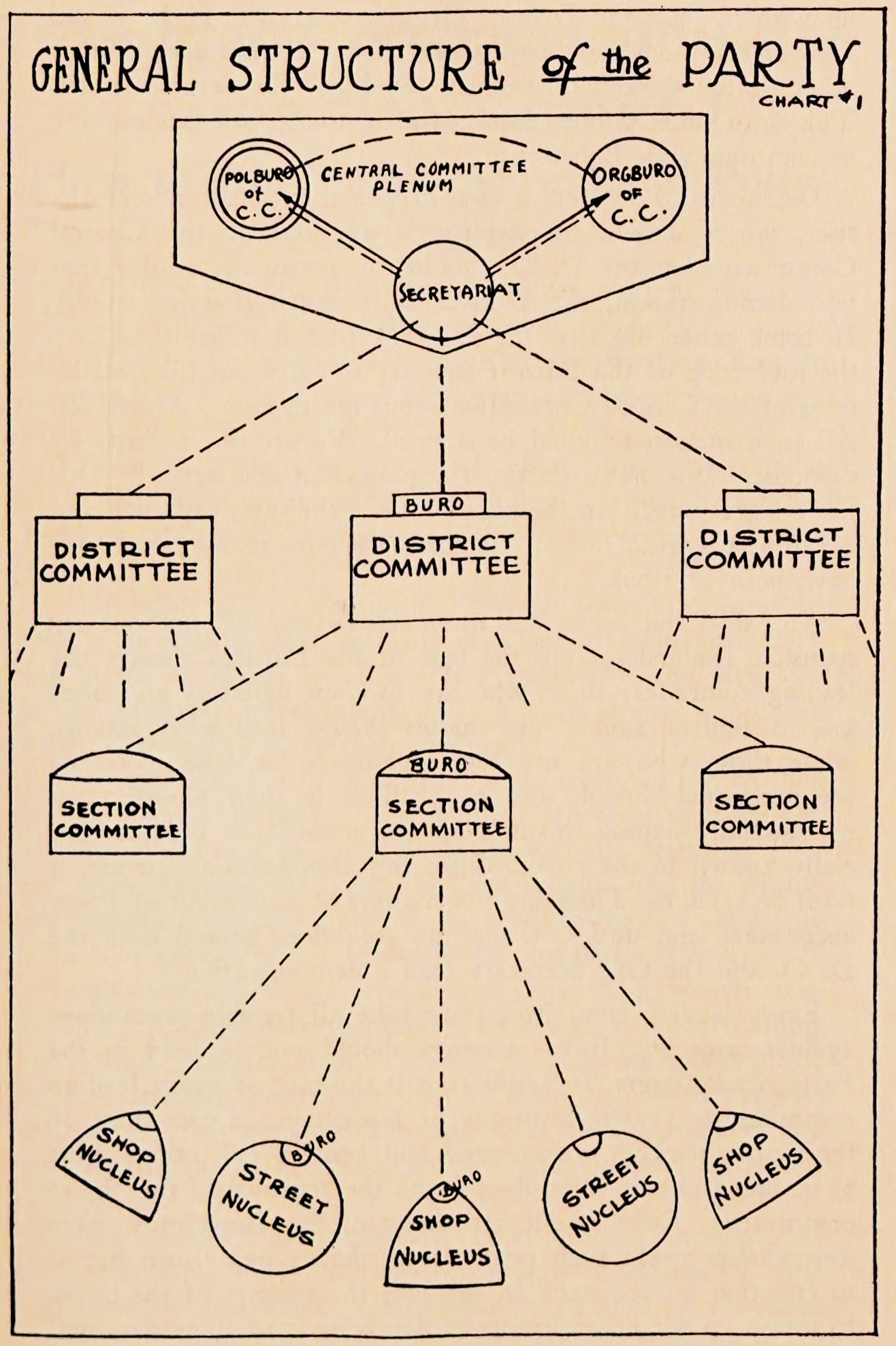
Fractions, a nuclei, sections, districts, bureaus, etc. Not only are these theses from the Comintern an important document on the history of Communist organization, these were not suggestions but mandates, they are very useful in interpreting the arcane language many of the documents and articles posted here.
‘Theses on the Organisational Structure of the Party’ from International Press Correspondence. Vol. 5 No. 49. June 9, 1925.
(Approved by the Orgbureau of the E.C.C.I. on May 4th 1925.)
The Significance of Party Organisation.
A well-built up party organisation is most essential for the Party, Independent of how the Party organisation functions, it can only then fulfil its tasks, if the policy of the Party is Communist, i.e., a class policy. And vice versa, no matter how excellent the Party policy may be, it can only become an excellent one and not remain a mere paper policy, when the Party organisation is so built up that it is able to carry out its policy amongst the masses of the working class. This is done through the Party members in the factories, through communist fractions in the mass organisations of the workers and peasants, in public meetings, through the Communist press, through representatives in public institutions (Parliaments and municipalities) in short, wherever working men, working women, office workers, poor peasants, oppressed peoples, etc. exist.
But the form of organisation also plays an important role. It must be flexible and elastic, that is, it must be able to adapt itself rapidly to the conditions under which it works. The Executive organs must be in permanent contact with the Party members and must distribute the work to the latter, issue instructions, control their work, etc., in order thus to draw them into regular active Party work. Through the Party members, the Party organisation circulates the slogans of the Party and realises the tactics of the Party among the masses. At the same time the Party organisation is informed by its members of the condition of the working class and of the moods of the masses among which the Party members work.
The Party organisation and its leadership should build Communist fractions in all mass organisations of the workers and peasants. These fractions serve the Party as agents within these organisations. The Party campaign should be so organised that all parts of the membership, all organs, no matter where they may be, always act in conformity and with the most precise mutual understanding. It is therefore necessary that the Party leadership always issue clear and definite instructions to these organs upon the manner of carrying out the campaign.
The form of organisation proposed below can serve to realise the above outlined purposes.
Only an organisation built up on these lines is in a position to consolidate organisationally the influence of the Communist Party upon the working masses.
Democratic Centralism and Party Discipline.
It is necessary to carry on a prolonged preparatory campaign amongst the members of the Party for a rigid discipline based upon the full consciousness of the Party membership, for a centralised, flexible form of organisation in all the sections of the Communist Party, for the purpose of creating a fighting apparatus able to lead the proletariat in its political and economic struggle and to enroll the conscious and active elements of the working class within the Party, through which the latter then can and must influence the masses of the workers.
As long as the Communist Party exists legally the suitable form of Communist organisation is democratic centralism. The Communist Party is a living and vigorous Party of action; in consequence, differences of opinion within the Party membership in the discussion of questions of programme and tactics are unavoidable. Very often a majority and a minority are formed in these discussions. When that is the case, the minority must submit to the majority, and must carry out all decisions with the greatest conscientiousness as long as they are not annulled by a higher Party authority.
Without this pre-requisite, an effective organisation cannot be built up nor can the proletariat be led.
The Factory Nucleus.
1. The members of the Party must be organised in factory nuclei and must do active work within them. They must submit to all decisions of the Party and the CI: they must pay membership dues regularly, and support the Party press.
2. The factory nucleus is the Party organisation in the factory; it directs with responsibility all the Party work within the factory.
3. All the members of the factory nucleus meet regularly in nucleus meetings.
4. The nucleus meeting discusses and decides upon all questions, not only those referring to the factory and the factory council, but also inner Party questions, and those of a political, economic, trade union nature, etc. It receives the report of the activity of the nucleus leadership as well as reports of individual comrades and groups assigned to special work by the nucleus. It elects a nucleus executive of 3-7 members, as well as delegates to nuclei group conferences.
5 a) The nucleus executive is the executive organ of the nucleus. It organises and directs work in the interval between nucleus meetings.
b) The nucleus executive organises nucleus meetings draws up their agenda, appoints reporters; elaborates proposals and calls upon members of the nucleus to make reports on questions of domestic and foreign policy.
c) The nucleus executive distributes Party work among the members of the factory nucleus, so that all of them have a definite task, and reports to the nucleus meeting upon this distribution. The nucleus meeting is entitled to confirm or revise the distribution of work decided upon by the nucleus executive. The nucleus executive also issues instructions and watches over the execution of Party work by the members. Functions of Party work within the Party nucleus are, for instance, the following: trade union work, work amongst women, work in the factory council, election campaigning, contact with the unemployed, cooperative work, work of political education, distribution of literature, editing the factory newspaper, cooperation with the youth nucleus, work within the sport organisations, directing work in the departments of the factory, work within the sick benefit and insurance funds, contact with the peasantry, work amongst the soldiers (eventually work amongst workers speaking a foreign language), Red Aid work etc., etc. The nucleus executive also commissions the members to influence and win over through individual propaganda definite non-communist colleagues in the factory.
d) The nucleus executive must report regularly, at least once a month, to the nucleus meeting upon its activity; it must report upon how the party work was distributed and carried out. The more important reports of comrades detailed for special work should also be made in these meetings.
e) The nucleus executive receives applications for membership in the Party, discusses them, and brings them up for decision in the nucleus meeting.
f) The nucleus executive collects membership dues for the Party.
6. The nucleus executive is elected for a term of three months.
7. The nucleus executive elects a nucleus leader from amongst the executive members, as well as other officials if necessary.
8. All the decisions of the nucleus executive or of the nucleus meeting are binding upon all members of the nucleus and must be carried out.
NOTE: Party nuclei with the same functions can also be established in offices, shops, stores, on farms, etc., wherever workingmen, working women and office workers exist.
a) Members of the Party, who do not work in any factory, (housewives, servants, artisans, poor peasants, etc.) can be organised in so-called street nuclei, according to the streets in which they live.
b) The street nuclei discuss and decide upon all Party questions, do all Party work in the respective residential districts, carry on house-to-house agitation, distribute literature, etc. However, the street nuclei, where formed, must not impede the work of the factory nuclei and are in no way on an equal footing with the latter. Only the factory nucleus is the basis of the Party organisation (From the resolution, of the Fifth World Congress.)
c) Members of the Party in a factory where they are not sufficiently numerous to form a nucleus of their own (one or two) as well as Party members not working in a factory at all but living in the neighbourhood of at factory with a factory nucleus, may be affiliated to the latter. Care should be exercised, however, in this affiliation. If this affiliation be necessary, the members working in the factory must always have an assured absolute majority. The nucleus must endeavour continually to gain new members in the factory itself so that the percentage of affiliated members grows smaller and smaller.
d) The unemployed remain members of the nucleus of the factory in which they formerly worked. In cases of prolonged unemployment, they may be released from this nucleus with the consent of the district executive and be affiliated to some nucleus in the district in which they live.
The Party Organisation of a Locality.
1. All the members of the factory, street, shop, farm, and other nuclei meet in joint meetings; discuss and decide upon all Party questions, after they have been dealt with previously in all the nuclei and the latter have taken a stand on the matter; elect delegates to the district conference; and elect the local executive.
NOTE: a) In villages, where Communists cannot form street nuclei, they should be organised into a village organisation. b) When the membership is very large, or when the Party is only semi-legal, the membership meetings can be supplanted by a local conference (with representatives of the nuclei). In this case the nucleus meeting elect delegates to the local conference on the basis of proportional representation.
2. The local executive directs all the Party work, issues instructions to the nuclei and organises and leads all the campaigns of the Party in the locality. The local executive where such do not yet exist. For this purpose it can also send organises nuclei in all factories, workshops, stores, etc. members to such factories, workshops, stores, etc. in order to begin work there; or it instructs Party nuclei in the neighbourhood to carry out this work. The local executive organises all Communists in the trade unions, municipalities, cooperatives, sport organisations, and in all other workers’ and peasants’ organisations into communist fractions, and issues instructions for and directs their work.
3. The local executive elects a secretary and organises with the approval of the next higher Party authority the departments necessary for the successful carrying out of all Party work in the locality, such as, for instance, an Organisation Department, Agitprop, etc. The secretary of the local organisation directs the work of these departments.
4. At least half of the local executive must be composed of members of factory nuclei, who work directly in the factory, in a workshop, on a farm, or in another place of employment.
5. The local executive is obliged to visit nucleus meetings regularly, where it reports upon work already done as well as discusses plans for work in future.
6. Party comrades living far from the factory in which they work must be specially registered by the nuclei group, ward or local executive. These comrades are at the disposal of the executives and may be sent to the street nuclei, in the district where they live, or may be commissioned by the local executive to do definite work on holidays, or after work, etc. in so far as they have no special tasks assigned them by their nucleus amongst the comrades or other workers of factories in which Communists work, but where no nuclei have existed as yet, or in factories in which there are no Communists.
NOTE: In the Party organisations of a small town the nuclei are to be united into wards, which hold their own conferences (eventually meetings) and which elect the ward executives as well as the delegates to the town conferences,
The Sub-District.
The Party organisations of smaller towns, villages, etc. are organised into sub-districts. The rules for the Party organisation of a locality apply with the necessary changes to the sub-district organisation.
Working District.
The Party may introduce a new organisational unit between the local organisations and the sub-districts: the working district. The Executive of the working districts is the connecting link between the various local groups and the sub-district executives. It looks after the execution of the decisions of the Party in its sphere of activity. Its principal task is to exhort the local organisations to do systematic work in the nucleus field. It is the function of the working district to hold together our numerous, scattered, small local organisations in the rural districts.
The City.
1. In a city several nuclei (factory, street, shop, store and other nuclei) in the same part of a ward are organised into nuclei groups in affiliation to a leading nucleus of a large factory.
2. All the members of a nuclei group meet at membership meetings, in which all political questions are discussed and decided upon, after they have been dealt with previously in all nuclei, and after the latter have taken a stand thereon. At the members meeting the nuclei group executive and the delegates to the ward conference are elected. The number of delegates is to be determined according to the proportional system.
NOTE: When the membership is very large, the nuclei group meeting may be replaced by a conference (of delegates from the nuclei). The delegates are elected on the system of proportional representation.
3. At least half of the nuclei group executive must be composed of members of the factory nuclei, who work directly in the factories.
4. The nuclei group executive directs all the Party work, issues instructions to the nuclei, and organises and leads all Party campaigns within the province of the nuclei group. It organises nuclei in all factories, shops, stores, etc., where such do not yet exist. For this purpose it can also send members to such factories, workshops, stores, etc. in order to begin work there; or it instructs Party nuclei in the neighbourhood to carry out this work. The nuclei group executive reports on its activity to the nuclei group meeting or to the nuclei group conferences, and to the nuclei.
5. With the approval of the ward executive, the nuclei group executive may organise sub-departments.
6. The nuclei group executive is in contact with the ward leader through its chairman.
7. In conformity with the administrative divisions of the town, several nuclei groups are organised according to wards.
8. The ward meeting or conference, receives reports of the ward and urban executive, decides upon all Party questions, and elects the ward executive as well as delegates to the urban conference.
9. The ward executive directs and controls all the Party work of the ward, issues instructions to all the organisations of the ward, organises and carries out all the campaigns of the Party within the province of the ward, and organises and directs communist fraction work within its sphere of activity.
10. The nuclei group and ward executives are obliged to visit nucleus meetings regularly, where they report upon work already done as well upon plans for work in the future.
11. The members of the nuclei group and ward executives must be affiliated to nuclei as active Party members.
12. The urban conference takes a stand upon all Party. questions, receives reports of the urban and district executives and elects the town executives as well as delegates to the district conference.
NOTE: Should the town executives at the same time be the district executive, it is not elected at the town conference, but at the district conference, to which the ward meetings or conferences elect delegates directly.
13. The town executive directs and controls all Party work throughout the town, issues directions to all Party organisations in the town, organises and conducts all Party campaigns on a town scale, directs communist work in the mass organisations outside the Party, municipal councils, etc., elects a presidium and secretary, establishes in agreement with the corresponding leading Party organs departments such as for instance the Agitprop, the Org Department, the Women’s Department, the Trade Union Department, etc. In the event of such bodies not being established, individual comrades should be entrusted with the tasks which would have devolved on such bodies. All instructions and directions issued by the departments should be signed by the urban secretary. The urban secretary is to be in direct contact with the ward organisers and if necessary he is at liberty also to get into direct contact with all Party organisations in the town. The presidium, the secretary or the various departments of the urban executive are at liberty to have consultations with comrades who carry on special work in the wards, nuclei groups or nuclei, such as work among women, distribution of literature, trade union work, etc. The secretary of the urban executive is to maintain the connection with the district executive.
14. The ward or nucleus group executives are at liberty to convene conferences with nuclei leaders or nuclei executives as well as with nuclei functionaries and with the leaders of Communist fractions in all organisations where fractions exist. Such conferences have no decisive function. They can under no circumstances whatever take the place of regular Party conferences or Party members’ meetings. The urban executive prepares these conferences (presents reports, makes proposals, etc.). The decisions made by these conferences come into force as soon as they have been endorsed by the respective authority; the latter is then responsible for them. When preparing Party campaigns it is advisable to convene the nuclei and Communist fraction leaders in order to give them instructions.
NOTE: Apart from the regular members’ meetings, conferences and executives, no other bodies with decisive functions (shop stewards meetings, bodies of functionaries, etc.) are permissible.
The District,
1. Party organisations of a definite district for instance those of several towns (large, medium and small towns) and several sub-districts and spheres of work should be amalgamated into one Party district organisation.
2. Town or sub-district conferences elect delegates to the district conference,
3. The district conference deals with all Party questions, receives the reports of the Central Committee of the Party and of the district executives; it elects delegates to the Party Congress and also the district executive committee.
4. The district executive superintends and controls the entire Party work of the district; it issues directions to all Party organisations in the district; it organises and conducts all campaigns in the district; it organises and superintends Communist fraction work in all non-party mass organisations in the district.
5. The district executive elects a Presidium and a secretary who gives all his time to the Party. It establishes various bodies for the Party work of the districts, as for instance Org, Agitprop and Trade Union Departments, etc. The departments of the district leading organ keep up their connection with similar departments of the subordinate Party organisations of the district only through the district secretary. All directions, instructions and political documents of the departments of the district executive organ must be signed by the district secretary.
Regional Organisations.
In some countries several districts can be amalgamated into a regional organisation if economic or political circumstances make it advisable.
The regional executive is elected at a conference of representatives of the respective district executives. The Central Committee of the Party must be represented at this conference.
The regional executive elects a Presidium and a secretary. The appointment of the latter must be confirmed by the Central Committee.
The task of the regional executive consists of coordinating and supporting the campaigns and instructions of the Central Committee of the Party.
The Central Committee.
1. The Central Committee of the larger legal Parties may consist of 25 or more members and a tew candidates. These constitute the Plenum of the Central Committee. (In illegal and semi-legal Parties the number of members of the Central Committee may be reduced.)
2. In the larger Parties the Central Committee elects two bureaux: The Political Bureau and the Org-Bureau,
3. The members of the Political and Org-Bureau and of the Secretariat work principally in the city where the Central Committee has its seat. The other members of the Central Committee work principally in the districts.
4. The Plenum of the Central Committee meets at least once a month and decides all the most important questions as well as questions of principle.
5. The Political and Org Bureaux carry out the current business of the Central Committee.
6. The Political Bureau consists of three to seven members of the Central Committee and meets at least once a week. It deals with political questions and makes decisions on them. The decisions of the Political Bureau can only be annulled by the Plenum of the Central Committee.
7. The Org. Bureau comprises three to seven members, deals with all questions of organisation, and directs the distribution of active Party workers. An appeal can be made to the Pol. Bureau from the decisions of the Org. Bureau and the former can annul them.
8. The Plenum of the Central Committee elects a Secretariat of 2-3 comrades (who must be members of the Central Committee), which must execute the decisions of the Org. Bureau, of the Pol. Bureau, and of the Plenum of the Central Committee, and see to the preparation of material for the sessions of the three directing organs.
9. The Secretaries of the Central Committee divide amongst them the work of the Secretariat.
10. At least one of the Secretaries of the Central Committee must be a member of the Pol. Bureau, and all secretaries must belong to the Org. Bureau of the Central Committee.
11. For the establishment of permanent and close contact between the Org. Bureau and the Pol. Bureau of the Central Committee, (as required for methodical and unified work of both organs) one or two members of the Pol. Bureau in addition to the secretaries must belong to the Org. Bureau.
12. Departments of the Central Committee are established for the following spheres of activity: Organisation Department, Agitprop Department (this includes the education department), Trade Union Department, Agricultural Department, Women’s Department, Department for National Minorities, (not in all Parties), Red Aid, business management, (this includes accountancy and the cashier’s office), etc.
13. All the departments are subordinate to the Central Committee, and are under the direct control of secretaries of the Central Committee, so that the latter may be continually informed about the work of the various departments. The Secretariat decides whether a question in the Pol. or Org. Bureau upon the motions made by the Department and previously examined by the Secretariat, cannot be made without notifying the respective Secretary.
14. At the head of each department there is a department chief (in big parties a deputy as well) who is appointed by the Secretariat of the Org. Bureau.
15. Upon its own initiative or at the request of different departments the Control Committee (Pol. Bureau, Org. Bureau, Secretariat) calls representatives of the corresponding departments of the local organisation for consultations.
16. In addition to the Party conferences, the organs of the Central Committee (Org. Bureau, Pol. Bureau, Secretariat) may convoke conferences with the secretaries of the districts or local organisations.
17. All the instructions, etc. of the different departments must be signed by the secretary under which the department stands, and do not go directly to the corresponding department of the organisations, but to the executive of the organisations, which transmits them.
18. The Central Committee determines how often all organisations in the Party should report (and whether in writing or orally). The district executives of a legal Party should report to the Central Committee at least once monthly.
Communist Fractions.
In order to render effective communist influence upon the masses of workers and peasants outside the Party, every Communist Party must possess organs carrying on a communist policy in the non-communist fractions. To a large degree the success of Communist Parties depends upon their firm organisation, rigid Party leadership and energetic activity, the living contact of the CP with the masses. On them also depends the unity of the execution of the instructions of the Party the uniform tactics of the Party–altogether the correct activity of the CP.
1. Communists in a definite organ or organisation (trade unions, factory nuclei, cooperatives, organisations of the unemployed, sport, cultural, educational and other organisations, of the working class, tenants’ and peasants unions, war veterans’ associations, world war veterans, national revolutionary organisations, congresses and conferences of these organisations, municipalities, city councils, parliaments, etc.) form a communist fraction.
2. As soon as a communist fraction has been formed it elects a leader, and if the membership and the sphere of activity of the fraction is very large, an executive as well.
3. According to whether the organisation in which the fraction is formed is a local, sub-district, district or national organisation, the fraction is subordinated to the local executive of the Party, the sub-district executive the district executive or the Central Committee.
4. The respective Party executives of Party organisations (local membership meetings, local, sub-district, and district conferences) determine and control the application of the tactics and the political line of the Party in the work of all the fractions subordinate to them, receive the reports of the elected officials, (union executives, etc.).
5. The leaders elected by the fractions as well as their executives, must be confirmed by the respective Party executives. This is also true for the candidate set up by the communist fractions for election to the trade union executives, cooperative executives, etc. With regard to the parliamentary fractions, and the communist fractions of the town councils and municipalities, the Party executive or members’ meetings or Party conferences (where the Party is illegal, only the Party executive) must decide before the election which Party members should be set up as candidates for the institutions in question. The same is true of the recall of elected Party members. The final decision upon mandates rests with the Central Committee.
6. In the daily work of the fractions (in so far as the instructions of the Party are followed and there are no important differences of opinion within the fractions themselves), they have full freedom of action and possibilities of work. The respective Party authority must receive a report on the activity of the fractions at least once a month.
7. The Central Committee has permanent contact with all the fractions on a national scale through the departments for directly). (Parliamentary fractions, the fraction in the National executive of the trade unions, the fraction of the Executive the Co-Operative Federation, the fraction of the Central Committee of the Peasants’ Party, the fraction of the headquarters of the Workers’ sport organisations, etc.).
NOTE: In the countries in which there are no communists on the National Executive of the Trade Union Federation the Central Committee must maintain contact with the communist fractions in the executives of the various trade unions.
8. Besides being subordinate to the local Party authority, a communist fraction in a cooperative, sport organisations, etc., is subordinate to the communist fraction in the next higher organs of the same organisations.
9. The Communist fractions in the various trade union executives are in direct contact with the Communist fraction in the National Executive of the Trade Union Federation and work in accordance with the instructions of the latter. The Party Central Committee is entitled to enter into communication with all the trade union fractions of the national trade union executives, if it deems it necessary.
10. The fraction of a single trade union executive can, with the approval of the Central Committee, issue instructions to the fractions, which at the same time receives. instructions from the fraction of the district trade union councils, and which maintain contact with the latter. The fractions in district organs work under the direct leadership and control of the district executive of the Party.
11. The Communist fraction of the district executive of a trade union can issue instructions to the fractions of this union in the district. The respective fractions at the same time receive instructions from the communist fractions of the local trade union council. The fraction of a local trade union council works under the direct leadership and control of the local executive of the Party.
NOTE: The instructions of the Party may also be issued to the district union executive directly through the district Party executive, or even directly from the Central Committee, in the cases in which it deems it necessary.
12. The rules which govern the competence and subordination of the Communist fractions hold good for all trade union organisations down to the communist fractions in the factory council.
13. Should the National Executive of the Trade Union Federation contain no Communists and the formation of a Communist fraction therefore be impossible, the Trade Union Department of the Central Committee of the Party must create an organ to supplant this fraction composed of representatives of the Communist fractions of the National Executives of the various trade unions. The same policy should be followed in the districts and locally.
14. In the same manner, through the trade union departments of the Central Committee, and of the district and local Party executives, all the communist fractions of the trade union executives in the unions of all tendencies in the trade union movement can and must be united into a central body, where methods are worked out, experience is exchanged, mutual aid is rendered in their work, campaigns are organised according to a common plan, and the like.
International Press Correspondence, widely known as”Inprecorr” was published by the Executive Committee of the Communist International (ECCI) regularly in German and English, occasionally in many other languages, beginning in 1921 and lasting in English until 1938. Inprecorr’s role was to supply translated articles to the English-speaking press of the International from the Comintern’s different sections, as well as news and statements from the ECCI. Many ‘Daily Worker’ and ‘Communist’ articles originated in Inprecorr, and it also published articles by American comrades for use in other countries. It was published at least weekly, and often thrice weekly.
PDF of full issue: https://www.marxists.org/history/international/comintern/inprecor/1925/v05n49-jun-09-1925-inprecor.pdf

