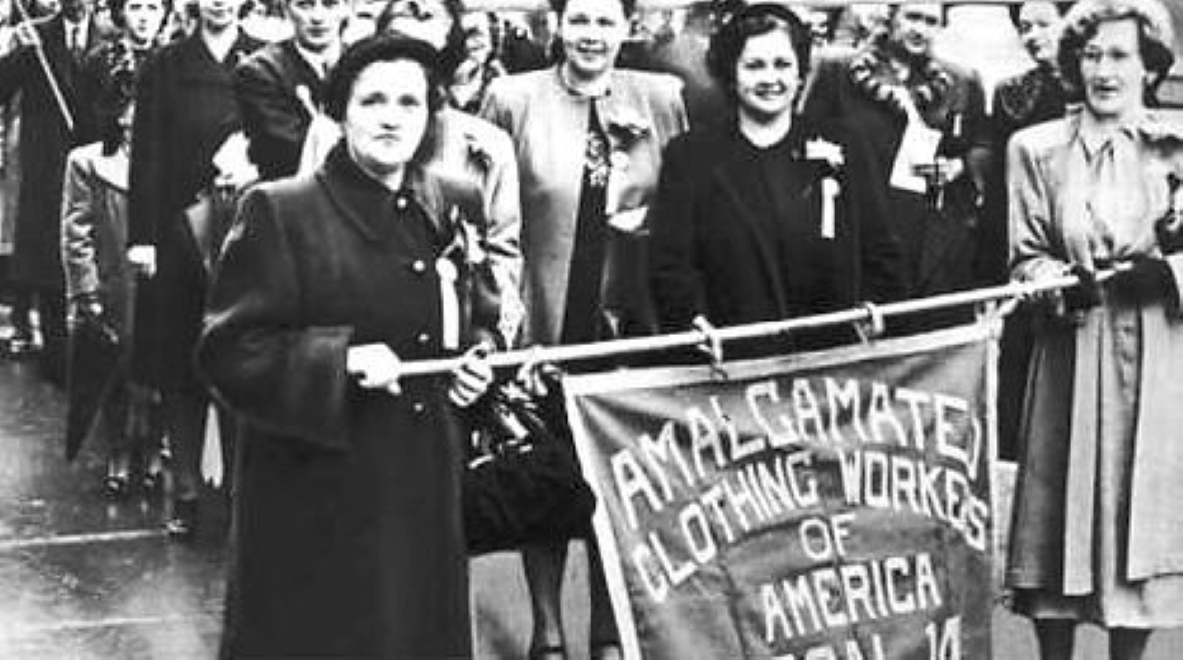
Mary Shieber with the militant’s critique of the Amalgamated Clothing Workers. The A.C.W.A. was born as a radical rebellion, the Chicago Uprising of 1910, against the A.F.L.’s conservative United Garment Workers of America, led by the ‘Socialist’ leadership around Sidney Hillman. That leadership was both ‘progressive,’ becoming the by-word for ‘social-unionism’, and whose overriding anti-Communism led it to make common cause with the government and gangsters.
‘Amalgamated Clothing Workers of America: A Child of the Old Regime’ by Mary Shieber from Solidarity. Vol. 7 No. 332. May 20, 1916.
In 1914 the United Garment Workers of America held its 18th annual convention in Nashville, Tenn. At the opening of the convention, certain delegates, although elected by their respective locals, were not seated–about 100 in all. A number of seated delegates rebelled against such action and decided among themselves that either these 100 protested delegates should be seated, or they themselves would buck the convention.
President Rickert, knowing beforehand, that the eastern and some of the western delegates were opposed to his presidency, and not caring to lose his high-salaried position–he was afraid if all delegates were seated he (Rickert) would lose out, and so the undesirable ones were excluded. Rickert knew that new ideas spelled doom for him, and at any cost, he would rule the convention.
Little did Rickert and his followers care, when this body of men, sooner than see their fellow workers denied all rights they were justly entitled to, left the hall. No persuasion or reason would Rickert & Co. listen to. The non-seated delegates would not be recognized, and so all delegates, desirable and otherwise, decided to break away from the U.G.W. of A. They decided to secede and form an independent organization.
How those boys fought, and how earnest they were in building up a new, a democratic organization. They decided to elect their own officers, and work in behalf of all the tailors. They were going to emancipate the workers. They were going to teach the workers that solidarity is the strongest weapon with which to fight the master class. They were going to do away with autocracy, and change it to democracy, Craft organization was a failure; industrial organization would be their aim. And so a new organization sprang up out of the old. It was a child of the old regime, and it called itself the Amalgamated Clothing Workers of America.
Now let us see how this new rebellious child fulfilled its mission. Officers were elected, with Sidney Hillman as president. He was and is considered as a sort of god–as something above the rank and file. His followers got busy with beautiful phrases and as usual made the workers the goat. They tried to instill into the minds of the members that as a president it was ill-becoming that he receive a “wage.” “They were mighty lucky to get the services of such a wonderful personage. He was entitled to a “salary.” And the poor misguided workers thought this Von Hindenberg, this saviour, was worthy of all the honor that could be bestowed upon him.
Such, in brief, was the foundation laid, the elementary lesson taught, the workers of this new and democratic organization the boys who were to do away with autocracy. They never tried to educate the workers to the real meaning of unionism–how the workers themselves, by solidarity, could liberate themselves, but taught them that they should look up to their leaders; that they should be loyal to the leaders, trust them, etc. Such was and is today, the education given the rank and file. If the leaders (misleaders) actually presented conditions just as they should be presented, how quickly the workers would feel the weight of these leeches and job seekers and make short work of them, by throwing them off their backs. And so they try to keep the general membership in ignorance of the real facts as they arise.
When a resolution or other matter of importance is brought up, or is to be passed upon, the same is read, a few suckers making motions, the rank and file never understanding what is being done, but by force of habit raising their hands when a vote is taken. They might be swearing their lives away for all they know If a few who really are interested in union affairs ask questions or try to show up the rottenness of proceedings, they are soon termed kickers, and in time the select few try to influence the membership against these kickers, by saying “How peaceful our meetings are when these kickers aren’t present,” etc. How they try to blind the poor misguided workers, just to hold their jobs, and how the workers fall for that stuff is farcical. They are so used to looking up to leaders, that they are lulled to sleep all the while, depending on someone else to do their thinking for them.
So much for the education the workers get. In the tailoring branch of the industry, there exists such a thing as class distinction. The cutter feels himself above the head operator (all around man); the h.o. feels above the pocket-maker, the pocket-maker above the sleeve maker, and so on along the line. Class distinctions reigned supreme in the past, and this new organization was going to do away with class distinctions among workers. Yet what do we find today? Pocket-makers’ benevolent club; Girls’ Club, headed by Ellen Gates Starr (who needs votes); pressers’ club, etc.; and instead of these sectional clubs, attending their local meeting, they go to their club and don’t’ give a damn about the thing which should concern them most of all. Out of a membership in Chicago of about 1,000, 50 or less attend local meeting. And these “emancipators,” instead of doing away with these craft clubs, encourage them.
So you see, the few job holders and job seekers can most always pass and carry through anything that will tend to better their own conditions, never once giving the workers, a thought. Now if all this isn’t dividing up the workers, I’d like to know what is. It is the same craft organization as of old, only that it has a new name and new misleaders. Yet they of the Amalgamated call themselves an industrial organization. Their constitution is the same as the U.G.W. of A. Just last year (1915) they adopted a preamble something on the order of the I.W.W. preamble, but who knows about it? Surely their tactics, and methods of organization are not based on industrial lines. Their members know nothing about the preamble. Their union cards are made up of 2 pieces of pasteboard stuck together, with yellow dues stamps pasted in. Out of a matter of form, at one of their meetings the preamble was read to the membership and a vote taken as to the adoption of said preamble; and as above stated, they raise their hands and vote out of force of habit. It was adopted, the members knowing nothing more about it. They must have it stuck in some storeroom for reference, in case it should be asked of them what principles they have, on paper. You may ask 95 per cent. of the A.C.W. of A. about their preamble and they won’t’ know what you are talking about.
A few remarks in closing: “The joint board of the Amalgamated Clothing Workers of America, employes of Hart, Schaffner & Marks, drew up an agreement with said firm, which binds them for three years, girls getting a minimum of $8, men $12. Although girls put in as much time, as much energy, as much labor power, they are not worth as much as their fellow men workers, another thing these broad-minded “emancipators,” these “industrialists” have done they have actually sold the workers to their employers for a term of three years and only for a bare existence at that; when they well know, or should know, that necessities of life do “not remain stationary in price. Suppose food stuffs, clothing, shelter, should take a sudden jump–you are bound by a contract. Where Mr. S. Hillman, and joint board, would you get off at. Let me inform you, Mr. Hillman, that in the days of serfdom our forefathers sold themselves to masters, but today we are “civilized,” and yours is such a cosmopolitan organization. And to show to the world what a wonderful victory you won for yourselves, a May Day parade was arranged with bands and right you are; the bands were music to your ear. Your salary goes on, while the poor misguided slaves will go back to the shops, not even daring to strike should the occasion demand. Doesn’t your contract bind them? So at last your mission was fulfilled, you liberated (?) the tailors, and in their ignorance they look up to you as their saviour. And as recompense, a banquet was held at one of the Chicago restaurants to celebrate this wonderful agreement–an agreement that signs away the life and liberty of your people. Ye of the Amalgamated are to be congratulated upon your wonderful victory.
Such is the development of the child of the old regime.
The most widely read of I.W.W. newspapers, Solidarity was published by the Industrial Workers of the World from 1909 until 1917. First produced in New Castle, Pennsylvania, and born during the McKees Rocks strike, Solidarity later moved to Cleveland, Ohio until 1917 then spent its last months in Chicago. With a circulation of around 12,000 and a readership many times that, Solidarity was instrumental in defining the Wobbly world-view at the height of their influence in the working class. It was edited over its life by A.M. Stirton, H.A. Goff, Ben H. Williams, Ralph Chaplin who also provided much of the paper’s color, and others. Like nearly all the left press it fell victim to federal repression in 1917.
PDF of full issue:

