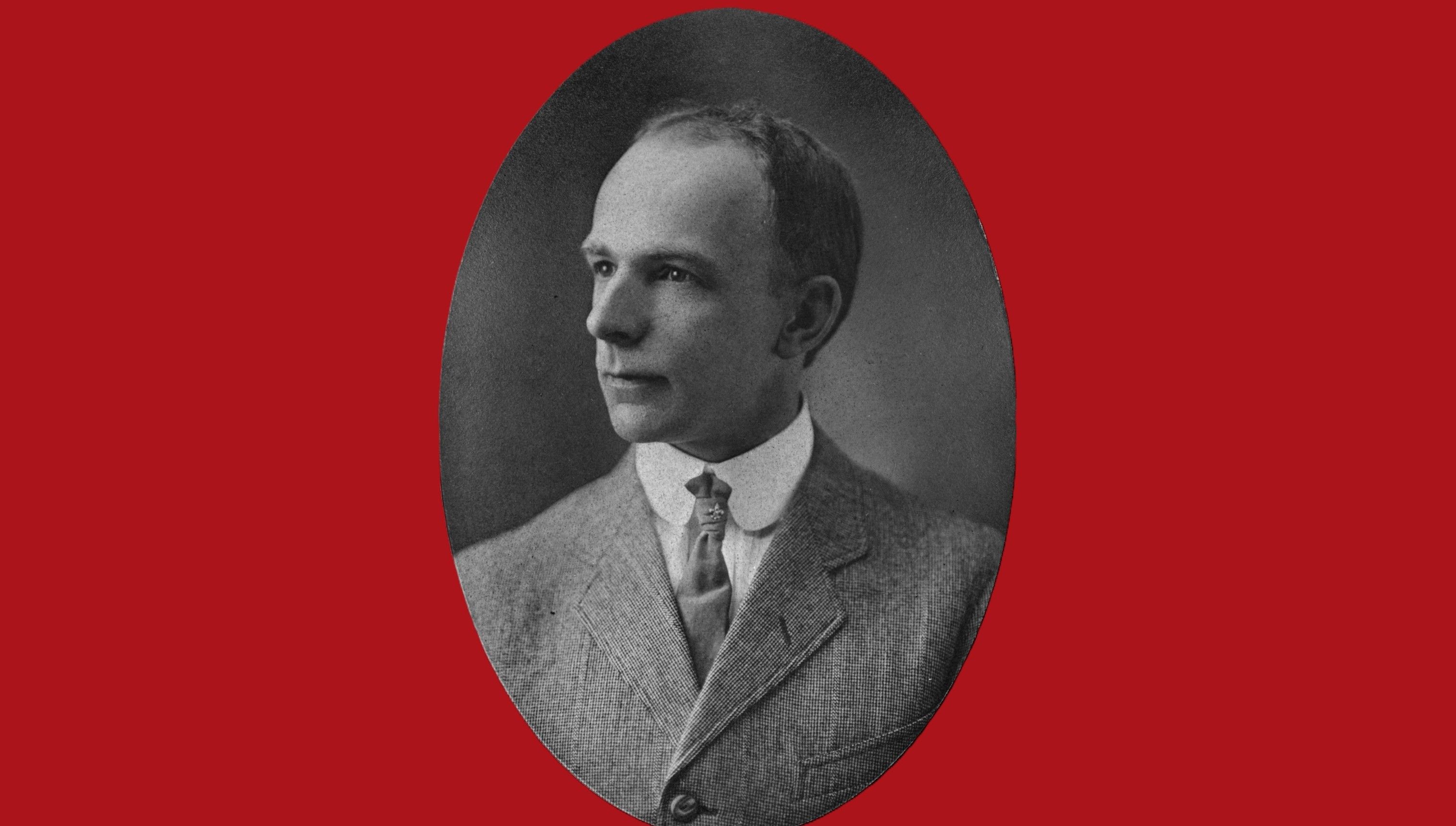
Ruthenberg speaks to the manufactured anti-Communist hysteria, and his own and others’ arrests at the Communist Party’s convention in Bridgman, Michigan.
‘The Michigan Red Raids’ by Charles E. Ruthenberg from Truth (Duluth). Vol. 6 No. 40. October 6, 1922.
(Extracts from speech by C. E. Ruthenberg.)
The morning during the latter part of August the newspapers all over the country informed their readers of a raid upon an alleged Communist Convention at Bridgeman, Michigan. The story of this raid told of the capture of the members of a secret, underground organization which was conspiring against the United States government.
A few days later these, same newspapers published a picture of seventeen of the men arrested at Bridgeman. This picture showed them surrounded by typewriters, mimeographs, and printed matter. There were no cannons or guns or bombs–but still they were accused of trying to overthrow the United States government–with typewriters and mimeographs.
We have been taught to believe that in the United States the constitution underlying the government of this country guarantees to all the people the right of freedom of speech, freedom of press, and freedom of assembly. We are taught this in our schools, it is preached to us in the pulpits, and our newspapers and periodicals foster this belief.
Let us go Into, for a moment, the relationship of this so-called secret conspiratorial organization which held its convention at Bridgeman, Mich., to these fundamental rights supposed to be guaranteed by our constitution.
The Communist Party of America was organized in 1919 at a convention held in the city of Chicago. There was nothing secret about this convention. There was nothing underground about the organization it created. The Communists had nothing to hide in regard to their principles and their purpose. They proclaimed these principles. They proceeded on the assumption that the constitutional provision in regard to the freedom of speech, freedom of press and freedom of assemblage applied to Communists as well as other people.
What was the result?
In 1919 a wave of revolutionary ferment was sweeping over all of the European countries and had also made itself felt in the United States. In Russia there had been the revolution and in Germany and all of Central Europe revolutionary struggles were going on. The people of Europe were trying to realize that better world which they had been promised would be the outcome of the World War.
The same struggle manifested itself in the United States. The steel workers, who for decades had suffered under the oppression and exploitation of the steel trusts were trying to win for themselves part of that Democracy and better life which had been so glowingly pictured during the war period.
They wanted to be free men; not Industrial slaves working twelve hours a day, seven days a week as they had been working in the past. They organized and went out on strike.
The miners Union, too, was engaged in a struggle for more of what they produced through their labor power. A half-million miners were out on strike in 1919 as they have again been out on strike in 1922.
The Communists’ purpose is to give leadership to the struggles of the Workers. It is the task of the members of the Communist Party to place themselves in the forefront of the struggles. It is their duty to keep up the morale and fighting spirit of the workers struggling for better things for themselves.
The Communists tried to fulfil this task in 1919. They gave what service they could to the striking steel workers and the striking miners, with the result that all the power of the United States government was directed against their organization in an effort to destroy it.
On January 1st, 1920 there were four thousand members of the Communist Party in the prisons of the United States held under indictments providing long prison sentences, and for deportation.
That was the answer which the Communists received to their acting upon the assumption that even Communists had the right of free speech, free press and freedom of assemblage in the United States.
Four thousand men and women arrested in many cases without warrant or any other authority of law, held in filthy Jails to be railroaded to imprisonment for long years, or deported from the United States while wives and children remained behind.
Is it to be wondered that under these circumstances that the Communist Party has since taken some measure to protect itself against a “Democracy” which treated it thus? If the Communist Party is an underground organization It is not because the Communists have some secret purpose which they dare not proclaim in the open. The Communists desire nothing more than to publicly proclaim their ideas and their principles. But the answer of the government of the United States to such public proclamation of those principles–not to any overt act of force or violence, but the mere public statement of the principles of Communism–has been to put scores of Communists in prison and to deport hundreds of others.
The conditions under which the raids of this year against the Communist Party were made are parallel to those of 1919. Again we were in the midst of a great industrial struggle. Again there were a half-million miners on strike and a half-million railroad shopmen fighting for better things for themselves.
These strikes looked as if they were going to be won by the workers. It looked as if the open shop and wage slashing campaign of the last two years would be stopped by the resistance of these million workers on strike.
And under these conditions we have new raids upon the Communist Party. For what purpose? In order to terrorize the labor movement by Lie atmosphere created by the new “Red” raids. The attack upon the Communist Party in 1922 is part of the general attack upon the Labor Movement. The Daugherty Injunction and the raids at Bridgeman are part of the same offensive. That organized labor recognized this is shown in the quick response to this attack in the passage of resolutions by the Chicago Federation of Labor and the Minneapolis Trade and Labor Assembly protesting against and denouncing the arrest of the Communists.
The defense of the Communists against this new attack of the government will be a campaign to unite those people in the United States who believe in the principle of freedom of speech, freedom of press and freedom of assemblage. Today these constitutional guarantees are a hollow mockery as applied to the Labor Movement. The answer of Labor to the attack upon it must be to unite and to make these rights real through an organized campaign in support of these rights.
The Labor Defense Council in which all elements of the labor and liberal movement in the United States are united is the answer to these attacks. The National Executive Committee of the Labor Defense Council is representative of all the elements in the industrial and political movement of the workers. In Chicago the first local group has been organized in which in represented the trade unions, the Farmer-Labor Party, the Trade Union Educational League, the Proletarian Party and the Workers Party. Similar local groups are being organized in all parts of the country.
The Labor movement is answering the attack of the government by uniting its forces for defense of the right of labor to freedom of speech, freedom of press, freedom of assemblage, freedom to strike and peaceably picket and freedom to organize to achieve better things for self.
Workers’ Party Press Service.
Truth emerged from the The Duluth Labor Leader, a weekly English language publication of the Scandinavian local of the Socialist Party in Duluth, Minnesota and began on May Day, 1917 as a Left Wing alternative to the Duluth Labor World. The paper was aligned to both the SP and the I.W.W. leading to the paper being closed down in the first big anti-I.W.W. raids in September, 1917. The paper was reborn as Truth, with the Duluth Scandinavian Socialists joining the Communist Labor Party of America in 1919. Shortly after the editor, Jack Carney, was arrested and convicted of espionage in 1920. Truth continued to publish with a new editor J.O. Bentall until 1923 as an unofficial paper of the C.P.
Access to full issue: https://www.mnhs.org/newspapers/lccn/sn89081142/1922-10-06/ed-1/seq-1

