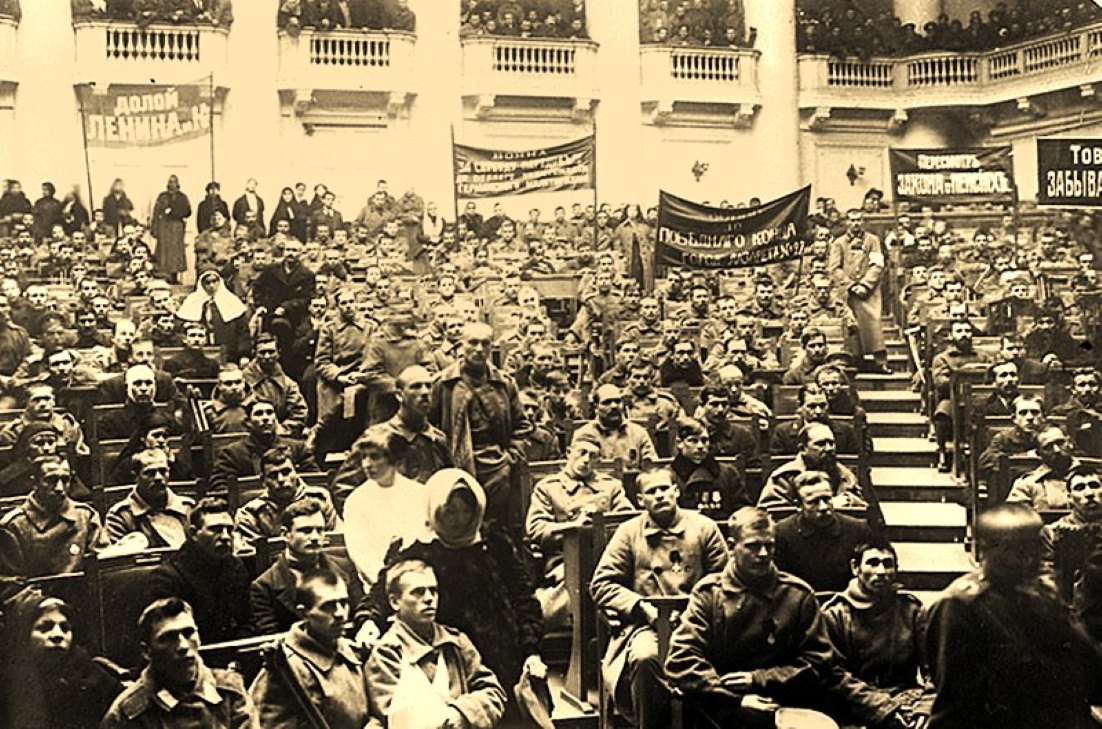
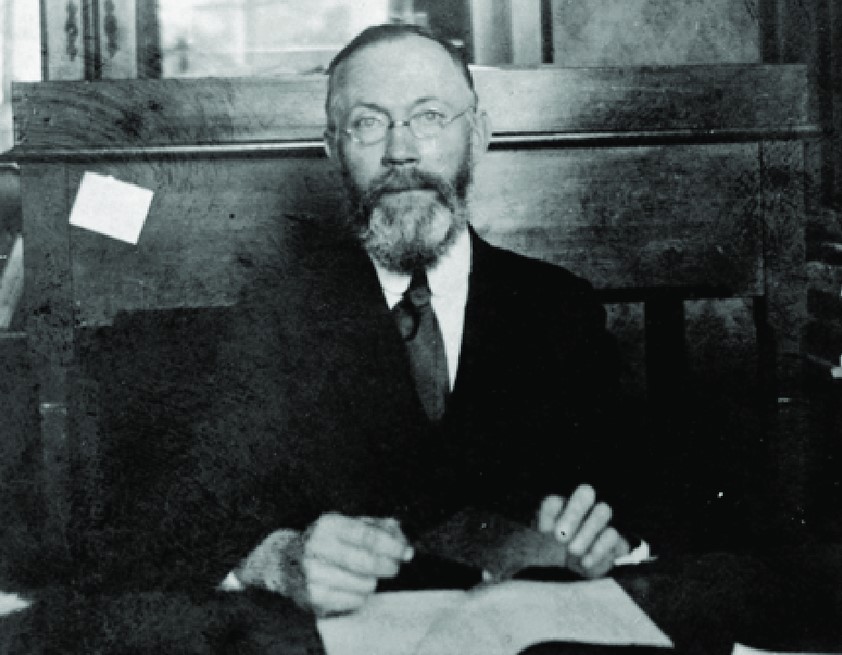
Pannekoek closely following events provides essential analysis of the unfolding Russian Revolution of 1917. This written in the aftermath of the July Days, has Pannekoek amplifying the positions of Lenin and the Bolsheviks in the Soviets even as events seemed to retreat.
‘The Russian Revolution’ by Anton Pannekoek from New International. Vol. 1 No. 10. February, 1918.
WITH the overthrow of Czarism, the Government naturally came into the hands of those who heretofore had constituted the opposition. In the Duma this was the bourgeois opposition of the Cadets, and, from the Left, the Social Revolutionists (peasant-delegates) with Kerensky and the Menshiviki with Tscheidse as their best known representatives. At the same time that the reactionary Duma disappeared the Provisional Government was formed from the Duma opposition.
Here the same development as in a number of previous revolutions occurred again; although the masses are instrumental in making the revolution, a committee of bourgeois politicians constitutes itself as government and assumes a popular character by assimilating a few well-known leaders of the masses. But contrary to previous experiences in Western European revolutions–in which the masses fell apart in powerless atoms immediately after the action–a higher development was reached now: the revolutionary masses constituted their own powerful organization. In accordance with the example of 1905 the delegates of factories and the revolutionary army corps organized into a “Council of Workers and Soldiers” as a kind of permanent parliament, defending the active force of the revolution and the democracy of the masses against the members of the bourgeois government. From the very start this Council acted as the organ of democratic distrust of the masses against the bourgeois government; the bourgeois press lamented the intolerable accessory government; the Council considered itself the organ of the popular revolution against Imperialism and war. In its name Lenine and other Russian revolutionaries were greeted by Tscheidse on their return from Switzerland to Petrograd through Germany after the closure of other routes by the English Government. And at the same time the Council addressed all workers and Socialists in neutral as well as in warring countries with the proud appeal to break with their imperialistic governments and to hold a Congress for peace–in defiance of the Congress of the great betrayal staged in Stockholm by Troelstra, Branting and Scheidemann.
Soon the Council of Workers and Soldiers acted against the Provisional Government, and at once the inner contradictions in the groups of the revolution became clear. Not yet the deeper and general class conflicts: workers, peasants and capitalists, but the more superficial antagonism between the imperialistic policy of the bourgeoise demanding from the revolution a more energetic carrying on of the war and the masses craving for peace. The demonstrations in the beginning of May under the auspices of the Council forced the bourgeoisie to give in: Miljukof and Gutschkof, the imperialistic leaders, abdicated. The Provisional Government was re-organized in accordance with the new balance of power: a number of Socialist (Menshiviki) leaders entered the ministry as representatives of the Council.
In the Council itself this result met with opposition; there the differences based on different classes in the Russian social order appeared more clearly. The “Social Democratic Labor Party,” the “Bolsheviki” (Lenine, Zinovief, Kamenef) which as a militant party had already gained great influence among the industrial proletariat even under Czarism, became more and more the representative of the Petrograd workers. But in the Council they constituted a minority; the majority of the delegates, those of the soldiers, were peasants; their mode of thought corresponded best with the moderate Socialism of the Social Revolutionists and the Menshiviki. They believed in continuing the war as a war to defend the revolution against the Germans, who wanted to re-instate the Czar; the same slogan of a “war of defence” with which, in 1914, in Germany and France the masses were swept into the war, here again served its purpose; practically they were social-patriots. They approved of their leaders, Kerensky, Skobeleff, Tchernoff, Tseretelli, constituting the government in a ministry together with representatives of the bourgeoisie.
This problem forms the main point of differences between the Leninites and the majority of the Council. The Bolsheviki demand: no participation in a bourgeois government, but the government in the hands of the Council. The Council of Workers and Soldiers, together with the peasants also organized at a congress, constitute the whole of the Russian working people. This has to decide its own affairs alone–the bourgeoisie is not required for this: we don’t recognize its right to count as a class.
It may seem strange that the Bolsheviki wanted to give the power to an institution in which they formed only a minority and which could not be expected to act according to their views. This, however, was perfectly logical, a body representing exclusively peasants and workers would be compelled to take such economic measures required for those classes independent of theories, and do what we wish it to do–if only it is separated completely from a coalition with the bourgeoisie in the interests of the latter.
Why did the Menshivik leaders and the majority of the Council oppose this solution and why did they cling to the bourgeois politicians? Why did they not take full control at the outbreak of the revolution, why not May 2nd? Why did they turn the power, conquered by the workers in the streets, over to the bourgeoisie? The answer is not difficult: they shrinked before the gigantic task of reorganizing society, backed only by the proletariat against all of the property interests. At the beginning of the revolution, they stated this clearly in a manifesto: Russia with its enormous population of peasants and its primitive capitalistic development is not yet ripe for Socialism and therefore it is necessary that at present the bourgeoisie must rule, a kind of would-be Marxian theory, that does not realize that Socialism only can result from a long process of struggles, in which the degree of ripeness of society depends upon the ripeness of the proletariat for struggle and power. But in Russia their task looked still more hopeless, because of disorganization through the war and the mismanagement of the Czar; they did not see fit to reconstruct without the co-operation of the bourgeoisie; they relied upon the abilities of the bourgeois politicians to bring order in the chaos. All this tends to prove that those Menshiviki, although they call the selves Socialists and although they represent working classes, mentally are much closer to the bourgeoisie than to the revolutionary Socialists.
The further developments under the coalition government have shown how completely these timid views were in discord with actual conditions. Being a coalition government, it had to keep the middle of the road between the struggling classes; it could not support the workers against the capitalists nor the capitalists against the workers; it had to refer the peasants eager for land to the future constitutional assembly, because it dared not break with the land owners. It had to preach patience and compromises to all sides without satisfying anybody; it did not dare to tackle any problem seriously and had simply to let things drift along. And meanwhile the antagonism became stronger and difficulties greater.
There has been written much about the anarchy prevalent in Russia. The bourgeois did not mean by this the disorder in the production and distribution, but the fact that the workers were on their feet and forced the bourgeoisie and the government to recognize them–which actually meant the beginning and the necessary condition for a new social order. The bourgeoisie called for a strong government, as the only means to restore order and they emphasized that here as always a “Socialistic” government only could result in disorder. And indeed, the situation was untenable. They could only see salvation in a capitalistic government, which would keep the proletarians in submission by force, so as to have them work and slave obediently and without protest for the profits of the bourgeoisie. But there was another way out. The inefficiency of the government did not result from its “Socialism”–which only existed in fooling the proletariat with nice talk and fine slogans–but in the lack of Socialism. What a real Socialist government should have done under the circumstances has been stated repeatedly by the Bolsheviki. It is their credit to have formulated against the old phrases of the social patriots, a program of immediate demands based on the exigencies of the actual conditions in Russia, a program that could save the country and the proletariat from the untenable conditions and could pave the road for development towards Socialism. In this respect also the Bolsheviki have been the vanguard of revolutionary Socialism throughout the world.
In the first place there was the management of production. Where capitalists closed their factories as a weapon against the workers, or because they did not see fit to exploit with sufficient profit, the factories had to be expropriated and put into the hands of the workers and the technical staff to continue production. Where landowners refused to cultivate their land, it had to be expropriated and put into the hands of the peasants. By giving land to the peasants without regard for the rights of the landowners, it could be expected that the peasants would put their products at the disposition of the rest of the population. Agricultural implements and machinery had to be given to the peasants at low prices. By regulation of the transport and strong measures against extra profits, it would be possible to reduce the high cost of living. And by socializing the most important industries, which so far made big war profits, especially also the large banks, as well as by strongly drawing on private capitals, it would be possible to open big resources of income. And no doubt a revolutionary government would start at once to repudiate national debts, which sucked the Russian people by their enormous interests to the benefit of West European bond holders. The Russians would be crazy if they patiently continued to pay interest on bonds issued by the Czar and by so doing to pay tribute to the helpers of their hangman for being his accomplices. In this way the yearly budget of the State would be materially relieved.
But for all these measures there was one necessary condition: a speedy end to the war that sacrificed all production to munition output, and tied millions of men at the front, exhausting all resources. For this reason, peace, the struggle for peace was in the center of agitation of the Bolsheviki. Peace not only was an economic necessity, in order to prevent bankruptcy and hunger: peace also was the most important demand of the class struggle against the bourgeoisie. The Russian bourgeoisie did not want peace, but war; even if for the present it had to suppress and conceal its own imperialistic aims, still it realized the necessity of sticking to co-operation with the Entente…in the great world struggle between Germany and England it could not be neutral. And more so because a Russian government could not bear the war expenses without the financial aid of England.
Therefore the party of the revolutionary proletariat stood opposed to the Provisional Government. What the government has been blamed for by the Bolsheviki was not only its impotence, as a result of its class character, to achieve improvements in economic conditions, but also that it followed a war policy, which characterized it as the servant of the Entente. The provisional Government considered the secret treaties, between the Czar and the English and French Governments, as an obligation on its part, and notwithstanding repeated demands and promises to publish these treaties, it failed to do so. This fact alone brands the Provisional Governments as a bourgeois government secretly plotting with other bourgeois governments about war and peace, considering the masses only as obedient tools. How far this so-called “revolutionary” “Socialist” government with ministers was from being a real revolutionary administration is shown also by the fact that it maintained the whole existing bureaucracy of the Czar, including the military, which they claimed to put into the service of the revolution.
The social-patriots co-operated in this policy. They were bound to assist, because otherwise they had to break the coalition, an act they did not want; here again was shown: Socialists co-operating in a bourgeois government are forced to assist in and take responsibility for a bourgeois policy. Whoever does not want Socialist policy, must accept bourgeois policy, which under present conditions always means imperialistic policy. But it was not even a forced solidarity with their colleagues only; when they persistently told the people that war against Germany was necessary as a war of defense of the revolution against the strongest, most reactionary state power, this was largely demagogy, but in which they themselves as social-patriots also believed.
In this they did not take a stand different from the social-patriots in England and France, who also claimed to carry on the war as champions of democracy and freedom against German militarism and German autocracy. Plechanov already had given them an argument by claiming that the German workers could only be brought to revolt through a war against Germany. And this war policy included, in addition to the illusion and promise to win over the Entente Governments for the revolutionary peace terms, no annexations, etc., at the same time the reality of cooperating in an imperialistic war of conquest directed by secret diplomacy in the service of French-English capital.
The result has shown how perfectly right was the conception of the Bolsheviki and revolutionary Socialism in general: the class struggle is paramount. Each war, no matter for what splendid cause, waged together with the bourgeoisie against another country, is to forsake the class struggle and therefore is class treason, is a crime against the cause of the proletariat. From this clear viewpoint Lenine and his group carried on the struggle for peace and attacked the social-patriots. But although strong in theory, it was most difficult to win the masses for this conception under the existing conditions. For peace was not a matter of one or two peoples, the international war could only end by an international peace, and a revolutionary proletariat that stood for peace in one country could not end the war. Lenine knew perfectly well that a separate peace of revolutionary Russia with autocratic Germany was psychologically as well as politically an impossibility. As long as the German workers refused to revolt against their government, the policy of the Bolsheviki, therefore, was no doubt, logical and possible, but it could not expect to win the masses easily. The Russian revolutionary fire had to spread over Europe or to smother its own insufficiency.
The participation of Socialists as representatives of the Council of Workers and Soldiers in the coalition Government, produced the same results as elsewhere. The Menshiviki Socialists participated in and supported bourgeois policy, which it is true did not interfere in the direct economic struggle, but in broad lines followed a policy in the interest of Capital. They sanctioned this policy by their influence with the masses. And as they were bound to their bourgeois colleagues, so was the organization that delegated them. The Council could not denounce its delegates; to show its confidence in these leaders it had to proclaim its confidence in the Government. The Council became a governmental organ; the Council became a tool, which made it accept the deeds of the bourgeois ministers without protest.
In May and June the Council in Petrograd was the scene of a persistent struggle; by means of a powerful propaganda the Bolshevik tried to convince the delegates that their ministers and through them the Council played into the hands of the bourgeoisie by these tactics. The majority of the peasant-soldiers allowed themselves, however, to be carried away by the fine phrases of Kerensky and Tseretelli, who always talked revolution and democracy, fatherland and freedom. And also the Congress of Councils from all parts of the country, which met in the latter part of June and where against 150 internationalists (Bolsheviki, Trotzky, Martov) stood a block of 600 social-patriots who supported the Government.
And this support became essentially a struggle against the Left Wing. The organs of the bourgeoisie had for a long time recognized the Bolsheviki as their most dangerous foes and they demanded strong action against these “anarchists.” The struggle of the Bolsheviki, which they carried on as spokesmen for the proletariat against the government, gradually was considered as treason towards the fatherland, treason towards the revolution; and now the Council, as guardian of the Government, proceeded stronger against its minority. When on June 23rd a demonstration was contemplated to show the dissatisfaction of the workers with the Government policy, it was Tseretelli who accused the Bolsheviki in the Council of planning an armed overthrow of the Government; in order to avoid an open conflict–the Government had troops in readiness–the demonstration was not held. By its organized contact with the small bourgeois agrarian elements the proletariat had lost its freedom of action. “Never in 1905,” wrote Trotzky, “was proletariat so isolated as now. In December 1905 the workers had to try a definite struggle before the reserve forces of the agricultural classes had been mobilized: but then there was no friendship of these awakening masses against the proletariat. This has been achieved now–.” This was indeed the meaning and the result of the participation of social democrats in a coalition cabinet: small bourgeois and peasants were tied to the bourgeoisie and the proletariat was isolated. The change in government on May 2nd, this “victory” of the revolution was in fact the beginning of the road downwards.
When in the end of June this became more and more evident the counter revolutionary forces appeared. Rodzianko called the members of the Duma to Moscow to be ready when required: this reactionary crowd sensed some future possibilities. The Don Cossacks called a congress and recommended themselves in their well-known capacity as reliable tools of order. Kerensky delivered enthusiastic talks at the front to get the soldiers warmed up for a new beginning of the war and those who opposed or voiced their mistrust in the capitalist government were arrested. When at the Rumanian front four regiments refused to go to the trenches, they were surrounded at the orders of a general and forced to submit. The dream of freedom and peace had to end: the offensive was prepared.
The offensive was the way out of the untenable situation of the provisional government. To them the financial condition was worst of all, and as they were not willing to follow the line of the Bolsheviki–confiscation of banks, high taxes on capital–being a capitalist government, there was no way out than begging the Entente. Rightly the Pravda correspondence claims that by accepting the Bolsheviki suggestions, and so becoming financially independent, the Government could have threatened with repudiation of national debts and forced the Entente governments by the revolt of the French small bourgeoisie to start serious peace negotiations. By its policy the provisional government became the slave of the Entente Imperialism and England and America demanded: blood for gold. No new loan, unless the offensive was launched. In secret conferences the plan was schemed with the generals of the English and American rulers; with great energy Kerensky organized the campaign started on July 1st.
Nothing characterizes the nature of this offensive better than the fact that it was kept secret for the Russian people. If the preparations had been publicly known, the warnings of Lenine and his friends that the offensive was bound to fail, on account of the lack of fighting spirit of the soldiers, and that the power of the generals would greatly increase the reaction, might have exercised a strong influence upon the public opinion of the Council. For this reason the offensive had to be a surprise. In London and Paris the papers announced the offensive days in advance; in Petrograd it was only announced after it had started and the Germans were repulsed. And the provisional government rightly figured that this success would break the opposition that might have prevented the plan in advance. After long discussions the Council passed a motion to approve the offensive against a strong majority of 271 votes–many more than the number of Bolsheviki. The great change in character of the Council from a revolutionary into a governmental organ also was demonstrated by the fact that now, instead of planning peace with the revolutionists of all countries, they prepared for a peace conference with social-patriots. On the same day on which the offensive started, the delegates of the Council shook hands with Scheidemann in Stockholm.
The Council did not realize that by this action they committed suicide. For an offensive, not as a small trick, but in deadly earnest, and under these circumstances, demands a well-disciplined army, demands discipline in the military sense of the word, demands ending whatever control the soldiers had, demands therefore ultimately the abolishment of the Council itself. With the offensive the Government of Kerensky and Tseretelli openly and willingly entered the road of the counter-revolution. And all elements that put their hope in counter-revolution, the bourgeoisie and its politicians, applauded the offensive as the beginning of “sound” conditions. And in their way they were right. The authority of the generals over the troops was increasingly recovered, and this was the basis for the recovering of the bourgeois order. And at the same time that the proletarians and revolutionary soldiers prepared a sharper opposition against this policy, they were more strongly attacked by the social-patriots–blind pioneers and tools of the reaction–and accused of being agents of Germany and traitors to the revolution.
A clash could not be avoided. The Bolshevik leaders tried again and again to prevent and to postpone this until conditions would clearly show the government to be a failure. But the conflict could not be avoided. On July 15th the Government ordered the Petrograd machine gun regiment to the front; it refused arguing that it was not willing to fight in favor of English-French Imperialism, and would only submit if the Government published the secret treaties in accordance with its promise. It also refused to give up its arms; two other regiments joined. When at the same time a crisis broke out in the Government, the Cadets refusing to grant the moderate autonomy demanded by the Ukraine and resigning as ministers–the workers in the factories also became active; in great masses the workers and soldiers moved through the streets on the evening of July 16th. Kerensky narrowly escaped when they tried to arrest him. The Government now took its measures; although the Cossacks were defeated in some of the streets, the Governor of Petrograd ordered more and more reliable troops to cover systematically all the important strategic points and so gradually succeeded in mastering the situation. The history of these days (July 16th-19th) is not yet known in details, because of the immediate closing of the frontiers by the Government. But the causes of the defeat of the proletariat of Petrograd are easily understood after what has been stated above. The workers alone were too weak against the peasants and bourgeoisie organized into an army, The policy of the Bolsheviki was based on creating a mutual interest between workers and peasants, but actual conditions made this difficult to attain immediately. Conditions caused the peasants-soldiers (small owners) to follow the social-patriotic leaders, who in fear of a revolutionary Socialist policy accepted a bourgeois imperialistic policy. Because in these July days the Council unreservedly took sides with the Government and strongly denounced the demand of the revolutionary workers to take power into its own hands as the representative of democracy, and because they declared the demonstrators foes of the fatherland, the soldiers did not immediately see any other way but to obey the orders of their generals and to suppress the revolutionary demonstration by force.
In a certain respect, the struggle of July 16th-19th can be compared with the events of June 1848 in Paris. The defeat of the proletariat by the coalition of middle class (peasants) and bourgeoisie gives a deciding turn towards reaction. From now on everything is gradually broken down, that which the revolution had gained in democratic achievements. As a matter of course, the victors started by taking revenge on their enemies, who had been so long attacking them and who now were disarmed. After a campaign of weeks and months in the bourgeois press denouncing the Bolsheviki as adulterers, thieves, scoundrels, paid agents of foreign powers, to prepare the right feelings, they now were arrested–Lenine himself succeeded in escaping–accused of high treason, revolt against the government, bribed by German gold. The Bolshevik newspapers were pressed; a posse formed by the former “black hundred” who now again ventured into the open destroyed the editorial office of the Pravda–which fact the government cabled to Western Europe as a proof of the hatred of the “people” against the “anarchists.” The workers in Petrograd were disarmed. Martial law and capital punishment, which were reintroduced, demonstrated the brand of Socialism of the social-patriots. And at the same time the offensive at the front collapsed, in accordance with the predictions of the Bolsheviki, because large units refused to fight, and the Russian armies were driven from Galicia. The terror of “order” reigned in Petrograd.
The most decided, the most radical force of the revolution was forced down for the time being and consequently the government tactics shifted greatly to the right. The government felt compelled to concentrate all patriotic forces to save the fatherland; a conference was called (in Moscow), where together with the Councils of Workmen and Soldiers–as a matter of course excluding the “criminal” Leninites–and delegates of the peasants, different organs of the bourgeoisie were united to work out new tactics. Even now they did not feel strong enough simply to push aside the social-patriots; the leaders of the Cadets, Nbokof, Rodischef, Milyukof, refused to participate in a ministry: to them circumstances were not yet ripe. First the Council of Soldiers and Workers, the organ of democracy, had to be removed. The Council originally the Center between right and left, now became the utmost left and its leaders discovered with alarm how uncertain its position had become. They suddenly realized what they refused to see when the Leninites called it to their attention time and again: that, strengthened by the acts of the government, the counter revolution grew and threatened to destroy all the gains of the Revolution.
The Council had, as a preliminary, first to realize its insignificance. At the Conference of August 4th the delegates of the bourgeoisie declared: conditions as they are cannot continue any longer; there has to be unity in the government; if the Council refuses full responsibility for the government, it should not continue to demand a voice and to obstruct, but should accept a dictatorship of the government. So Miljukof asked: is the Council willing to take the governmental power in its own hands? He perfectly knew that the Council feared nothing more than to have full power and to frighten them still more–you can never know–the minister of finances, Tsingaref, declared that Russia was on the verge of state bankruptcy and that the coming winter would bring a general famine. No, not the governmental power, Tscheidse lamented in answer to this categorical question; but neither a dictatorship. The bourgeoisie knew enough, but was clever enough not to hurry: most of the social patriots remained in the ministry, supplemented by Cadets and other elements still more to the right, and the Council promised to support this government.
At the same time General Kornilof started to organize the retreating army. And he emphatically made the following condition: a free hand to take such measures as were considered necessary to reestablish discipline, including capital punishment, and without interference from anybody. The government accepting these conditions, the army would become ever so more what it is in Europe, a spineless tool in the hands of the commanders, and then the last prop would have been cut on which the Council rests: in such an army committees of soldiers are impossible; a simple command of the general can at once eliminate the whole Council. And when finally the Council sees the danger and wants to resist, it would be too late: it has no longer control over the soldiers.
Up to this stage the Russian revolution developed almost completely in accordance with previous bourgeois revolutions, especially with that of France in 1848, the development being the natural consequence of the attitude adopted by the different groups and parties. And herein lies mainly the important lesson of this revolution for the proletariat. It shows us how the middle classes (in 1848 the small bourgeoisie in Paris, in 1917 the Russian peasants) by allowing themselves to be used against the workers, bring the bourgeoisie into power and so dig their own grave; weakened because they themselves helped to subdue the proletariat, the middle classes now are powerless against reaction and see all their class demands dissipate. And the supporters of this narrow suicidal policy, which in 1848 were the bourgeois democrats, now were known as social-patriots, the party of the misinformed or bourgeois-minded workers and small bourgeois classes, who keep the masses stupid by their radical sounding phrases, combined with purely bourgeois conceptions. They proved in Russia the worst enemies, not only of the proletariat, that largely ceased to listen to them, but also of those classes that listened, resulting in disaster.
But–the revolution is not ended at this stage. The inner conditions are still as untenable as before and become more untenable since. The proletariat has the power to rise again; the world war still continues and presses upon the European proletariat the necessity of revolutionary movements.
Holland, August, 1917.
New International was the paper of the Socialist Propaganda League of America begun in Boston as ‘The Internationalist’ at the start of January 1917 and first edited by John D. Williams who had started an early correspondence with Lenin. The SPLA was the US reflection of the Zimmerwald movement of internationalist Socialists during World War One that became the basis for the Third International after the Bolshevik Revolution and New International became its voice. On January 16, 1917 a meeting was held in Brooklyn attended by Leon Trotsky, Nicolai Bukharin, Alexandra Kollontay, V. Volodarsky, and Grigory Chudnovsky and the SPLA to discuss the International. The paper then changed its name to New International with Fraina as editor. The paper lasted only about a year before Fraina began publishing Revolutionary Age.
PDF of full issue: https://www.marxists.org/history/usa/pubs/new-international/v1n10-feb-1918-ni.pdf

