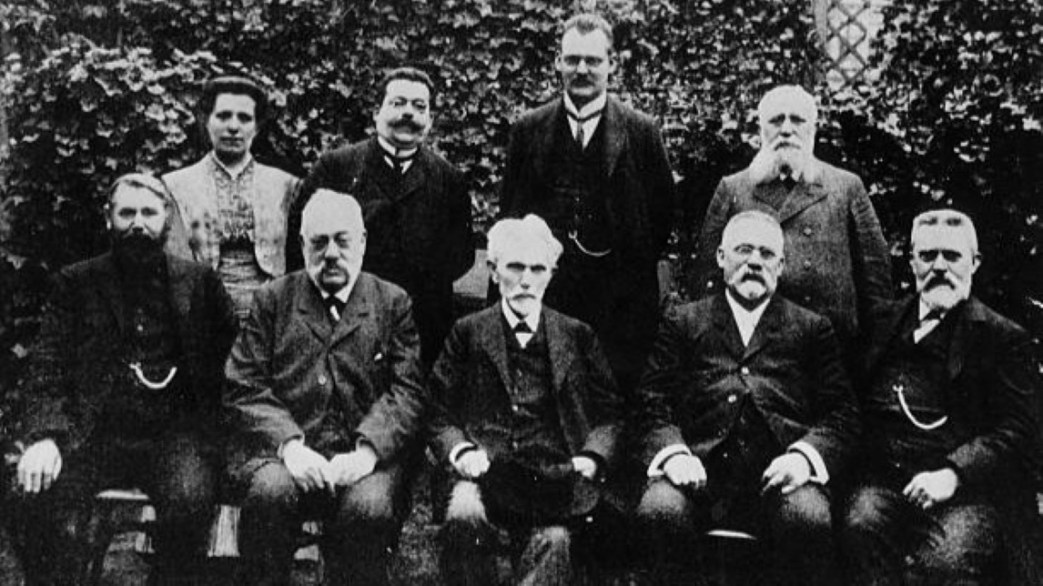
Askew was Scottish Marxist who lived in Germany becoming a translator into English of many German-language works by Kautsky and others as well as serving as European correspondent for the U.S. Socialist press. On the left, Askew would become a Communist, dying in Moscow in 1929. Here he describes Revisionism as it was at the 1908 Nuremberg conference.
‘Struggle Between Revisionists and Radicals Renewed at Nuremberg’ by J.B. Askew from The Chicago Daily Socialist. Vol. 2 No. 292. October 8, 1908.
GERMANS HAVE A HOT SESSION
Special European Correspondent. Stuttgart, Sept. 18. As was expected, this year’s congress of the German Socialists at Nuremberg was stormy. There were sharp divisions of opinion as to the best solution of the questions which naturally arise in the development of the party. There was the old struggle between the Revisionist and the Radical sections of the German party.
There are naturally many points from which such a controversy may be viewed. The general Revisionist point of view is that the whole controversy is caused by the fact that the so-called Radicals are people who cannot leave peaceful folks alone, and that we put forward the pretended difference as a cover under which we can make personal attacks on people whom we dislike on personal grounds.
An Absurd View
In all controversies there are mixed all manner of motives and aims, and that personalities have formed the basis for many a dispute in the congress is not to be denied.
No less absurd is the view that Socialists stick blindly to the theories of Marx and try to apply theories which experience and the process development have long shown to be false.
Quite apart from the question of how far Marx and Marxism are really out of date, which I will not discuss here, the controversy between the Marxists and their opponents is itself a symptom of an antagonism which has developed in the bosom of the movement between the interests of the mass of the members and the officials who have been elected to represent the members.
I do not mean to assert that this antagonism is conscious, but on the contrary, I believe it to be largely unconscious. This, however, is indifferent to my argument as I am not dealing with the moral but the political aspect of the question.
What Revisionism Is
Revisionism, so far as it can be described as a theory, in the first place is the theory of the official element in the labor movement and the theory of those elements in the so-called bourgeois intelligence who have joined the Socialist movement, but have not been able to emancipate themselves from bourgeois methods of thought–methods into which the workingman is only too liable to fall when he attains to an official position. The chief symptom of Revisionism is a growing loss of faith in the possibilities of self-emancipation on the part of the workers and a consequent or concomitant belief in the intelligence and insight of the capitalists as well as an exaggerated value of the role played by the trade union and parliamentary leaders.
Then there is a loss of faith in the inevitability of Socialism with a consequent tendency to reduce Socialism itself to a mere dream of a far off event without any influence on practical life, and also to exaggerate the possibilities for a better existence for the proletariat under capitalism as well as to paint the few concessions which have been gained under capitalism not only in the most ludicrously optimistic colors, but as due to the astuteness of the leaders.
To Replace A Faith
In other words, the whole tendency of Revisionism is to replace a faith in the self-emancipation of the workers through Socialism with a blind confidence in the wisdom and capacity of their leaders, and instead of making clear to them the inevitable and actual misery of their condition under capitalism, to palliate to them the evils under which they suffer under capitalism, and to make out that the position of the workers ls better than it is.
The Revisionist thinkers then have a tendency to fall little by little and step by step into the methods and arguments of the defenders of capitalism.
At first it takes the guise of recognizing such elements is the capitalist arguments are true, until little by little the thinkers find that one concession in this direction leads to others without realizing that the foundation stones of Socialism are being removed and that the structure is in danger.
The Logical Outcome
It is hardly necessary to say that it is not my intention to imply that any of the Revisionists have gone so far as to give up the Socialist program, but that this is the logical outcome of their assumptions and arguments is perfectly clear to me.
How far they themselves draw the conclusions or how long they will take to do it is another matter. One thing, however, is clear–nobody can remain in an illogical position without weakening his own action.
That is what has given the entire Revisionist controversy its importance, and the question which has formed the center of discussion in Nuremberg was whether the party as a whole is to control its representatives or whether these are to be allowed to take up a position which places them in fact above all control, because, what we allow to one today we may be certain will be pushed one or two steps further by others tomorrow.
Here was no mere academic question of the theory of the party, but was an actual question of the political practice of the party.
Has Been Condemned
Revisionism has been condemned at various congresses of the party by enormous majorities–so great that the Revisionists have hardly dared to show their strength, but at the congress this year they felt strong enough to defy a decision of the Lubeck congress on a matter which no one can say they had any sufficient reason to alter and now which they themselves had followed for many years. They did it in a manner which was in itself a defiance to the party.
Without letting the party executive know, the landtag groups of the three southern German states came together to a secret meeting and resolved to vote for the budget despite the resolution of the Lubeck congress.
They hoped thereby to force the hands of the next congress by placing it before an accomplished fact, and they hoped thus that the congress would be obliged to give way to them rather than disavow them. Luckily the matter was brought to the notice of the Pelpalger Volks Zelung, and excited general indignation, especially the fact that the Baden Socialists deliberately refused to give any information to the central executive of the party, and its press systematically played to the gallery of the South German particularism or the local hate against Prussia.
Ruse Is Employed
Not only that, but in view of the fact that the congress of the party was to be held in South Germany an attempt was made to pack the congress with South German delegates pledged to vote for the Revisionists. In fact it is almost certain that the hope that they would be able to do this induced them to provoke a trial of strength. Had they succeeded in capturing the congress naturally that would great victory for them. I may say in this respect that contrary to the usual practice which forbids a man to be judge in his own case and which prevents the reichstag deputies from voting when questions concerning their conduct of the relchstag deputies are being decided, the South German landtag deputies, who formed a large proportion of the representatives at the congress from South Germany, voted regularly in their own cases.
This fact makes the final outcome so much the more strikingly clear how crushing was the final defeat at the hands of those who were disinterested.
The Chicago Socialist, sometimes daily sometimes weekly, was published from 1902 until 1912 as the paper of the Chicago Socialist Party. The roots of the paper lie with Workers Call, published from 1899 as a Socialist Labor Party publication, becoming a voice of the Springfield Social Democratic Party after splitting with De Leon in July, 1901. It became the Chicago Socialist Party paper with the SDP’s adherence and changed its name to the Chicago Socialist in March, 1902. In 1906 it became a daily and published until 1912 by Local Cook County of the Socialist Party and was edited by A.M. Simons if the International Socialist Review. A cornucopia of historical information on the Chicago workers movements lies within its pages.
PDF of full issue: https://www.marxists.org/history/usa/pubs/chicago-daily-socialist/1908/081008-chicagodailysocialist-v02n292.pdf

