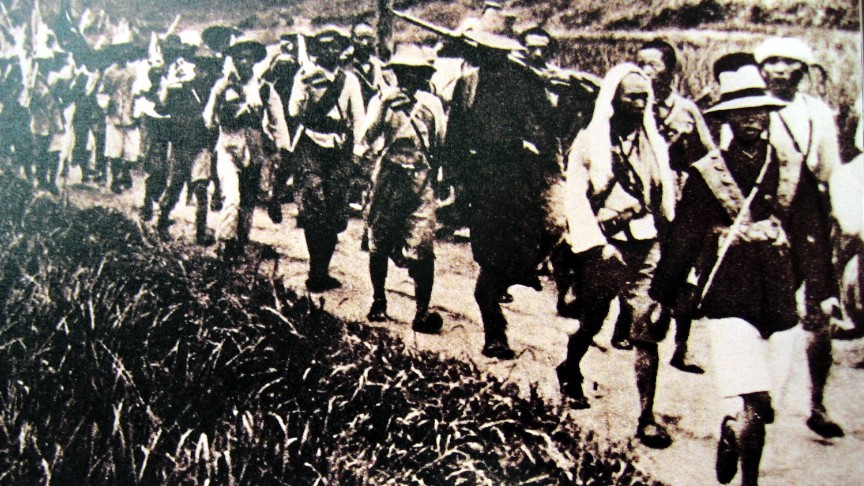
A survey of the situation in China during 1930, which saw not just a war between the KMT and Communists fought mainly in the south, but also a complex, shifting war between Chiang-Kai-Shek and ‘war lords’, some former KMT generals, fought mainly in the north–with all manner of different imperialist and regional players also participating.
‘Soviet Revolution and War of the Generals in China’ by Chiehua from International Press Correspondence. Vol. 10. No. 38. August 31, 1930.
In addition to the Soviet revolution of the workers and peasants and the advance of the Red Army in China, which are directed against the whole counter-revolution, against the native big landowners and big bourgeoisie and the foreign imperialists, there is also taking place the war of the Kuomintang generals in North China. One battle follows another, in which tanks and bombing planes and even poison gas are employed.
The wars of the generals, which never before raged so furiously as at present, are not only an expression of the fights over the division of the spheres of power of the various generals and the split up condition of the ruling class of China, but they also reflect the antagonistic interests, which are becoming more and more acute, of the imperialist powers in China.
The Chiang Kai-shek government, behind which there stands the imperialism of the United States, cannot pay so much regard to the interests of the Japanese and the British imperialists, as the latter would like, so that they have no other course than to make use of the lackey services of the Kuomintang generals of North China.
Simultaneously with their fierce fighting these generals are now endeavouring to form a government in North China as a counter-weight to the Nanking government. The out-of-work Kuomintang politicians of the type of Wan-Chin-wei are being used as advertisements for the new government. The formation of a government in North China will in all probability come about only gradually. A Northern government would mean an intensification of the war as a result of its better financing by means of the income derived from the customs duties and by means of foreign loans.
The present fights of the generals are no longer half fights and half negotiations as they were formerly, but big battles in which over 200,000 men are engaged and extend over a fighting front of more than 1000 kilometres. The scene of the war is in particular the provinces of Honan and Shantung. Chiang Kai-shek’s troops are being opposed by Feng Yu Hsiang troops on the Lunghai railway line in Honan, and by the troops of Yen Shi San on the Tientsin-Puckow and Kantchow Hsinang lines in the province of Shantung. In spite of all the assertions of Chiang Kai-shek that he will soon settle his enemies, there is no hiding the fact that he is in way superior to them. Already in these fights over 100,000 men have been killed on both sides. In his interview with the foreign press Chiang Kai-shek said: “For our army victory does not mean capturing territory, but annihilating the enemy.” It is estimated that the cost of the upkeep of the troops of the Northern generals amounts to over 10 million Mexican dollars a month. The cost of the troops of Chiang Kai-shek and of the other provinces amounts to over 30 million dollars a month. These enormous sums are squeezed out of the Chinese people.
The conduct of the war has been rendered difficult not only by the lack of finances but also by the lack of human material caused by the enormous losses. Both sides have sent every available man to the front and have even sent raw recruits into the field. Chiang Kai-shek is recruiting soldiers in every town. Yen Shi-san has even sent police troops to the front Feng Yu Hsiang compels the big districts to supply 4000 men and the small districts 2000 men for the purpose of conducting the war.
The mercenary troops of the generals’ armies remain for months without pay and are even sent hungry into the field. The severely wounded are left to die on the battlefield without receiving any aid, as the generals think that it is cheaper to recruit fresh soldiers than to heal and restore wounded. Mutinies, insubordination, desertions by the soldiers are the order of the day. The shortage of money and the mutinies are accelerating the collapse of the armed forces of the generals.
In addition to the political crisis there prevails an unprecented economic crisis. Transport by water and land is to the greater part at a standstill; the closing down of works and factories is a general phenomenon in the industrial towns. At the commencement of this year 70 silk mills were closed in Shanghai alone. In the Southern provinces, over 4000 big factories were recently closed down. The factories and works which are still continuing operations are working only 3 or 5 days a week. The number of the unemployed is growing constantly. The depreciation of the silver currency by 40 per cent enables the imperialists still further to exploit and rob the working population. China, which is known as a rice-producing country, is suffering from a shortage of this cereal owing to the ruin of peasant agriculture, so that rice has to be imported. The rice crisis is assuming a very acute form. Owing to the terrible increase in the price of rice, which in many districts has risen by 30 or 40 per cent, furious riots are breaking out among the workers and peasants. The workers are demanding an extra rice allowance as a supplement to their wages and the peasants are plundering the rice stores of the big landowners.
Terrible famine prevails not only in the Northern provinces such as Shansi and Kansu, but also partly in other provinces. The population affected by the famine numbers about 70 million. According to the figures of the relief expeditions sent to combat the famine, in Shansi in 29 districts of the province 40 per cent, of the population have died of starvation, in 28 districts 25 per cent. in 15 districts 17 per cent and in 20 districts 11 per cent of the population.
The economic and political crisis in China, which is becoming more and more acute, has proved the incapability to the ruling class to find a way out of the impasse. The millions of workers and peasants, the sole bearers of the Chinese revolution, are endeavourting to find a way out of this need and misery. The Chinese revolution, which bears a bourgeois-democratic character and whose tasks still remain unfulfilled owing to the treachery of the national bourgeoisie, is entering on a new phase, the phase of the agrarian revolution under the leadership of the proletariat against imperialism and the feudalist regime, against the counter-revolutionary bourgeoisie, for the revolutionary democratic dictatorship of the workers and peasants in the form of Soviets as the precondition to its conversion into the social revolution.
After the defeat of the Canton insurrection, the Chinese revolution, in spite of the united front of the landowners, the bourgeoisie and world imperialism and in the face of many difficulties, still carried the Soviet banner forward to new successes.
Everywhere in the South and Central provinces the revolutionary peasants are engaged in a struggle. The flags of the Soviet power are already waving in the villages and towns. After having twice captured Changsha, which meant a great step forward for the social revolution, the Red Army, Supported by the revolutionary working and peasant masses directed its attention to the towns of Wuchang, Hankow and Hanyang, situated in the centre of China and forming together the town of Wuhan. One can say that Wuhan has long been encircled on all sides by Soviet districts. In the province of Hupeh, in which Wuhan is situated, already seven corps of the Red Army are carrying on the fight. With the exception of the 9th and 10th corps in the Northwest district, all corps are advancing from all sides on Hankow. The surrounding territory is already in the hands of the Soviets.
The Soviet regions already existing embrace a population of over 60 million. The Soviet movement has spread from the South of China to the North. The Red Army has now grown from 14 corps numbering 100,000 men, to 21 corps. In the South of the province of Kiangsu there are five district Soviets. It was here that the 15th corps of the Red Army was formed. In the Northwest of the province of Chili the 19th corps has been formed in 3 Soviet districts to the East of Peking. In the South of this province the Soviet Power exists in five districts in which are the 20th and 21st corps of the Red Army.
In view of the increasingly concentrating Soviet Power. due to the growth of the Soviet territory in the South of China, the revolutionary workers and peasants, under the leadership of the Communist Party of China, decided to make the necessary preparations for the establishment of a Soviet Government in one or a number of provinces. The Presidium of the Congress of the Soviet Districts, which met at the end of May last, in view of the rapid growth of the social revolution, issued a manifesto in the middle of July for the convention of a Soviet Congress of workers and peasants and soldiers soviets for the whole of China on the 7th of November. At this Congress the question of the establishment of the Central power of the Soviets will be exhaustively dealt with.
While the agrarian revolution in the rural districts is making rapid headway, the labour movement in the towns is also growing, which means a strengthening of the leadership of the whole revolutionary movement in China by the working class. Since last year the labour movement has slowly recovered from the depression. In the year 1928 the number of strikers was 400,000; in 1929 this figure had increased to 750,000. The fights of the workers have developed from the defensive to the offensive. Every economic fight becomes rapidly converted into a political fight. In almost every fight it has come to armed collisions with the police. In all the big towns, such as Shanghai, Hankow and Hongkong, workers defence corps are being founded in preparation for an armed revolt. The preparation of the “fourth insurrection” in Shanghai (in the great Chinese revolution three insurrections took place in Shanghai) has become the general slogan of the workers of this town. The workers’ defence corps in Shanghai were already formed in April and in all fights formed the shock troops of the revolutionary workers against the police.
The Communist Party has set itself the task of strengthening its leadership in the workers’ struggles and winning the broad masses of the working class for the red trade unions. The victorious strike of the tramway workers in Shanghai was due only to the determined leadership of the red trade unions.
On the 16th of July, anti-generals war day in China, and on the 1st of August thousands of workers demonstrated in all the big towns with red flags in spite of police terror, whereby it came to street fighting. All this shows that the workers in China are determined to break the white terror by tenacious fight.
With the upsurge of the revolution there is taking place at the same time an increase in the bloody suppressive measures of the counter-revolution. The Kuomintang regime, which is occupied with the war with the generals and perceives its difficult situation, is endeavouring with all means to choke the revolutionary movement in blood.
The advance of the revolution has not only caused the ruling class, the Kuomintang reaction, to tremble, but also the international imperialist Powers perceive with great anxiety the red danger. The victorious advance of the Red Army in China was immediately followed by the cry of the imperialist States, such as the U.S.A., Great Britain and Japan, for joint intervention.
The warships and gunboats of the imperialists proceeding up the Yangtse river to the most im [] on its banks. The bombardment of Yochow, Changsha and other red towns has revealed the brutality of the robber-imperialist States and opened a direct war against the Chinese revolution.
The world proletariat must clearly see that the Chinese revolution is not only a revolution against the Nanking bourgeoisie, but also against world imperialism. The victory of the Chinese revolution must be achieved by the overthrow of the ruling classes and by the defeat of world imperialism. The workers of all countries must realise that the Chinese revolution is also directed against their enemy. The victory of the Chinese revolution means also the victory of the world proletariat just as the defeat of the Chinese revolution is also its defeat. The world proletariat must energetically support their working brothers in China who are now engaged in a fierce fight. In order to prevent the bloody doings of the imperialists in China the workers must develop a revolutionary fight in their own countries. Only by strengthening the revolutionary movement in the capitalist countries will it be possible to prevent the robber-campaign of the imperialists and to hold up the warships proceeding to China.
The victory of Soviet China cannot be achieved by the revolutionary workers, peasants and soldiers of China alone, but must be won by the common fight of the revolutionary workers, peasants and soldiers of all countries.
International Press Correspondence, widely known as”Inprecor” was published by the Executive Committee of the Communist International (ECCI) regularly in German and English, occasionally in many other languages, beginning in 1921 and lasting in English until 1938. Inprecor’s role was to supply translated articles to the English-speaking press of the International from the Comintern’s different sections, as well as news and statements from the ECCI. Many ‘Daily Worker’ and ‘Communist’ articles originated in Inprecor, and it also published articles by American comrades for use in other countries. It was published at least weekly, and often thrice weekly. A major contributor to the Communist press in the U.S., Inprecor is an invaluable English-language source on the history of the Communist International and its sections.
PDF of full issue: https://www.marxists.org/history/international/comintern/inprecor/1930/v10n38-aug-21-1930-inprecor-Virginia.pdf

