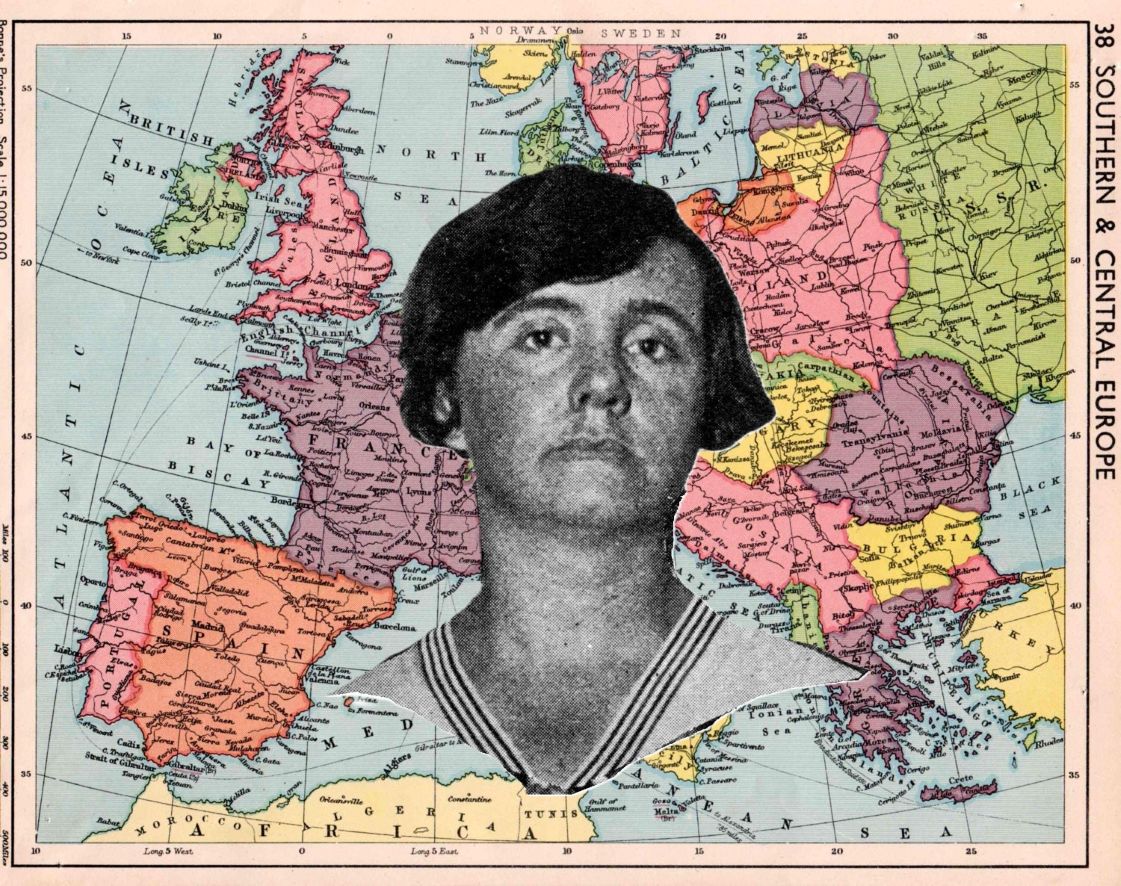
Vera Buch offers a fascinating view of the fractured world of dissident Communists after she toured Europe on behalf of the Communist League of Struggle meeting with activists in Scotland, England, Belgium, Holland, and France.
‘Prospects for an Internationalist Communist Center: Report of European Tour’ by Vera Buch from Class Struggle (C.L.S.). Vol. 5 No. 11. November, 1935.
When the collapse of the Trotsky movement due to its fusion with the Centrist parties left a certain chaos internationally, the Communist League of Struggle decided it was high time to make a definite beginning to locate and if possible to bring together such groups as were still struggling for an internationalist communist line. The isolation had become so great—thanks to Trotsky’s one man policy from the beginning as well as to the other difficulties of our period—that actually we did not know the state of the movement elsewhere. Groups of which we had heard at other periods or with whom we had been in correspondence had dropped out of sight. However, from correspondence renewed with some countries (France, Belgium, Greece) and from new contacts in Scotland and Holland we found groups existing with views sympathetic, on some points at least, to our own. We, therefore, felt there was a basis for attempting a regrouping of the movement and decided to send a delegate for an international tour.
The trip had to fulfill several purposes at once. It was a voyage of discovery, hunting for left groups like Diogenos with his lantern. It was a linking up of such groups as were found and at the same time a preparation for the international conference which we considered an essential step towards the creation of a new internationalist communist center. It may help to clarify matters if a brief summary of the international situation among working class political organizations is given before proceeding to a detailed report on the tour.
Both Communist and Socialist parties may be lumped together today as Opportunist or as Centrist bodies, with little difference in degree between them. They vary from country to country, in some countries the left wings in the S.P. are stronger than in others, but everywhere a convergence is taking place of S.P. and C.P., if not an actual united front. Opportunism reigns supreme in those parties, which still claim the largest influence over the working class. Only a few phrases mentioning Soviets or proletarian dictatorship once in a while classify the Communist Parties as even Centrist bodies; their policies (for example the latest 1935 Dimitrov method of fighting fascism and the plan to appeal to the League of Nations on Ethiopia—see Class Struggle of Oct., 1935) having become thoroughly reformist.
The collapse of the old internationals has brought to the surface everywhere new groupings and fractions within the old parties most of which have to be also classified as Centrist, although some are moving in a left direction. At the present moment we see three such groupings with an international scope:
1. The London Bureau. This grouping includes a fair number of parties: The British Independent labor Party, the Norwegian Labor Party, the Revolutionary Youth Bureau, the Spanish Socialist Party, etc. At its conference held in Paris in February, 1935, this grouping defeated a motion for the immediate formation of the Fourth International at the same time passing a resolution accepting the new international in principle. Their program is everywhere characterized by vagueness and a postponing to the future the tasks which need to be tackled today.
2. Recently a new grouping has appeared, the bloc of the “New Zimmerwald”. The S.A.P. (affiliated with the London Bureau) the Pivert group in the French Socialist Party (S.F.I.O.) and the Doriot group in France, constitute this tendency, which does not appear to be tremendously different from the London Bureau, except that it goes one step ahead in calling for an international conference, a “New Zimmerwald”. the Doriot group and perhaps others are partisans of the idea of one proletarian party, bringing together all working class parties on a bare minimum basis of communist principles.
3. The Trotskyists from out the shelter of their centrist coverings are calling once more for the formation of the Fourth International (and on the same basis and with the same maneuvers as in 1933, it appears). Their call has been signed by their Secretariat, by the W.P. of the U.S., the W.P. of Canada, the Dutch R.S.A.P. (formerly with the London Bureau) by the Bolshevik Leninist group in the S.F.I.O. Where are all the groups of other countries formerly affiliated with the Trotskyist center? Where is Spain? Where is Greece? Where is Poland? Where is China, South America, etc.? We are forced to conclude that we were correct when we said the fusion policy would rend the Trotsky movement asunder, and what few pieces are left we see here.
There exist also certain independent currents in several countries, among which we must look for the crystallization of a real left at the present time. Not all the groups we shall speak of are in agreement with what we consider to be a correct communist line, and no doubt only time will tell which are the product of disillusionment and have stepped aside from the battle front to criticize and which will actively play a role in the coming revolutionary struggles of the proletariat. Nevertheless, we have considered these groups to be sufficiently close to want to base our coming conference on them. These groups include the following:
1. The Internationalist Communist Tendency formerly connected with the Left Opposition and now independent. Of these we have seen four groups besides our own: two in France and two in Belgium. There exist also three groups in Greece (with one of which we have corresponded and which has declared itself to be in agreement with us) also groups in Poland, Spain and China.
2. The Anti-Parliamentarian tendency of which we have discussed with two groups in Scotland and two in Holland.
3. The Italian Left Fraction (Bordighist tendency) with headquarters in Belgium and groups also in France, Italy and America.
4. Besides these there are two groups in Scotland and the nucleus of a group in England which do not fit into the above classifications, but which have expressed themselves as being in agreement with the program of the C.L.S.
Scotland
The first lap of the tour was Scotland where I spent a month. Mass meetings were held in the principle industrial cities: Glasgow, Paisley, Coatbridge, Aberdeen and Kirkcaldy at which I spoke on “The Situation in America”, on “The Collapse of the World Communist and Socialist Movements” and “The Need for a New Movement”.
The audience at the meetings we held were always thoroughly proletarian, based on the industries of the section, with a big proportion of unemployed. The various points of view were represented: C.P., I.L.P., Labor Party. Even a representative of the British section of the Socialist Labor Party ( or rather one of their sections, since they boast of two ) popped up in one of the meetings, strange to say quite identical not only in his line of talk, but even in appearance with his American brethren, who grace our forums here.
There is great interest in America there, and the bonds between ourselves and the workers of Great Britain are stronger than we realize. Countless workers, who have lived for a time in the States have returned to their native land still retaining their interests and connections in America and constituting a permanent link between this country and their own. But on the other hand, the situation confronting the workers in Great Britain is as different as possible from our situation. They have to deal with an old capitalism, with a full fledged system of reformism, with a ruling class especially well consolidated and clever in keeping the workers in check. Furthermore—and this after all is a decisive though little recognized feature in their life—they are the center of an empire. The British working class sits at the top of a pyramid of which the base is the exploited colonial masses of India, South Africa, etc. Since the collapse of the General Strike in 1926, stagnation has been the keynote of the labor movement, to which the unwillingness of the rulers to provoke the laboring masses. The great resources of the British Empire, the extensive grip of the reformist organizations (including the unions) on the workers, and the extensive unemployment all contribute. Scotland, especially the Clyde Valley—center of heavy industry—is more severely exploited than most of England, and worse hit by unemployment, hence a more favorable center of activity than London or probably any other city of Great Britain.
There also took place a number of discussions with the organized tendencies. Two groups exist (the Anti-Parliamentarian Communist Federation and a recent split-off the United Socialist “Movement” of Aldred). No political reasons exist for there being two groups, as the opinions of both are quite the same. In fact, Aldred was compelled to admit (when questioned at a meeting in Paisley as to why he had left the A.P.C.F.) that the split had only a personal basis. Neither group puts out a paper at the present time. We cannot within the space of this article go thoroughly into the views of any group, and I will therefore simply summarize these views as follows: Belief in the function of the party as a propaganda organization, existing only until Soviets or workers councils are organized and then disappearing; conception of the reactionary character of the peasantry in all cases; against defense of the Soviet Union; conception of Leninism as an essentially reformist ideology and responsible for the failure of the Communist International; reactionary character of the national liberation movements; boycott of trade unions. There is by no means unanimity of opinion among the comrades of these groups, and so many shadings of opinion exist that exceptions may be found to any of the above stated conceptions. Some of the individual comrades are far closer to our own point of view than this summary would indicate. These groups carry on propaganda meetings and circulate quite a lot of literature. Since they refuse to have anything to do with “reformist bodies” they do not do any systematic work among the other working class organizations and to the general handicap of the present period and the stagnation prevailing on their island they add the handicap of a sectarian approach to the movement. Nevertheless there is a sincere attempt to fight reformism, and it is too bad that groups which stand out against the legalism and parliamentarism, which have turned the labor movement in Great Britain into a bulwark of capitalism, should be isolated through any fault of their own. Their conceptions of the movement lead to an abstractness in their approach, to a tendency to dwell on the generalities of Socialism, rather than on the concrete solutions of the problems which press on the workers today.
In Coatbridge—a coal, iron and steel center near Glasgow, a sort of Scotch Cambridge—there is an open forum holding weekly lectures with an average attendance of at least two hundred. The bulk of the workers around this forum have been or still are in the various political tendencies—L.P., I.L.P., and C.P. When the chairman of the forum, at one of the meetings which I addressed, expressed agreement with the views I presented, we called a small meeting of the most interested workers for a discussion of the program. After an exposition of the principles of the C.L.S., the workers agreed to consolidate an organization along the lines of those principles. They also endorsed our attempt at an international conference and took a stand for the Fourth International.
There exists, also, in Glasgow a group of the Scottish Workers Republican Party, inheritors of the group of the well known sturdy revolutionary fighter, John MacLean. This group arranged a discussion meeting jointly with the Esperanto Club and the Workers Study Circle, a meeting attended bay about 75 people. From our discussion, and from the talks I had with Comrades MacIntyre and Renny—the leading comrades of the group—they seem to be quite close to the views of the C.L.S. and endorsed our views on the Fourth International and International Conference. On one point, however, I think we differ with them: They are attempting to carry forward MacLean’s idea of a Scottish Workers Republic, a sort of proletarian nationalism. Where the national differences are on the road to disappearing, as they seem to be in Scotland, to stir them up and accentuate them, to try to stimulate national feeling to this extent would seem to be dividing the workers forces and to play into the hands of reaction. On the other hand the opinion of these comrades that Scotland, and particularly the Clyde Valley—the most heavily industrialized section of Great Britain—can play a leading role in the revolution and act as a spear head against British imperialism, seems very correct and, indeed, provides a real strategy for the movement there.
In Aberdeen, I spoke before a branch of the I.L.P., probably the best branch they have, outside of Glasgow, in all Great Britain. There were about 50 people present constituting the active membership of the branch. I stressed the vague and wishy- washy character of the I.L.P program, its compromising maneuvers with the C.P. and the need for the Fourth International. No one opposed these views in the discussion and after the meeting several members expressed their agreement with what I had said; one in fact requested me to send a bundle of the Class Struggle monthly, which he undertook to circulate.
There are Trotskyists in Scotland—but try to find them! At one of the meetings in Glasgow a youth , who spoke in the discussion identified himself with the L.O. I spoke to him cordially afterward, and he informed me that there were six or seven comrades, who circulated Trotsky’s writings and condemned the fusion policy. Naturally I expressed a desire to meet with this group, but the young man appeared to be on pins and needles to get away, and the moment my attention was taken up by someone else speaking to me, he fled. Neither track nor trace of him nor his group could thereafter be found.
England
Indeed the Trotskyists altogether were quite illusive. In London, I would have liked to have addressed them as a group, but Comrade Matlow, the secretary of the “Marxist Group” in the I.L.P., with whom I communicated, was obviously unwilling to cooperate with me. No trace could be found of them outside of the I.L.P., in which they function as a rival faction to the Communists (Revolutionary Policy Committee). The “Red Flag” has ceased to wave.
In fact, no group outside the Centrist and reformist parties with the exception of the Anarchists could be found functioning in London. The former Anti-Parliamentarian movement has disintegrated. But there are possibilities of organizing an Internationalist Communist group through the efforts of Comrade John O”Donnell, an Irish revolutionist of long standing, at one time with the A.P. movement but now independent. He and a group of comrades hold street meetings, so that there is a movement existing in a loose form, without definite organization and without an organ. Comrade O”Donnell is thoroughly in agreement with the principles of the C.L.S. and taking steps to crystalize an organization and to put out a paper. Poverty and other obstacles stand in the way, but here is a fighter, who does not shrink at difficulties and who will surely get results in time.
Belgium
In the small time I spent in Belgium, I was in touch with three groups. A joint meeting was held in Brussels of the League of Internationalist Communists (Hennaut group) and the Italian Left Fraction (Bordighist group). I spoke on “The Situation in America,” on “The Principles of the C.L.S.”, and on “Our Plans for the International Conference”. The comrades were at first skeptical, their objections being not in principle, but rather due to disappointment at the collapse of the Trotskyist attempt in 1933 (Paris conference) and to a belief that our forces are still too weak. This I answered with the argument that we are not ready to proclaim the organization of the Fourth International, but rather to create a nucleus, an Internationalist Communist center which can develop the necessary correct program and can help to group together the left elements, which must break away from the old parties as they disintegrate, as well as to attract the fresh elements from the ranks of the workers. The comrades were sufficiently convinced to agree to cooperate with us, and even to undertake the arrangements for the conference.
Both of these groups deserve more attention than we can give them here. Comrade Hennaut was formerly Secretary of the C.P. of Belgium, and with a group of comrades was expelled for supporting the position of the C.P. In 1931, Trotsky created a split in the movement, by endorsing the Charlerei section (the questions involved are too complicated to be gone into here) repudiating the Brussels section of which Comrade Hennaut was the head. This section with groups in various cities has since remained independent, putting out two papers in French and in Flemish.
The Italian Left Fraction, formerly among the founders of the Italian C.P., is one of the oldest opposition groups in the Comintern. Their disagreements with Lenin and with Trotsky were chiefly along the lines of anti-parliamentaryism. They have groups in Belgium, Paris, and the United States, and publish two papers: “II Prometee”, a newspaper in Italian, and “Bilan”, a theoretical monthly organ, in French.
There was not time to attend the meeting of the Internationalist Communist League (Trotskyist) but I interviewed the Secretary, Comrade Vercocken, a worker comrade (as are the leaders of the other Belgium groups) during his day off. Comrade Vercocken’s condemnation of the Trotskyist fusion with the Belgian Labor Party was published in the May, 1935 “Class Struggle”. But Comrade Vercocken has still not separated himself clearly from Trotsky. The fusion is to him an incorrect tactic, not a capulation, and he thinks the Fourth International can be built with such elements as the W.P. in America and the R.S.P. in Holland. He definitely accepted, however, the invitation to attend our conference. My impression of our interview was that Comrade Veroocken eventually must find himself on our side of the fence, although it may take more hard knocks to convince him and to break him away from Trotsky.
There is much misery in Belgium, and the inflation and threatened collapse of the government have created great restlessness among the workers. In the Spring of this year, the miners carried on an outlaw strike against the will of the union bureaucrats in which they took over the mines and held them for thirty hours, until beaten down by troops. Comrade Hennaut was expelled from his position as secretary of the Building Trades Union for endorsing the strike. Fighting the DeMann Plan and the reformist it represents, tearing the workers away from the grip of the bureaucracies in unions and political parties, are in general the tasks of the moment there.
Holland
The next lap of the trip was a limited stay in Holland, where I was most hospitably received by the comrades of two groups. One of these, the Internationalist Communists, are the descendants of the Gorter-Pannekock opposition in the Comintern. Comrade Gorter is now dead and Comrade Pannekock is too old to function. This opposition was connected with the K.A.P. of Germany which Comrade Lenin considered ultra leftist, but which was defended by Comrade Gorter in his pamphlet, “Reply to Comrade Lenin in the Infantile Sickness of Leftism”. While I could not read the literature of the group, the exposition of their views which Comrade Canne-Meyer gave in German convinced me that their opinions are identical with those of the United Workers Party. The other group, the “Union of Communists”, which works closely with this one, has a quite different history, being a split off from the Communist Party, expelled after a period as an opposition within. Its secretary, Comrade Gooharadt, a young man apparently of energy and devotion to the movement, was formerly editor of the party paper. At the present time this group appears to have accepted the theoretical positions of the Internationalist Communists. Both of the above groups have members in various cities as well as in Amsterdam where I met them.
The biggest “left” group in Holland is of course the R.S.A.P. composed of a fusion of the R.S.P. (affiliated with the old S.O.) and the C.S.P. (Independent S.P.—a split off from the S.P.). The comrades took me to see Schmidt and Sneevliet, leaders of this party. Comrade Schmidt, known for his charming manners, was quite elated having been just elected to the municipal council. He graciously consented to see me the next day for a longer interview and, also, failed to show up, when I came to keep the appointment. I did, however, meet Comrade Sneevliet, with whom I would have liked to discuss the situation in his party. Comrade Sneevliet, however, after a few preliminary remarks, was off on a history of the N.R.S. (an independent union movement which is controlled by the R.S.A.P.) and I was convinced that had I been there for ten hours more, I would not have heard anything except the story of his baby, N.R.S.
There is another little group of Trotskyists in Amsterdam, keeping up an independent existence. For what reasons I was never able to find out, for which the comrades tried to arrange an interview for me, these courageous revolutionists refused to see me on the grounds that I could not be anything else than a spy for Sheeviliet! Our friend Sneeviliet must be a potentiate of tremendous power if his spy system is so well organized as to be able to bring spies all the way from America to trap the Trotskyists of Amsterdam!
One interesting point was reported by the Comrades of the Internationalist Communists and Union of Communists, namely the development of a left fraction within the R.S.A.P., whose views they told me were between those of the Trotskyists and the Anti- Parliamentarians.
France
In France such a multiplicity of groups exists as to be at first a little confusing to the new comer. But after a study of their papers and a little knowledge of their history one can group them and sift out what is really worth while. Let us first take the two groups of the Internationalist Communist tendency which are now functioning independently.
1. L’Union Communists. This is a group which broke away from the L.O. in 1933 at the time of the Paris conference. They conducted the attempt to form the Fourth International, not on principle, but on the grounds of opportunist methods, of basing the attempt upon centrist elements and upon bureaucratic methods of calling the conference, laying out the program in advance, etc. The group has since developed quite a divergence from the views of Trotsky. They emphasize very much the intransigence of principle and vanguard character necessary for the proletarian party. On the Soviet Union they seem to be drifting towards the views of the Bordighist fraction by which Comrade Hennaut also has been influenced. On the French situation the group has a slogan which seems to me must be characterized as dubious, namely: “Break the discipline of parties”. They argue that the France Soviet pact and in general the policy of the Front Communists constitute a capitulation as gross as that of the Socialist leaders in 1914, and that we must have a slogan which will bring out to the workers the betrayal which already has been consummated. What is missing is that the workers are not yet ready to respond to such a slogan. It, therefore, becomes a sort of bureaucratic ultimatism. It is perhaps a lack of patience with the rank and file in the C.P. and S.P., an unwillingness for the slow, tedious work of the fraction among the masses of workers who are still bound to the chariot wheels of opportunist groups, which is responsible. It is true that events in France are moving rapidly, the crisis is rapidly approaching, but this fortunately does not bring about a corresponding speed in the workers ideological development. On the other hand, this group has developed a good program on the present situation in France and also on the question of the fight against imperialist war, printed in their paper, “L’Internationale”.
The small group of comrades in the French Communist League, who opposed the fusion with the S.F.I.O. remain independent as the “Action Leniniste”, publishing “Le Proletaire d’Avante-Garde”. For a brief period during the beginning of 1935 this group was fused with the Union Communists. So many conflicting things were told me by both sides as to their subsequent split that it is difficult to state exactly what took place. The chief reason seems to have been, however, on the question of fractional work inside the S.F.I.O. This the Action Leniniste has tried to do, and the Union Communists apparently is opposed. The A.L. is attempting also to do mass work in the unions and unemployed groups with which its members have connection. The Action Leninists, however, has yet to work out a firm position as a group, to distinguish itself from the Bolshevik Leninists otherwise than by not joining the S.F.I.O. Both of these groups accepted to cooperate with us in the international conference.
2. The Bolshevik Leninists function now only as a fraction inside the S.F.I.O. Already their six youth comrades of the Sonic Federation were expelled, with a few others. Naville, who had at first hesitated, joined later than the others, but Naville assured me the happy family is quite unified now, and everything is rosy as rosy can be. No one would deny that the Bolshevik-Leninists have the most clearly left program of any of the numerous fractions. In influence they cannot compare, however, to the group of M. Pivert, whom they are trying to win over. The B.L.’s are simply one of many groups inside the S.F.I.O., bound by the discipline of the party, compelled to call upon militants to join and build up the socialist party and restrained from any real criticism of the leaders. The expulsion of the youth, public remarks of Leon Blum at the last national congress of the party, and recent restrictions on La Verite all point towards a coming expulsion of the Bolshevik- Leninists as a group.
Treint, old war horse of the syndicatist and Trotskyist movement, has found a resting place within the S.F.I.O., even before the Trotskyists, and there, with a little group around him, puts out the “Lutte Finals” (Final Struggle). Treint’s favorite talking point is the existence of state capitalism in Russia.
We pass over the other groups within the S.F.I.O. as having no significance at present for the formation of the Fourth International.
Rosmer, also one of the founders of the French Trotskyist movement, is no longer a member of any group, but speaks occasionally at meetings and is publishing a book dealing with the record of the labor movement in the last war.
3. The syndicalists in France may be found today in two definite currents). a.) The group around the paper “Revolution Proletarienne”. I interviewed some of the leading comrades of this group. This group does no independent organization work. It functions only within the unions of the C.G.T.U. (General Federation of Labor). When I asked why the revolutionary syndicatists had no organization of their own, the comrades became rather apologetic. They pleaded that their views met with little sympathy, etc. b) The anarcho- syndicalists are around the union grouping known as the C.G.T.R.S. (Revolutionary Syndicalist Federation of Labor) which puts out a paper “Le Combat Syndicalists” (The Trade Union Fight). The comrades I met of this organization informed me their chief strength is in Lyons, the silk center, and a few other towns—such as Narbonne—in the south of France. It does not appear to be strong enough to play a decisive role, although there is a large percentage of unorganized workers in France, (probably 9-10ths) which can provide a big field of activity.
4. Two opposition fractions of the Communist movement exist: a) the group around the paper “Quo Faire?”. which claims to have a number of functioning fractions inside the C.P. as well as people supporting the paper outside. It is difficult to see what future this group can have. It is definitely opposed to the idea of new parties, and orients itself entirely on the reformation of the C.P. Its criticisms cannot be very drastic, and even should it be able to group a few malcontents around itself, nothing can be done except to throw them against the wall of the Stalinist bureaucracy. b) A much more considerable group in numbers is the Doriot faction. Doriot since his expulsion in 1933 for advocating the united front in the German situation seems to be evolving definitely towards the right. His group, “The Friends of Unity”, publishing a newspaper called “Emancipation”, advocates the one party idea and is linked up with what remains of the “Pupists” (Party of Proletarian Unity)—the French Lovestoneites and also with a group known as “Front Social” (Social Front), which is a split off from the Radical Socialist Party. At the head of the Front Social is one Borgery, who is considered to have Fascist tendencies. Rumors are current that some of the leaders of the Dorist group have had interviews with dissident elements of the Voluntaires Nationaux, a Fascist organization, a subsidiary of the Croix de Feu. There was also an interview with Doriot published in “La Republique”, in which Doriot is said to advocate a war policy in line with that of certain sections of the French bourgeoisie, namely a conciliation with Germany. This policy has also been advocated openly in “L”Emancipation”. The Doriot faction is a large one: Besides the members outside the C.P., it controls the majority of the section of the C.P. in St. Denis, a proletarian section on the outskirts of Paris, where Doriot is Mayor. Expulsion does not take place because this is one of the most important sections and the Stalinists cannot afford to lose the members.
A significant step has been taken among the French left wing in the organization of an anti-war conference, (one meeting of which I attended) which has grown to considerable size. Its national conference on August 10th-11th, represented already thousands of workers. The Doriot group, the “Proletarian Revolution Group” and the Teachers Federation appear to be in the majority. Naturally, it was difficult to obtain unanimity of program among a very heterogeneous gathering, and naturally, also, a correct and complete stand on the war question, which would involve condemnation of the policies of more that one group in the conference, is not to be found. The conference, however, is taking a stand against the France-Soviet Pact; it is the first organized move against the Popular Front and as such, if the Internationalist Communist groups are willing to work as minorities in it, should provide a means for winning some workers away from the Communist and Socialist parties.
The Communist League of Struggle was formed in March, 1931 by C.P. veterans Albert Weisbord, Vera Buch, Sam Fisher and co-thinkers after briefly being members of the Communist League of America led by James P. Cannon. In addition to leaflets and pamphlets, the C.L.S. had a mostly monthly magazine, Class Struggle, and issued a shipyard workers shop paper,The Red Dreadnaught. Always a small organization, the C.L.S. did not grow in the 1930s and disbanded in 1937.

