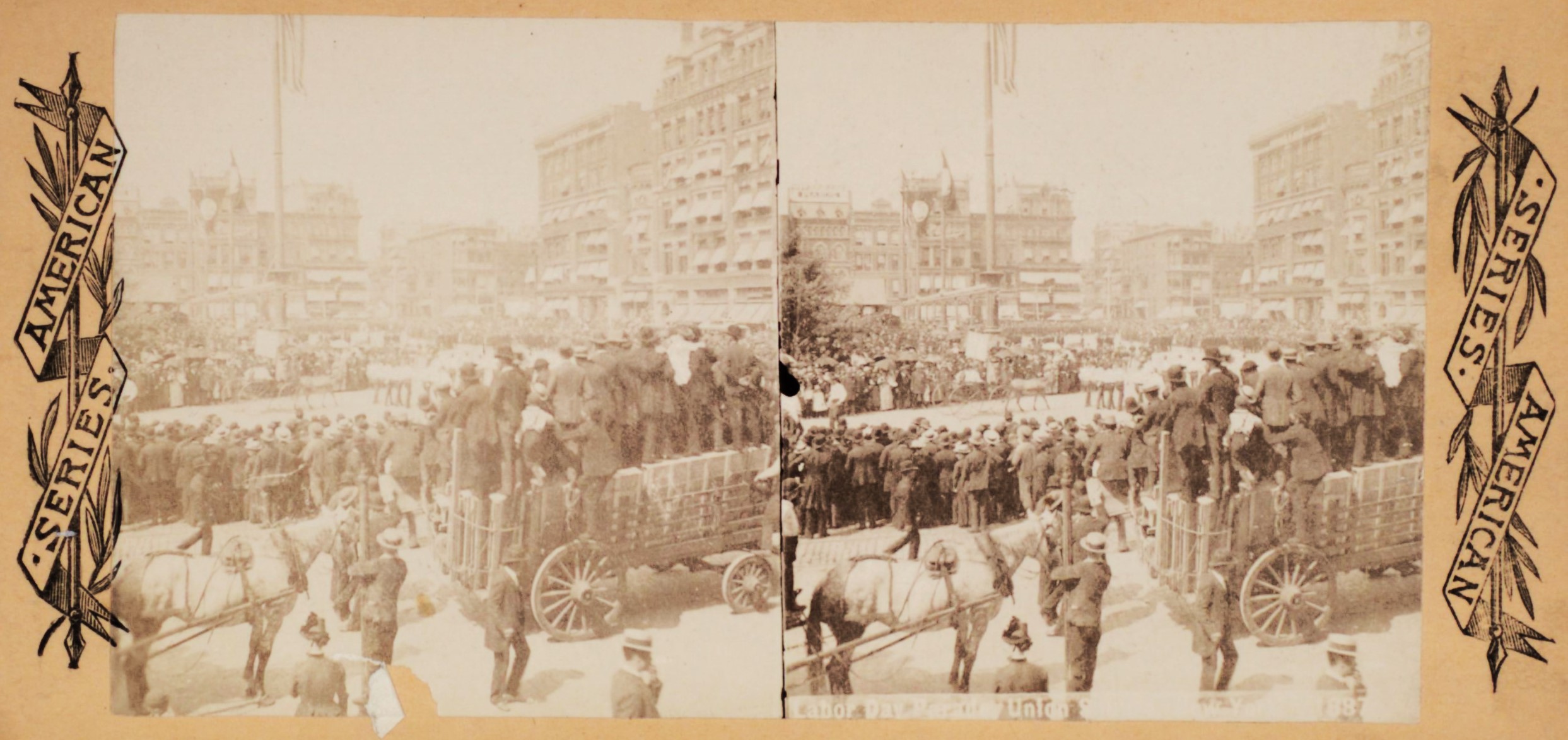
In preparation for that summer’s founding convention of the I.W.W., Justus Ebert, here a member of the Socialist Labor Party, summarizes the U.S. labor movement from its origins through the to the coming ‘Chicago conference.’ A history he would very much be a part of as a comrade who voice was central to the workers’ movement for decades. Born in 1869, Ebert began his life in the world of newspapers as a New York newsboy, working in it at nearly every aspect until his death in 1946. A Marxist and member of the S.L.P. by the mid-1890s based in Brooklyn, a lithographer by trade, Ebert was senior editor of the The People, before leaving the S.L.P., like many of its activists, in 1908 to stay with the I.W.W. after De Leon’s exit. A staggeringly prolific writer, for forty years there was almost no week that went by without a left-wing publication printing an article by Ebert. As an editor of Solidarity and Industrial Pioneer, his articles as ‘J.E.’ graced nearly every issue of the I.W.W. press, particularly focused on economy and industrial processes. Later writing for Labor Age (like other former I.W.W..ers B.H. Williams and Covington Hall, Ebert was also long-time editor of The Lithographers Journal, organ of the Amalgamated Lithographers of America.
‘Trades Unionism in the United States 1742-1905: Bulwark of Capitalism or Framework for Socialism?’ by Justus Ebert from The Weekly People. Vol. 14 Nos. 47 & 48. February 18 & 25, 1905.
DEDICATION.
To thee old cause!
Thou peerless, passionate, good cause,
Thou stern, remorseless, sweet idea
Deathless through the ages, races, lands.
–WALT WHITMAN.
AN HISTORICAL GLIMPSE
FOREWORD.
The question of trades unionism is one of great importance. The organizations of men employed at trades figure largely in the economics and politics of the day. Their principles and control have become a matter of tremendous social significance. This applies not only to the present forms of society, but those of the future as well. Trades unions are either the bulwarks of capitalism or the rudimentary framework of Socialism.
A question so pregnant with significance is worthy of study. Emerson says: “Man is explicable by nothing else than all his history.” So with trades unionism. The best study of trades unionism in the United States is all of its history. It will be the object of this paper to furnish a glimpse of this history in order that interest in the study of American trades unionism may be stimulated and the extent of its profundity realized. As the word implies, the glimpse will necessarily be brief, including in its sweep only typical instances of progress, both upward and downward.
THE BEGINNING.
Washington Irving, in his learned “Knickerbocker’s History of New York” found it essential for his humorous purposes, to begin his narrative of this great metropolis, at the beginning of the world. It is not necessary for our purposes, which are far more serious, to begin this historical glimpse at so remote a period. As a consequence, lengthy disquisitions on primeval causes will be foregone, in order that a statement of facts may be presented without much ado.
The first strike in the United States occurred in 1742, when number of journeymen bakers in N.Y. City refused to bake until they had received more wages. Though this required combined action, trades unionism may be said to have only begun to make history in this country in the early 70s of the last century. Then began the great organization of labor which has continued ever since, growing more extensive and portentous with each succeeding year, until now it shakes the entire nation from ocean to ocean with its reverberations, and holds out the promise of becoming a constructive force in the transition from the old order to the new.
The reason for the late growth of American trades unionism is not far to seek; nor is it complex and difficult of mastery. When the journeymen bakers of N.Y. City struck in 1742, the country was sparsely settled. A great continent had not been even fringed with population. Land abounded. Pioneering was the order of the day. There was comparatively little interstate commerce and communication. Most commodities were created and consumed in the homes of the people. The manufacture that existed in the cities and towns was mainly based on the division of manual labor, or handicraft, and required little capital for its pursuit, making it easy for journeymen to embark in self-sustaining enterprises. As a result of this condition there were no large industrial centers, with their few owners of highly concentrated capital, on one hand, and millions of propertyless workmen, on the other, engaged in an irrepressible conflict interest. The Civil War, however, by destroying Chattel Slavery, gave great impetus to Capitalism, which, in turn, developed the conditions which make the modern labor organization the great social phenomenon it now is.
PRIMITIVE CLASS-CONSCIOUSNESS.
Nevertheless, though it is a fact that American trades unionism lid not begin its important career until after the Civil War, its history prior to that period cannot be neglected with impunity. Therein is shown how the great plant took root. Therein will be found the key to the understanding of its “un-American” aspirations. Besides the strike of bakers already mentioned, history records at strike of shoemakers in Philadelphia in 1796. They went out again in 1798, and still again in 1799. In 1802 the sailors of New York City struck. In 1805, its shoemakers followed suit. In 1817 several ports could refer to a simultaneous strike of caulkers and shipwrights. But though these revolts were summarily suppressed as the work of unlawful combinations and conspiracies, they were all more or less spontaneous and sporadic in character, instead of the reflex of a strong tendency toward conscious and deliberate organization. This did not appear until 1825. In that year, according to Prof. Richard T. Ely’s “The Labor Movement in America”, the history of trades unionism in this country may be said to have made a beginning. As this date coincides with the rise of the great textile and other industries, it appears an appropriate one for such a beginning, in every respect.
What was the distinguishing characteristic of the year 1825? “About that time,” says Prof. Ely, “a new spirit and a new purpose began to animate the laboring classes. They became more conscious of their existence as a distinct part of the community and with interests to an extent not identical with those of other social classes, and very naturally the idea of class action on a larger scale than heretofore became more familiar to workmen; and from that time forward this idea became more cherished among them.”
To the social student, it is at once apparent that what gave the year 1825 distinction and marked it as the period in which to begin the history of the labor movement in this country, was its manifestations of the Socialist, or class, spirit. Trades unionism was for the first time animated with the idea that the interests of the working class are separate and distinct from other social classes, and that its organization must be perfected accordingly. This is an important fact, as it shows the “Socialistic tendencies”–“those foreign importations of recent date”–to be of sturdy old American origin!
EARLY POLITICAL ACTION.
Prof. Ely, still referring to the period now being described, says further:
“During this first period political action as an instrument of social amelioration is frequently urged, and we begin to hear of workmen’s parties.”
This is indeed remarkable, considering that it was only in 1822 that the workmen of New York secured the franchise. Prof. Ely, quoting Prof. Hosmer’s “Samuel Adams”, shows that almost a century before, the artisans and mechanics of Boston, were a bold and spirited body of men who exerted an influence in political affairs. Political action led to the organization of a comparatively strong workmen’s party in New York State and New England in 1830. In 1835, the Equal Rights party arose in this city. Sir Charles Lyell; the noted geologist, tells of a New England workmen’s party in his book, “A Second Visit To The United States”, which is replete with facts, impressions and opinions on the America of 1845. Sir Charles, describes the election in Boston. He tells how, mistaken for an elector, he was given the tickets of four parties. “The real struggle was between the Whigs and the Democrats”, he writes, “the former of whom carried the day; but besides their tickets, two others were presented to me, one called the Native American, and the other, the Workmen’s ticket. The latter had for its emblem a naked arm, wielding a hammer, and for its motto “The strong right arm of labor. The five Senators proposed in this list consisted of two printers, a carpenter, a blacksmith and a surveyor, and among the representatives were four shoemakers, one tailor, eight carpenters, four printers, an engineer, etc.” This will enable us to form an idea of the composition of the workmen’s political parties of that day. The class spirit of early trades unionism was not confined to trade organization and political action. It also found vent in the furtherance and support of communistic and Socialistic enterprises of a Utopian character. The theories of Owen, Fourier and Brisbane were a part of American trades unionism from the very beginning.
MODERN SOCIALISM FORESHADOWED.
In order to appreciate the spirit of early trades unionism, a few illustrations cited by Prof. Ely, may be used. He mentions that already in 1830, “Young America”, a labor paper that grew out of “The Workmen’s Advocate”, the first labor paper in this country, advocated, among other radical measures, “Abolition of chattel slavery, and of wages slavery”. He also refers to the noteworthy address of Ely Moore, President of “The General Trades Union of New York”, the first central labor union in the country, delivered in 1833. Moore states the objects of “The General Trades Union of New York” to be “to guard against the encroachment of aristocracy, to preserve our natural and political rights, to elevate our moral and intellectual condition, to promote our pecuniary interests, to narrow the line of distinction between the journeyman and the employer, to establish the honor and safety of our respective vocations upon a more secure and permanent basis, and to alleviate the distresses of those suffering from want of employment.” Prof. Ely informs his readers that two or three years after the delivery of this address there was enough class feeling in New York to enable Moore to secure an election to Congress as a representative of the working class.
More remarkable than the spoken address of Moore is the printed address of Stephen Simpson, published in the city of Philadelphia in 1831. In it “the working class”, to quote Prof. Ely, “are told that the old political parties offer them no hope of satisfactory reforms, and they are urged to support the ‘Party of The Workingmen’, which, ‘resisting the seductions of fanatics on one hand and demagogues on the other’, presses forward in the path of science and justice, under the banner of labor, the source of wealth, and industry the arbiter of its distribution’.” This is a truly Socialist declaration!
A more striking Socialist declaration is that of Thomas Skidmore, a labor candidate for Governor of New York State, uttered in 1829. Says Skidmore:
“Inasmuch as great wealth is an instrument which is uniformly used to extort from others their property, it ought to be taken away from its possessors, on the same principle that a sword or a pistol may be wrested from a robber, who shall undertake to accomplish the same effect in a different manner.”
This is the Marxian doctrine of the expropriation of the expropriators foreshadowed on American soil two decades before its first European enunciation.
PROGRESS ACHIEVED–CONDITIONS COMBATED.
Prof. Ely shows that, animated by this Socialist spirit, the American workmen proceeded to form local unions. Then unions of various crafts joined hands for common action. Next, with the development of transportation and communication and the expansion of industry, national unions were slowly evolved. Twenty-six national trades unions, animated by working class spirit and interests, were, according to Ely, in existence at the outbreak of the Civil War! These unions fought for the right to combine, for monthly and weekly pay-days, for better wages and conditions, and for the 10-hour-day. The latter was their main immediate goal. They had to encounter many hardships. Fines and imprisonments for alleged violations of conspiracy laws, were among them. So were the decennial crises, which beginning with 1826, continued on to 1837, ’47, and ’57, inflicting great misery and suffering. Owing to their lack of class perception, due the undeveloped nature of industry and the utopian n character of their Socialism, the workmen’s parties either expired or were absorbed by the Democratic party. One of the greatest strikes of the early trades unions was in 1845. 4,000 Pittsburg molders then struck for shorter hours. Strikes, however, were not numerous or extensive, when compared to modern times. A bulletin of the Bureau of Labor, records 13 strikes throughout the country in 1853, and an equal number in 1854. Making liberal allowance for all statistical shortcomings, the pre-Civil War strikes are few indeed.
Despite their numerous vicissitudes and mistakes, the early American trades unions, true to the characteristics of all trades unions, upon the return of comparatively better conditions, reorganized and resumed their onward march.
THE CIVIL WAR AND TRADES UNIONISM.
The Civil War checked the growth of trades unionism. It was natural that the great conflict over the slavery question should engage working class time and attention. Did not one of its organs, 30 years prior to that great event, demand the “abolition of chattel slavery, and of wages slavery”? After the Civil War, however, the class spirit began to reassert itself and trades unionism flourished once more. The first distinctive manifestation was, logically, toward international unionism. This is attributed to the introduction of the doctrines of the International Workmen’s Association, which had branches in this country. Socialist immigration also contributed toward the creation of this condition of affairs. But the greatest achievement of the latter half of the decade under observation, was the founding of the Knights of Labor. The modern labor movement may be said to begin with the Knights of Labor. It was an epoch-making organization.
Though internationalism had been injected into the American trades union movement, national improvements were seriously needed. It had become evident that closer interrelations and more sympathetic action for the advancement of their common interests, was necessary among the various trades. The weak position of unions composed of mechanics of one trade was recognized, as was also the value of a union of all trades. It was from this condition of affairs, aided by the impetus given to capitalist development by the abolition of chattel slavery, that the Knights of Labor sprang.
THE EPOCH-MAKING K. OF L.
The Knights of Labor was founded in Philadelphia, Pa., 1869 by Uriah Stevens, a tailor, who is said to have been influenced in his work by “The Communist Manifesto” of Karl Marx and Frederick Engels. The Knights of Labor was a secret organization, composed of local assemblies, controlled by a general assembly and a master workman. The Knights of Labor sought to unite every branch of skilled and unskilled labor. To this end, centralization of power was deemed indispensable and essential. The Knights of Labor motto was “An injury to one is the concern of all”; its method the sympathetic strike and boycott by all fer one and one for all.
While the Knights of Labor believed in arbitration “for the purpose of strengthening the bond of sympathy between employer and employee”, to quote its declaration of principles, it did not express a belief in their mutual interests. In fact, the Knights of Labor’s recognition of the interdependence of all branches of labor, backed by the sympathetic strike, made it very Socialistic. This fact is further emphasized by its declaration in favor of the public ownership of telephones, telegraphs and railroads, and its faith in cooperation as a means “to supersede the wage system.”
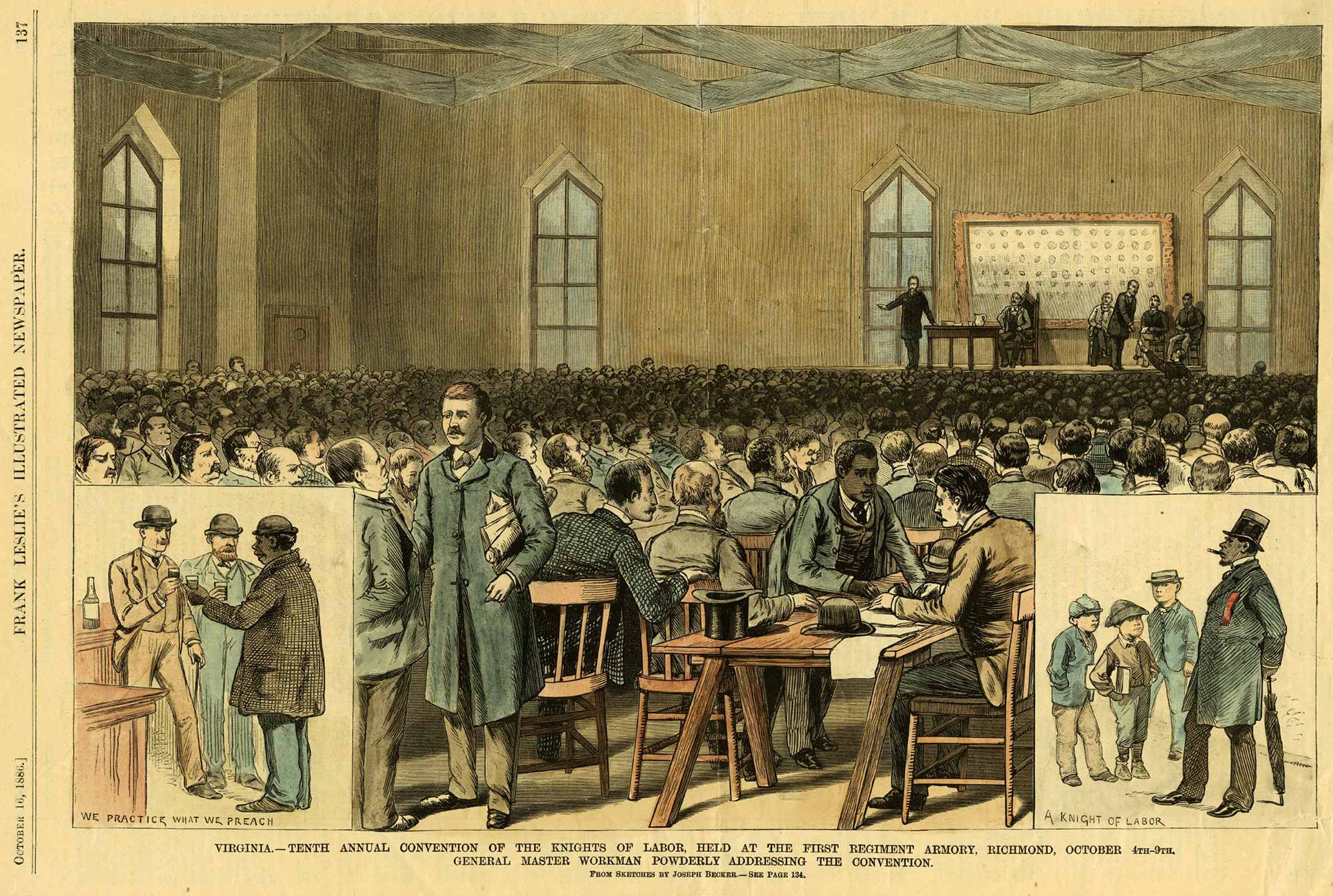
Like its predecessors of old, the Knights of Labor believed in having working class politics in the union and the union in working class politics. Its activity in this direction contributed to the promotion of working class politics in the 70s and 80s of the last century. Many of its members were elected to office in Connecticut and other states, during this period. In brief, it may be said that the Knights of Labor was thoroughly in accord with the historical class spirit of American trades unionism–a logical evolution, carrying the working class movement forward on the more extensive and higher plane demanded by industrial development.
THE K. OF L. WORKING CLASS 8-HOUR DAY.
Especially was this the case in the fight for the eight-hour-day which it inaugurated. The pioneer unions fought for the twelve and the ten-hour-day. The K. of L. took up the battle where they had stopped, and declared its object to be “to shorten the hours of labor by a GENERAL REFUSAL to work more than eight hours.”
The K. of L. eight-hour agitation was strictly a working class agitation. The K. of L. argued that “a general refusal to work more than eight hours” would mean a general reduction of the hours of labor, which, in turn, would make the employment of more men generally necessary. With more men employed, successful strikes for better conditions would be more possible and numerous.
The Knights of Labor eight-hour-day agitation reached its climax on May 1, 1886. On that day “general refusals to work more than eight hours”, took place in the principal industrial cities of the country. One of the latter was Chicago. There, the men employed in the McCormack machine works, struck. They were brutally clubbed by the police. At a protest meeting held later in Haymarket Square, several policemen were killed by a bomb thrown by some unknown person or persons. As a result of this bomb-throwing occurred the infamous Chicago “anarchist” hangings. This entire incident had a bad effect on the eight hour movement. The intense feeling that followed proved detrimental to victory. Despite this, however, some of the exceptional trades, achieved the eight-hour-day, thanks to the working class agitation of the Knights of Labor.
The Knights of Labor was an effective boycotter. Its members bound by the principle “An injury to one is the concern of all”, and aided by competition, religiously and successfully tabooed all firms opposed to its demands. One of the most famous boycotts in which it was engaged, was that on the Theis Music Hall in New York City. This boycott, bitterly contested and long fought, resulted in arrests and convictions of the representatives of the working class engaged therein. These so aroused the labor world, that the memorable George campaign of 1886 was precipitated. This campaign raised the spectre of Socialism in the politics of Capitalism as it had never been raised before in this country.
The Knights of Labor was bitterly opposed by press, church, law, state and capitalist class. Its secrecy, in those days of undeveloped Pinkertonism, coupled with centralized control and sympathetic strikes, made it feared by them all. The church denounced it as a secret order detrimental to religion. The press expatiated upon its “fostering of class antagonism”. The law and state were appealed to, to puncture its boycotts and suppress its strikes. While the capitalist class bespoke “the lead diet” for it.
THE A. F. OF L–ITS ADVENT AND PRINCIPLES.
In the heyday of its power, which was in and about the year 1896, the Knights of Labor was said to number 1,000,000 strong. It was just about this time–or to be exact, in 1881–that “The Federation of Organized Trades and Labor Unions” was launched in Pittsburg, Pa. A contributor to the Weekly People, some years ago, claimed that “The Federation” was formed by Samuel Gompers, at the instigation and under the patronage of Andrew Carnegie, who was then, as now, “a friend of labor”, only then he did not have the blood of the workmen of Homestead on his hands. Considered the place of the Federation’s launching and the present relations of Gompers and Carnegie, this claim seems well founded.
The reasons given for the formation of “The Federation of Organized Trades and Labor Unions” mainly revolved around the secret and centralized character of the Knights of Labor. It was claimed by the Federationists that this was detrimental to the interests of the working class. It was further asserted that in order for working class organizations to attain greater numbers and success, open and autonomous unions, bound together in a federation, were imperative. The Federation was purely English in conception and principle. It was modeled on the Trades Union Congress of England. Like that Trades Union Congress it held that the interests of capital and labor are mutual. Despite the “Socialistic” declarations in its platform, this is the Federation’s leading tenet to-day, as much to the sorrow of a great portion of the capitalist, as well as the working class, as we shall see as we proceed.
The advent of “The Federation of Organized Trades and Labor Union” caused a contest for supremacy to arise between it and the Knights of Labor. This contest, on the part of the Federation, was, at first, an educational one; later, one of counter organization and scabbing. Meetings were held at which the shortcomings of the Knights of Labor were criticized and condemned, and unions formed of converts and recruits. With strength came the formation of opposing organizations, and a campaign of scabbing against the K. of L. assemblies. The N.Y. City cigar, tailoring, brewing, and other industries are rich in material for a history of the disintegration of the K. of L. and the foundation of the A. F. of L., by this dual method. The Knights of Labor was practically exterminated. Though still alive it exists as a shadow of its former robust self.
This course on the part of The Federation was to be expected. The principle of autonomy, combined with the principle of the mutual interests of capital and labor, in opposition to the principle of centralized, united action in the interests of the workers, is a disintegrating principle. It makes the interests of one craft superior to all others; and by so doing, promotes the interests of employers more than employes. The growth of the A. F. of L. may be cited by some in refutation to this statement. This growth will be analyzed latter on.
LEGISLATION VIA THE INFLUENCE OF ORGANIZED LABOR.
The Federation, in destroying the Knights of Labor, not only overthrew secrecy and centralization, but it also opposed the policy of organizing independent workmen’s parties. It yielded to the seductions of demagogues and threw overboard the dictum of Stephen Simpson that there was no hope of satisfactory reforms from the old parties. The Federation inaugurated instead the policy of securing legislation through the influence of organized labor. By petition, by committee, by lobby, but never by independent political action, must labor secure political measures. Labor may organize to secure for itself what it wants on the economic field, but it must get what it wants on the political field through others!
The Federation’s policy of political begging has been barren of results, as far as labor is concerned. The anti-injunction bill of the Federation–a bill to prevent the issuance of restraining orders or injunctions during strikes–was only recently killed by the House Committee on the Judiciary. Its Chinese Exclusion bill was so amended as to prove a victory for its opponents. For eight or nine years, the Federation has vainly tried to secure the passage of an eight-hour bill for men employed on government contracts. At this rate of progress, success seems a dream. The Federation has secured the passage of many labor laws, but they are dead letters, never enforced, as witness the violations of the New York State Child Labor Law. Lastly, “the political influence of organized labor” avails naught in governmental “open shop” controversies, as the Miller episode, and the re-election of President Roosevelt, the champion of the “open shop”, proves.
But this policy of political begging is beneficial to the labor leaders and the capitalist class. It enables the labor leaders to secure big salaries as labor lobbyists, and establishes a lobby that is useful in aiding the promotion of legislation beneficial to capitalist interests. Witness the aid rendered by the Federationists, in establishing the Department of Commerce and Labor. Samuel Gompers was slated for Secretary of this department, but the plum fell to an out-and-out capitalist, with no labor pretensions. This department is so little devoted to labor that the N.Y. “Sun” advocates the lopping off of the two last words of its title. Witness also, how this policy keeps the capitalists in control of the government, so that when the members of the Federation go out on strike they are promptly clubbed by the policemen or shot by the militiamen whom they voted into the control of the capitalist class.
This policy of political influencing, as shown in Prof. Ely’s quotation from Prof. Hosmer, was a good one in the beginning of the eighteenth century; but, in this, the twentieth century, it is a reactionary, illogical, corrupt and cowardly policy, which robs labor of political independence and contributes to its economic degradation, while promoting the interests of the capitalist class.
THE CAUSE OF A. F. OF L. RETROGRESSION.
The social influences which caused the radical departure of the Federation from the historic economic and political tendencies of the American labor movement, were far reaching. They began with the discovery of the California gold fields, followed by the opening of the great West at the close of the Civil War. These served to attract Eastern workmen to the Pacific Coast, and labor immigration from Europe, mainly Great Britain, to the Eastern States. The workingmen from the latter country made themselves felt in the American labor movement. As the Dutchmen who lived all their lives alongside of canals, built one across Canal street, Manhattan, on their arrival here, convinced that existence was impossible without it, so with these English workmen: accustomed to capitalist principles and political begging as a basis of trades unionism at home, they believed them essential to working class existence abroad. Owing to the migration Westward, and the aid of capitalist magnates, they gradually gained ascendancy and victory! It is no accident that such prominent names connected with the A. F. of L., Gompers, Carnegie, Arthur, King, etc., are English in birth or antecedents. And it is also no accident that the old American trades union spirit. is now strongest in the West!
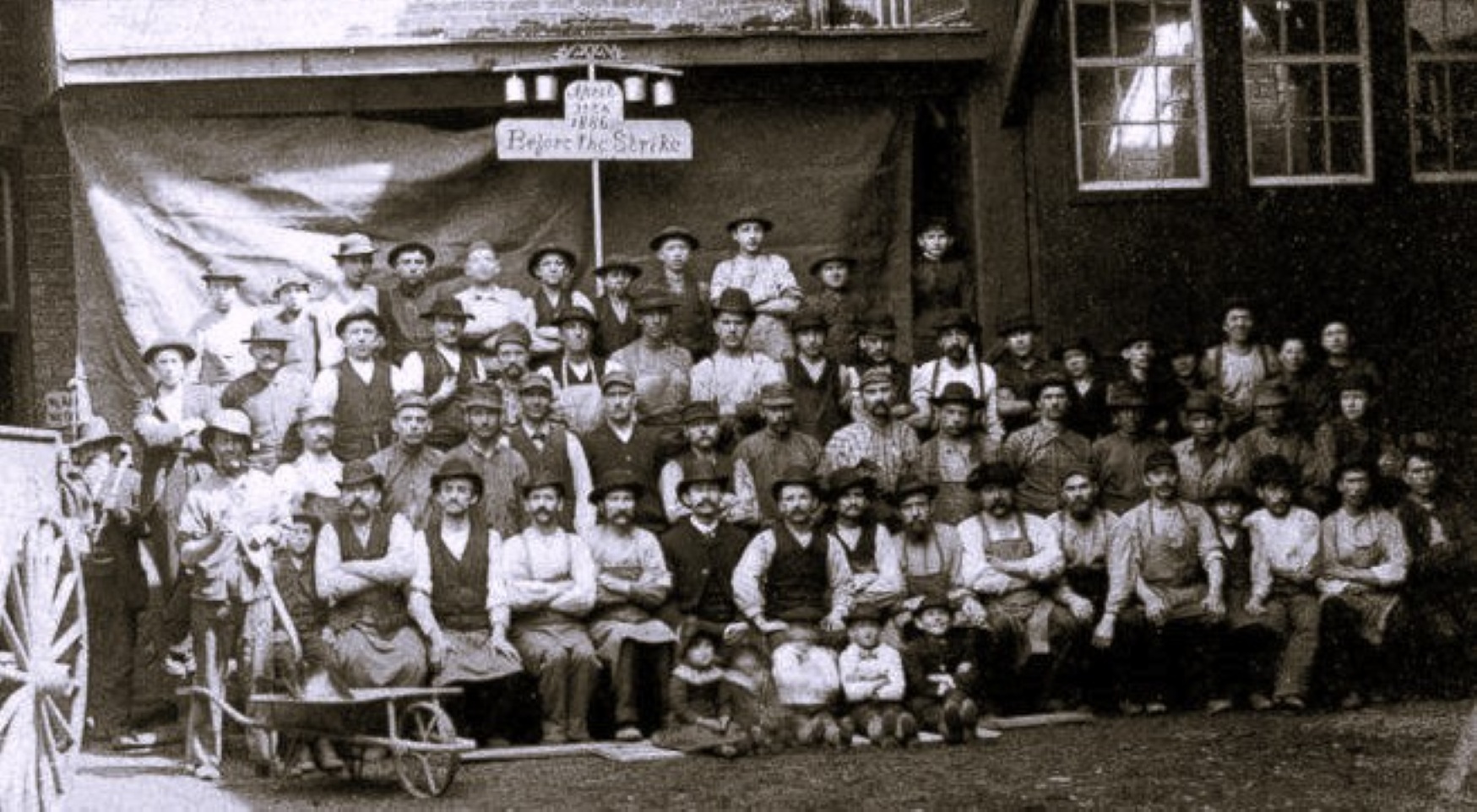
There is still another respect in which the Federation departs from the historical spirit of American trades unionism. The Federation is the notorious opponent of any movement that, in the language of the Knights of Labor, “aims to supersede the wage system”. The Federation opposes Socialism, whether Utopian or scientific. The Federation misrepresents and maligns the great international Socialist movement, besides which, its achievements are the achievements of a pigmy compared to an all-pervading power. In brief, the Federation opposes working class interests any other movement than its pro-capitalist brand of unionism, and thereby holds the working class nose down to the capitalist grindstone.
THE INTENSIFICATION OF LABOR.
The Federation holds the same non-historical and non-working class attitude in its eight-hour agitation. The old Knights of Labor argued that the eight-hour-day, reduced the unemployed and improved the possibilities of winning strikes and improving conditions. It was a working class argument. The Federation argues that an eight-hour-day affords greater rest and recreation, thereby enabling the worker to produce as much, if not more, than in a day of ten hours. Samuel Gompers points to the fact that as hours go down, exports go up. It is also a fact that the death rate among the working class goes up as hours come down; while, as the death rate goes up, the age limit comes down. The census figures show the death rate of males employed in all occupations to have increased from 13.8 per cent. in 1800 to 15.0 per cent, in 1900. The discussion on the age limit shows that men over 35 years find it difficult to secure employment, while men of fifty are being weeded out. The Federation’s eight-hour argument is a capitalist one, helping along the intensification of labor which is so marked a characteristic of this economic age. The capitalists have not generally accepted it, as they find the principle underlying it can be (thanks to the Federation’s autonomous principles and the unemployed), applied to a nine or a ten-hour-day as well.
THE NATIONAL CIVIC FEDERATION.
There is yet another phase of the Federation that it is at variance with the historical tendencies of the American movement, that must be touched upon before we can conclude this statement of its development. Reference is here made to the Federation’s alliance with the ultra-capitalists of this country, through the National Civic Federation. The National Civic Federation was inspired by Ralph M. Easley, a professional “social engineer”; and launched by the late Senator Mark Hanna, Bismarckian opponent of labor, turned Republican national leader and capitalist diplomat. As is now generally believed, the National Civic Federation was formed to keep the working class in line with ultra-capitalist interests during the American commercial invasion of Europe. Of course, the pretense was to “permanently benefit the mutual interests of capital and labor through the principles of conciliation and arbitration”. The Federation of Labor believes in the mutual interests of capital and labor, so it logically was bound to join forces with the socially engineered and inspired National Civic Federation. The modus operandi of the National Civic Federation was simplicity itself. Where wages were increased, prices were increased also, but in far greater proportion. Bureau of Labor reports show wages to have increased 16 per cent. Commercial agency reports show prices to have gone up 46 per cent. Where possible, trade agreements were entered into, that is, agreements regarding hours, wages, employment, etc., and providing for arbitration and conciliation, were made between employer and employe. Where such a trade agreement existed, and the union men, resenting its open and continued violation, struck for its enforcement, there scabs would be sent by the A. F. of L. union interested to take the strikers’ places. This was notably the case in the longshoremen’s strike in Buffalo and other lake ports. Where there was no trade agreement and a strike occurred, a committee composed of labor leaders and capitalists (a portion of the latter being euphoniously dubbed “representatives of the impartial and suffering public”), was selected to settle it. They generally did, most effectively, as we shall see. Under this plan, the strikers returned to work “pending arbitration,” only to find scabs filling their places, their demands entirely ignored and new impositions practiced upon them, under the agreement to return to work. This was the case in the strike of the Bolton teamsters, the San Francisco iron workers, and other instances too numerous to mention. Where this was not the case, where differences were adjusted to the “mutual satisfaction” of both sides, i.e., arbitrated, the result was more wages for the men, with a greater proportion in increased output for the capitalists, as John Mitchell has shown in his figures on wages and output in coal mining. The “mutuality of interests,” under the Civic, Federation plan, is very much that of the wife, who is reported to have said, “Hubby, what’s yours is ours and what is ours is mine.”
THE ODIOUS CAPITAL-LABOR COMBINES.
It was said above, “As is now generally believed, the National Civic Federation was formed to keep the working class in line with capitalist interests during the American commercial invasion of Europe.” It is also now generally believed that the National Civic Federation was formed to promote the interests of one set of capitalists against another. Baer, the divine head of the coal trust, made it plain that Mitchell and Hanna, backed by the National Civic Federation, were united in an attempt to advance bituminous coal interests in anthracite, markets, The attacks of Parry and the National Manufacturers’ Association upon the National Civic Federation, to all appearances, also proceed from economic causes produced by the alliance between the Federation and the ultra-capitalists. Certain it is, that since the inception of the National Civic Federation, combinations of labor unions with employers’ associations, for the purpose of monopolizing industry, via the trade agreement, have become numerous and scandalous. The truth of this, the exposes of the Chicago labor-capital combine by Ray Stannard Baker, and the onslaughts of Theodore Starrett against the New York City Building Employers’ Association, leave no room to doubt. These exposes reveal a condition of affairs totally unknown to 19th century American trades unionism, with its purely working class considerations–a condition of affairs in which capitalists and laborers not, in special combines are opposed by methods which promote bribery and the destruction of property and life, causing widespread demoralization and injury. Thanks to these odious special combines, Parksism and “Weinseimering” are produced and industrial corruption takes rank with political corruption. The Federation and the ultra-capitalist interests of the country go hand-in-hand, to the undoing of labor and society in general.
A. F. OF L.’S TRUE CHARACTER AND GROWTH.
To the student familiar with the history of trades unionism in this country, it is clear that Daniel De Leon uttered a profound truth when he said: “The American Federation of Labor is neither American, nor a Federation, nor of Labor. It is English, divided against itself, and for the capitalist class.” These words become more profound when the reader knows that the membership of 2,000,000 claimed by the Federation is in large part composed on men forced into unions by employers who appreciate the strike-killing, union-scab-supplying and industry-monopolizing “trade agreement,” and realize that conciliation and arbitration, as practiced by the National Civic Federation, is a good thing for the employer. These employers so much appreciate this kind of trades union that they readily agree to collect the dues of the union by checking off the amount from each employe’s pay. This is done by the coal operators for the largest union in this country, the United Mine Workers. With employers finding such trade unions profitable, what is there to prevent their “phenomenal growth?” Surely not the resistance of the workers compelled to join them?
LABOR HUMILIATED–LIGHT IS BREAKING.
The American Federation of Labor, despite the large numbers forced into its fold by trade agreements and alliances with employers, is now a helpless thing. Its autonomous principles divide its component parts into warring factions. Fratricide occupies the place of solidarity. Centralization for united action has given way to the dictatorship of Gompers in the interest of the capitalist class. The industrial depression has made every great industrial city, from San Francisco to Fall River, a cemetery for lost strikes against reduction of wages. The “prosperity” of the reign of the National Civic Federation has given way to the 1,000 “open shops” of Parry. Arbitration, as a preventer of strikes, is a failure. Strikes increase. Whereas there were only fifteen strikes in this country in 1855, the Congressional Report on Labor for May, 1904, shows that, from 1880 to 1900 there were 127,400 strikes, involving 6,610,001 persons, or twice the population at the signing of the Declaration of Independence. Everywhere, despite the “great” American Federation of Labor–which, its leaders claim, is destined to lead the working class of the world to victory–Labor is humiliated in the dust. But every cloud has its silver lining. Into every life a little rain must fall. In the words of the Quaker poet, Whittier:
“Through the harsh noises of our day,
A low, sweet prelude finds its way;
Through clouds of doubt and creeds of fear,
A light is breaking, calm and clear.”
And so with the American trade union movement. The members of the constituent bodies of the American Federation of Labor are deeply dissatisfied with its principles and organization. Of these, the Machinists and Brewery workmen are shining examples. There is an increasing demand for a demarcation of the interests of capital and labor and for a more sympathetic and compact form of working class organization. This demand finds expression in the attack on John Mitchell, at the Miners’ Convention, by Robert Randell, and in the growing opposition to the trade autonomy of the A. F. of L. These are healthy indications, denoting a return to the historical spirit of trades unionism in this country, but they are not new. The return to the historical spirit, on a plane in accordance with modern economic conditions, began in 1896, when the Socialist Trade & Labor Alliance was founded. The Socialist Trade & Labor Alliance is the complete and mature expression of the historical class spirit of the American trade union movement, just as modern industry is the complete and mature expression of the spirit of early American capitalism, as voiced by Alexander Hamilton.
THE SOCIALIST TRADE AND LABOR ALLIANCE.
The Socialist Trade & Labor Alliance is the direct antithesis of the American Federation of Labor. It denounces trade autonomy backed by capitalist principle. It strives for the organization of the entire working class on the principles of the class struggle. It aims at the unconditional surrender of capitalism on both the economic and political fields.
The Manifesto of the Socialist Trade & Labor Alliance declares: “Capitalism has made it impossible for the worker to gain his living as an independent producer. By introducing into the productive industries mechanical powers, equal to the capacity of more than one thousand million men, it has reduced the workers to absolute dependence upon the few who control these mechanical powers and the factories and raw material required for their operation. Thus the skill and muscle of the worker, his labor power, have become entirely valueless, unless he sells them to those who own the means of production. The workers’ labor power has become a commodity bought and sold in the market like potatoes or shoe leather. Hence the wages of labor, the market price of labor power, falls under the law of market prices, which tends to rise whenever the demand exceeds the supply and tends to fall whenever the supply is in excess.
“Such being the indisputable facts, the general tendency of wages must depend upon the condition of the labor market; it will be downward whenever and wherever the number of available workers exceeds the number in demand.
“The old-style labor organization, which had its origin in England, and was imported from there to this country, is an attempt to raise the price of labor power by bringing all of its available supply into one combination, and thus dictating the terms of sale. That plan relies on mere numbers and does not take into consideration the following essential factors which tend to defeat the most numerous combination:
“1. The worker cannot, like the merchant, put his commodity on the shelf until a better price is offered.
#2. The capitalist can do, in the labor market, what the purchaser in no other market can do; he can himself create a surplus by introducing machinery, thereby depressing the price of the article he requires, and, if a combination exists, breaking it.
“3. The capitalist can do what the purchaser in no other market can do; he can by means of the powers of the State, which he controls, declare every attempt to raise the price of the article which he requires a crime and suppress it.
AIMS TO CAPTURE DOUBLE SEAT OF CAPITALIST POWER.
“These three factors are all the direct results of the capitalist system, which has firstly stripped the worker of all possessions, and compels him, under fear of starvation, to sell his labor power to the capitalist; which has secondly given to the capitalist a monopoly of the means of production, and thereby enabled him by improvement of the same, to replace human labor and overstock the labor market; and which, thirdly, has made the machinery of government an agency of the capitalist class.
“And besides these there are other features of capitalism that operate to increase the surplus in the labor market. Competition compels the capitalists constantly to improve the methods and instruments of production; trusts and pools reduce the working force of whatever branch of trade or manufacture they take possession of; the concentration of capital in all its forms crushes out portions of the middle class and throws them into the labor market as proletarians.
“These are all important facts, and no sensible or honest effort for the betterment of the conditions of labor is possible unless they are taken into consideration.
“A serious consideration of the facts that control the condition of labor show very plainly that no appreciable improvement is possible as long as the capitalists remain in possession of the means of production and exchange, and in control of the powers of government. It is plain, therefore, that all efforts for such improvement must be chiefly directed to the ousting of the capitalist class from that double seat of power.”
WHAT THE S.T. & L.A. PROMISES.
This manifesto further declares that the Socialist Trade & Labor Alliance
“Stands upon the basis of facts, and therefore promises nothing impossible. It knows that the final victory it promises is possible, aye, is assured. In the meantime, while the capitalist system lasts, we aim to use the economic organizations, which we have established and will extend, to wring such temporary advantages from the capitalist class as conditions will allow. We do not say that the workers must not strike or boycott. We know that often the brutality of capital drives the workers to despair. We know that sometimes the capitalists are so situated as to afford a chance for an effective contest. On all such occasions we will fight with more vigor and persistence than the old-style organizations ever could, because our ranks are held together by the true spirit of the common interest of all wage workers in the overthrow of capitalist class rule. Whether these unavoidable contests are carried to victorious results, depends largely upon economic conditions which we cannot control; we make no promise as to that. We need not promise. Defeats will not disconcert us, because these contests will be considered by us merely as skirmishes preceding the great battle of emancipation. But this we can safely promise, that warfare will not only be more effective than that of the old-style labor organization, but it is the only industrial policy that can bring results.”

This statement of what the Socialist Trade & Labor Alliance is, would be incomplete without a knowledge of its declaration of principles. They are as follows:
S.T. & L.A. DECLARATION OF PRINCIPLES.
“Whereas, In the natural development of capitalism, the class struggle between the privileged few and the disinherited masses, which is the inevitable and irrepressible outcome of the wage system, has reached a point where the old forms, methods and spirit of labor organization are absolutely impotent to resist aggressions of concentrated capital, sustained by all the agencies of government, and to effect any permanent improvement in the condition of the wage earners, or even to arrest for any length of time their steady and general degradation; and
“Whereas, The economic power of the capitalist class, used by that class for the oppression of labor, rests upon institutions essentially political, which in the nature of things cannot be radically changed, or even slightly amended for the benefit of the working people, except through the direct action of the working people themselves, economically and politically united as a class;
“Therefore, It is as a class, conscious of its strength, aware of its rights, determined to resist wrong at every step, and sworn to achieve its own emancipation that the wage workers are hereby called upon to unite in a solid body, held together by an unconquerable spirit of solidarity under the most trying conditions of the present class struggle. As members of the Socialist Trade & Labor Alliance of the United States and Canada, we shall constantly keep in view its great object, namely: The summary ending of that barbarous struggle at the earliest possible time by the abolition of classes, the restoration of the land and of all the means of production, transportation and distribution to the people as a collective body, and the substitution of the Co-operative Commonwealth for the present state of planless production, industrial war and social disorder; a commonwealth in which every worker shall have the free exercise and full benefit of his faculties, multiplied by all the modern factors civilization.”
BATTLES AND TRIUMPH OF S.T. & L.A. PRINCIPLES.
It was with the foregoing declaration of principles that Senator Perkins of California, startled the U.S. Senate in 1897, saying: “This is how the working class is organizing now.” It was in accordance with these principles that the Pittsburg, Pa., Steel Pressed Car Company and the Slaterville, R.I., textile strikes were fought and won. It was in accordance with this declaration of principles that the S.T. & L.A. men anticipated, with great honor to themselves, in the Morris Heights, N.Y., and the Bloomfield, N.J. strikes. It was in accordance with this declaration of principles that the American Woolen Company (the Woolen Trust) was given the struggle of its life throughout the New England states, when it introduced the two loom system. And lastly, it was in accordance with this declaration of principles that the members of the Socialist Trade and Labor Alliance voted for the Socialist Labor Party and its demand for the unconditional surrender of capitalism at every recurring election.
THE AMERICAN LABOR UNION.
Since the Socialist Trade & Labor Alliance was launched another organization has arisen in the West with similar principles. It is called the American Labor Union. The cardinal principle of the American Labor Union is industrial unionism. This principle is defined in an editorial entitled “A Pickwickian Socialist”, in “The American Labor Union Journal” for December, 1904, as follows:
“The economic organization of the proletariat is the heart and soul of the Socialist movement, of which the political party is simply the public expression at the ballot box. The purpose of industrial unionism is to organize the working class on approximately the same departments of production and distribution as those which will obtain in the Co-operative Commonwealth, so that, if the workers should lose their franchise, they would still possess an economic organization intelligently trained to take over and collectively administer the tools of industry and the sources of wealth for themselves.”
This principle is the same as that enunciated by Daniel De Leon, one of the founders of the S.T. & L.A., in his lecture “The Burning Question of Trades Unionism,” delivered in the spring of 1904. As utilized by the American Labor Union, the principle differs from the underlying principle of the S.T. & L.A., in that it accentuates the economic side of trades unionism. Otherwise this principle recognizes the great truth that trades unionism is a part of the rudimentary framework of Socialism, forced into position by capitalist evolution. This recognition is in refreshing contrast to that bestowed upon the principles underlying the Gompers’ A. F. of La, which “The Wall Street Journal” heralds as “One of the strongest obstacles to Socialism in this country.”
THE CHICAGO CONFERENCE.
The American Labor Union claims a membership of 200,000. The Western Federation of Miners–which made the grand fight in Colorado, for the eight hour day, against the combined forces of Gompersism and Capitalism–is an integral part of it. The American Labor Union has taken the lead in calling a conference of unions favoring industrial unionism at Chicago on June 27. This call further accentuates the difference between A.L.U. and S.T. & L.A. principles in that it advocates an entire severance of the economic from the political movement of labor. Yet it is believed that this conference will mark the beginning of a new era in the history of trades unionism in this country. And it is fervently hoped that the conference will abandon the non-political attitude outlined in its call, and return to the historical spirit of American trades unionism by organizing the working class on the lines of the Socialist Trade and Labor Alliance.
It will not be amiss at this juncture, when compromise is apparent in the call of the Chicago conference, to close with the significant lines of Lowell:
We see dimly in the Present what is small and what is great,
Slow of faith, how weak an arm may turn the iron helm of fate,
But the soul is still oracular; amid the market’s din,
List the ominous whisper from the Delphic cave within–
“They enslave their children’s children who make compromise with sin.”
***
New occasions teach new duties; Time makes ancient good uncouth, They must upward still, and onward, who would keep abreast of Truth.
No compromise: “Upward still, and onward!”
THE END.
New York Labor News Company was the publishing house of the Socialist Labor Party and their paper The People. The People was the official paper of the Socialist Labor Party of America (SLP), established in New York City in 1891 as a weekly. The New York SLP, and The People, were dominated Daniel De Leon and his supporters, the dominant ideological leader of the SLP from the 1890s until the time of his death. The People became a daily in 1900. It’s first editor was the French socialist Lucien Sanial who was quickly replaced by De Leon who held the position until his death in 1914. Morris Hillquit and Henry Slobodin, future leaders of the Socialist Party of America were writers before their split from the SLP in 1899. For a while there were two SLPs and two Peoples, requiring a legal case to determine ownership. Eventual the anti-De Leonist produced what would become the New York Call and became the Social Democratic, later Socialist, Party. The De Leonist The People continued publishing until 2008.
PDF of full issue: https://www.marxists.org/history/usa/pubs/the-people-slp/050218-weeklypeople-v14n47.pdf
PDF of full issue 2: https://www.marxists.org/history/usa/pubs/the-people-slp/050225-weeklypeople-v14n48.pdf

