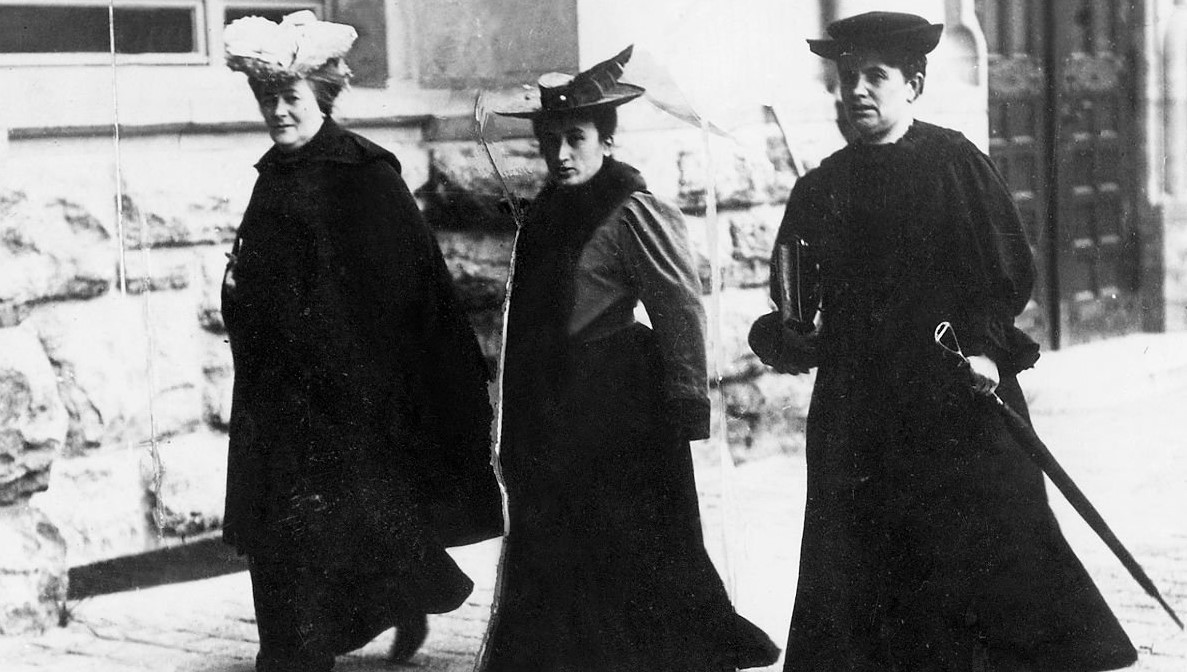
Zetkin on the work that saw a phenomenal increase in women members of the SPD from 1907 to 1908, from 2,456 to 62,257.
‘The Socialist Women’s Movement in Germany’ by Clara Zetkin from The New York Call. Vol. 2 No. 218. September 11, 1909.
In 1907 the Social-Democratic party of Germany embraced 2,456 women members; in 1908 they numbered 62,257. These figures show the practical result of political propaganda in favor of Socialism during the last twelve months; 1908 was the first year in which the new law on association for the whole empire gave permission to the women to join political organizations. Until then every federated state had an association law of its own, and in the greater part of the empire the legal prescriptions forbade women to be members of political societies or to establish them. Still worse, the authorities interpreted the laws so arbitrarily as to declare committees of three women comrades to be political organizations, which were dissolved, and severe punishments were inflicted on their members. In some of the federated states the law, up to May, 1908, even prohibited to women the attending of political meetings and conferences.
It is an evidence of a very powerful class-conscious conviction and good political sense and training, that in spite of the fetters of the reactionary laws and the brutal practices of the authorities, the Socialist women had succeeded in joining the party to the number of nearly 30,000, and that these more than doubled this number in the course of last year. In 257 local sections of the Social-Democratic party they elected in 1908 a woman comrade into the executive committee, and in more than fifty other sections, such election were to take place. One hundred and fifty lecture and study circles for women have been established by party sections in order to serve the theoretical and practical instruction of their women members.
The Socialist propaganda among the workers wives and women wage earners has been carried on by hundreds of public meetings in which women comrades addressed most particularly the working class women. There were distributed among them 250,000 copies of a leaflet, which in a simple and popular manner analyzed the political events of the day, showing for what reasons women as well as men are interested in politics and must join the Social-Democratic party. As since 1892 Gleichheit, the organ of the Socialist women, which is the property of the party, has spread Socialist ideas among the working class women and provided for the theoretical education of the women comrades. Several trade unions with a large membership of women give the paper free of cost to their women members; Gleichheit last year had a circulation of 73,000 copies.
The office of the Socialist women, which in former years was the center of their propaganda and activity, and was managed by their trustee for the empire (who was elected at their bi-annual conferences) was joined in 1908 to the general office of the party, according to the new form of political organization for both sexes. The women’s office now works with the party’s executive in which one of the two women office holders fills the post of assistant member. In cases where it seems useful–and such happens very often–the women’s office enters also in relation with the general committee of the trade unions. Thus the political leaflet mentioned above was issued by our women’s office in conjunction with the executive of the Social-Democratic party and, together with them and the general committee of the trade unions, the office called the attention of the women comrades to various political tasks in favor of social reforms by sending out circulars. They ought to make a vigorous propaganda so that the wage earning women in large numbers shall exercise the franchise in the administrative bodies of the state sick insurance, the only kind of franchise women possess in Germany. The women comrades were further engaged to found local committees for the protection of children and to perfect those already existing. As the legal inspection of the enforcement of the children’s protective law is absolutely insufficient, these committees, together with the local trade unions’ councils, have to watch over the enforcement of that law. Besides the Socialist women were urged to found and to perfect protective committees for women workers which collect their grievances on illegal and pernicious conditions of labor, forwarding them to the factory inspection office.
Besides their activity in that line, the Socialist women have continued their propaganda in favor of the full political emancipation of their sex. The struggle for universal suffrage, vigorously maintained, particularly in Prussia, was a struggle for adult suffrage for both sexes, propagated in meetings and leaflets. Public and factory meetings in great number and an indefatigable activity in many other forms have helped the trade union in organizing the women workers. The number of women trade unionists has increased from 136,929 in 1907 to 138,443 in 1908. The work of our trade unions in enlightening and organizing wage earning women is not smaller nor less important than the work of the Social-Democratic party to make women enter into the political battles of the working class.
The party and trade unions are inspired with the Socialist conception of history. Therefore they are aware of the great Importance, in principle and practice, that a Socialist woman movement has. In consequence the political and trade union organizations give hearty help to the work of the women comrades. Yet, in spite of the fact that our Socialist women’s movement is indebted to them for fraternal assistance, it must be emphasized that its development as to extension and maturity is in the last analysis the work of the women comrades themselves.
The most prominent feature of the Socialist women’s movement in German is clearness and a revolutionary attitude as to Socialist theories and principles. The women who head it are fully conscious that the social fate of their sex is indissolubly connected with the general evolution of society, the most powerful moving force of which is the evolution of labor, of economic life. The integral human emancipation of all women depends in consequence on the social emancipation of labor that can only be realized by the class war of the exploited majority. Therefore our Socialist women oppose strongly the bourgeois women suffragists creed that the women of all classes must either gather into an unpolitical, neutral movement striving exclusively for women’s rights. In theory and practice they maintain the principle that the class antagonists are much more powerful, effective and decisive than the social antagonisms between the sexes, and thus the working class women will never win their full emancipation in a struggle of all with deference of class, against the social monopolies of the male sex, but only in the class war of all the exploited without difference of sex against all the all the exploiters equally without difference of sex. That does not mean by any means that they undervalue the importance of the political emancipation of the female sex. On the contrary, they employ much more energy than the German women suffragists to win the suffrage. But the vote is, according to their views, not the end of their aspirations, only a weapon, a means in a struggle for revolutionary aim–the Socialist order of things.
The Socialist women’s movement in Germany is inspired by the monumental dictum of Karl Marx: “The philosophers have only interpreted the world in different ways. But what must be done, is to change the world.” It strives to help in changing the world by awakening the consciousness and the will of the working class women to join in performing the most titanic deed that history will know: the emancipation of labor by the laboring class itself.
The New York Call was the first English-language Socialist daily paper in New York City and the second in the US after the Chicago Daily Socialist. The paper was the center of the Socialist Party and under the influence of Morris Hillquit, Charles Ervin, Julius Gerber, and William Butscher. The paper was opposed to World War One, and, unsurprising given the era’s fluidity, ambivalent on the Russian Revolution even after the expulsion of the SP’s Left Wing. The paper is an invaluable resource for information on the city’s workers movement and history and one of the most important papers in the history of US socialism. The paper ran from 1908 until 1923.
PDF of full issue: https://www.marxists.org/history/usa/pubs/the-new-york-call/1909/090911-newyorkcall-v02n218.pdf

