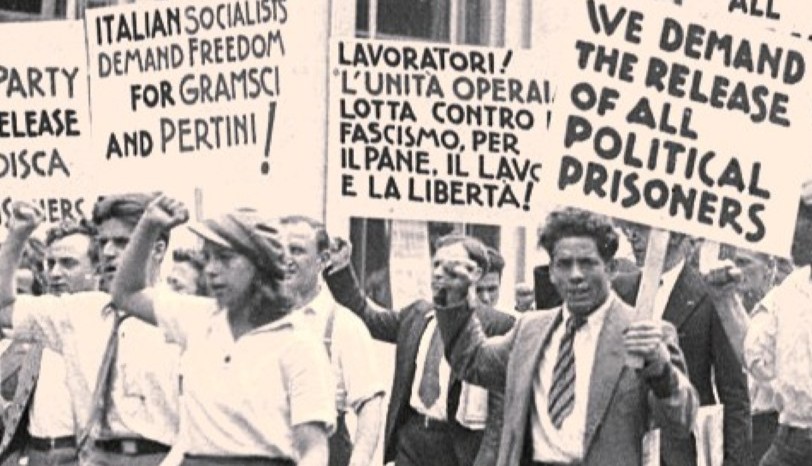
A leading figure of the Italian revolutionary left in the U.S. on the political movement in his native country. Originally from Sicily, Cannata was editor of the I.W.W.’s Il Proletario and a founder of the Anti-Fascist Alliance of North America, the first antifascist organization in the States.
‘Fascismo’ by Giuseppe Cannata from The Liberator. Vol. 6 No. 1. January, 1923.
THE world’s attention is today centered upon a movement originating in Italy which has more than a merely local significance. Fascismo has been defined and superficially described; Clare Sheridan has been amazed at the virility of Benito Mussolini and his juvenile entourage; and an illiterate collaborator of the Sunday Call Magazine has made the atrocious discovery that the Fascisti have a tender regard for the Italian Communists and a deadly hate for the white-bearded and placid leaders of the reformist socialists.
But does all this give a correct idea of the genesis of the fascist movement? I believe it is necessary to go a little deeper into the question. Above all, we must examine the economic characteristics of the Italian nation and their effect on the various social groupings. The leaders of Fascismo are, curiously enough, practically all ex-radicals; and this is a very significant fact. More than half a century ago, Marx coined a contemptuous epigram regarding the personnel of Italian socialism: “Lawyers without clients, doctors without patients, teachers without pupils”, said he. And this for a reason.
Among the modern great powers, Italy is, has been and will be the pariah. With a density of population surpassed in Europe only by Belgium, she lacks all the natural resources that can furnish the economic basis to a crowded population. She is essentially an agricultural country; has practically no coal or petroleum resources and little iron and other ores. Her African colonies (Somali, Eritrea, Tripoli), are the valueless crumbs dropped from the table of the Great Plunderers: France and England.
We have then a virile, temperamental and imaginative people, with a past of glory and power, cooped up and condemned to economic poverty. The middle class “intelligentsia” comes from the universities fired with the spirit of Caesar, Scipio Africanus, Cicero, Dante, Titian; it wants worlds to conquer–and instead it is forced to fill a mean civil service post. Disillusionment and unrest follow. Many of these discontented men turned in the past to the labor and radical movements; and why not? Here was adventure, here was tumult and glory of a kind.
The ruling classes of France, England and Germany had no such problem to face: their cultured elite had innumerable industrial, political, colonial, naval and military posts to fill. Kipling sang the glories of empire, but D’Annunzio was in the torment of the literary decadents.
The war was an opportunity for these misfits; the radical veneer disappeared. Syndicalist, socialist and anarchist leaders of prominence knew but one slogan to offer to the workers: intervention! The “cultural patriots” went into a frenzy: De Ambris, Mussolini, D’Annunzio, Labriola saw before their eyes a mirage of glory and power.
Then came the peace, a peace which meant a return to the prosaic past. Drunk with the habits of military life and the prestige of martial heroism this element carried over a great amount of turbulence into the civil life of the nation. Under the moral (or immoral) leadership of D’Annunzio, and allied with the semi-criminal elements which served as shock troops (arditi) during the war, these super-patriots engaged in the opera-bouffe performance at Fiume, a nationalist orgy in which the heroic “liberators” kept up their enthusiasm by continuous and extremely theatrical demonstrations, dope-injections and other sensational tomfoolery. Having made themselves a complete nuisance to the starving population of Fiume, and after some slight pressure from the mother-country, the “heroic” legions returned to Italy in search of new laurels. This was at about the time of the great metallurgical strike and occupation of the factories in Italy (September, 1920).
A new adventure presented itself to the mind of Benito Mussolini, editor of the ultra-nationalist Popolo d’Italia. The Italian reds were threatening a seizure of power, a social revolution. They are internationalists. Horrors! what would become of ultra-nationalists in a country governed by internationalists? The fascist bands are organized; they will fight the “reds”; they will defend the motherland against the peril of social revolution!
If up to this point the elements described above had been. merely tolerated by the liberal and pacific government at Rome, a change was soon to take place. As soon as the black-shirted death’s head hussars of Italy began attacking the radical and labor groups, burning their headquarters, destroying with vandalistic fury literature, printing presses and institutions which embodied half a century of sacrifices of the Italian workers, their fortunes steady rose. The Italian bourgeoisie, cowardly, unenterprising, incompetent, ready in the autumn of 1920 to give up its position as ruling class without a struggle, bankrupt morally and financially, had at last found its Pretorian Guard.
The history of the decadence of Imperial Rome is being repeated: a weak, dissolute ruling class places its defence in the hands of low mercenary bands of armed ruffians. These acting as the agents of the class in power, carry out a policy of oppression and violence which the oligarchy itself hadn’t dared to employ directly.
The fascisti have not belied their ancient ancestors; their violence has been inconceivably brutal; they have killed men, women and children; they have outraged, raped, sacked, burned, plundered and tortured their victims. With a superior military equipment, furnished by the funds of the capitalist companies, they have been able to attack the workers always in superior numbers. Their “punitive expeditions” never approached a locality until a previous search for arms had been carried out on the workers by the local police force. The courts of the “impartial” government carried the tragi-comedy further, tried the fascisti for their crimes, found them “guilty” and then suspended sentence. The system worked admirably, but the workers’ organizations were so powerful and their combative spirit such that the black-shirted “heroes” have had to lament no less than two thousand dead in two years of struggle.
We now advance to the culminating episode of the story. Keeping in mind the analogy between modern Italy and decadent imperial Rome, the crowning triumph of Fascismo will immediately reveal itself as a revolt of the Pretorian Guard of Italian capitalism. Benito Mussolini had previously given this estimate of the Italian situation:
“We have a class (the proletariat) that can establish a dictatorship and does not want to; and we have another (the bourgeoisie) that would like to establish a dictatorship, but cannot.”
In fact, the democratic leadership of the Italian state was wallowing in a sea of futile endeavors. Imagine the immensity of its task in the financial sphere alone: a country with a national debt of 100 billion lire, a foreign debt of 80 billion lire and prospective budget deficit of six billion lire for the current year, the whole being equivalent to the approximate national wealth of Italy. With the industrial activity of the nation paralyzed by the class conflict and credit abroad impossible to obtain, the most astute politicians of Italy, Giolitti, and the ablest economist, Nitti, were afraid to take the helm of the Italian ship of state.
Mussolini, the leader of the pretorian guard, viewing the spectacle of political helplessness around him, visualized a more ambitious role for himself and his “black shirts”: the pretorian guard, through its strong armed might, would take over the state!
This has come to pass; with a pomp and show of power that can only express the inhibited cravings of the lowly upstart, Mussolini has come to Rome; he has flung his contempt in the face of the democratic bourgeois politicians and the venerable old school diplomats. Many of the old lackeys of the bourgeoisie saw a Frankenstein in this monstrous compound of violence and bad manners. But in the main, industrial capital has recognized Mussolini as its saviour. Behind the usual political bunk about the co-operation of classes for the national good, there is hidden the steady purpose of reconstructing capitalist industry and finance through the more intense exploitation of the workers.
What are the projects of this new government that poses as a new agent, above all social classes? Increased taxes on wine and on the incomes of manual workers (formerly exempted); the return of the national railways, telegraphs and telephones to private ownership, and a more intense labor exploitation; the forcible suppression of all labor disputes, etc.
There is something inconceivably bold and provocative in the plans of these ultra-nationalist hoodlums: after having dragged the workers into the world war, they plan today to make them pay for the war by increased exploitation. Signor Mussolini may have cut a virile and competent figure as a critic of the former regime, but he will undoubtedly break his neck on the rocks of class-antagonism. Already we have the first inkling of what is to come in the news from Naples that the railwaymen of that city have occupied the stations in protest against the labor policy of the fascist government. In his desperate efforts to save the Italian state by balancing the budget, Mussolini is prepared to lower by at least twenty per cent the standard of living of six million Italian workers’ families. This mad enterprise will goad the energetic Italian proletariat to its last and most terrific struggle for power and freedom. This time there shall be no half-measures, no stopping short of the final goal–the proletarian dictatorship and communism.
Signor Mussolini must have been reading the handwriting on the wall when he recently declared: “If I fail, I am a finished man. The experiment will not be tried again.”
The Liberator was published monthly from 1918, first established by Max Eastman and his sister Crystal Eastman continuing The Masses which was shut down by the US Government during World War One. Like The Masses, The Liberator contained some of the best radical journalism of its, or any, day. It combined political coverage with the arts, culture, and a commitment to revolutionary politics ay a pivotal time in Left history. The writings by John Reed from and about the Russian Revolution were hugely influential in popularizing and explaining that events to U.S. workers and activists. Increasingly, The Liberator oriented to the Communist movement and by late 1922 was a de facto publication of the Party and was sold to the Party by Eastman. In 1924, The Liberator merged with Labor Herald and Soviet Russia Pictorial into Workers Monthly. The Liberator is an essential magazine of the US left.
PDF of full issue: https://www.marxists.org/history/usa/culture/pubs/liberator/1923/01/6n01-w57-jan-1923-liberator-hr.pdf

