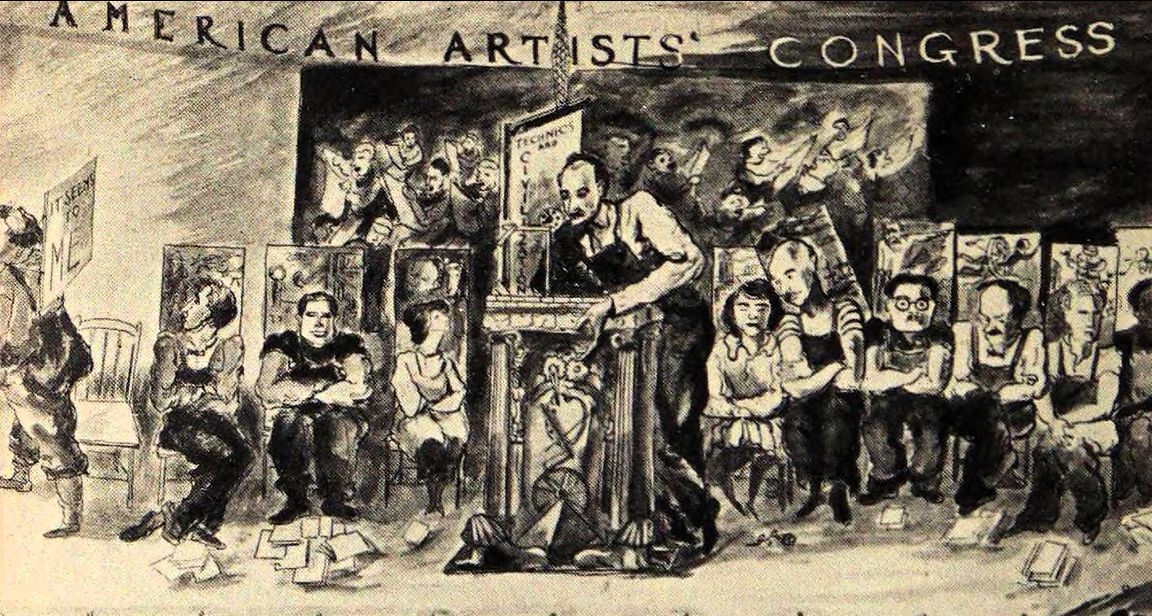
Freeman on the founding of the American Artists’ Congress in February, 1936. The Congress would replace the John Reed Clubs as the Communist Party’s main arts and artists organizing project for the Popular Front era, with an overwhelming focus on resisting fascism’s intellectual retrogression and cultural violence.
‘The Battle for Art’ by Joseph Freeman from New Masses. Vol. 18 No. 9. February 25, 1936.
“THIS is the most wonderful experience of my life,” a painter said to me in the lobby of the New School for Social Research where the American Artists’ Congress was meeting.
I have known this man for years. He is very gifted, he has been very successful. Money and fame have been his; he was always welcome in the best museums and drawing rooms. And, like nearly all those who flourished in the pre-depression arts, he lived in a rarefied atmosphere of self-centered sensation and applause.
In the past five years I have watched this man losing first his market, then his public, then his faith in all the ideals which had once sustained him. He felt the impact of the profound crisis which has overwhelmed contemporary society and he began to question everything, including himself and his work. For the first time since the war, he began to take a passionate interest in the events of the day–hitherto supposed to be none of the artist’s business. Above all, he began to seek a new understanding of his own place in society.”
And now he had found the most wonderful experience in his life. He had found that he was not alone. There were at least 399 of America’s leading artists who felt as he felt, and hundreds of others ready to join them.
For the first time, artists had met in a nationwide organization above esthetic groupings. They were ready to act together for the solution of their own problems. And out of these problems they had seen their true relation to the rest of the world. Here, the young modernist and the old academician, the abstractionist and the revolutionary cartoonist joined hands in an identical cause, for common work.
This united not only each artist with his fellow craftsmen, but united all the artists with the millions who are struggling for the defense and advancement of culture.
Nobody was more surprised at the extraordinary success of the American Artists’ Congress, which met in New York City this week, than the artists themselves. All too modestly, they assumed that painters could not speak, write or organize. Yet the congress itself was in many ways an advance over last year’s congress of writers, itself a real landmark in American culture.
Thanks to secretary Stuart Davis and his collaborators, the organization was remarkably smooth; thanks to the awakening of the artists, the papers and discussions were on a high, mature level. Painters who had for years considered themselves inarticulate, spoke up from the floor with passion, logic and fluency. Various groups of artists have been doing this for the past five years.
What gave this week’s congress special significance was that it transcended the various groups by including all of them.
The four hundred delegates from every part of the United States who attended the sessions were truly representative of American art. They were among the best known and the most competent men and women in their field, and they came from every existing esthetic school.
Active in the congress were artists as diverse as George Biddle and Peter Blume, Adolph Dehn and Aaron Douglas, William Gropper and Paul Manship, Lynd Ward and Max Weber, Gilbert Wilson and Ernest Fiene, H. Glintenkamp and Arnold Blanch, Rockwell Kent and Paul Strand.
The call for the congress was addressed to all artists of recognized standing in their profession “who are aware of the critical conditions existing in world culture in general, and in the field of the arts in particular.” The central aim was collective discussion, planning and action for the preservation and development of culture. The artists emphasized that the very existence of culture is endangered by the prevailing economic crisis, by the growth of fascism, by the preparations for war.
The artists, relating their own experiences to the general growth of reaction in the United States, could only conclude that they must act collectively to defend their interests as artists and to defend culture as a whole. Convinced that isolated action is ineffective, the artists also resolved to ally themselves with all groups engaged in the common struggle against war and fascism.
But once the artist stepped out of his studio into the public arena, he was transformed as an individual. The shy painter became a vigorous tribune. The artists who filled Town Hall Friday evening, when the congress opened with a public session, were vibrant with enthusiasm and purpose; in the carriage and voices of the speakers there was courage and responsibility.
Lewis Mumford, in the chair, said the congress was unique in the history of American art. Stuart Davis pointed out that the period of economic depression has challenged all psychological and esthetic certainties which had once given force and direction to the artists’ work.
Mr. Davis set the tone for the evening by emphasizing that fascism and war are of necessity inimical to culture. If the artists are to be serious, he said, “we can attack even the most highly specialized problems that confront us only in relation to our main objective, which is to build a bulwark for the defense of intellectual freedom, for economic security.”
Rockwell Kent criticized the prevailing social order by ironical contrast with Greenland, whose natives, he said, refused to believe that in America men are permitted to starve while the necessities of living are destroyed. Joe Jones described the repression of art in the United States with numerous instances of censorship and destruction; and Margaret Bourke-White told of the encouragement of the artist in the Soviet Union.
One of the most moving addresses of the evening was made by Aaron Douglas, who spoke on the Negro in American culture. Mr. Douglas pointed out that until recently the Negro’s role in art was solely that of a distorted spectacle. Revolutionary art, alone, has treated the Negro seriously, if not always profoundly. The real potentialities of the Negro in art, he concluded, will emerge only when the Negro has freed himself from social discrimination and segregation.
Racial discrimination was discussed by George Biddle, President of The Mural Painters, who proposed a resolution that American artists refuse to participate in any art exhibition connected with the Olympic games sponsored by the Nazi regime.
“As realistic American artists we protest against participation with a government which sponsors racial discrimination, the censorship of free speech and free expression, and the glorification of war, hatred and sadism.”
The audience passed this resolution by unanimous acclaim. The artists’ opposition to war and fascism was then further developed by the sculptor Paul Manship and the painter Peter Blume.
When Jose Clemente Orozco took the platform for a brief greeting from the painters of his country, the audience spontaneously rose in ovation, a stirring tribute to the greatest of living craftsmen. The appearance of Art Young, too, aroused deep emotion; and Heywood Broun wound up this extraordinary gathering by a brilliant and passionate appeal for feeling in art as against the taste of millionaire patrons; for the trade-union organization of artists; for art rooted in the lives of the millions who make up American labor.
FOR the next two days–all of Saturday, February 15 and all of Sunday, February 16 the four hundred artists who made up the congress met in four executive sessions at the New School for Social Research.
Here the papers and the discussions centered on the specific problems of the American artist, principally how he can obtain outlets for his work. This involved the problem of audience, and the artistic language which would make works of art accessible to the greatest possible number of people. The great variety of esthetic tendencies represented in the congress did not prevent the artists from uniting on their common fundamental problems. They all agreed that they would not permit their art to be employed for the propagation of fascism and war; and in insisting upon the rental policy they repudiated the building up of the museums at the expense of the artist. The major theme was developed at the first session by Meyer Schapiro of Columbia University, who spoke on the social basis of art; by Lynd Ward, the woodcut artist, who spoke on race, nationality and art; and by Jerome Klein, the critic, who spoke on the artist and his audience.
Existing outlets for the artist, the speakers showed, do not favor the development of a free art. The prevailing social system exerts constant pressure on the artist to produce a luxury art corresponding to the needs of the parasitic classes. Mr. Schapiro pointed out that the leisure class which dominates the art market sets up purposelessness in art as a special value equivalent to its own conspicuous consumption.
Along similar lines, Jerome Klein demonstrated that speculation in works of art militates against the recognition and support of the artist in his own lifetime. Frustrated while he is still alive by museums and patrons who treat art merely as a long-term investment, the artist paints for post-mortem recognition and of necessity paints canvasses divorced from contemporary reality. Mr. Klein, however, noted a strong and definite movement in American art toward expressing the aspirations of the unprivileged masses. This social critical art reaches a large, new audience which changes art itself into an effective social instrument.
Gilbert Wilson illustrated the meaning of the new social art from his own experience. His murals were attacked by the American Legion of Terre Haute, which mistook a quotation from the Declaration of Independence for a quotation from Eugene Debs.
In a brilliant satirical paper describing. the life of the artist in the prevailing social order, Max Weber said:
“Regardless of what talents or gifts we were favored with by the gods, in order to obtain a hearing and a return commensurate with our creative gifts, we must live in slums, lose our reason, cut off our ears and noses, and finally commit suicide if we hope for a considerable audience a half-century after our flight from this planet.”
It was Mr. Weber’s opinion that the question of subject matter, as influenced by the new social consciousness, will be solved soonest and best “through closer ties between artists and the steadily-growing class-conscious proletarian audience.” The new art, he said, would reveal the poetry and power and potential beauty inherent in the great toiling awakening masses.
It is impossible in this space to describe all the papers read at the congress. Dealing with the most diverse problems of the artist’s craft and his economic status, every one of them was on high mature level. The experience of the studio and the artists’ trade union, of the P.W.A. picket line and the museum, of the art colony and the popular magazine were collated and discussed by experts in each field and by the congress as a whole, until there emerged the most complete picture yet given of art in the United States today. To this was added the experience of Mexico, brought by Orozco and Siqueiros; the experience of Cuba and Peru, brought by especially accredited delegates; and the experience of Germany and Italy on the one hand and the Soviet Union on the other.
Two leading American artists who had originally refrained from joining sat through the sessions and testified to the effectiveness of the new organization by applying for membership. The four hundred delegates voted to establish a permanent League of American artists, and elected an executive committee of thirty-five for that purpose.
There was every evidence that the most progressive forces in American art have entered upon a course that will at once invigorate art and all that is best in contemporary society.
The New Masses was the continuation of Workers Monthly which began publishing in 1924 as a merger of the ‘Liberator’, the Trade Union Educational League magazine ‘Labor Herald’, and Friends of Soviet Russia’s monthly ‘Soviet Russia Pictorial’ as an explicitly Communist Party publication, but drawing in a wide range of contributors and sympathizers. In 1927 Workers Monthly ceased and The New Masses began. A major left cultural magazine of the late 1920s to early 1940s, the early editors of The New Masses included Hugo Gellert, John F. Sloan, Max Eastman, Mike Gold, and Joseph Freeman. Writers included William Carlos Williams, Theodore Dreiser, John Dos Passos, Upton Sinclair, Richard Wright, Ralph Ellison, Dorothy Parker, Dorothy Day, John Breecher, Langston Hughes, Eugene O’Neill, Rex Stout and Ernest Hemingway, Artists included Hugo Gellert, Stuart Davis, Boardman Robinson, Wanda Gag, William Gropper and Otto Soglow. Over time, the New Masses became narrower politically and more journalistic in its tone.
PDF of full issue: https://www.marxists.org/history/usa/pubs/new-masses/1936/v18n09-feb-25-1936-NM.pdf

