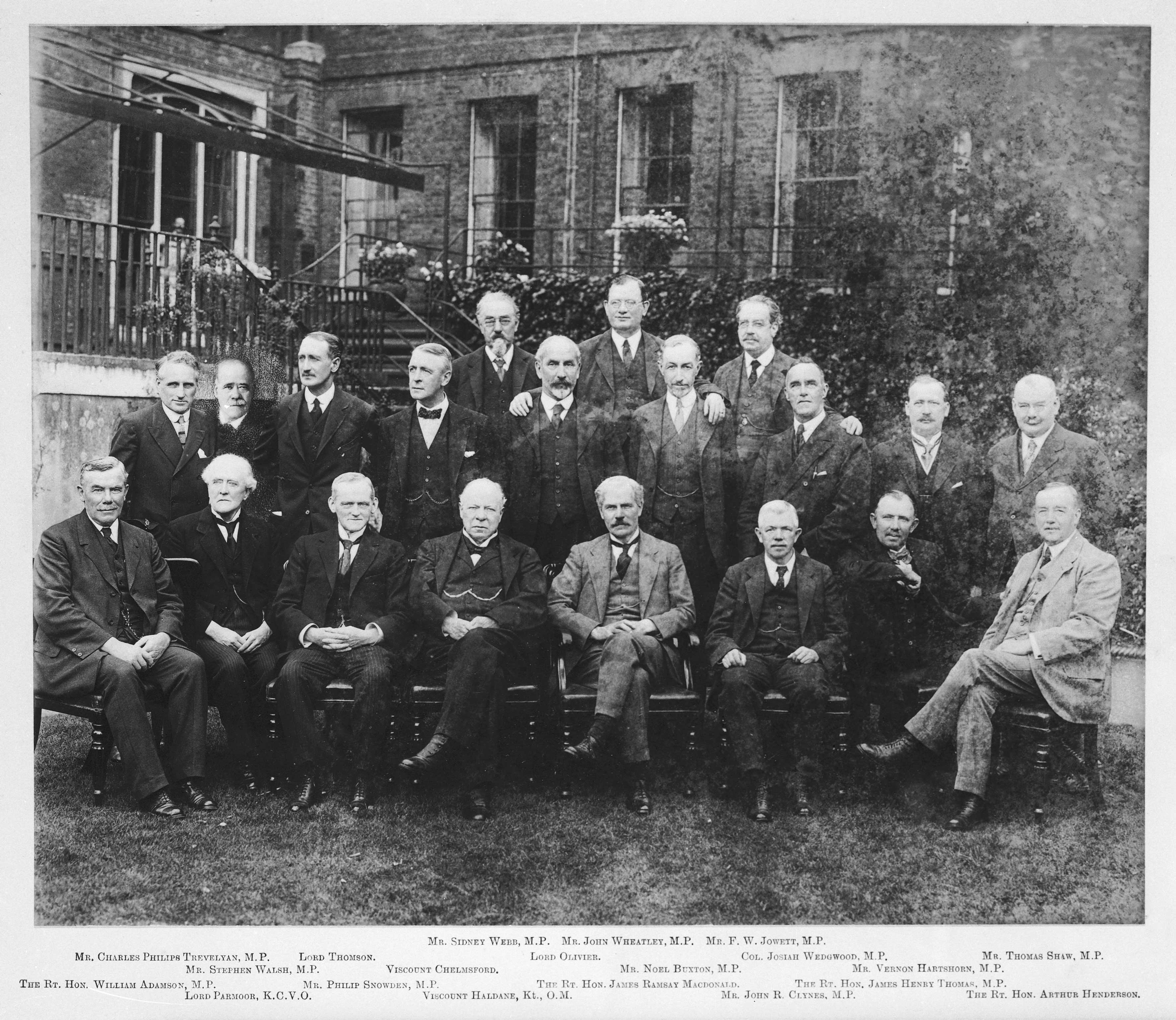
The wretchedness of the Labour Party leadership is almost a law of history. Dunne on the Ramsay MacDonald template adhered to since.
‘The Leadership of the British Labor Party’ by William F. Dunne from The Daily Worker Magazine. Vol. 1 No. 352. March 1, 1924.
SINCE the rise of the British Labor Party to power the American liberal and labor press, as well as the organs of capitalism, have devoted columns of space to it. There has been a decrease in the articles on Russia for here is something that American writers think they understand–it has a homelike flavor and there is no great hostility to the British Labor Party as yet.
It is, say most of the publicists, the apotheosis of democracy and the crowning proof that in Anglo-Saxon nations no other weapon than the ballot need be used by the workers.
In the liberal press, particularly, does the comment reach an ecstatic note; the dictionary is plundered to embellish the adjectival eulogies of the aims and methods of the British Labor Party.
A Neglected Fact.
None of the commentators seem to have taken into consideration one fact that is obvious to the most casual observer of the British labor movement–that the Labor Party is not a homogenous entity but a huge amorphous body in which all shades of opinion from the Manchester school of liberalism to the advocates of social revolution thru the dictatorship of the working-class are represented.
No criticism or comment which does not stress this fact is worth the paper it is written on. The British Labor Party is the exact opposite of the Communist Party of Russia in every respect except that both number workers and farmers among their supporters.
The Communist Party can be criticised as a party but the British Labor Party cannot and this, I think, accounts for the enthusiasm of the liberal brethren; each can find some proof that his pet hobby is embodied in its program.
Communist Criticism.
It can be ascertained quite easily that the criticism of the British Labor Party by Communists is in striking contrast to that of all other writers on the subject; that, as a matter of fact, Communist criticism is not criticism of the British Labor Party as such but of its leaders and their policies.
More even than the now almost defunct social-democratic party of Germany is the British Labor Party a party of leaders, but with this difference the Labor Party leaders have no such control over their followers as had the officials of the German organization. This is a blessing for the British working-class.
The leadership of the British Labor Party is now in the hands of parliamentarians, that is to say that those who speak for the party are committed to a belief in the eternal efficacy of present parliamentary forms as the only means necessary to abolish capitalism and establish a social system free from exploitation.
There is not the slightest evidence to support the contention made by their admirers that MacDonald, Snowden, Webb, Brailsford and other intellectual leaders of the British Labor Party have any different conception of the role of the working-class other than that of the “full-belly” philosophy of the members of the Liberal party.
The Tone of Respectability.
True, their appeals are directed to the workers; they glorify the working-class in public speeches but their official and private acts show them to be dominated by the middle-class craving for respectability that has been the curse of the British labor movement and that cannot be escaped by any party which sets as its goal a parliamentary majority.
The rise of the Labor Party does not mean, as so many liberal observers contend, that the British working-class has been converted suddenly to perfect confidence in parliamentary action or that the left wing of the labor movement has seen the error of its ways and abandoned the strike and boycott in favor of conciliation and arbitration. It does not even mean that there is any great mass loyalty to the Labor Party.
There is no question but that the Independent Labor Party–the group which includes the leaders already mentioned–is using a good deal of its energy in trying to convince the masses that but for the lack of an actual majority in the house of commons all working-class problems, such as unemployment, would be near solution. It is also quite plain that the parliamentarians consider a labor party government such a victory for the workers that everything should be subordinated to strengthening its hold on the parliamentary machinery.
Objection to This Policy.
There could be little objection to this if there was any reason to believe that with such a majority the leadership of the labor party would be spurred to a real assault on British capitalism.
The strength of any working-class lies in its economic organizations and no political party which, previous to the overthrow of the capitalist state, minimizes the necessary activity of the trade unions is a working-class or revolutionary party in the real sense of the term.
It may mouth, thru its leaders, the phrases of the social revolution, but when it discourages because it fears for its parliamentary prestige–another phrase for the favorable neutral attitude of certain capitalist strata–the use of the strike weapon against sections of the capitalist class, it confesses that it differs from its capitalist competitors for parliamentary honors in minor details alone.
Discouraging Strikes.
The leadership of the British Labor Party, in addition to lauding parliamentary action to the exclusion of all other means, expressing its firm conviction in the basic goodness of modern democratic institutions including government, before and during election, has, since it assumed office, discouraged to an extent not yet fully known in America, the new spirit of militancy that has shown itself in two great strikes–the railwaymen and the dockers.
It is from the official organ of the Independent Labor Party to which the intellectual leaders of the British Labor Party belong that we gain an accurate estimate of their knowledge of and loyalty to the principles and tactics of the class struggle.
Writing in the “New Leader,” just before the railway strike, Brailsford accuses the union of betraying the Labor Party because it proposed to strike to resist a reduction in wages. It is hard to discern any difference between this official expression of the British Labor Party leaders and that of any employers’ publication in the United States:
The Leaders’ Position.
“It would have been difficult,” says Brailsford, “to invent a diversion so nicely calculated to upset public confidence (in the Labor Party–Ed. note) and to foster a mood of panic What is at stake is the whole future of this machinery of conciliation No one can question the abstract right of the Associated Society to reject a decision with which they are dissatisfied. But it is clear that if they do so the moral authority of these decisions is destroyed. The real sanction for the working of conciliation is public opinion…Sooner or later the discipline of service must replace the discipline of the class struggle… This strike, if it takes place, will deal the Labor Party in public opinion a blow which no Rothermore or Beaverbrook could have inflicted If we are fit to govern, we must learn in the industrial as well as the political field to master our jealousies, to suppress our egoists and to organize ourselves in the workshop as in the party for the triumph of the common cause.”
In other words, while British capitalism remains in full possession of the factories and the food, the parliamentary leaders of the British Labor Party strive to inaugurate an era of industrial peace in which a striking worker is to be branded as a traitor to the “public welfare.” Ye gods!
The federation of British industries and the unemployed and starving British working-class are lumped together as mutual beneficiaries of the “cause.”
Reason For Tolerance.
Is it any wonder that there is no panic in the ranks of the British capitalists? No enmity, but only kindly tolerance for leaders whose industrial policy consists of the establishment of conciliation boards to which the workers will humbly appeal when conditions become too onerous and who denounce the workers’ impatience with such tactics as “egoism” and disregard of the “discipline of service.”
The duty of a revolutionary party in capitalist parliaments is to arouse the workers against the capitalist system; to stimulate all of their activities, to mobilize them for the final struggle, to destroy the last vestige of respect for and fear of capitalism in the minds of the workers, to furnish a program that by its clearness and uncompromising character stands out as the next step–which the workers must take on the road to victory. The Labor Party leaders deny the need for any struggle except that for “public respect.”
Self-Deception.
The British Labor Party is deceiving itself as well as the working-class. It apparently does not understand that the stagnation of British industry, unemployment, loss of economic power by the unions and consequent defeats have had the usual result in countries where the workers possess the franchise–they swing to parliamentarianism as the only available method of securing any immediate relief. They hope the government will be able to do what they could not do with their unions alone while the factories were closed put an end to the increasing tyrannies of the employers.
They expect the Labor Party government to take the side of the workers in the strikes that are inevitable and if the leaders were not of the type that values the smug approval of the middle class more than the esteem of the workers, they would, as a political tactic sure of success, use the government as lever with which to pry maximum concessions in the form of wages and working conditions from the employers. A government with a policy of this kind need not long remain a minority bloc in parliament in a country where the majority of the population are members of the working-class.
Unable To Lead.
But the leadership of the British Labor Party is constitutionally unable to have confidence in the driving power of the masses or to mobilize that power.
The left wing of the party may get control of the organization but never of the leaders. Their route is already charted. They will adhere to their policy of class collaboration and parliamentary futility and in the end will denounce the workers as ignorant ingrates; dull hopelessness will be their outstanding characteristic and the more bitter ones will finally become the advisers of the most reactionary section of the British capitalist class.
There are those persons who will say that this is bitter criticism and untimely; that the leaders of the British Labor Party have not had time to prove themselves and predictions as to their end are unwarranted.
Not Individuals But Types.
To those I say that I am not criticising MacDonald, Snowden and the rest as individuals but as a type a type in which there are few if any variations. They are historical products thrown up by the clash of forces in the class struggle and whether they come to the surface in Russia, Italy, Bulgaria, Germany or England matters but very little.
They strive to cure the evils of a struggle that can be ended only by accentuating the struggle, thru a reconciliation of warring classes and in this they serve the beneficiaries of the system. Capitalism claims them for its own and the manner of their end can be predicted with almost mathematical accuracy.
Not in its present leaders, but in the left wing elements of the labor movement who reject the policy of conciliation and class collaboration lies the real leadership of the British working-class.
When they take their place as the acknowledged vanguard of the British movement they will find the present leaders in the camp of the enemy.
The Road To Ruin.
Belief in the identity of interest of all classes in the British Isles, grouped around the standard of the British empire, conviction that the state is or can be made an impartial agency, complete confidence in parliamentary machinery as an instrument that can wipe out the cause of class antagonisms, lead straight to the betrayal of the revolutionary movements. If it does not, the history made in the last seven years is devoid of meaning for the working-class.
The Saturday Supplement, later changed to a Sunday Supplement, of the Daily Worker was a place for longer articles with debate, international focus, literature, and documents presented. The Daily Worker began in 1924 and was published in New York City by the Communist Party US and its predecessor organizations. Among the most long-lasting and important left publications in US history, it had a circulation of 35,000 at its peak. The Daily Worker came from The Ohio Socialist, published by the Left Wing-dominated Socialist Party of Ohio in Cleveland from 1917 to November 1919, when it became became The Toiler, paper of the Communist Labor Party. In December 1921 the above-ground Workers Party of America merged the Toiler with the paper Workers Council to found The Worker, which became The Daily Worker beginning January 13, 1924.
PDF of full issue: https://www.marxists.org/history/usa/pubs/dailyworker/1924/v01-n353-supplement-mar-01-1924-DW-LOC.pdf

