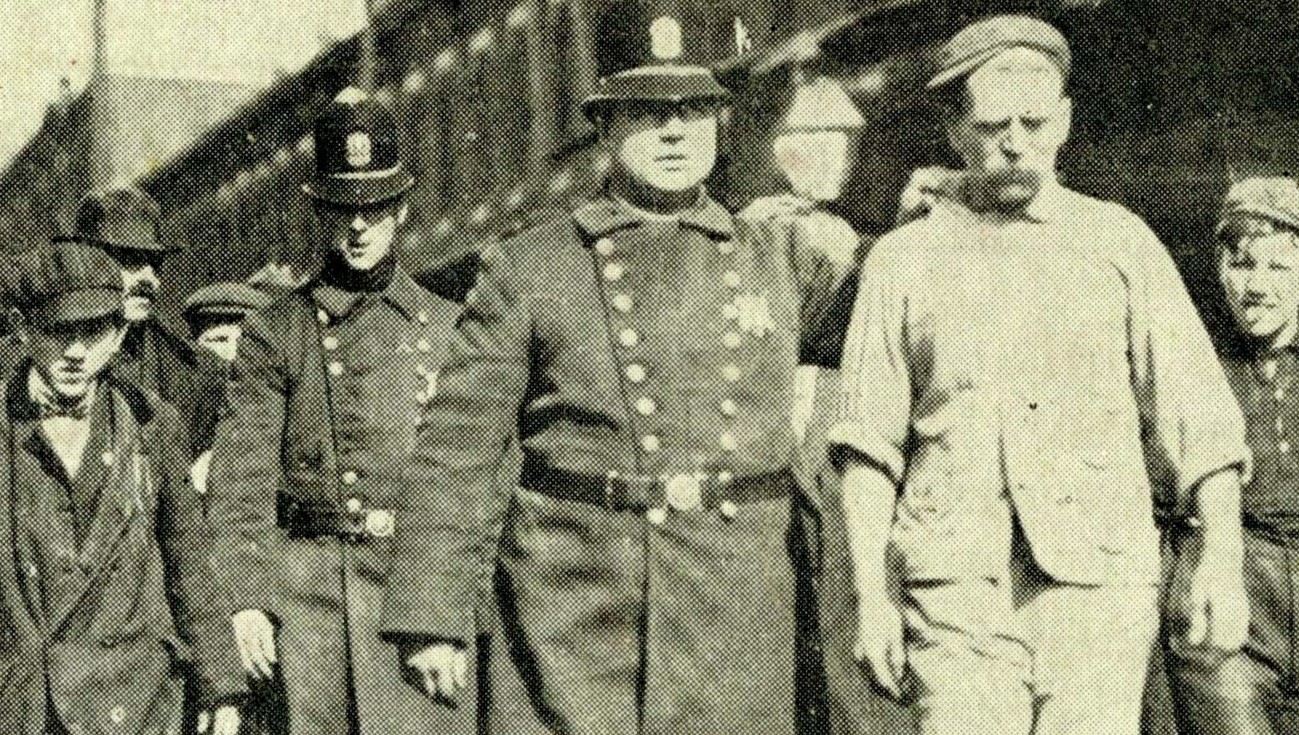
Luella Twining reports from the streets of Philadelphia during that city’s monumental general strike in which tens of thousands of unorganized workers participated in alongside union members.
‘With the Strikers in Philadelphia’ by Luella Twining from The Chicago Socialist. Vol. 4 No. 115. March 10, 1910.
When I stepped from the train Saturday the streets of Philadelphia were crowded. I was reminded of the streets of Boston when 200,000 people paraded for the defense of Moyer, Haywood and Pettibone.
The verse flashed through my mind:
“There was tumult in that city,
In that quaint New England town,
And the streets were rife with people.
Facing restless up and down.”
As I harried to Independence square I drew comparisons between 4th of July. 1776, and March 5, 1910, the day of the first general strike in this country. I wished that the strike might lead to gaining liberties for the workers they did not gain on the 4th of July, 1776.
When I reached Independence square I saw a vast throng contending with the police, pushed here and there, trying to be orderly and attempting to obey the police as they rushed through the crowd shouting ridiculous orders, with their clubs swinging right and left. The mayor issued the order. “No demonstration will be held Saturday afternoon,” and the policemen were on hand to “obey orders.”
The “Cradle of Liberty” was closed to the strikers, and fifteen policemen guarded the cracked “liberty bell.” What they were afraid of nobody knows. A striker called out, “You don’t need to guard liberty bell; we won’t ring it. It rang for liberty in “76 and we are denied freedom of speech within a hundred feet of it in 1910.”
This was greeted with prolonged cheers. The strikers formed into line and after parading the downtown streets marched to the different labor halls in the city, where meetings were held.
Thousands of unorganized joined the ranks of the strikers at these meetings in response to an invitation for them to do so, sent out by the “committee of ten” in charge of the strike.
It is estimated that 50,000 unorganized men and women have gone out so far.
It is interesting to note that this strike is one of the rank and file. Meetings are constantly in session all over the city. The strikers vote on certain measures and notify the “committee of ten” of results. This committee simply follows the orders of the rank and file.
“When will the transit company call out the militia?” I asked a prominent official. “Oh,” he replied, “the transit company is afraid to call the militia out.” In response to a look of surprise from me, he continued, “The members of the militia are mostly craftsmen, though unorganized. The men from the shops where they work are out on strike and you can bet they’ll not obey the order “to shoot their best friends.”
Mayor Reyburn and Director Clay of the transit company, in charge of the strike, are quoted as saying that they think it may be necessary to call out the federal troops (who would shoot to kill).
The cars are running, but they are almost empty. I stood on historic Chestnut street last night for one hour and watched them. Three or four cars passed by empty, then one with half a dozen passengers, then several empty ones.
Socialists have watched the cars carefully and have discovered that persons are being paid to ride. A Socialist’s wife saw the same woman go by her home three times in a car on three successive trips.
Men and women have been seen riding in one car half a day at a time. The men acting as motormen and conductors steal the fares–that is, the motorman does if the conductor wilt “whack up with him.” A union man watched the men as the jobs were assigned them. The boss pointed out a certain man, appointing him conductor. another man motorman, etc. The men who were appointed motormen almost created a riot. They wanted their share of the fares.
Yesterday a conductor turned in 15 cents at the end of the day. “Is this all you’ve got” the boss asked. The conductor grinned and replied, insolently. “Well, what are you going to do about it? You know d–well I’m not going to risk my life for nothing.”
The transit company is publishing notices to the strikers filled with the sophistry with which we are so familiar. Director, Clay, its spokesman, says that the transit company is willing to deal with the strikers as in individuals, but positively repudiates the union.
The statement is met with derision by both the organized and unorganized workers, for they read the letters and telegrams sent in by the Manufacturers’ association and all the other employers’ associations to the transit company, offering assistance and expressing admiration for the company for its bold stand.
The solidarity of capitalists is too apparent to be ignored, and inspires the workers to stand together also. The Socialists are taking advantage of the occasion to explain to the strikers that they could win their strike easily had they put men of their own class into office, who would use the policemen to help them instead of clubbing and beating them.
Word has just come that the workers in the power house voted to strike today. This will stop the street cars, for their places cannot be easily filled.
The Chicago Socialist, sometimes daily sometimes weekly, was published from 1902 until 1912 as the paper of the Chicago Socialist Party. The roots of the paper lie with Workers Call, published from 1899 as a Socialist Labor Party publication, becoming a voice of the Springfield Social Democratic Party after splitting with De Leon in July, 1901. It became the Chicago Socialist Party paper with the SDP’s adherence and changed its name to the Chicago Socialist in March, 1902. In 1906 it became a daily and published until 1912 by Local Cook County of the Socialist Party and was edited by A.M. Simons if the International Socialist Review. A cornucopia of historical information on the Chicago workers movements lies within its pages.
PDF of full issue: https://www.marxists.org/history//usa//pubs/chicago-daily-socialist/1910/100310-chicagodailysocialist-v04n115.pdf

